
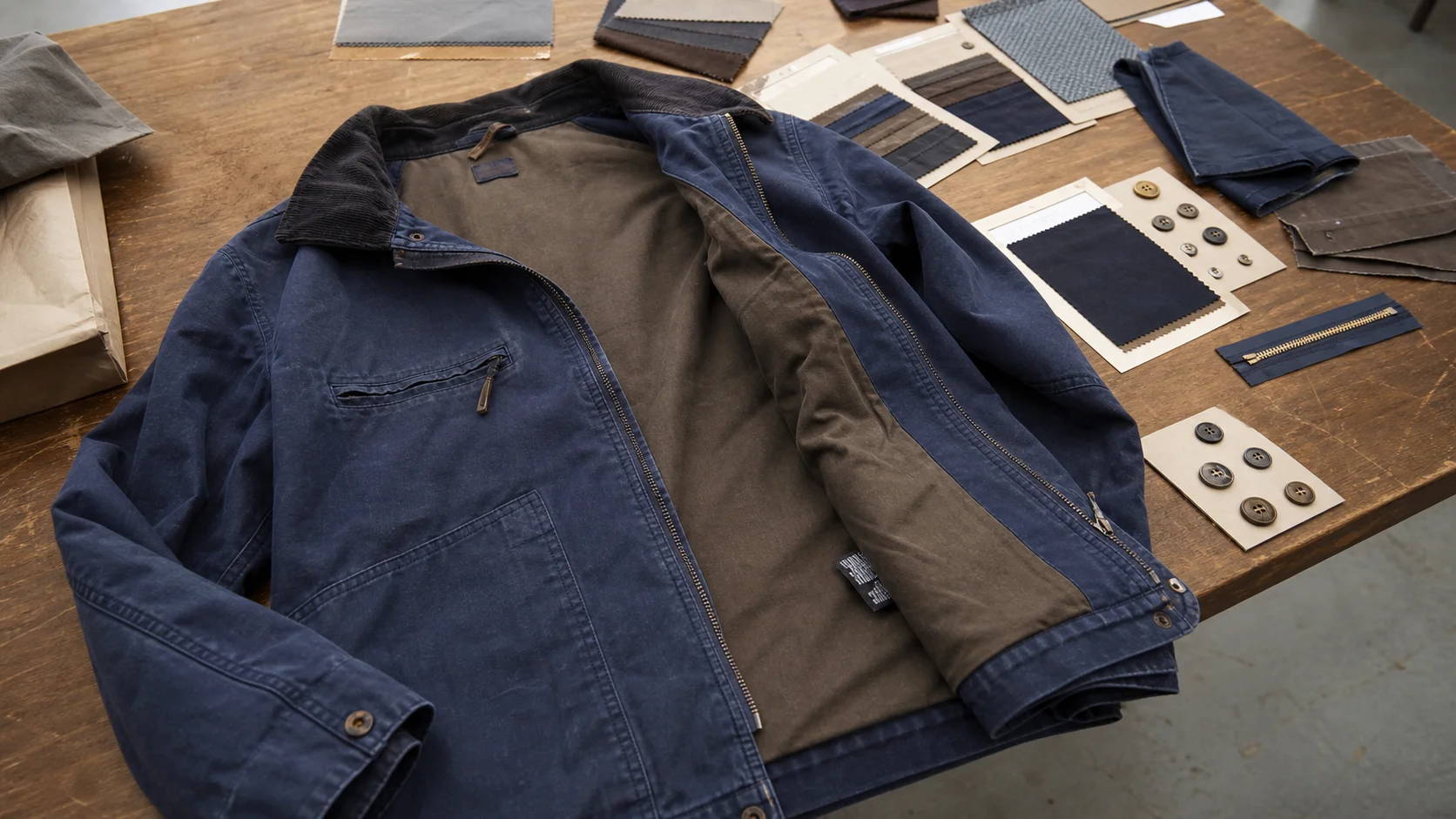
A product-specific quality control outline for distributor buyers sourcing repairable work jackets, focused on durability, repair access, inspection...
Repairable Work Jacket QC Checklist for Buyers - Sustainable Fashion manufacturing guide
A repairable work jacket is not just a heavy jacket with stronger stitching. For distributor buyers, it is a product promise: the garment should withstand hard use, accept replacement parts, support field repair, and still look commercially acceptable after service. That changes the quality control checklist from a standard apparel inspection into a more practical durability and serviceability review.
In sustainable fashion, repairability is often discussed as a consumer benefit. In B2B workwear sourcing, the commercial reason is more direct. A repairable work jacket can reduce returns, support uniform programs, extend reorder cycles for end users, and help distributors position themselves around lower waste. The risk is that “repairable” becomes a marketing claim without the engineering to support it.
Buyers should inspect for three outcomes: the jacket must be durable enough to justify repair, simple enough to repair economically, and consistent enough that spare parts and replacement panels fit across production lots. A jacket that requires specialist machinery for every small fix may be technically repairable, but it is not practical for most distributors or service partners.
Purchasing judgment: if the jacket is intended for industrial, construction, logistics, utility, or field service users, treat repairability as a specification requirement, not a sustainability add-on.
This checklist is written for distributor buyers who need to evaluate repairable work jackets before bulk production, during manufacturing, and before shipment. It covers fabric, trims, pattern engineering, stitching, testing, inspection risks, MOQ expectations, sample approval, and the tradeoffs that matter when balancing cost against durability.
Before requesting quotes, buyers should define what “repairable” means in measurable terms. A supplier may interpret it as reinforced seams. A distributor may mean replaceable zippers, patchable elbows, removable hood components, replaceable cuffs, and access to spare trims. These are different product requirements and will affect cost, MOQ, lead time, and testing.
A practical distributor buyer definition should include the following:
Not every work jacket needs every repair feature. A low-cost promotional work jacket may only need reinforced stress points and replaceable buttons. A premium industrial jacket may need replaceable zipper sliders, modular hoods, elbow reinforcement, and spare patch kits. Buyers should avoid over-specifying features that the end user will not pay for.
Repairability Level Typical Use Case Core QC Focus Buyer Tradeoff Basic Repairable Light workwear, merchandising, seasonal uniforms Reinforced seams, spare buttons, patch-compatible fabric Lower cost, limited service life Commercial Repairable Distributor workwear programs, logistics, facility teams Replaceable zipper, reinforced wear zones, stable trims Better durability, higher trim management Industrial Repairable Construction, utility, maintenance, field service Modular parts, heavy-duty construction, documented repair method Higher unit cost, stronger brand valueIf support is needed to define the product development route before approaching factories, buyers can review technical production services through Fabrikn services.
Repairable work jacket QC starts before bulk cutting. Many failures come from weak specifications, not poor sewing. The tech pack should tell the factory what must be durable, what must be replaceable, and what must remain consistent across repeat orders.
The specification sheet should include fabric weight, composition, weave or knit type, finish, color standard, lining type, interlining, trims, thread, seam types, reinforcement details, measurement tolerances, care instructions, packaging, and repair components. Vague terms such as “heavy cotton,” “durable zipper,” or “strong thread” are not enough for a repairable workwear program.
Sales samples often prioritize appearance. Repairable products need an earlier engineering review. Buyers should ask the supplier to show how the zipper can be replaced, where elbow patches attach, whether the lining allows access to outer seams, and whether spare parts match production components.
A repair feature that looks good on one sample can become impractical in bulk. For example, a hidden zipper behind a complex storm flap may improve weather protection but make replacement time longer. A fully bagged lining can make the jacket cleaner inside but restrict access for repairs. The right choice depends on the end user and expected service model.
Repairability depends on repeatable components. Buyers should lock the bill of materials before production approval. This includes supplier names or equivalent specifications for shell fabric, lining, insulation, zippers, snaps, thread, elastic, hook-and-loop, reflective tape, and label materials.
Factories may request substitute trims when inventory changes. Substitution is not always a problem, but it should trigger buyer approval. A zipper with the same color and length may still have a different slider, tooth profile, or tape strength. A snap cap may look similar but fail after repeated opening. A repairable jacket program should avoid uncontrolled substitutions.
The golden sample should represent approved bulk quality. For repairable work jackets, one sample is usually not enough. A sealed sample set should include:
The factory, buyer, and inspection team should use the same approved references. Disputes during final inspection are easier to resolve when the reference set is clear.
Fabric is the biggest performance driver in a work jacket. It also determines whether repair patches blend, whether seams hold, and whether the jacket remains worth repairing after wear. Distributor buyers should inspect fabric before cutting, not only after the garment is sewn.
Common work jacket shell fabrics include cotton duck, cotton canvas, poly-cotton twill, ripstop polyester-cotton, nylon oxford, recycled polyester, softshell bonded fabric, and coated or laminated performance fabric. Each has a different QC priority.
For repairable jackets, fabric should not be selected only by initial hand feel. A soft brushed fabric may sell well but abrade quickly at cuffs and pockets. A stiff heavy fabric may be durable but uncomfortable, increasing wearer complaints. The buyer’s task is to select a fabric that matches the use case, not simply the highest gsm.
Factories often use a 4-point fabric inspection system, but buyers should confirm the agreed method. Fabric rolls should be checked for holes, stains, oil marks, slubs, barre, width variation, shade banding, bowing, skewing, coating defects, and inconsistent finish.
For repairable work jackets, shade control deserves special attention. If replacement panels or repair kits are part of the program, buyers should define acceptable shade tolerance against a standard such as a lab dip, strike-off, or approved bulk swatch. Perfect shade matching after wear is unrealistic, but uncontrolled lot variation will make repairs look poor from day one.
Work jackets may be washed less frequently than shirts, but shrinkage still matters. Cotton-rich jackets can shrink enough to affect sleeve length, body length, zipper alignment, and lining balance. Pre-production testing should confirm shrinkage after the intended care process.
Purchasing judgment: if the end user expects long wear and periodic repair, reject fabrics that look good only before wash testing. A jacket that twists, shrinks, or fades early is not a strong repairable product.
Trims are small in cost compared with fabric, but they are a common reason for returns. In repairable jackets, trims are also part of the service system. If a zipper slider fails and the replacement part is unavailable, the repair promise becomes weak.
Zippers should be specified by brand or by measurable performance requirements. For work jackets, typical options include molded plastic zippers, coil zippers, metal zippers, water-resistant coil zippers, and two-way front zippers. The choice affects durability and repair method.
Molded zippers are strong and common in workwear, but they are less forgiving if teeth break. Coil zippers can be smoother and more flexible, but slider compatibility must be controlled. Metal zippers suit some heritage work jackets, yet they add weight and can corrode depending on finish and use environment.
Snaps and buttons should be tested for attachment strength and ease of replacement. A snap that is too tight can tear fabric during use. A snap that is too loose can open under movement. Rivets can reinforce pockets, but poorly placed rivets create stress concentration and may scratch surfaces in certain workplaces.
Thread should be selected for the fabric and use case. Common choices include polyester spun thread, polyester core-spun thread, bonded nylon, and specialty thread for flame-resistant or high-visibility garments. For many work jackets, polyester core-spun thread provides a useful balance of strength, sewability, and cost.
Thread color should be included in the trim card. Contrast stitching may create a strong design signature, but it makes repair more visible and exposes sewing defects. Tonal thread hides repairs better. Buyers should decide whether the brand value of contrast stitching is worth the service complication.
Garment construction determines whether a work jacket survives stress. Repairable construction is not always the same as maximum reinforcement. Some seams should be extremely strong. Others should be accessible enough to open and resew without damaging surrounding panels.
Buyers should specify seam types by location. Common options include lockstitch, chainstitch, overlock, flat-felled seam, lapped seam, bound seam, double-needle topstitch, and bar tack reinforcement. Each has a purpose.
Stitch density should be appropriate to fabric weight. Too few stitches reduce seam strength. Too many stitches can perforate fabric, especially coated or lightweight synthetic materials. For heavy canvas, buyers often see ranges around 7 to 10 stitches per inch, depending on construction. For lighter woven shells, the range may be higher. The final requirement should be confirmed through seam strength testing, not copied from another style without review.
Work jackets fail at predictable locations: pocket corners, zipper ends, cuff openings, sleeve seams, underarms, elbow zones, hood attachment points, drawcord exits, and hanger loops. The QC checklist should require reinforcement at these points.
Buyers should check whether reinforcement creates new problems. A rigid patch on a flexible shell can cause tearing around patch edges. Heavy bar tacks on thin fabric can cut yarns. Metal grommets can pull out if not supported by reinforcement fabric. Good QC looks at the whole system.
Lined and insulated jackets require extra review. A bagged lining gives a clean finish, but repairs may be harder. A partially accessible lining can support repair but may look less refined. Quilting helps stabilize insulation, yet poor quilting can create cold spots or restrict movement.
For repairable work jackets, buyers should ask whether the lining includes an access point for zipper or seam repair. This can add labor cost but may reduce future repair time. It is more useful on higher-value jackets than on low-price seasonal programs.
A distributor buyer repairable work jacket quality control checklist should include specific serviceability checks, not only general garment workmanship. These checkpoints help confirm whether the jacket can be repaired at reasonable cost after sale.
The front zipper is one of the most common failure points. QC should check whether replacement is practical. Inspect seam allowance, lining access, storm flap construction, and top and bottom zipper finishing. If replacing the zipper requires dismantling half the jacket, the repair cost may exceed the commercial value of the garment.
A practical approach is to specify a front zipper construction that allows a trained repair operator to remove and replace it cleanly. Buyers may request a repair trial on a pre-production sample: remove the zipper, install a replacement, and review appearance, time required, and damage to surrounding fabric.
Elbows, cuffs, pocket edges, and lower front panels often wear first. These areas should be designed for reinforcement or patch repair. Buyers can request matching patch fabric, compatible thread, and repair templates for service partners.
Repairable jackets depend on component continuity. Buyers should ask suppliers how long trims can be supported. Common spare parts include zipper sliders, pullers, snaps, buttons, cord locks, drawcords, hook-and-loop tabs, cuffs, and patch fabric. For distributor programs, it may be sensible to order a small spare parts allocation with the first bulk order.
Typical spare trim quantities vary by program, but buyers often consider 1% to 3% extra for high-risk trims such as buttons, snaps, and zipper pullers. For replacement panels or patch fabric, the right quantity depends on projected repair service. Too little creates service problems. Too much ties up inventory in color lots that may not be used.
A repairable product should have basic repair documentation. This does not need to be a long manual for every style, but the factory should provide clear technical references for service partners.
Buyers developing a new sustainable workwear program can align sourcing, sampling, and inspection planning through Fabrikn contact support.
Fit quality affects durability. A jacket that is too tight at the shoulders or elbows will fail faster because the wearer constantly stresses the seams. A jacket that is too loose can snag, twist, and wear unevenly. Repairability does not compensate for poor fit engineering.
The measurement specification should cover chest, sweep, across shoulder, sleeve length, bicep, cuff opening, armhole, front length, back length, collar height, hood opening, pocket placement, and zipper length. Tolerances should be realistic for heavy garments. Very tight tolerances may be difficult on padded or thick fabrics, while loose tolerances can cause inconsistent fit across lots.
Common tolerance ranges may include around 0.5 cm to 1 cm for smaller points and 1 cm to 2 cm for larger garment dimensions, depending on fabric, construction, and size range. Buyers should set tolerances by garment type and risk, not use one generic tolerance table for every product.
Size set samples should be reviewed before bulk production. For work jackets, buyers should check movement, not only static measurements. Wearers may need to lift arms, bend elbows, reach forward, carry tools, or layer over hoodies and base layers.
Grading must also protect repairability. If elbow patches grade poorly, they may sit too high on larger sizes or too low on smaller sizes. Pocket placement, reinforcement points, and reflective tape positions should be checked across the size range.
Testing requirements depend on claims, market, and end use. A jacket sold as durable workwear does not have the same obligations as certified PPE. If the jacket includes high-visibility, flame-resistant, waterproof, or chemical-resistant claims, buyers need appropriate compliance review and test evidence from qualified laboratories.
Distributor buyers should confirm compliance with target market requirements. Depending on destination, this may include restricted substance lists, azo dyes, formaldehyde, heavy metals, phthalates, PFAS restrictions, nickel release, and labeling requirements. Sustainable fashion claims also need careful support. Recycled content, organic cotton, and low-impact finishes should be backed by documentation where the buyer intends to market them.
One key tradeoff: water-repellent finishes can improve performance but create compliance and sustainability concerns, especially where PFAS restrictions apply. Buyers should specify the acceptable finish type, performance target, and test method before ordering bulk fabric.
Words such as waterproof, flame resistant, hi-vis, recycled, biodegradable, carbon neutral, and repairable carry different levels of risk. “Repairable” is generally easier to support than certified safety claims, but it still should be backed by design features and documentation. Avoid broad claims if the jacket only includes spare buttons.
Inspection should happen at more than one stage. Waiting until final inspection can reveal problems too late, especially when fabric defects, incorrect trims, or construction mistakes affect the full production lot.
Before cutting, the factory should inspect fabric and trims. Buyers or third-party inspectors can review records and spot check materials against approved standards. Key checks include shade lots, fabric defects, shrinkage reports, zipper type, snap finish, thread color, label content, and repair component availability.
Inline inspection usually takes place when production has started but before the order is complete. This is the best time to catch construction issues. For repairable work jackets, inline inspection should pay attention to:
Inline inspection is especially valuable for first orders, new suppliers, new fabrics, and styles with complex repair features. It may add inspection cost, but it reduces the risk of discovering systemic defects after production is finished.
Final inspection usually follows an AQL sampling plan, often when production is 100% complete and at least 80% packed. Buyers should define acceptable quality limits by defect severity. Critical defects may require zero tolerance. Major defects affect saleability, function, or safety. Minor defects affect appearance but may not prevent sale.
Defect Type Examples Likely Buyer Decision Critical Sharp metal, unsafe drawcord, serious compliance failure Reject shipment until corrected Major Broken zipper, open seam, wrong fabric, missing reinforcement Reject or require rework Minor Loose thread, slight crease, small cosmetic mark within tolerance Accept if within AQLFor repairable jackets, some defects deserve stricter classification than in ordinary garments. Missing bar tacks at pocket corners, wrong zipper gauge, weak snap attachment, and omitted repair access points can undermine the product concept. Treat these as major defects.
Packaging is often treated as a final administrative step. For distributor buyers, it affects warehouse handling, retailer presentation, repair parts management, and returns processing. Sustainable fashion goals may also require reduced plastic, recyclable packaging, or clear material labeling.
Labels should be checked for fiber content, country of origin, care instructions, size, brand, safety warnings where required, and any certification references. If the jacket is marketed as repairable, labels or hangtags should not overpromise. A simple statement such as “Designed with replaceable trims and reinforced repair zones” is stronger than a vague lifetime claim if the distributor does not operate a lifetime repair service.
For repair programs, spare trims should not be mixed loosely into cartons without clear labeling. Buyers should request a spare parts packing list and identify whether spare components ship with the bulk order or separately.
Repairable work jackets usually require more development control than basic outerwear. MOQ, sampling time, and lead time depend on fabric availability, trim customization, testing, factory capacity, and repair component planning.
MOQ varies widely by supplier and material. Buyers should treat any number as a commercial starting point, not a fixed rule. Typical ranges may look like this:
A low MOQ can be useful for market testing, but it may limit control over fabric, trims, and color continuity. A higher MOQ may give better component consistency and lower unit cost. Distributor buyers should compare landed cost, repair support, and reorder reliability rather than chasing the lowest first order quantity.
A disciplined sample process prevents expensive production mistakes. A typical repairable work jacket sample flow may include:
Skipping the repair trial may save a week but can create a product that is repairable only in theory. For premium distributor programs, the repair trial is worth the time.
Lead time depends on more than sewing capacity. Fabric development, dyeing, finishing, trim sourcing, testing, sample approvals, production scheduling, inspection, and freight all affect delivery. Typical lead times for work jackets may range from 60 to 120 days after approval of pre-production sample and materials, with longer timelines for custom fabric, certified performance claims, or complex trims.
Fast production is possible when fabric and trims are in stock, the factory has made similar styles, and buyer approvals are quick. Delays commonly come from failed lab dips, late trim approval, zipper shortages, fabric shrinkage corrections, testing failures, and unclear comments between sample rounds.
Purchasing judgment: if the order requires custom fabric, branded trims, testing, and repair spare parts, build a calendar with approval gates. A promised ship date without material approval dates is not a reliable production plan.
Repairable work jackets carry predictable risks. Good buyers know which issues can be accepted, which can be reworked, and which should stop shipment.
A durable shell does not compensate for cheap zippers, snaps, or hook-and-loop. If trims fail early, the end user sees the whole jacket as poor quality. Buyers should spend more on high-risk trims before adding decorative features.
Heavy elbow patches, thick seams, and rigid pocket reinforcements can improve durability but reduce mobility. If the jacket is uncomfortable, wearers may reject it even if it lasts longer. Fit testing with realistic movement is necessary.
Modular parts, access openings, replaceable panels, and extra seam allowances can improve repairability, but they add sewing complexity. Factories need clear construction standards and inline inspection. A simple, well-made repairable jacket is usually better than a complicated jacket made inconsistently.
Recycled fabric, repairability, reduced waste, and long-life design can support a sustainable fashion position. Claims should be specific and supported. Buyers should collect material certificates, test reports, repair documentation, and packaging details before marketing the product.
A repairable jacket without spare parts is incomplete. Buyers should decide whether spare trims will be stocked by the distributor, supplied by the factory on demand, or included in repair kits. Each option has a cost and inventory impact.
Buyer Decision Lower-Cost Option Higher-Control Option Best Use Fabric Stock fabric Custom tested fabric Stock for small runs, custom for core programs Zipper Generic zipper Specified heavy-duty zipper with spare sliders Specified zipper for repeat distributor styles Repair Design Basic reinforcement Replaceable components and repair access Match to jacket price and service model Inspection Final inspection only Incoming, inline, and final inspection Use full inspection for new or complex orders Spare Parts No dedicated stock Planned spare trims and patch fabric Essential for repairable positioningDistributor buyers sourcing repairable work jackets should also review supplier capability. A factory that makes fashion outerwear may sew a good-looking jacket but struggle with industrial durability standards. A workwear-capable supplier should understand heavier fabrics, reinforced stress points, functional trims, measurement control, and inspection discipline. Buyers can learn more about sourcing support and company background through Fabrikn about us.
The following checklist can be used as a working reference before order placement and during inspection.
A repairable work jacket is a strong product direction for sustainable fashion and B2B workwear distribution, but only when design, sourcing, production, and inspection all support the claim. Buyers should prioritize measurable durability, accessible repairs, stable components, and honest after-sales planning. The best product is not always the most heavily built jacket. It is the jacket that performs reliably, can be serviced without excessive cost, and meets the end user’s real working conditions.
Get a free quote from Fabrikn — your trusted B2B clothing manufacturer with 10+ years of experience. MOQ as low as 200 pieces.
Get a Free Quote →A repairable work jacket is designed so key failure points can be fixed or replaced. This may include replaceable zippers, spare buttons or snaps, patchable elbows, reinforced pockets, accessible seams, and documented trim specifications. The repairability level should match the jacket’s price, end use, and service model.
Buyers should start with the tech pack, bill of materials, and repair concept. If the fabric, trims, seam types, and spare parts are not clearly specified before sampling, final inspection will not solve the core quality risk.
Typical MOQ may range from around 300 to 800 pieces per color when using stock fabric and standard trims. Custom fabric, custom dyeing, branded trims, or performance materials may push MOQ to around 1,000 to 3,000 pieces per color or more. Trim MOQs can also apply separately.
Zippers, snaps, buttons, hook-and-loop, drawcords, cord locks, thread, and labels are all important. The front zipper usually deserves the most attention because it is a common failure point and can be costly to replace if the construction is not repair-friendly.
For premium or distributor-core workwear programs, yes. A repair trial can show whether a zipper, cuff, patch, or trim replacement is practical. It helps buyers avoid a product that is marketed as repairable but too expensive or difficult to service.
Common risks include wrong zipper gauge, weak snap attachment, missing bar tacks, poor pocket reinforcement, fabric shade variation, lining distortion, skipped stitches, and omitted repair access points. These defects can affect durability and should often be treated as major issues.
Lead time often ranges from 60 to 120 days after final material and pre-production sample approval. The timeline depends on fabric availability, trim sourcing, testing, sample revisions, factory capacity, inspection, and shipping method.
Repairability can support sustainability by extending garment life and reducing replacement frequency. Buyers should keep claims specific and evidence-based, using clear design features, spare parts planning, material documentation, and repair instructions rather than broad unsupported statements.