
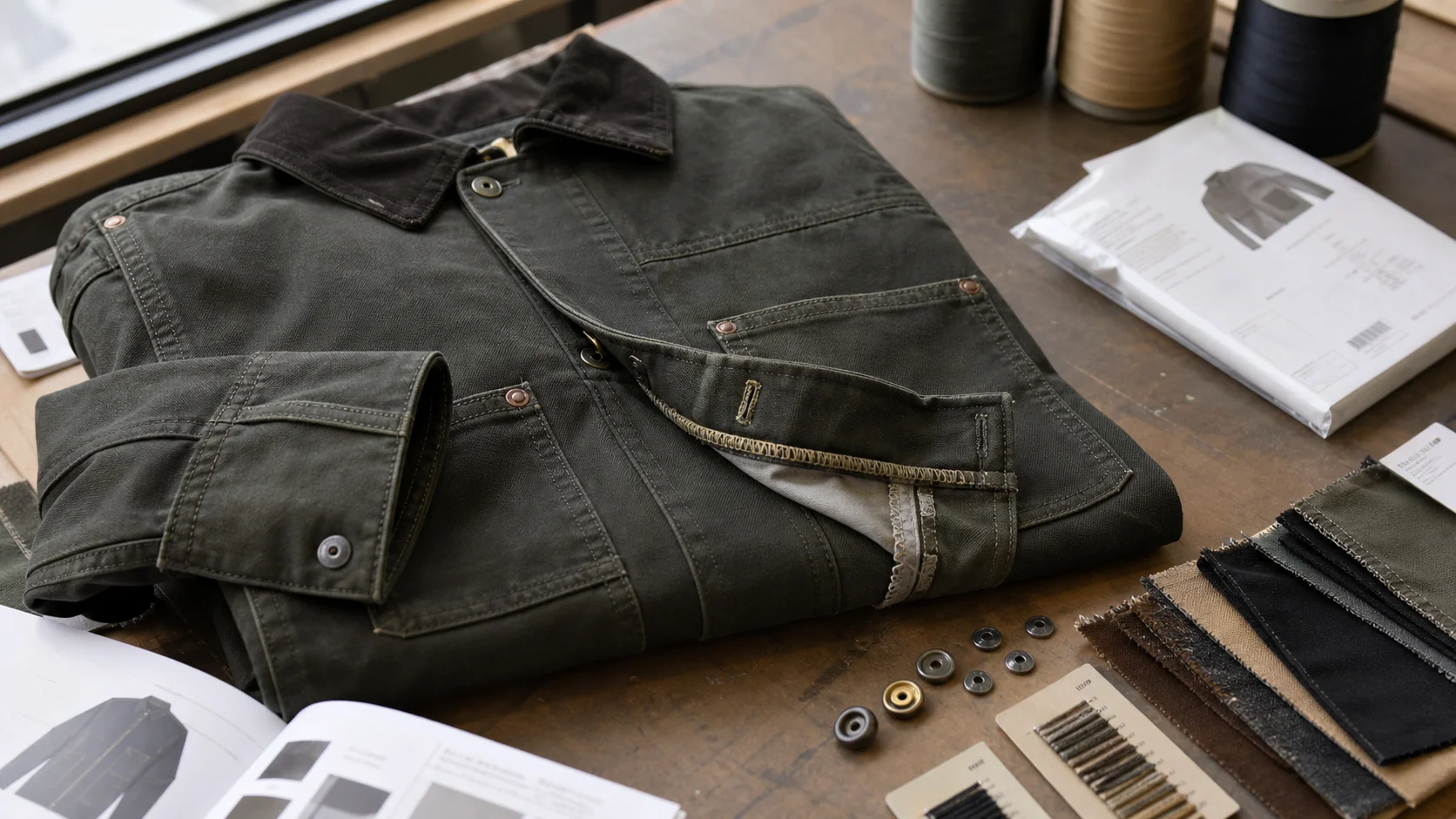
A practical SEO outline for marina operators evaluating repairable work jacket trim sourcing, durability, and sustainable production choices for harsh...
Repairable Work Jacket Trim Sourcing for Marinas - Fabrikn production reference
Marina operators buy work jackets for a very practical reason: staff need outerwear that stands up to salt air, frequent cleaning, wet handling, and daily abrasion from ropes, cleats, carts, and dock hardware. The jacket itself matters, but the trim package often decides whether the garment can be repaired or has to be replaced. Zippers, snaps, cuffs, drawcords, elastic, pocket reinforcements, hang loops, and reflective tape all affect how long a jacket stays in service.
This review focuses on repairable work jacket supplier trim sourcing for marina operators, with a sustainability lens. The right trim strategy reduces replacement cycles, makes aftercare easier, and supports a more controlled uniform program. The wrong one creates recurring failures: corroded zipper teeth, snapped pullers, frayed cuff bindings, cracked snaps, and trim colors that fade unevenly in marine conditions.
For sourcing teams, the question is not simply “Can the supplier make the jacket?” It is “Can the supplier source trims that are durable, replaceable, and consistent enough for reorders and repairs?” That distinction matters in a coastal working environment.
Marina uniforms face a mix of weather exposure and physical wear that is harsher than standard office outerwear. Staff may be moving between docks, fuel areas, service pontoons, storage yards, and customer-facing spaces. That means the jacket trim needs to do more than look clean on delivery day. It has to survive repeated use and still be easy to service later.
Trim sourcing affects three purchasing outcomes:
For operators working with seasonal labor or rotating crews, a repairable jacket system can be more cost-effective than frequent replacement. The savings are not only in garment cost. There is also less disruption from reissue, less waste, and fewer emergency purchases during peak season.
A repairable jacket is designed with parts that can be replaced without dismantling the entire garment. That sounds obvious, but many “work jackets” are built as disposable units once a zipper fails or a cuff edge tears out. Repairability starts at the spec stage.
Practical repairable design usually includes:
For marina operators, the most useful design approach is often the simplest one: avoid over-customized trims unless they create a real functional advantage. Decorative zipper pulls, proprietary snap systems, and unusual reflective tapes may look distinctive, but they complicate repair and reorder planning.
A jacket that can be repaired quickly is usually more valuable than a jacket that looks premium but is difficult to source parts for after the first season.
Zippers are one of the highest-risk trim items in marine workwear. They take repeated stress from frequent opening and closing, glove use, wet conditions, and salt exposure. Metal zippers can be durable, but some metals corrode in coastal environments if finishes and coatings are weak. Many suppliers therefore recommend coil or reverse coil zippers for exterior jackets, especially when corrosion resistance is a priority.
For sourcing review, ask for the following:
For repairability, a standard zipper tape width and common size are usually better than a proprietary design. A supplier that can source compatible replacement zippers later is often a better fit than one offering a one-off special.
Snaps and rivets need attention because failures here can create both functional and safety issues. If the jacket includes storm plackets, pocket flaps, adjustable cuffs, or detachable liners, the hardware should be tested for pull strength and corrosion resistance. Stainless or coated hardware is generally preferable in marina settings, but the exact choice depends on budget and the jacket structure.
Review the supplier’s approach to fasteners:
Cuff and hem trims are often overlooked until they fail. On marina work jackets, elastic can lose recovery from repeated washing, and knitted cuffs can fray or stretch out. Rib quality matters, as does the fiber blend. Polyester-rich rib often keeps shape better than low-grade blends, but comfort and hand feel still matter for daily wear.
Useful specification points include:
If the jacket has an adjustable hood or hem, drawcord components should be selected with repair in mind. Toggle parts often fail before the cord itself. The sourcing question is whether the supplier can provide identical replacements later without forcing a redesign. A basic cord and stopper setup is usually easier to maintain than a custom molded system.
Some marina jackets require visibility features, especially for staff working near moving equipment or low-light dock areas. Reflective tape is functional, but it also creates a sourcing challenge. Not all tapes wash the same, and some lose reflectivity faster than the jacket shell wears out. The tape should be tested for wash durability, adhesion, and compatibility with the shell fabric.
For repairable garments, reflective trim should be placed in predictable positions and sized according to standard availability where possible. The more unusual the layout, the harder it is to repair cleanly.
Repairable sourcing is not only about the visible trims. It also depends on the base materials and sewing specs that support those trims.
For marina use, shell fabrics are commonly selected for abrasion resistance, water resistance, and ease of cleaning. Polyester blends, coated fabrics, and softshell constructions are all possible, depending on the role. A supplier review should confirm fabric weight, weave density, coating type, and colorfastness. Lightweight fashion outerwear is rarely suitable unless the jacket is for limited indoor or light-duty use.
Useful questions include:
Repairability also depends on whether the lining can be opened and resewn without puckering or damage. Quilted linings and insulation layers can make repairs more complex. If the jacket is intended for heavy use, consider a lining that balances warmth with serviceability. Excessively delicate linings reduce the life of the garment even when the shell remains usable.
Seam failure is a common inspection risk. Thread strength, stitch density, and seam type all matter. For a work jacket that may be repaired multiple times, the original stitch construction should not be so delicate that alterations become destructive. Strong topstitching, clean seam allowances, and reinforced stress points support a longer useful life.
Ask the supplier for:
Branding should not block repairs. Heat-transfer labels, woven labels, and care labels can all interfere with later work if placed poorly. A supplier that understands serviceability will position labels so they can be preserved or replaced without compromising the garment. For marina programs, understated branding is often easier to maintain than large decorative applications.
A useful supplier review goes beyond catalog claims. It should test whether the vendor can source the right trims consistently, document them clearly, and support repeat orders after the initial production run.
When assessing a repairable work jacket supplier, look at these areas:
Review area What to check Why it matters Trim availability Standard zipper sizes, snap types, tape colors, elastic options Supports repair and reorder continuity Specification control Written trim codes, approved samples, tolerance ranges Reduces lot-to-lot inconsistency Sample accuracy How closely proto, PP sample, and bulk match Shows whether sourcing is disciplined Testing capability Wash, abrasion, colorfastness, corrosion-related checks Important in salt-air use Repair support Can the supplier provide extra trims or spare parts? Directly affects garment life cycleIf a supplier cannot answer these questions clearly, the risk is usually hidden in the operational phase, not the initial sample stage. That is where many uniform programs lose money.
Where buyers need a broader sourcing discussion, a structured service page can help outline production capabilities and trim management expectations. See Fabrikn services for a general view of apparel development and sourcing support. If the requirement is more specific, a direct conversation is usually the fastest way to confirm trim availability and repair-friendly options through contact us. Buyers who want a wider background on the company and its production approach can also review the about us page.
MOQ and lead time are often where repairable jacket programs become expensive or complicated. Trim choices influence both.
Typical MOQ ranges vary by supplier, complexity, and customization level, but the following are common planning ranges in B2B apparel sourcing:
Sampling usually follows a sequence:
Lead time depends on fabric and trim readiness. Standard trims can be faster to source, while custom zipper pulls, branded snaps, or special reflective tapes add risk. Typical bulk lead times may range from 30 to 90 days after all materials are approved, but this can extend if trims are not in stock or if lab testing is needed.
For marina operators, the practical lesson is clear: the more repairable and standard the trim package, the easier it is to keep the program on schedule. Customization should be justified by function, not habit.
Inspection should focus on the places where marine wear shows up first. A jacket can pass a quick visual check and still fail in actual use a month later. The most useful inspection points are the trim interfaces.
A repairable jacket can still fail if the construction is too closed off for later service. Narrow seam allowances, hidden interfacing, and overbuilt laminated areas can make repairs expensive or impossible. A sourcing review should ask not only whether the jacket looks durable, but whether a tailor or repair unit can access the failed part without damaging the whole garment.
In the final inspection, buyers should confirm:
Using a clear defect standard is wise. Minor shade variation in trim may be acceptable in some workwear categories, but not when it creates visible mismatch across a uniformed marina team.
Repairability is a sustainability strategy, but it is not free of tradeoffs. Some highly durable trims can be more difficult to recycle. Some water-resistant finishes improve garment life but create additional end-of-life considerations. Buyers should avoid oversimplifying the issue.
Practical sustainability benefits include:
Tradeoffs to evaluate honestly:
For marina operators, the best sustainability outcome is often not the most technical one. It is the one that keeps jackets in service longer with manageable repair costs and predictable reorders. That usually means standard trims, robust seams, and conservative customization.
Before approving a repairable work jacket program, procurement teams should check the following points:
Buyers should also ask for a spare-parts policy where possible. A small reserve of zippers, pullers, snaps, and labels can extend garment life and reduce service interruptions during peak operations.
Repairable work jacket trim sourcing for marinas is a purchasing discipline, not a styling exercise. The best jacket is not always the most feature-heavy one. It is the one that can be maintained, repaired, and reordered without friction. That depends heavily on the trim package: standard zippers, durable hardware, serviceable cuffs, stable reflective materials, and clear trim documentation.
For marina operators, a conservative sourcing approach usually performs better over time. Keep the trim list practical. Confirm replacement availability. Require sample approval at every stage. Ask for the specifications that matter in salt-air conditions, not just the marketing description. A jacket built this way will usually cost less across its working life, even if the initial unit price is slightly higher.
When supplier review needs to be more structured, buyers can start with the capabilities outlined on Fabrikn services, follow up through contact us, or use the about us page to understand the company background before sharing a trim brief.
Get a free quote from Fabrikn — your trusted B2B clothing manufacturer with 10+ years of experience. MOQ as low as 200 pieces.
Get a Free Quote →A repairable jacket uses standard trims, accessible seam construction, and replaceable components such as zippers, snaps, and cuffs. The goal is to extend garment life instead of replacing the whole piece when one part fails.
Zippers, snaps, and cuff elastic are common first-failure points. Salt exposure, frequent use, and repeated laundering tend to expose weak hardware quickly.
For standard work jackets, MOQs often start around 300 to 1,000 pieces per style or color. Custom trim packages can raise that figure, especially if branded hardware or special finishes are involved.
A typical process includes a proto sample, a wear or fit sample, and a pre-production sample. More complex trims may require additional rounds if sourcing or performance issues appear.
Confirm zipper type and size, snap material and finish, cuff and hem composition, reflective tape performance, thread strength, and trim color codes. Written approval reduces reorder problems later.
Only if they support a real function. Custom trims can improve branding or performance, but they often make repairs and reorders harder. Standard trims are usually the safer choice for operational workwear.
The biggest risk is usually hidden inconsistency: a trim that looks correct in sample but performs differently in bulk. That is why wash testing, corrosion checks, and pull testing matter before final approval.
The most practical route is to choose durable, repairable trims and avoid unnecessary customization. Longer garment life usually creates better sustainability results than a low-cost jacket that must be replaced every season.