
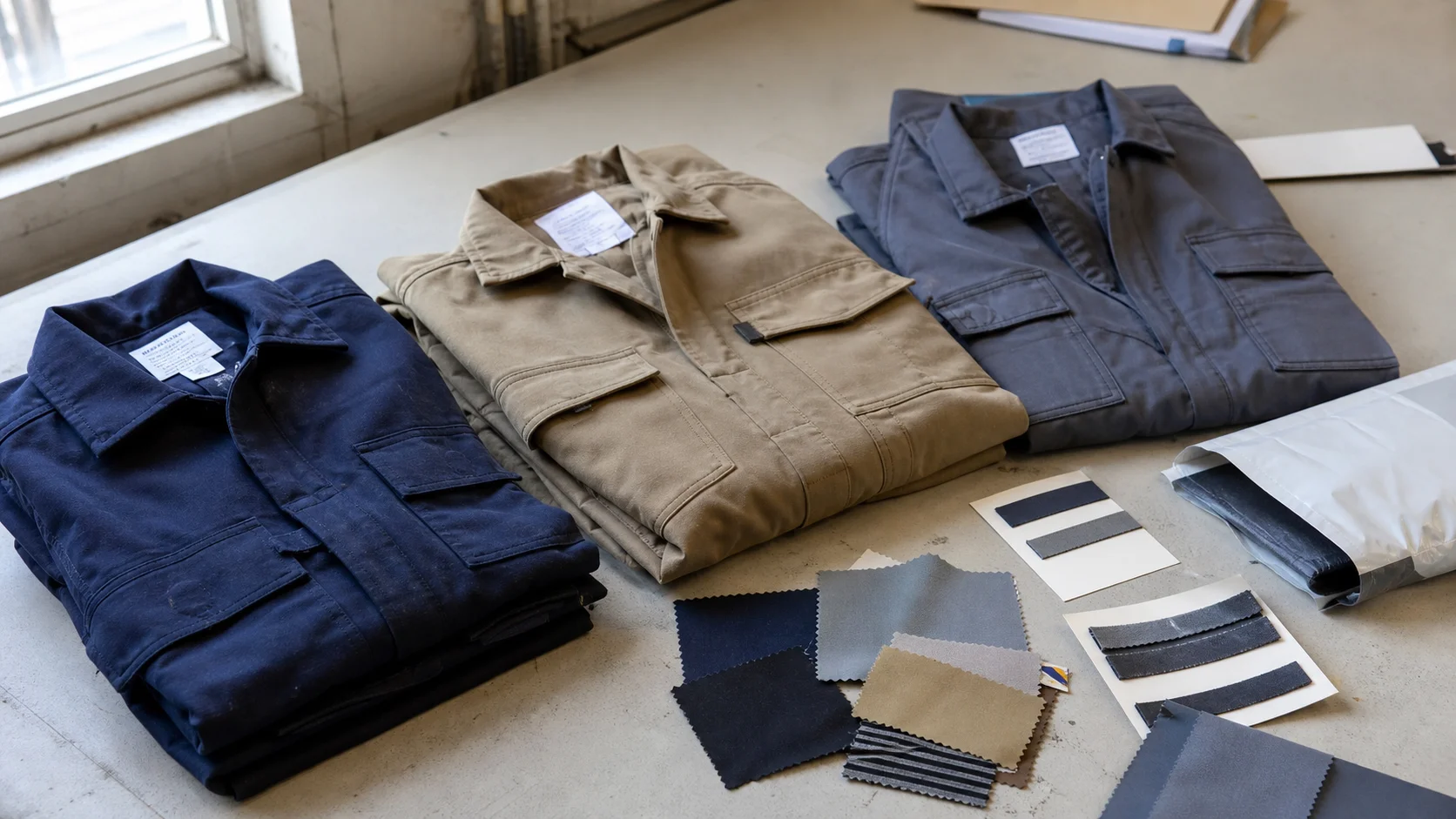
A practical guide for restaurant groups planning bulk coverall orders, with the sizing, fabric, decoration, compliance, and cost decisions that affect MOQ...
Restaurant group coverall bulk orders look simple on a spreadsheet and messy in procurement. The garment itself is not complex, but the cost structure is shaped by fabric choice, trim spec, decoration method, sizing spread, packing method, compliance requirements, and the number of approval steps before production starts. For multi-unit foodservice operators, the right purchase decision is rarely the cheapest quoted unit price. It is the option that balances durability, stain resistance, staff comfort, wash performance, and predictable replenishment.
This guide breaks down the real cost drivers behind restaurant group coverall bulk orders, what typical minimum order quantities look like, how to compare supplier quotes, and where buyers usually lose money through avoidable specification gaps. It is written for sourcing teams, operations managers, and procurement leads who need a practical framework rather than a sales pitch. If you need support with program scoping or vendor coordination, review the services page, or reach out through contact us. Background on the company is available on the about us page.
Restaurant Group Coverall Bulk Order Cost Guide - MOQ, Cost & Sourcing manufacturing guide
Coverall pricing for restaurant groups is usually built from five buckets: material, labor, decoration, packaging, and logistics. The unit price on a quote is only the visible part. A cleaner comparison comes from landed cost, which includes freight, duties if applicable, rush fees, sample charges, and the cost of rework if the first approval set is not fit for production.
For foodservice programs, the strongest cost drivers are often not the obvious ones. A modest change from a standard poly-cotton fabric to a higher-performance twill, or a shift from simple embroidery to printed branding, can change pricing more than buyers expect. Pocket configuration, collar style, reflective trim, flame resistance, and reinforced stress points also affect cost.
Restaurant groups should also separate initial program cost from replacement cost. An inexpensive coverall that loses shape, fades quickly, or fails seam durability tests may be cheaper on paper but more expensive over a six-month replenishment cycle. In high-turnover kitchen environments, that tradeoff matters.
MOQ, or minimum order quantity, varies by factory setup and the level of customization. For standard restaurant coveralls made from common stock fabrics, MOQs are often lower than buyers expect. For custom color, custom trim, or special finishes, the floor rises quickly because the supplier has to allocate production time, material purchasing, and cutting efficiency around a smaller run.
Typical ranges used in sourcing conversations are often as follows:
These ranges are directional, not universal. Factories with stronger inventory positions may accept smaller runs. Contract manufacturers that work from raw mill orders may require more volume to make the order commercially viable. Restaurant groups planning multi-location rollouts should ask for pricing at three levels: pilot quantity, full deployment quantity, and replenishment quantity. That exposes whether the supplier is truly competitive or only attractive at one scale.
Buyers should also watch the MOQ by color and size ratio. A supplier may accept 300 units overall but require 100 per color or 50 per size. That detail can distort inventory planning if the restaurant group has a mixed workforce across kitchen, prep, and service roles.
Sample approval is where many coverall projects lose time. A common mistake is treating the first sample as a formality. In practice, the sample confirms fit, pocket placement, cuff behavior, wash handfeel, branding location, and how the garment holds up when worn in an active kitchen environment.
A disciplined approval process usually moves through several stages:
Each round adds time and sometimes cost. Some suppliers charge sample fees, and those fees may or may not be creditable against the bulk order. Buyers should clarify whether sample charges include courier fees, whether revisions are capped, and whether artwork set-up is billed separately.
A clean approval process is cheaper than a rushed correction. Most coverall overruns come from unclear measurements, missing trim specifications, or late changes to branding placement.
Practical sourcing advice is straightforward: lock the fabric before final fit approval, lock the artwork before pre-production, and avoid changing both after the sample has been signed off. Every late revision adds risk to the schedule and often leads to expedited freight or partial shipments.
Lead time depends less on the garment category and more on the supplier’s material position. A basic coverall can move quickly if the fabric is in stock and the trim is standard. A custom program with dyed-to-match components or special finishes can take several weeks longer.
Several dependencies can extend the timeline: fabric dyeing, lab testing, overseas holiday closures, limited factory capacity, and approval delays from the restaurant group side. Multi-location rollouts should build in buffer time because staggered approvals across departments are usually slower than a single sign-off process.
Lead time should be discussed in the same conversation as replenishment planning. A restaurant group with high staff turnover needs a visible reorder point, not just a one-time bulk buy. If the supplier cannot support repeat orders with consistent fabric lots and stable sizing, the initial savings may disappear in the second purchase cycle.
Fabric selection is the biggest lever in coverall cost, especially for restaurant groups that need a balance between comfort and durability. Foodservice coveralls commonly use cotton-rich blends, poly-cotton twills, and performance fabrics with stain-release or moisture-management properties. The best choice depends on the work environment, laundering frequency, and desired brand presentation.
Trim choices create their own cost ladder. Standard zippers and buttons are straightforward. Heavy-duty branded zippers, concealed closures, metal snaps, or reinforced pocket trim increase both material and assembly cost. Reflective tape, segmented trim, or contrast piping adds visual clarity but can slow production and raise defect risk at the seam.
Labels matter as well. A woven main label, size pip, care label, and country-of-origin label are usually manageable. A customized neck print or heat-transfer label can simplify comfort in the collar area, but the choice should be weighed against wash durability and brand requirements.
Bulk pricing is not always linear. A supplier may quote a steep drop from 100 to 500 units, then a smaller reduction from 500 to 1,000. That pattern reflects labor efficiency, cutting yield, and material purchasing thresholds. Buyers should compare price breaks carefully rather than assuming a simple “more units equals better price” formula.
The best negotiation point is usually the one that improves supplier efficiency without forcing excess inventory on the restaurant group. If a factory needs 500 units to optimize a line, it may be better to align the order at that level and negotiate packaging, labeling, or freight terms rather than chase a small unit discount that creates a poor production fit.
Bulk discounting also interacts with forecast accuracy. A large order may lower unit cost, but it increases the risk of size mix mismatch, style obsolescence, and storage cost. For restaurant groups with seasonal staffing shifts, a phased buy can be smarter than a single oversized purchase.
Inspection is where the hidden cost of a coverall program becomes visible. A low quote is not useful if the shipment arrives with shade variance, broken stitching, poor seam alignment, or inconsistent sizing. These defects tend to show up in bulk more than in samples because the production environment is different from the development room.
A sensible bulk order should include a quality plan. That may mean a pre-production review, in-line checks, and a final inspection against agreed tolerances. If the supplier cannot provide a clear inspection method, the buyer is taking on unnecessary risk. For higher-volume programs, third-party inspection can be justified, especially when the coverall is part of a uniform standard across multiple restaurant locations.
Buyers should specify acceptable tolerances up front. That includes chest width, body length, sleeve length, inseam if applicable, and acceptable fabric defects. If tolerances are left vague, dispute resolution becomes subjective and delay-prone.
Cost control in restaurant group coverall procurement is mostly about reducing complexity without weakening performance. The goal is not to strip the garment down to the cheapest possible version. The goal is to remove unnecessary variables.
There is also a commercial tradeoff between custom and stock. A custom coverall can strengthen brand presentation and fit the work environment better. A near-stock design with a small branding adjustment may be more cost-effective and easier to reorder. For many restaurant groups, that compromise is the right one.
If the project involves multiple departments, procurement should define what is non-negotiable and what is flexible. Examples of non-negotiables usually include fabric performance, logo placement, washability, and size range. Flexible items may include pocket depth, exact trim style, or decorative stitching. Clear priorities make supplier quotes easier to compare.
A complete RFQ saves time and gives buyers a quote that is actually comparable across suppliers. Incomplete requests invite assumptions, and assumptions create hidden cost gaps.
When possible, include a garment tech pack or detailed reference sample. Clear dimensions and visual references reduce revision cycles. Suppliers quote more accurately when they can see exactly where the buyer is flexible and where the spec is fixed.
Supplier selection should not be based on price alone. The better question is which supplier can deliver the same garment twice, not just once. Restaurant groups need consistency because staff uniforms create a visible brand impression across locations.
Useful selection criteria include production capacity, communication quality, sample turnaround, fabric sourcing stability, tolerance discipline, and willingness to document approvals. A supplier that asks good questions early is usually safer than one that accepts every detail without challenge. In apparel sourcing, the fastest “yes” is not always the most reliable answer.
Restaurant groups that want a structured sourcing process can use the provider pages at /services/ and /contact-us/ to start a procurement conversation. The useful test is not whether the supplier can quote quickly. It is whether the quote reflects the real program, including replenishment, inspection, and shipping risk.
The table below is a practical way to think about cost structure. It is not a live quote, and actual prices vary by fabric, labor market, decoration, and shipping route. Use it as a sourcing framework, not as a promise.
Program Type Typical MOQ Spec Complexity Expected Cost Pressure Buyer Watchpoints Basic stock-style coverall 100-300 pcs Low Lowest unit price, lowest setup cost Confirm size spread, fabric weight, and wash durability Custom-branded coverall 300-500 pcs Medium Moderate unit price and decoration cost Check logo placement, sample revisions, and decoration wash performance Performance or compliance-driven coverall 500+ pcs High Higher material and testing cost Validate testing scope, lead time, and replacement availabilityA workable cost model should include unit price, sample cost, freight, duties if relevant, and a reserve for defects or replacements. If the supplier quote looks unusually low, the buyer should test what is missing. Common omissions include embroidery setup, second-round samples, carton branding, and emergency freight.
Restaurant groups often benefit from calculating cost per wear rather than sticker price alone. A coverall that lasts twice as long at a slightly higher price may be the cheaper choice over the contract period. That logic is especially important when the uniform is worn daily and washed frequently.
For larger networks, it can be useful to separate the order into a pilot batch and a full rollout batch. The pilot validates fit and user acceptance. The rollout locks the final commercial terms after real-world feedback. That structure lowers risk without giving up volume leverage.
Get a free quote from Fabrikn — your trusted B2B clothing manufacturer with 10+ years of experience. MOQ as low as 200 pieces.
Get a Free Quote →For standard styles, 100 to 300 pieces is a common starting point. Custom-branded or more technical programs often move into the 300 to 500 piece range or higher. The actual MOQ depends on fabric availability, decoration method, and how many variations are included in the order.
The quotes are usually not identical once you compare fabric weight, trim quality, construction details, sample charges, packaging, freight, and testing. One supplier may also be pricing from stock materials while another is sourcing everything fresh.
One prototype and one pre-production sample are common for a straightforward program. Complex fit requirements, custom branding, or fabric changes can require more than two rounds. Every extra revision adds time, so the spec should be as complete as possible before sampling starts.
Measurement inconsistency is one of the most disruptive issues, followed by shade variation and trim failure. These problems often appear only at bulk scale, which is why a documented tolerance sheet and final inspection plan matter.
Usually not. The lower unit price can be misleading if the garment fades, shrinks, or fails early. Restaurant groups should compare cost over the expected wear cycle, not just at purchase.
Yes, especially if the order is cleanly specified and repeat business is likely. Suppliers value predictable reorders, limited revision cycles, and simple logistics. A small initial order can still qualify for better pricing if it is structured well.
Restaurant group coverall bulk order pricing becomes manageable once the specification is disciplined. The most reliable savings usually come from clarity, not pressure tactics: clear fabric targets, clear size ratios, clear approval steps, and a realistic view of what the garment needs to do in daily service. A supplier can only price what the buyer actually defines.