
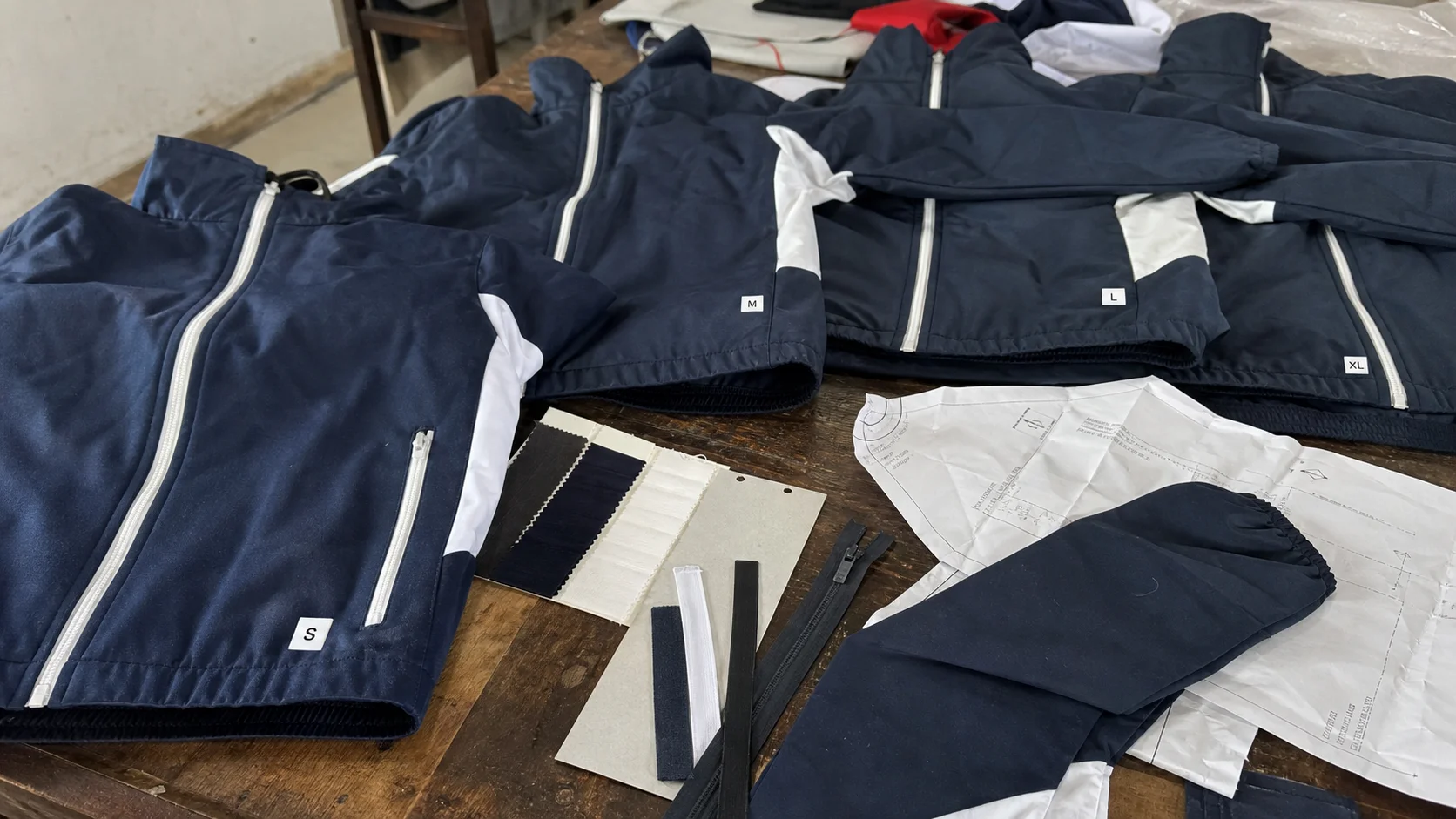
A focused review of rowing jacket size grading for resort uniform programs, covering fit blocks, grade rules, sample approvals, and production checks that...
Rowing jackets sit in a narrow but demanding category for resort uniform programs. They need to look clean on the rack, move well in active use, and hold a consistent fit across sizes without creating avoidable returns or staff complaints. A rowing jacket manufacturer size grading review is the point where those requirements either become manageable or turn into a fit problem that spreads across the order.
For resort buyers, grading is not just a technical exercise. It affects staff comfort, appearance standards, replacement planning, and size run economics. A jacket that grades too aggressively through the chest or sleeve can look sharp in one size and awkward in the next. A jacket that is too conservative can cause tightness at the shoulder, short sleeves, or excess bulk at the hem. The right review balances fit consistency, fabric behavior, and production practicality.
This article focuses on what resort uniform buyers should check when reviewing size grading from a rowing jacket manufacturer, what risks commonly show up in development, and how to make approval decisions that hold up in production.
Rowing Jacket Size Grading Review for Resort Buyers - Activewear & Teamwear manufacturing guide
Resort uniform programs depend on visual consistency. A rowing jacket is often used in guest-facing roles, shuttle teams, marina operations, activity staff, and seasonal service teams. The same style may need to work across a wide range of body types and be issued in mixed male and female size runs. That creates a real grading challenge.
If the grading curve is too shallow, larger sizes may feel restrictive and small sizes may look boxy. If the curve is too steep, the jacket can lose its intended silhouette as size increases. Either problem can affect presentation and wear comfort. In a resort setting, comfort matters because staff will use the jacket for long shifts, in changing temperatures, and often while carrying radios, keys, or light equipment.
The commercial issue is simple. Poor grading increases size exchanges, slows bulk replenishment, and puts pressure on inventory. Buyers rarely want a style that requires separate corrections for every size band. A usable grading review should catch issues before the first production order is locked.
For a broader sourcing framework, it helps to understand the supplier’s service model and development support. A manufacturing partner that can review fit, grading, and sampling methodically is often a better fit than one that only promises low unit cost. See Fabrikn services for the kind of support buyers usually expect when evaluating product development.
Size grading is the systematic adjustment of a base pattern across a size range. It does not mean enlarging every dimension equally. A well-graded rowing jacket changes in controlled increments based on the garment block, the intended fit, and the stretch characteristics of the fabric.
The main points that usually change are chest circumference, shoulder width, sleeve length, bicep width, body length, hem sweep, and collar opening. For jackets with elastic cuffs, hem elastic, or articulated sleeves, the grading logic becomes more important because those details can make a garment feel either flexible or tight even when the measurements look acceptable on paper.
Buyers should ask whether the manufacturer grades from a validated base size or from a generic block. A factory that uses a generic block may produce measurements that look close but do not translate well in wear. That risk rises when the jacket has panels, lining, zipped pockets, storm flaps, or contrast piping.
The most useful question is not whether the garment “passes” measurements. It is whether the full size range preserves the intended wearing experience. A jacket that fits in medium but becomes stiff in XL is not properly graded for a resort uniform program.
Resort buyers usually need a balance between polish and practicality. Rowing jackets are often designed with a slightly athletic profile, but they cannot be so close to the body that they limit movement during work. The fit standard should reflect the actual job use, not a fashion fit chart.
Shoulder fit is one of the first places grading problems appear. If shoulder width increases too slowly, larger sizes pull across the upper back and restrict arm lift. If it increases too quickly, smaller sizes can look dropped and loose. Sleeve mobility also depends on the underarm shape. A narrow sleeve cap may look neat but can bind when staff reach forward or raise their arms.
A rowing jacket should usually allow for easy layering over a polo or base layer. A resort program often runs into real-world wear scenarios that are not reflected in the original fit sample. The jacket may need to fit over a shirt, light knit, or thermal layer depending on season and location. Chest and waist grading should account for that without creating excess volume.
Body length affects both appearance and movement. Short bodies can ride up when staff bend or drive carts. Long bodies can interfere with pockets or look oversized in smaller sizes. Hem elastic, drawcords, and shaped back hems can correct some of this, but they also create grading variables that need careful testing. If the hem is too tight in larger sizes, the jacket can balloon at the torso. If it is too loose in smaller sizes, the shape becomes undefined.
Collar grading is easy to overlook. A collar that scales poorly can feel tight in the neck or too open at the top. That matters for resort teams because the jacket may be worn partially zipped. If the neckline is not consistent across sizes, the garment will look different in group photos, guest interactions, and daily operations.
Fabric selection has a direct effect on grading performance. A woven nylon shell behaves differently from a polyester softshell or a stretch twill. Even within the same fabric family, coating, finish, and weight affect drape and recovery.
For rowing jackets, common fabric options include lightweight woven shells, recycled polyester blends, softshell laminates, and brushed backing materials for cooler climates. Each option has tradeoffs. Lightweight shells are easier to layer and often more packable, but they can show shape irregularities more clearly. Softshells offer better comfort and structure, but they can become heavy and may be less suitable for tropical resort operations.
Trim selection is equally important. Zippers, snap closures, elastic bindings, cuffs, and lining fabrics all influence fit. A metal zipper adds weight and can make the front stand differently in larger sizes. Elasticized hems need consistent tension across the size range. A lining that is too slippery may improve comfort, but it can also shift the jacket’s fit perception because the garment slides over base layers more easily than expected.
Buyers should request full trim specifications before approving a grading set. That includes zipper gauge, tape width, puller type, elastic recovery standards, and any fusible interfacing used at the collar or placket. These details matter because a jacket that grades well in the sample room may behave differently once real trims are installed in production.
Fabric and trim control is one reason buyers should evaluate the factory’s broader development capability, not just the quoted price. A supplier with stable sampling and production support is easier to manage over multiple replenishment cycles. For that reason, it is sensible to review the company background and process scope on pages such as About Fabrikn.
A serious grading review starts with a size set, not a single sample. One approved medium jacket does not prove the grading is correct. Buyers should expect a process that moves from base sample to size set, then to wear review, then to production approval.
The usual sequence looks like this:
Wear testing is especially important for resort uniforms because movement matters more than static measurement charts. Staff need to lift arms, carry items, sit, bend, and move between indoor and outdoor environments. A jacket that looks correct on a hanger can still fail in use if the sleeve pitch or body length is wrong.
Any approval should include both measurement tolerance and visual fit notes. If the manufacturer is using a standard tolerance table, buyers should confirm whether the tolerance is realistic for the fabric and construction. Overly loose tolerances can hide problems. Overly tight tolerances can create avoidable rejections, especially in woven styles where shrinkage and seam behavior can vary by batch.
A sample approval that only checks chest width and body length is incomplete. Grading should be judged as a full fit system, not a single measurement list.
Buyers reviewing a rowing jacket manufacturer should use a structured checklist. That reduces the chance of overlooking a detail that becomes expensive later.
Area What to Check Typical Risk Chest grading Increment between sizes, ease allowance, movement over layering Too tight in upper sizes or too boxy in small sizes Shoulder balance Shoulder width, slope, back balance, arm mobility Pulling at upper back or dropped shape in smaller sizes Sleeve length Full length, elbow articulation, cuff recovery Short sleeves in larger sizes or excess stacking at the cuff Body length Front and back length, hem position, seated comfort Jacket rides up or feels heavy and long Neck opening Collar circumference, zip height, stand shape Neck tightness or open gaps at the collar Fabric behavior Stretch, recovery, shrinkage, drape after wash Fit changes after laundering or wear Trim impact Zip weight, elastic tension, lining slip, seam thickness Front hangs poorly or grading becomes inconsistentThis checklist works best when it is used with actual body measurements and not just garment specs. A buyer who knows the intended end user size distribution can judge whether the size run is realistic. In a resort setting, that often means more attention to upper-medium through extra-large sizes, while still keeping small sizes consistent for front-of-house staff.
MOQ expectations usually depend on fabric availability, print or color customisation, and trim sourcing. For a custom rowing jacket, a practical MOQ can range from about 200 to 500 pieces per color or style for many factories, though some will quote lower for stock fabrics and simpler construction. Small orders often carry a higher unit price and less flexibility on grading revisions. Buyers should treat that as a cost of reduced volume, not as a sign that the factory is being difficult.
Grading decisions affect production lead time more than many buyers expect. A jacket that requires multiple sampling rounds, new trim development, or fabric testing will take longer to approve. Lead time also depends on whether the factory holds greige fabric, whether dyeing is required, and whether the construction needs special machines or bonding processes.
A realistic timeline for a custom rowing jacket project may include several weeks for sampling, followed by production lead time that can range from four to ten weeks or more depending on order size and supply chain conditions. That timeline can extend if the buyer requests a correction after the size set review or if shrinkage testing changes the spec.
Resort buyers should be careful about compressed calendars. Seasonal opening dates, refurbishment schedules, and staff uniform rollouts often create pressure to approve quickly. That pressure is where grading mistakes survive. It is usually better to hold the launch date slightly than to accept a flawed fit curve that creates ongoing replacements.
Lead time also depends on color matching. If the jacket includes resort-specific branding, lining contrast, or trim color alignment, approval of lab dips and shade bands can become a gate. That is another reason to review the whole program early rather than assuming grading can be solved late in the process.
Even a good fit approval can fail in bulk if production control is weak. Inspectors should watch for inconsistent grading across colorways, especially if different dye lots or fabric sources are used. A factory may keep the same pattern but still produce a different fit if the fabric weight changes.
Common inspection risks include seam distortion, zipper waviness, uneven elastic insertion, and panel mismatch. These issues are more visible in fitted outerwear than in looser garments. They also affect how the jacket looks across sizes. A seam that is slightly twisted in medium may become more noticeable in XL because the panel scale is larger.
Shrinkage is another frequent problem. If the fabric or lining has not been properly tested, the first wash can change sleeve length or body proportion enough to upset the approved grading. Resort uniform buyers should ask for wash test results on the exact fabric construction that will be used in bulk.
Measurement consistency matters too. A factory may produce a full set, but if the cutting or sewing teams are not aligned, the sizes can drift. Buyers should request in-line measurement checks and final inspection reports that compare actual dimensions against the approved spec. For repeat orders, retaining the original approved size set is useful. That provides a physical reference if the factory switches operators or subcontractors.
Buyers sometimes try to solve fit problems by demanding more and more spec changes. That can be productive up to a point. Beyond that, it starts to introduce noise. The better approach is to separate real grading defects from design preference.
Push hard on issues that affect wearability: shoulder pull, sleeve restriction, neck tightness, body length, and bulk at the hem. Hold the line on details that improve appearance but do not change function unless the resort has a specific brand requirement. Every added change can complicate production and create new measurement variables.
Tradeoffs are unavoidable. A slimmer jacket may present better for front-of-house staff, but it will be less forgiving for layering. A heavier fabric may hold shape better across sizes, but it may reduce comfort in warm climates. A more structured collar can look premium, but it may also become a source of tightness if the grading is not tuned correctly. Buyers should choose the version that matches the actual uniform use case, not the most polished sample in the room.
The same logic applies to branding. Embroidery, patch placement, or heat-transfer logos should be checked on each size, not only on the base sample. A logo that sits correctly on medium may feel too low or too close to a seam on extra small or extra large. Small alignment errors become obvious in a uniform environment.
A reliable rowing jacket manufacturer should be able to explain how it develops its base block, how it grades from size to size, and how it verifies fit before bulk production. Buyers do not need a lecture on patternmaking, but they do need a clear answer on whether the factory can reproduce the approved fit across seasons and replenishment orders.
Ask for a documented spec sheet, a grading rule chart, and a size set before bulk approval. Ask how the manufacturer handles fabric substitution, trim changes, and tolerance exceptions. Ask whether the factory can make minor pattern corrections after wear testing without reopening the whole development cycle. Those questions separate a capable supplier from a transactional one.
Good communication matters more than polished sales language. A supplier that flags a grading conflict early is usually more valuable than one that agrees to everything and then delays the order later. In resort uniform sourcing, predictability is worth more than optimistic promises.
For buyers planning a broader project discussion, it is sensible to start with the supplier’s contact channel and outline the intended use case, size range, fabric preference, and branding requirements. The clearer the brief, the easier it is to evaluate whether the manufacturer can support the fit standard. See contact Fabrikn when you are ready to discuss a custom rowing jacket program or request development guidance.
Get a free quote from Fabrikn — your trusted B2B clothing manufacturer with 10+ years of experience. MOQ as low as 200 pieces.
Get a Free Quote →Shoulder balance and sleeve mobility usually matter most. If those are wrong, the jacket feels restrictive even when the chest and body measurements look acceptable.
A proper size set should cover the planned production range, not only the middle size. Most buyers should review at least the smallest, middle, and largest sizes, with extra attention on the sizes that will be issued most often.
Many factories quote roughly 200 to 500 pieces per style or color as a practical MOQ, though that depends on fabric, trims, construction, and customization. Stock materials can sometimes support smaller runs.
Bulk failure often comes from fabric variation, trim substitution, poor cutting control, or sewing drift. A sample can be correct while production still shifts the fit if the factory does not control those inputs tightly.
Comfort and consistency should come first, with appearance engineered around them. A uniform that looks sharp but is uncomfortable will create complaints, poor wear compliance, and size exchange costs.
Lead time varies by fabric, customization, and sampling complexity, but buyers should plan for several weeks of development plus production time. A tight seasonal deadline should be treated as a risk, not a normal schedule.
Rowing jacket grading is one of those sourcing tasks that looks routine until it is not. The right review process protects the uniform program from fit complaints, unexpected rework, and inconsistent replenishment. For resort buyers, the best outcome is a jacket that stays dependable across the full size range, survives real use, and keeps the team looking coordinated without constant size exceptions.