
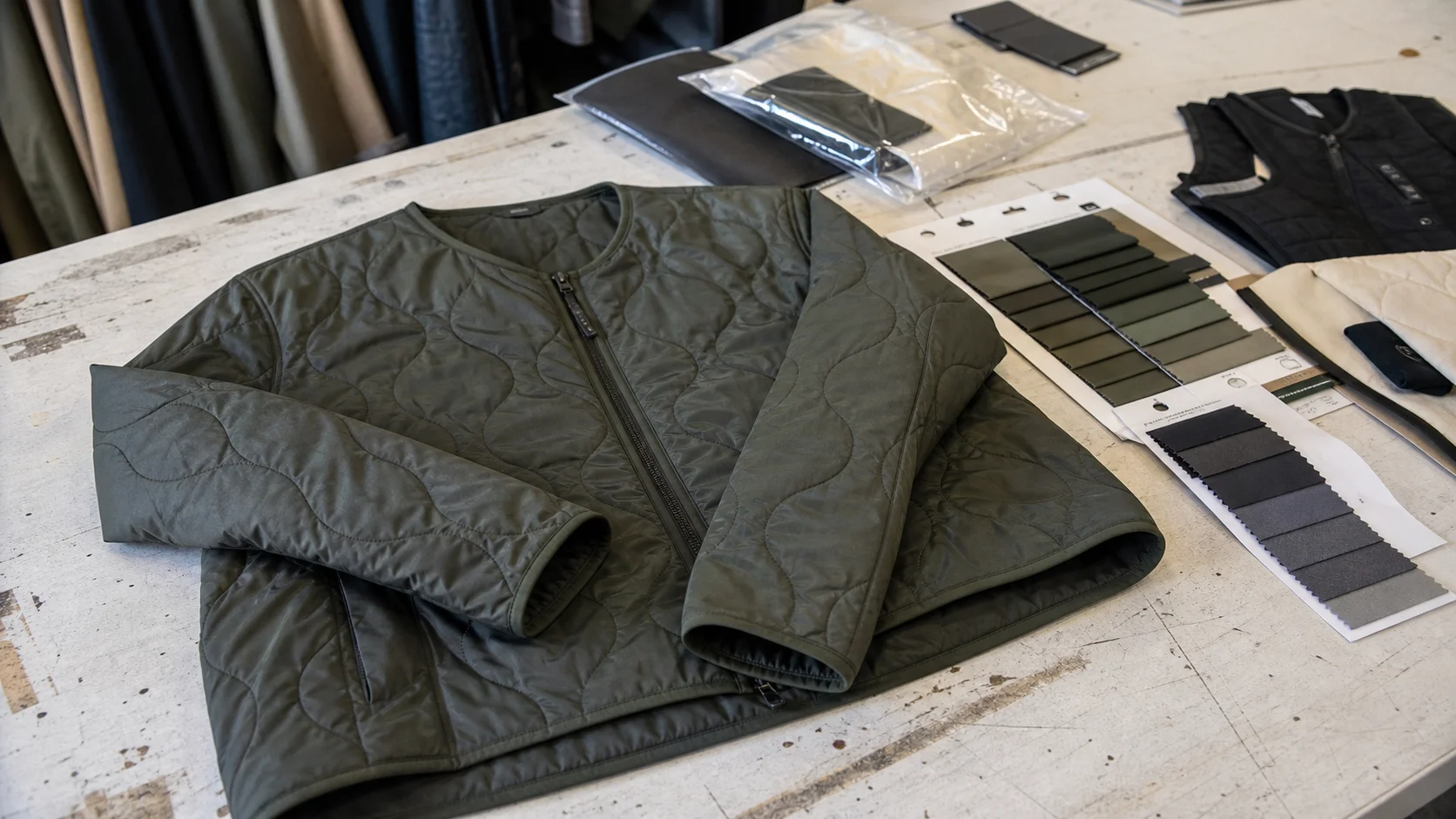
Break down every cost line that shapes the true landed price of rPET liner jackets, from recycled yarn and trim premiums to freight, duty, testing, and...
Distributor buyers sourcing rPET liner jackets need more than a quoted unit price. The real buying decision sits on landed cost: fabric, trims, labor, testing, packaging, freight, duty, inspection, financing, and the cost of delay when approvals slip. A jacket that looks economical at the FOB stage can turn expensive once shrinkage issues, zipper substitutions, label corrections, or air freight are added late in the order cycle.
This guide is written for distributor buyers evaluating an rpet liner jacket supplier landed cost guide for distributor buyers. The focus is practical. It covers what usually moves cost, where suppliers hide risk, how to compare quotes, and which specifications matter when the product needs to be repeatable across seasons and replenishment orders. For buyers building a longer sourcing program, fabrikn.com also provides related support through services, about us, and contact us.
rPET Liner Jacket Landed Cost Guide for Distributors - Sustainable Fashion manufacturing guide
Landed cost is the full cost of getting sellable jackets into your warehouse or 3PL, not just the factory invoice. For distributor buyers, that distinction matters because margin is often tight and replenishment timing affects customer service levels. A supplier may quote an attractive ex-factory price, yet the final delivered cost can move sharply once the shipment is packed, inspected, booked, cleared, and received.
A useful landed cost model usually includes the following:
Buyers sometimes focus too narrowly on freight. Freight matters, but it is only one line in the model. A low unit price with weak spec control often costs more than a cleaner quote with stricter pre-production alignment. The right comparison is total delivered cost against the retail or wholesale value of the jacket program.
Distributor sourcing gets more predictable when the quote is built from the BOM, not from a generic style description. The more vague the spec sheet, the more likely the landed cost will drift after order confirmation.
rPET liner jackets are not priced like a standard woven shell jacket or a basic fleece piece. The recycled polyester content can influence yarn price, fabric minimums, color matching tolerance, and testing requirements. Some mills are comfortable with recycled fiber documentation and GRS-type claims, while others need more lead time or impose stricter minimums on yarn dyeing and finish consistency.
The liner construction also matters. A simple quilted liner uses different cost drivers than a brushed tricot, mesh, or lightly padded insulated liner. If the jacket combines a shell, liner, hidden zipper, storm flap, elastic binding, and branded trims, each component adds risk of mismatch and replacement cost. Small changes in construction can change the bill more than buyers expect.
Distributors should treat the recycled content claim as a specification item, not a marketing line. Ask what percentage of the liner is rPET, whether the claim applies to the whole garment or only the lining, and what documentation supports that claim. If a buyer needs a consumer-facing sustainability statement, the supplier should be able to provide the needed paperwork before production starts.
The price of an rPET liner jacket usually depends on a handful of specification choices. These are the items that should be locked before a serious quote comparison is made.
Heavier fabrics cost more, but the relationship is not linear. A 20 gsm increase in liner weight may also increase dyeing cost, drying time, and cutting waste if the fabric becomes less stable. Buyers should confirm whether the liner is knitted, woven, brushed, or quilted, and whether the shell uses recycled polyester, nylon, or a blend.
Water resistance, anti-pilling, soft hand feel, and breathability finishes add cost and may require broader testing. A soft finish can improve sell-through, but it may also reduce durability if the buyer pushes the fabric too far into an aggressive cost target. This is a tradeoff worth making deliberately, not by accident.
Zippers, snaps, drawcords, cord ends, labels, hangtags, and seam tape all affect landed cost. A standard coil zipper is not the same as a branded, reversed, or waterproof zipper. If the jacket requires multiple trims in a custom Pantone match, the supplier may need extra lead time and higher minimums on trim order quantities.
Princess seams, articulated sleeves, hidden pockets, bonded details, and multi-panel hoods all increase labor. Labor can be the largest source of price variation when factories compare similar-looking jackets. Two jackets with the same fabric consumption can differ materially in sewn minutes.
Individual folding, insert cards, size stickers, barcodes, retail-ready hangers, and carton labeling add both direct cost and handling time. A distributor selling into retail channels should specify packaging early. Late packaging changes often produce avoidable rework charges.
Depending on market and customer requirements, buyers may need colorfastness, seam strength, dimensional stability, pilling, REACH-related checks, or recycled content documentation. Testing should be budgeted before production, not treated as an afterthought. If a sample passes visually but fails a performance or compliance test, the landed cost rises fast.
Cost Driver Typical Impact on Landed Cost Buyer Note Recycled fiber documentation Low to moderate May add testing or certification fees Custom zipper and trim set Moderate Often increases MOQ and lead time Quilted or padded liner Moderate to high Raises sewing time and inspection points Retail packaging Low to moderate Be explicit on fold, polybag, carton pack Performance testing Low to moderate Essential for consistent replenishmentMOQ for rPET liner jackets depends on the fabric source, construction complexity, and whether trims are stock or custom. For distributor programs, the practical range often falls into a few tiers:
These are broad market ranges, not guarantees. A supplier can offer a smaller MOQ by spreading risk across margin or by using available material stock, but that usually comes with less flexibility on color matching and replenishment speed. Buyers should ask whether the MOQ applies per color, per style, per size run, or per order. The answer affects inventory strategy more than the headline price.
For distributors, the smarter structure is often a pilot run followed by a replenishment order if sell-through proves the fit, hand feel, and thermal performance. That reduces exposure, but it only works if the supplier can repeat the same fabric lot and trim spec. If the first order is based on a one-off mill lot, the second order may not match closely enough for wholesale continuity.
Sample approval is one of the most underestimated cost controls in apparel sourcing. A poor sample process creates hidden landed cost later through rework, chargebacks, and delayed shipments. Distributor buyers should build a disciplined approval path and use it to lock the commercial spec before bulk cutting begins.
A practical sample flow for rPET liner jackets usually includes the following steps:
Each stage has a cost and time implication. Rushing from proto to production without a clear fit sign-off often leads to altered grading, extra size samples, and revised marker consumption. Those are not small expenses when scaled across a distributor program.
Buyers should insist on written approval for the key items: measurement spec, liner composition, trim color, logo placement, packaging, and labeling. Verbal approval is weak control. A golden sample should be retained by both sides if possible, because it gives the buyer something objective to compare against during inspection.
Lead time is a landed cost variable because time creates money. When production windows slip, the buyer pays through expedited freight, overtime requests, missed retail delivery, or lost promotional timing. A supplier quote that looks competitive can become expensive if the jacket is tied to unavailable yarn, dyed liner fabric, or a slow trim source.
Common lead-time dependencies include:
A standard production lead time for a simple jacket can be 45 to 75 days after material confirmation. Custom recycled fabric programs or more technical constructions can extend beyond that. Shipping time adds another layer, ranging from a few days by air to several weeks by ocean depending on lane, transshipment, and customs handling.
For distributor buyers, the best practice is to back-plan from the sell-in date and add contingency for sample approvals and compliance clearance. Late-stage compression is expensive. It usually forces freight upgrades and reduces negotiating power.
Freight and duty are where many distributor estimates break down. An FOB quote only covers the goods to the port of export. Landed cost requires the buyer to understand the destination market, tariff treatment, brokerage fees, and any local compliance documentation that clears customs without delay.
Ocean freight is usually the default for bulk jacket programs because it preserves margin. Air freight can rescue a late launch, but it can destroy a cost model if used for too much volume. Buyers should calculate the percentage of the order that can be absorbed by expedited freight before the margin becomes unworkable.
Duty depends on the importing country and the customs classification of the jacket. Small fabric or construction changes can affect the classification and the rate. That is a reason to validate HS code assumptions early. It is not enough to ask for a generic outerwear code and move on.
Additional import costs may include:
These charges can be modest individually and painful together. A distributor should model them as a percentage band, not a fixed afterthought.
Quality risk is a direct landed cost issue. A defect caught before shipment is much cheaper than a defect found after receipt or after customer distribution. The longer the supply chain, the more expensive it is to correct a problem.
Common inspection risks on rPET liner jackets include:
Inspection should match the commercial risk of the order. For a small pilot, a basic pre-shipment check may be enough. For a larger replenishment program, buyers should consider a more formal inspection plan that checks measurements, appearance, label accuracy, carton pack, and carton drop integrity. The goal is not perfection. The goal is to prevent expensive, avoidable claims.
Buyers often underestimate the cost of rework. If a trim color is wrong, the factory may need to replace all affected units, re-open cartons, and reship part of the order. That process can erase the savings from a lower factory quote. It is better to pay a slightly higher unit price for better process discipline than to chase the lowest number and absorb the correction cost later.
A workable landed cost model should be simple enough to maintain and detailed enough to expose risk. The following structure is useful for comparing suppliers:
Cost Element Example Questions Risk if Ignored Factory price Is this FOB, EXW, or CIF? Quote comparison becomes invalid Material specs What is the rPET percentage and fabric weight? Quality mismatch or claim risk Sampling How many sample rounds are included? Hidden development charges Testing Which tests are required for the market? Compliance delays Freight Ocean or air? Who pays destination charges? Margin erosion Duty and tax What HS code applies? Underestimated import cost Inspection Is there a third-party inspection requirement? Defect leakage Buffer What is the allowance for shrinkage or short shipment? Stock-outs and claim disputesDistributors should compare supplier quotes on the same basis. If one quote includes carton packing, labeling, and testing while another does not, the cheaper offer is not actually cheaper. Ask each supplier to break out the quote in the same line-item structure. That makes hidden cost visible and helps expose weak assumptions before an order is placed.
Strong negotiation in this category is less about pushing every line item down and more about reducing uncertainty. A supplier that understands the program clearly may give a better long-term price even if the first quote is not the lowest. Stability matters for distributor programs because repeat orders rely on consistency.
Useful negotiation points include:
One useful tradeoff is to accept a slightly higher unit cost in exchange for better lead-time protection and lower defect risk. For distributor buyers, that often beats a bargain quote that depends on perfect execution. The strongest supplier relationships are usually built on transparency about what can and cannot be held constant.
If a supplier is being considered as a long-term partner, the evaluation should include responsiveness, technical discipline, and documentation quality. Product development and production coordination matter as much as price. For buyers exploring broader sourcing support, the services page is a useful starting point, and the contact us page can be used to request a scoped quotation or development discussion.
Before placing an order, a distributor buyer should ask for the following:
Suppliers that answer these questions clearly tend to be easier to work with during replenishment. A fast quote without supporting detail is a warning sign. It may still be a workable vendor, but the buyer should expect more commercial management later.
For buyers comparing partners, the about us page can help frame the capabilities behind the supply relationship. Background matters less than process discipline, but it is still useful when narrowing the field.
rPET liner jackets are best bought with a disciplined sourcing lens. Recycled content adds value only when the documentation is credible, the fabric is repeatable, and the garment still meets commercial expectations on hand feel, fit, and durability. A jacket that misses those basics will not perform in the market just because it carries a sustainability story.
The right landed cost decision usually balances four variables: unit price, consistency, lead time, and defect risk. If two suppliers are close on price, the better choice is usually the one with stronger sample control and cleaner communication. If one supplier is materially cheaper but vague on fabric source, trim availability, or testing responsibility, the savings are often illusory.
Distributor buyers should treat the first order as both a product launch and a supplier test. The goal is not only to land the jackets at a manageable cost. The goal is to build a repeatable program that can be replenished without re-qualifying the entire product every time.
Get a free quote from Fabrikn — your trusted B2B clothing manufacturer with 10+ years of experience. MOQ as low as 200 pieces.
Get a Free Quote →The main driver is usually the combined effect of material spec, construction complexity, freight mode, and defect risk. A clean BOM with stable trims and a repeatable fabric source usually costs less in the end than a quote that depends on multiple substitutions.
Typical MOQ ranges often fall between 300 and 1,000 units per style or color, depending on whether the supplier uses stock materials or custom inputs. Custom fabric, custom trims, or more technical construction usually push MOQ higher.
Three to five rounds is common when a jacket needs fit validation, fabric approval, and a production reference sample. Faster approvals are possible when the spec sheet is detailed and the buyer is responsive.
Confirm fabric composition, liner construction, trim colors, size spec, packaging, label content, test requirements, and the approved golden sample. Bulk cutting should not start until the buyer has written approval on those points.
No. The buyer should ask for documentation that matches the claim used in sales or marketing. The level of proof needed depends on the customer, the market, and any certification or audit requirement tied to the order.
Air freight makes sense when the order is small, the launch is urgent, or a portion of the volume is needed to protect a retail commitment. It is not a substitute for a normal logistics plan, and it should be used selectively because it can erase margin quickly.
Common risks include shade variation, zipper mismatch, label errors, and size inconsistency after finishing. These issues are easier to prevent than to correct after shipment.
For distributor buyers building a repeatable program, the most useful next step is to request a quote built from a full BOM and a landed cost worksheet. That creates a comparison you can actually use, instead of a price list that looks good only before shipping and compliance costs are added.