
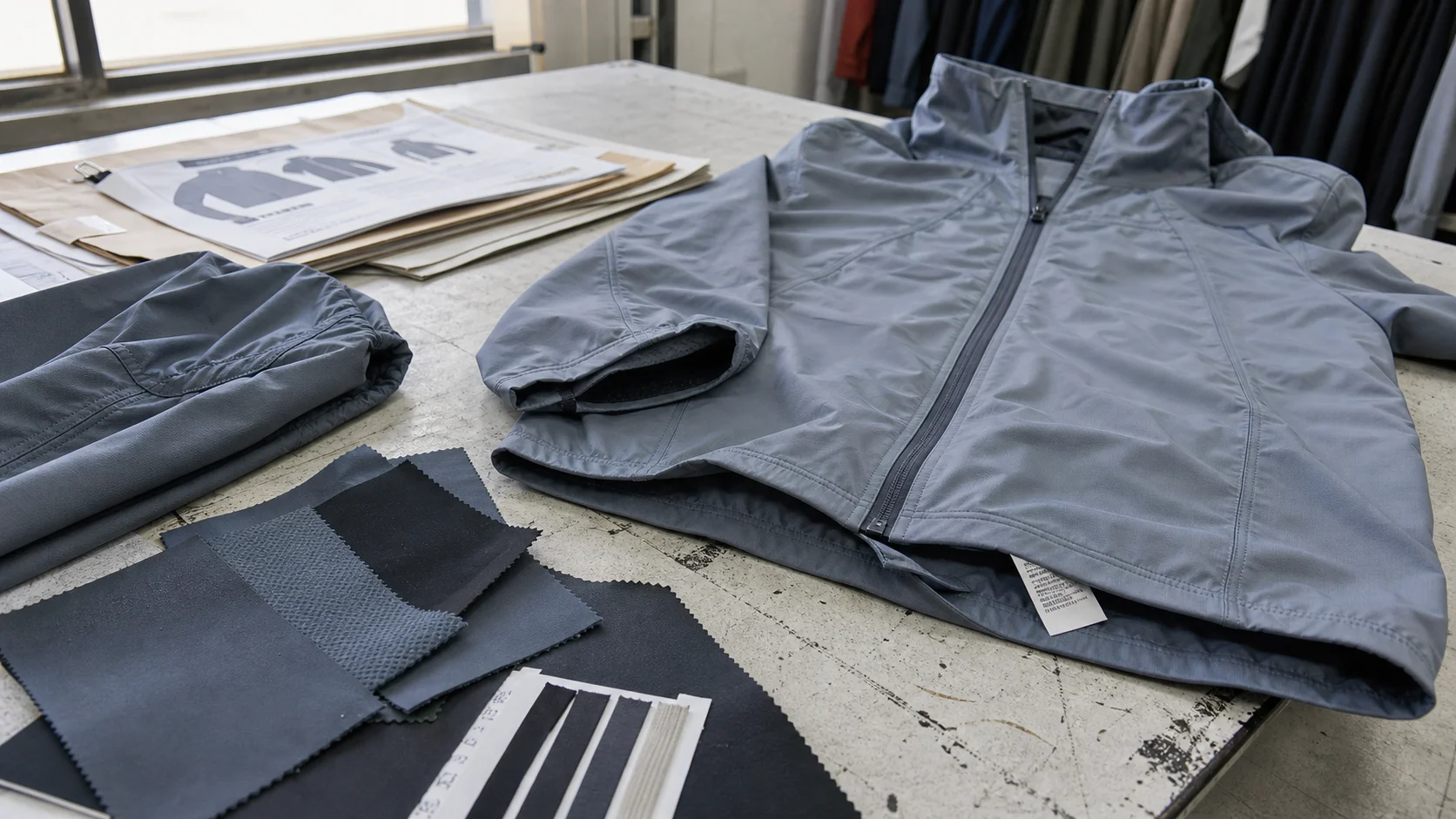
A distributor-focused outline for calculating the true landed cost of running wind jackets, including shell fabric choices, trims, decoration, packaging,...
Running Wind Jacket Landed Cost Guide for Buyers - Activewear & Teamwear manufacturing guide
For distributor buyers, the real cost of a running wind jacket is not the quoted factory price. It is the full landed cost: fabric, trims, making, packaging, testing, inland freight, export charges, ocean or air freight, duty, customs clearance, domestic delivery, and the cost of quality risk. A low FOB price can still become an expensive buy if the jacket needs rework, misses the selling season, or arrives with weak seams and inconsistent sizing.
This running wind jacket landed cost guide is written for distributor buyers sourcing activewear and teamwear programs. It focuses on practical cost drivers, typical MOQ ranges, sample approval steps, lead-time dependencies, and inspection risks that should be reviewed before confirming a purchase order.
Landed cost is the total cost of getting finished jackets from the supplier to your warehouse or customer delivery point. For a distributor buyer, this number matters more than the factory unit price because it determines resale margin, tender competitiveness, and whether the program can absorb delays or quality claims.
A running wind jacket may be quoted under FOB, EXW, CIF, DDP, or another trade term. Each term shifts responsibility between buyer and seller. FOB is common for international apparel sourcing because the supplier usually handles export-ready goods and delivery to the named port. The buyer then controls international freight, insurance, import clearance, duty, and final delivery.
DDP may look convenient, especially for smaller buyers, but it can hide cost details. It may also limit control over freight routing and customs handling. For recurring distributor programs, a transparent FOB quote plus a separate freight and duty model often gives better purchasing visibility.
Buying judgment: do not compare suppliers only by FOB price. Compare the same jacket specification, same packaging method, same shipment term, same inspection standard, and same delivery destination.
A running wind jacket is not just a lightweight shell. It is expected to be packable, breathable enough for movement, wind resistant, and consistent in fit across sizes. Many distributor buyers also need team colors, reflective details, club logos, school branding, sponsor prints, or private label packaging.
These details push the cost structure away from basic promotional jackets. Lightweight woven fabric is sensitive to seam puckering. Reflective tape and heat transfer logos require process control. Elastic cuffs, drawcord hems, concealed pockets, and ventilation panels all add sewing time. If the jacket has a water-repellent finish, colorfastness and spray rating may need checking before bulk cutting.
For teamwear distributors, size spread also affects planning. A program may need XS to 4XL, men’s and women’s fits, or youth sizes. Wider size ranges create marker efficiency challenges, more grading checks, and more inventory complexity. That does not always raise the quoted price directly, but it can raise development time and risk.
The landed cost of a running wind jacket usually includes the following cost buckets. Some are visible on the supplier quotation. Others sit outside the factory price but still affect the buyer’s margin.
A clear tech pack makes these buckets easier to control. Buyers who only send a reference photo often receive broad estimates, not reliable production quotations. The supplier must make assumptions about fabric weight, zipper grade, pocketing, finishing, and packaging. Those assumptions later become cost changes.
Fabric is usually the largest single material cost in a running wind jacket. The same design can move from budget to premium depending on fabric selection. Distributor buyers should define the fabric by composition, construction, weight, finish, color, and performance target rather than by a generic phrase such as “lightweight polyester.”
For a distributor program, polyester woven fabric is often the practical choice when price, color continuity, and repeat orders matter. Nylon can be attractive for packable running styles, but it may increase cost and require tighter shade control. A very thin shell fabric can save grams, yet it may increase seam slippage risk and make defects more visible.
Recycled polyester can be specified if sustainability is part of the sales story. It may require transaction certificates or chain-of-custody documentation depending on the claim. That documentation adds administrative work and sometimes testing cost. The commercial benefit can be strong for corporate and institutional buyers, but it should be costed from the beginning rather than added after quotation.
Trims can quietly change both cost and production reliability. A running wind jacket may look simple, but details such as zipper quality, pocket construction, reflective elements, and elastic finishing can affect the landed cost more than expected.
A basic coil zipper is usually the most cost-effective option. Branded zippers or water-resistant zippers increase cost and may raise MOQ for trim procurement. Water-resistant zippers also change the garment’s look and may require more careful sewing to avoid twisting or puckering.
Distributor buyers should specify zipper length, color, slider type, puller style, and whether the zipper must match body fabric or contrast. For teamwear, zipper color continuity matters because clubs and schools may reorder the same style later. If the zipper supplier changes between production lots, shade and puller shape can become a complaint point.
A fixed hood adds fabric consumption and sewing operations. A packable hood or concealed hood adds more complexity. Zippered pockets add cost through zipper trims, pocket bags, seam reinforcement, and extra sewing time. Back vents, mesh panels, and underarm eyelets improve wearability but need clean construction.
Running jackets often benefit from at least one secure pocket and some ventilation. Stripping out all features may win the lowest FOB quote, but the product can become harder to sell against retail-inspired alternatives. The best value is usually a controlled feature set: reliable front zip, practical pockets, modest reflective detail, and a clean hem/cuff solution.
Reflective tape, piping, or print can improve the product’s activewear positioning. It also creates inspection risk. Reflective material may crack, peel, shift, or fail after washing if the application method is wrong. For printed reflective logos, the buyer should request bulk test panels before committing to full production.
MOQ depends on fabric availability, trim customization, color count, size range, decoration, and whether the order uses stock materials or custom-dyed fabric. Exact MOQ must be confirmed with the supplier, but the following ranges are common enough for planning discussions.
Program Type Typical MOQ Range Best Use Case Main Tradeoff Stock fabric, simple branding 300-800 pcs per style/color Small distributor launch or urgent teamwear order Limited colors, trims, and fabric options. Custom color fabric 800-1,500 pcs per color Core distributor range with repeat potential Longer lead time and lab dip dependency. Private label with custom trims 1,000-3,000 pcs per style Retail-ready activewear program More trim approvals and higher development cost. Multi-size teamwear program 500-2,000 pcs per style Club, school, event, or corporate distribution Size allocation risk and replenishment planning.Low MOQ is attractive, but it often increases unit cost. Fabric mills may charge a small-lot dyeing surcharge. Trim suppliers may require minimums for zipper tape color, custom pullers, woven labels, or printed packaging. Factories may also price higher because cutting and line setup costs are spread across fewer units.
A distributor buyer should decide whether the program is a market test, seasonal promotion, or long-term range. For a market test, stock materials and fewer colors are sensible. For a long-term range, custom fabric and trim consistency may justify higher MOQ because reorders become easier to manage.
Sampling is not a formality. It is the point where the buyer confirms whether the quoted jacket is commercially acceptable and technically producible. Rushing this stage can lead to bulk mistakes that are expensive to fix after import.
The pre-production sample is the most important sample for cost control. It should match the bulk specification closely. If it uses substitute fabric, temporary zipper, or placeholder print, it is not a reliable production reference.
For running wind jackets, fit testing should include arm movement. A jacket can measure correctly on a table but feel tight across the back when the wearer runs or reaches forward. Raglan sleeves, articulated sleeves, or back vents can improve movement but add pattern and sewing complexity.
Buying judgment: approve fewer styles properly rather than pushing multiple untested colors and trims into production. A disciplined sample process protects landed margin better than a rushed low-price order.
Lead time is not one fixed number. It depends on material availability, color approval, trim lead time, factory capacity, decoration workload, testing, inspection, and freight mode. A realistic calendar should separate development, material procurement, production, inspection, shipping, customs, and final delivery.
Stage Typical Time Range What Can Delay It Tech pack review and quotation 3-10 working days Incomplete specs, unclear artwork, missing size range, or unknown test requirements. Development and fit samples 2-4 weeks Pattern changes, fabric substitution, complex branding, or slow feedback. Lab dips and trim approval 1-3 weeks Color rejection, custom zipper tape, reflective trim sourcing, or packaging artwork changes. Bulk material procurement 2-6 weeks Custom dyeing, recycled fabric documentation, trim MOQ, or mill capacity. Bulk production 3-6 weeks Order quantity, sewing complexity, factory line availability, or decoration bottlenecks. Inspection and shipment preparation 3-7 working days Failed inspection, packing errors, missing documents, or carton relabeling. International freight Air: days; ocean: several weeks Port congestion, customs exams, carrier changes, peak-season capacity, or weather disruption.For seasonal running jackets, late delivery is a direct margin risk. Air freight can rescue a delayed order, but it may destroy the savings from a lower factory price. Buyers should build the landed cost model with both normal freight and emergency freight scenarios when the sales window is narrow.
If the distributor is selling to schools, clubs, events, or corporate programs, final decoration approval can be the slowest part of the calendar. Logos, sponsor marks, and color placement should be approved before bulk fabric is cut. Changing branding after production starts can create scrap, rework, and missed delivery dates.
The following example is illustrative only. Actual costs depend on origin country, destination country, duty classification, order volume, freight market, packaging volume, and supplier quotation. It is useful because it shows how a low FOB price is only one part of the buyer’s final cost.
Cost Item Example Basis Estimated Cost Per Jacket Buyer Notes FOB garment price Lightweight woven shell, basic trims, private label $9.80 Includes fabric, trims, cutting, sewing, finishing, and export-ready packing. Testing and inspection allocation Shared across order quantity $0.25 Higher per unit on small orders; necessary for risk control. International freight Ocean freight allocation $0.60 Varies by carton volume, season, route, and shipment size. Marine insurance Basic shipment insurance allocation $0.05 Small cost, useful protection for higher-value shipments. Import duty and taxes Destination-specific $1.30 Must be checked by HS code and importing country rules. Customs brokerage and port charges Allocation across order $0.35 Can rise sharply for small shipments. Domestic delivery Port to distributor warehouse $0.40 Depends on cartons, distance, and delivery appointment requirements. Contingency allowance Quality, shortage, or delay buffer $0.30 Practical for seasonal programs and first production runs. Estimated landed cost Total $12.85 Use this figure for margin planning, not only the FOB price.A distributor selling the jacket at wholesale must then add overhead, financing cost, sales commission, warehouse handling, returns allowance, and target margin. If the product is sold through tenders or contract pricing, landed cost discipline becomes even more important because there may be limited room to raise the selling price after quotation.
Running wind jackets are usually light, but carton volume can still matter. Thin jackets packed individually may seem freight-efficient, yet full-zip jackets with hoods and protective packaging can occupy more space than expected. Buyers should request carton dimensions, carton weight, and packing quantity per carton before finalizing freight estimates.
Ocean freight is generally best for planned distributor programs with stable timelines. Air freight is useful for urgent event orders, late approvals, or partial launch quantities. A split shipment can make sense when a buyer needs a small quantity immediately while the balance moves by ocean.
The freight decision should be made before the purchase order is confirmed. If the order calendar already assumes air freight, the landed cost model must show that clearly. Treating air freight as a last-minute surprise is a common way to lose margin.
Import duty depends on garment classification, fabric composition, construction, gender category, country of origin, and destination rules. A lightweight woven polyester running jacket may be treated differently from a knitted jacket, lined jacket, waterproof garment, or padded outerwear. The buyer should work with a customs broker to confirm the correct HS code before importing.
Supplier descriptions should be accurate. Vague commercial invoice wording such as “sportswear” may create customs questions. Better descriptions include garment type, fiber composition, woven or knitted construction, gender category if relevant, and quantity. If the jacket uses recycled material, waterproof coating, or special finish, documentation should be aligned with the import declaration.
Trade agreements can reduce duty if the goods qualify, but qualification is not automatic. Country-of-origin rules must be checked carefully. Fabric origin, cutting, sewing, and finishing location may all matter. Buyers should not assume duty savings unless supporting documents are available and accepted by the importing country.
Packaging is often treated as a small detail, but it affects cost, warehouse handling, barcode compliance, and customer presentation. A teamwear distributor may need individual polybags by size, carton assortment labels, barcode stickers, club allocation stickers, or retail hangtags.
Every packaging requirement should be included in the quotation package. Changing packaging after bulk production can delay shipment because factories may need to reopen cartons, relabel units, or replace polybags. That labor cost is rarely attractive, and it can create counting errors.
Running wind jackets have specific quality risks because lightweight woven fabric and activewear trims expose workmanship problems. A buyer should set inspection standards before production, not after a dispute.
A final random inspection should check workmanship, measurements, quantity, carton packing, labeling, and basic function. For higher-risk programs, in-line inspection can catch issues before the whole order is completed. That is useful for first production runs, new materials, reflective applications, and tight delivery windows.
Testing should be tied to the product claim. If the jacket is sold only as wind resistant, testing priorities may include fabric weight, colorfastness, seam strength, and dimensional stability. If the jacket is promoted as water repellent, then spray rating and post-wash performance may be relevant. If the jacket includes reflective safety positioning, reflectivity and wash durability may need stronger verification.
Distributor buyers usually face the same tension: customers want a sharp price, but the product still needs to look credible, fit properly, and arrive on time. The lowest-cost running wind jacket is rarely the best commercial choice if it creates claims, delays, or weak reorder potential.
A good sourcing decision balances FOB price against saleability and operational risk. If two suppliers are close on price, the stronger choice is often the one that gives clearer specifications, better sample discipline, realistic lead times, and transparent packing details. For distributor buyers managing repeat teamwear or activewear programs, reliability is worth real money.
Before requesting quotations, buyers should prepare a clear specification package. This improves quote accuracy and reduces later price revisions.
Specification Area Information to Provide Why It Matters Style design Sketch, reference images, feature list, pocket details, hood type Defines sewing complexity and fabric consumption. Fabric Composition, weight, construction, finish, color standards Controls material cost and performance expectations. Trims Zipper type, elastic, drawcord, toggles, reflective details, labels Prevents hidden trim upgrades or substitutions. Decoration Logo artwork, placement, method, color, size Affects sample time, cost, and inspection risk. Sizing Measurement chart, grading, size ratio, fit comments Reduces bulk fit complaints and size imbalance. Packaging Polybags, hangtags, barcode labels, carton marks Affects warehouse receiving and customer delivery. Testing Required tests, standards, buyer compliance rules Prevents late-stage compliance cost surprises. Shipping term FOB, CIF, DDP, destination, required delivery date Allows landed cost comparison on the same basis.Margin improvement does not always come from pushing the supplier to reduce labor cost. In running wind jackets, better margin often comes from cleaner planning.
If the jacket is part of a broader activewear or teamwear collection, it may be useful to align colors, labels, trims, and packaging across products. A consistent platform can reduce development time and improve brand presentation. Buyers reviewing broader sourcing support can explore Fabrikn’s services for apparel development and manufacturing coordination.
Spot buying can work for simple promotional jackets, but it is less reliable for distributor programs that need repeat colors, size consistency, and controlled branding. A supplier partner is more useful when the buyer needs a planned range, seasonal replenishment, or multiple styles under one activewear identity.
The strongest supplier setup is one where costing, sampling, material approval, production planning, inspection, and logistics are connected. That does not remove all risk, but it makes risk visible earlier. For distributor buyers comparing manufacturing options, background information about the sourcing partner can be reviewed through Fabrikn’s about page.
Buyers preparing a first running wind jacket program should send a clear tech pack, target price, expected order quantity, delivery market, and selling channel. If the project requires costing support or production discussion, the next practical step is to contact the sourcing team through Fabrikn’s contact page.
A running wind jacket landed cost guide is only useful if it changes how the buyer requests quotes and approves production. The practical goal is to avoid false savings. A cheaper fabric, skipped sample, vague trim spec, or rushed freight decision can all move cost from the quotation stage into the claims stage.
For most distributor buyers, the best-value running wind jacket sits in the middle: a reliable woven shell, controlled DWR if needed, standard but dependable trims, clean reflective detail, practical pockets, and packaging that fits the sales channel. Premium materials make sense when the selling price supports them. Ultra-low specifications make sense only when the customer understands the limitations.
The key is to calculate landed cost before confirming the order. Include realistic freight, duty, testing, inspection, packaging, and contingency. Then compare suppliers on the same basis. That is how distributor buyers protect margin, delivery reliability, and customer confidence in activewear and teamwear programs.
Get a free quote from Fabrikn — your trusted B2B clothing manufacturer with 10+ years of experience. MOQ as low as 200 pieces.
Get a Free Quote →Landed cost is the total cost to bring the jacket from the supplier to the buyer’s warehouse or delivery point. It usually includes the FOB garment price, testing, inspection, freight, insurance, duty, customs clearance, port charges, domestic delivery, and a practical risk allowance.
Typical MOQs can range from about 300-800 pieces per style/color for stock fabric programs, 800-1,500 pieces per color for custom fabric colors, and 1,000-3,000 pieces for private label programs with custom trims. Exact MOQ depends on fabric, trim, color count, size range, and supplier capacity.
Polyester woven fabric is often practical for distributor and teamwear programs because it can offer stable cost, good color options, and easier repeatability. Nylon ripstop can feel lighter and more premium, but it may cost more and need tighter quality control. The best fabric depends on target price, performance claims, and selling channel.
Buyers can reduce landed cost by using available fabric colors, limiting excessive panels, standardizing trims, approving samples quickly, improving carton efficiency, and planning ocean freight instead of emergency air freight. Cost reduction should not remove critical fit checks, fabric approvals, or final inspection.
Common issues include seam puckering, zipper twisting, shade variation, reflective trim failure, weak seams, poor measurement control, incorrect labels, and packing errors. Lightweight woven fabrics need careful sewing control because defects are easy to see.
After sample and material approval, bulk production may take about 3-6 weeks depending on order quantity, sewing complexity, decoration, and factory capacity. Total lead time can be longer when custom fabric dyeing, lab dips, trim development, testing, inspection, and international freight are included.
FOB pricing often gives distributor buyers better cost visibility and control over freight, duty, and customs handling. DDP can be convenient for smaller or less experienced importers, but it may hide cost details and reduce logistics control. The right choice depends on the buyer’s import capability and need for transparency.
A pre-production sample confirms the final approved fabric, trims, branding, measurements, workmanship, and packaging before bulk cutting. It is the main reference for production and inspection. If it uses substitute materials, it should not be treated as a final production standard.