
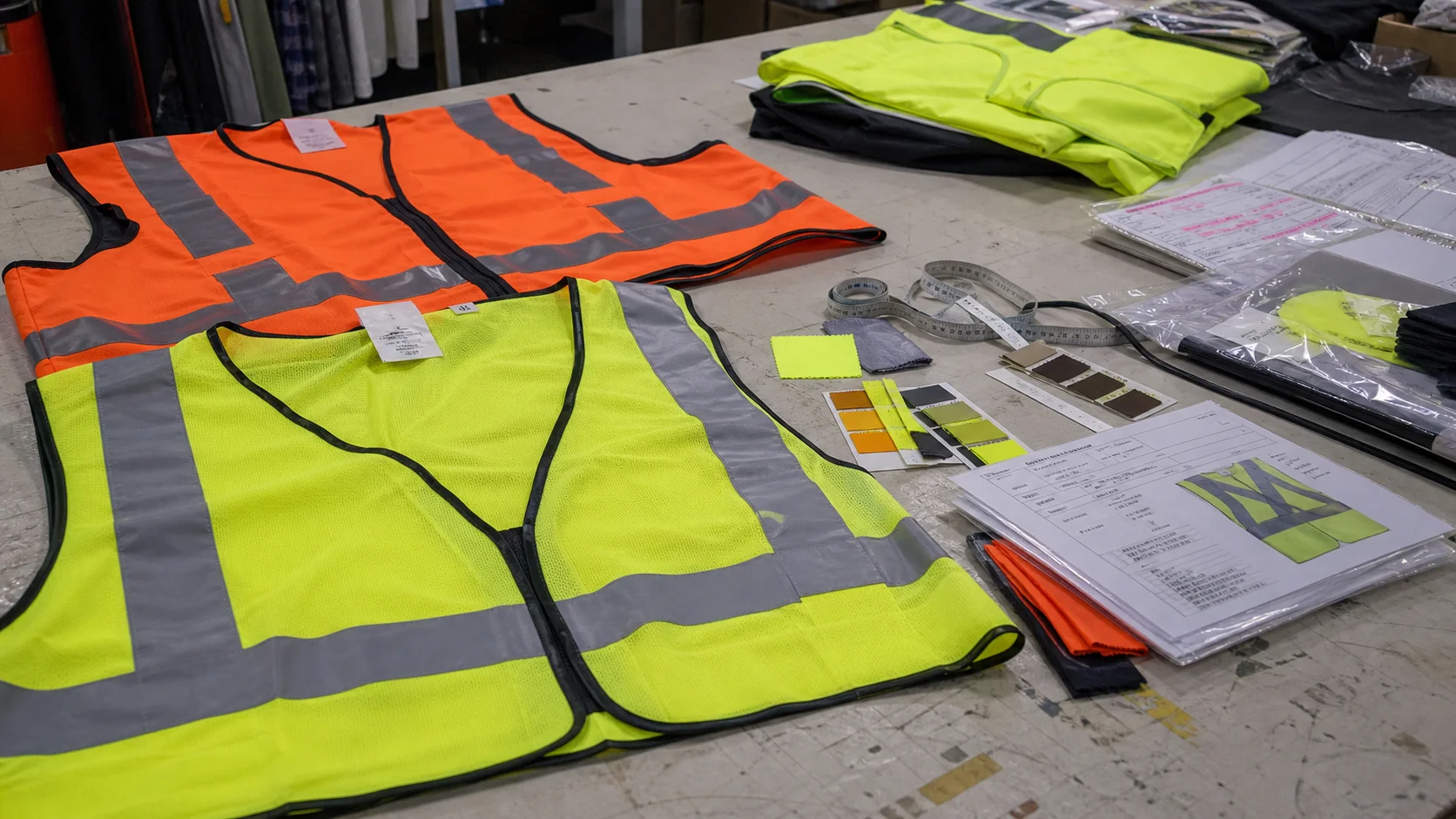
A sourcing-focused outline for cleaning crew buyers reviewing safety vest factory size grading, fit specs, sampling costs, MOQ tradeoffs, and production...
Safety Vest Size Grading Review for Crew Buyers - MOQ, Cost & Sourcing manufacturing guide
Buying safety vests for cleaning crews looks simple until the first delivery reaches the floor. A vest that fits well over a polo shirt in summer may pull across the shoulders when worn over a hoodie. A size run that looks balanced on paper may leave supervisors short of 3XL and 4XL units. Reflective tape that passes a quick visual check may distort after grading if the factory has not adjusted panel proportions correctly.
For crew buyers, the size grading review is not a technical formality. It is one of the most practical controls for reducing returns, uniform complaints, and reorders. In cleaning operations, safety vests are often worn by janitorial teams, facilities crews, airport cleaners, school custodians, hotel back-of-house staff, warehouse sanitation teams, and night-shift maintenance crews. These workers move constantly, bend, reach, carry supplies, push carts, and layer garments depending on climate and shift conditions.
This article reviews how to evaluate safety vest factory size grading for cleaning crews, with direct sourcing judgment on MOQ, cost, lead time, sample approval, fabric and trim specs, and inspection risks. It is written for buyers who need workable production guidance rather than generic sizing theory.
Safety vest size grading is the process of scaling a base-size pattern into smaller and larger sizes while keeping the garment functional, balanced, and compliant with the intended design. For cleaning crews, the review needs to focus on movement and layering, not just chest width.
A vest that is too tight restricts arm movement when staff mop, vacuum, empty bins, or lift supply boxes. A vest that is too loose can catch on carts, door handles, shelving, equipment, or cleaning machinery. Poor length grading can create another issue: larger sizes become wider but not long enough, or small sizes become short enough to ride up when the wearer bends.
In B2B sourcing, poor grading usually shows up after bulk delivery. Workers reject uncomfortable sizes, supervisors request swaps, and buyers discover that the factory followed a generic unisex size chart that does not match the crew profile. Recutting or reordering is rarely economical unless the order volume is high.
Purchasing judgment: do not approve a safety vest order based only on a flat size chart. Review at least one middle size, one smaller size, and one larger size before bulk production if the order includes a broad crew population.
Cleaning crews often include mixed-gender teams, part-time staff, seasonal workers, and employees with different body shapes. A single “standard adult size” approach may work for disposable visitor vests, but it is weak for daily-use crew uniforms. Buyers should treat size grading as part of the uniform specification, especially when the vest carries company branding or has role-based colors.
A factory can quote faster when the buyer provides a clear spec. A vague request such as “orange reflective safety vest, sizes S to 3XL” invites assumptions. Those assumptions may affect fit, cost, and lead time.
Before collecting prices, prepare a basic buying brief. It does not need to be complicated, but it should tell the supplier how the vest will be used and what size risks need attention.
If the buyer is still defining the program, a sourcing partner can help turn operational needs into a production-ready brief. Fabrikn’s services page gives a useful starting point for buyers comparing sourcing, sampling, and production support options.
The brief should also state whether this is a first order, a repeat order, or a replacement for an existing vest. For replacement programs, ask the supplier to match a physical sample or approved spec sheet. Matching only from photos is risky because size, fabric weight, tape width, and hand feel cannot be judged accurately.
Cleaning crew buyers often under-order large sizes. This is not because they ignore staff needs; it usually happens because price sheets and factory stock size runs make S to XL look like the default. In practice, a crew uniform program may need 2XL, 3XL, 4XL, and sometimes 5XL depending on the workforce and layering requirements.
For daily-use safety vests, a practical starting size range is S to 3XL. For municipal cleaning, logistics, healthcare facilities, campuses, airports, or large commercial cleaning contractors, XS to 5XL may be more realistic. If the vest will be worn over cold-weather layers, the buyer should consider whether the same size chart works year-round.
Size ratios should come from workforce data when possible. A common mistake is ordering equal quantities across all sizes. For cleaning crews, the better approach is to collect rough employee size demand from supervisors or previous uniform issue records. If no data exists, leave budget room for top-up orders in high-demand sizes.
Purchasing judgment: if the factory offers a low MOQ only for a fixed S-XL ratio, check whether that ratio matches your crew. A cheap size mix can become expensive when the team cannot use the sizes delivered.
A safety vest is a simple garment, but it still needs a proper measurement specification. Buyers should avoid approving a size chart that lists only chest width and length. Those two points matter, but they do not fully control fit.
The armhole deserves careful review. Cleaning staff reach forward and upward throughout a shift. If the armhole is too high or too narrow, the vest pulls. If it is too large, the vest may feel unstable and expose too much of the garment underneath. Larger sizes need more than chest expansion; they need proportional armhole and shoulder adjustments.
Length is another common problem. Some factories grade width aggressively but increase length slowly. That can produce a boxy 3XL or 4XL vest that does not cover the torso properly. On the other side, small sizes can become too long if length is not reduced enough, especially for shorter wearers.
Tolerances depend on fabric type, construction, order quality level, and price. A premium zipped vest with pockets should have tighter control than a very low-cost promotional mesh vest. Buyers should still set limits. Without tolerances, inspection disputes become subjective.
Size grading should be reviewed as a rule set, not as isolated finished measurements. The buyer should ask how much the factory adds between sizes at chest, length, shoulder, and armhole. A predictable grade rule reduces surprises.
For many adult unisex safety vests, chest width may increase by about 4 cm to 6 cm in total circumference between sizes. Since flat measurement is half the circumference, this often appears as about 2 cm to 3 cm per side-to-side flat measurement between adjacent sizes. Body length may increase by about 1 cm to 2 cm per size. These are not universal rules, but they are common enough to use as a review benchmark.
This table is an example only. The actual measurements should be based on the buyer’s workforce, local market expectations, garment type, and intended layers. A factory may already have a house size chart. That can save development time, but the buyer should not accept it automatically.
The main danger is uneven grading. If chest increases but shoulder barely changes, the vest may look poorly balanced. If armhole increases too much, the garment may feel sloppy. If reflective tape placement is copied from the base size without adjustment, smaller sizes can look crowded and larger sizes can look empty.
Purchasing judgment: approve the grading logic before approving price-sensitive bulk production. Once fabric is cut, fixing a grading error usually means replacing panels or remaking the order.
Size grading interacts with fabric and trim selection. A vest made from soft mesh behaves differently from one made from stiff woven polyester. A cheap binding can pucker around curves, especially at armholes and necklines. A zipper front requires more precise center-front grading than hook-and-loop closure.
Typical fabric weights for safety vests may range from about 110 gsm to 160 gsm for many economical and mid-market products. Lighter fabric helps cost and breathability but may reduce durability and opacity. Heavier fabric improves body and perceived quality, but it can increase cost and may feel warm during active cleaning work.
Reflective tape is a major cost and compliance component. Buyers should specify tape width, color, wash performance, backing type, and layout. Common widths include 5 cm reflective tape, sometimes with contrast trim depending on the market and visibility requirement. Tape quality varies widely. Low-cost reflective tape may look acceptable at shipment but fail after repeated washing or show poor reflectivity when tested properly.
Hook-and-loop closures are economical and forgiving in fit. They are common for cleaning crews because workers can put the vest on quickly. The drawback is that hook tape can catch on mesh, collect lint, and weaken after washing. Zippers look cleaner and feel more secure, but they add cost and require better grading accuracy. Breakaway designs can be useful in environments with snag risks, but they need careful testing because detachable points can open too easily if poorly specified.
For sourcing support, buyers who need to compare construction options can review Fabrikn’s about page to understand the type of apparel production coordination that may be useful when turning an idea into a controlled bulk order.
A disciplined sample process reduces bulk-production disputes. It also forces the buyer and factory to agree on what “correct fit” means before large quantities are cut.
For low-MOQ orders, some factories may try to skip size set samples. That can be acceptable for repeat orders using an already approved pattern, but it is risky for a new safety vest program. If budget is tight, buyers should at least request the smallest, middle, and largest sizes in the order range. For example, an S to 3XL program could review S, L, and 3XL.
The sample approval process should include actual wear checks. Ask a few crew members or supervisors to try the vest over typical work clothing. They should reach upward, bend, push a cart, zip or close the vest, and simulate normal work movements. This does not replace technical measurement, but it catches problems that a flat table review may miss.
Purchasing judgment: do not treat the pre-production sample as a design exploration sample. By that point, size chart, grading, fabric, trims, logo, and packing should already be close to final.
MOQ is one of the biggest practical constraints in safety vest sourcing. Factories may quote low prices but require minimums by style, color, size, or logo. Buyers need to clarify what the MOQ really means.
Typical MOQ ranges vary by supplier setup. Stock safety vests with simple logo printing may start around 100 to 300 pieces per order, sometimes lower through distributors or stock-based programs. Custom safety vests with specified fabric, tape layout, pockets, branded labels, and graded size sets often start around 500 to 1,000 pieces per style or color. More complex custom programs, special tape, non-standard colors, multiple logos, or certified materials can push MOQ higher.
Cost is affected by fabric weight, reflective tape quality, number of tape lines, pockets, zipper versus hook-and-loop closure, print method, size range, carton packing, compliance testing, and inspection requirements. Larger sizes use more fabric and tape. Some factories average the cost across all sizes, while others charge extra for 3XL and above.
Buyers should not evaluate price per piece without checking the size ratio. A quote based on mostly M to XL units may not hold if the order includes a high proportion of 3XL to 5XL. The same applies to reflective tape consumption. A wider vest with full vertical and horizontal tape coverage costs more than a basic short vest with minimal tape.
A low unit price can be the right decision for short-term or disposable use. For daily crew uniforms, the cheapest vest is often not the lowest-cost program. Poor fit, weak tape, bad stitching, and incomplete size availability all create hidden costs in reissue, complaints, and replacement purchasing.
Lead time depends on material availability, sample rounds, factory workload, order volume, testing needs, branding method, and shipping method. Buyers should separate sample lead time from bulk production lead time.
For stock vests with logo printing, production may take about 1 to 3 weeks after artwork and size quantities are approved, depending on quantity and print workload. For custom safety vests, sampling may take about 1 to 3 weeks per round. Bulk production may take about 3 to 6 weeks after pre-production approval, with longer timelines during peak seasons or when materials need to be dyed, tested, or imported.
Rushed orders increase the chance of grading and inspection problems. Factories may skip full size-set checks, rely on existing patterns, or compress quality control. A rush can be justified when crews need vests urgently for a contract start date, but buyers should understand the tradeoff.
Purchasing judgment: if the order is urgent, reduce complexity before reducing approval controls. A stock vest with known sizing may be safer than a rushed custom vest with unverified grading.
Buyers planning a new safety vest program should build in time for at least one revision round. First samples often reveal small issues: armhole shape, closure overlap, tape position, print scale, or body length. These are normal development corrections, not necessarily supplier failures.
Inspection should verify measurements, workmanship, color, tape placement, branding, packing, and size ratio. Safety vests may be simple to produce, but bulk issues can still occur.
Measurement inspection should pull samples from multiple cartons and sizes. Do not only inspect the middle sizes. Extended sizes are often where grading and cutting issues appear. Small sizes should also be checked because reflective tape and pockets can look crowded when the pattern is reduced.
Reflective performance is another concern. Visual inspection can identify obvious tape defects, but it does not replace proper testing when compliance is required. Buyers should ask for relevant test reports where applicable and confirm that the report matches the material used in production. A generic tape report is less useful if the factory switches tape suppliers during bulk production.
For higher-volume or contract-critical orders, buyers should consider pre-shipment inspection. This does not guarantee perfection, but it catches problems before the goods leave the factory. If the order is linked to a new cleaning contract launch, inspection has practical value because late replacement can be difficult.
The right questions reveal whether the factory understands grading or is only quoting a generic vest. Buyers do not need to sound technical, but they should be specific.
These questions are useful during quotation and sample review. If the factory cannot explain its grading rule, the buyer should be cautious. Some suppliers can still produce acceptable stock vests, but custom crew sizing may require closer management.
Buyers who need help reviewing specs, order details, or supplier communication can reach Fabrikn through the contact page to discuss sourcing support for apparel production programs.
Consider a cleaning contractor preparing uniforms for a 600-person workforce across several facilities. The team includes indoor cleaners, loading dock cleaners, supervisors, and night-shift crews. Workers wear polo shirts in warm months and sweatshirts during winter. The buyer wants high-visibility yellow vests with two horizontal reflective bands, one vertical band over each shoulder, a left chest logo, and hook-and-loop closure.
A weak buying approach would be to order 600 stock vests in S to XL based on the lowest quote. That may work for a short event, but it is risky for a daily uniform program. A stronger approach would be to collect approximate size demand, choose an S to 4XL or XS to 5XL range, request a factory size chart, and approve size set samples before production.
The buyer may find that 4XL and 5XL increase cost. That is not automatically a problem. The more important question is whether the total program cost still supports full crew coverage. Excluding extended sizes to protect the average unit price can create operational issues and employee dissatisfaction.
This kind of planning does not remove every risk, but it gives the buyer control. It also helps the factory understand that the order is not just a commodity vest purchase. The supplier must deliver a usable crew uniform across the full size range.
Size ratio planning should be based on actual crew data whenever possible. If no data exists, the first order should avoid extreme assumptions. Many buyers underweight larger sizes because smaller sizes look more common in retail size charts. Workwear demand can be different.
A starter size ratio for a general adult crew might place the highest quantities around L, XL, and 2XL, with smaller quantities in S, M, 3XL, and 4XL. This is only a planning example, not a universal rule. Workforce demographics, region, gender mix, and layering needs can change the ratio.
The buyer should compare this ratio with employee records before issuing a purchase order. If the workforce is known to require more 3XL and 4XL units, adjust the order early. Factories may not be able to add extended sizes at the last minute if fabric, tape, or cutting plans have already been set.
Safety vest specifications can be influenced by local regulations, customer contract requirements, or industry standards. Buyers should confirm what standard applies to their market and use case. Cleaning crews working in parking lots, loading docks, transport hubs, or roadside-adjacent environments may face stricter visibility requirements than indoor janitorial teams.
The size grading review should not compromise visibility layout. Reflective tape must remain correctly positioned and visible across the size range. When a vest is graded up, the tape layout may need spacing adjustments. When it is graded down, tape and pocket placement may need careful scaling to avoid crowding.
Compliance is not only about the vest design. Labels, user instructions, care information, and material test records may matter depending on the selling market. Buyers should ask for documentation before bulk production rather than after shipment.
Safety vest size grading for cleaning crews is a low-cost control point with high operational value. The garment may be simple, but the crew environment is not. Workers need movement, comfort, visibility, and quick identification. Buyers need consistent sizing, predictable replenishment, and fewer complaints after distribution.
The best sourcing path depends on the order purpose. For short-term use, stock vests with logo printing may be enough. For daily crew uniforms, custom grading review is worth the extra sample time. For large multi-site programs, size ratio planning and inspection should be treated as core purchasing tasks, not administrative details.
A good factory should be able to explain its size chart, grade rules, measurement tolerances, MOQ structure, material options, and inspection process. A buyer should be ready to provide use conditions, size demand, branding requirements, and approval expectations. When both sides are specific, the order is easier to price, easier to produce, and easier to distribute.
Get a free quote from Fabrikn — your trusted B2B clothing manufacturer with 10+ years of experience. MOQ as low as 200 pieces.
Get a Free Quote →Size grading is the process of scaling a base vest pattern into smaller and larger sizes. It controls chest width, body length, shoulder width, armhole size, bottom opening, and placement of reflective tape, pockets, and closures.
Many cleaning crew programs start with S to 3XL, but larger and more diverse workforces may need XS to 5XL. The best range depends on workforce data, layering needs, and whether the vest is for daily use or temporary use.
Stock safety vests with logo printing may start around 100 to 300 pieces. Custom safety vests often start around 500 to 1,000 pieces per style or color, while fully custom programs with special trims, grading, and materials may require higher quantities.
Yes, size set samples are strongly recommended for new safety vest programs. If budget is limited, review at least the smallest, middle, and largest sizes in the order range before bulk production.
They can. Larger sizes use more fabric, reflective tape, binding, and sometimes longer zippers or closures. Some factories average the cost across all sizes, while others add surcharges for 3XL, 4XL, or 5XL.
Polyester mesh is breathable and cost-effective for many cleaning crews. Solid polyester or bird-eye fabric may offer a better print surface and stronger appearance. The best choice depends on climate, durability expectations, branding, and budget.
The main risks are wrong measurements, inconsistent grading, poor reflective tape placement, weak stitching, incorrect size labels, shade variation, poor logo printing, and mixed carton packing. Extended sizes should always be included in measurement checks.
Stock vest logo orders may take about 1 to 3 weeks after approval. Custom orders may need 1 to 3 weeks per sample round and about 3 to 6 weeks for bulk production after pre-production approval. Material availability, testing, order size, and shipping method can change the timeline.
One unisex chart can work if it is reviewed properly and the size range matches the workforce. For large programs, buyers should test fit across real crew members and confirm that the vest works over typical clothing layers.
Send the size range, estimated quantities by size, fabric preference, reflective tape layout, closure type, pocket requirements, logo artwork, compliance needs, packing instructions, and target delivery date. A physical reference sample is useful when replacing an existing vest.