
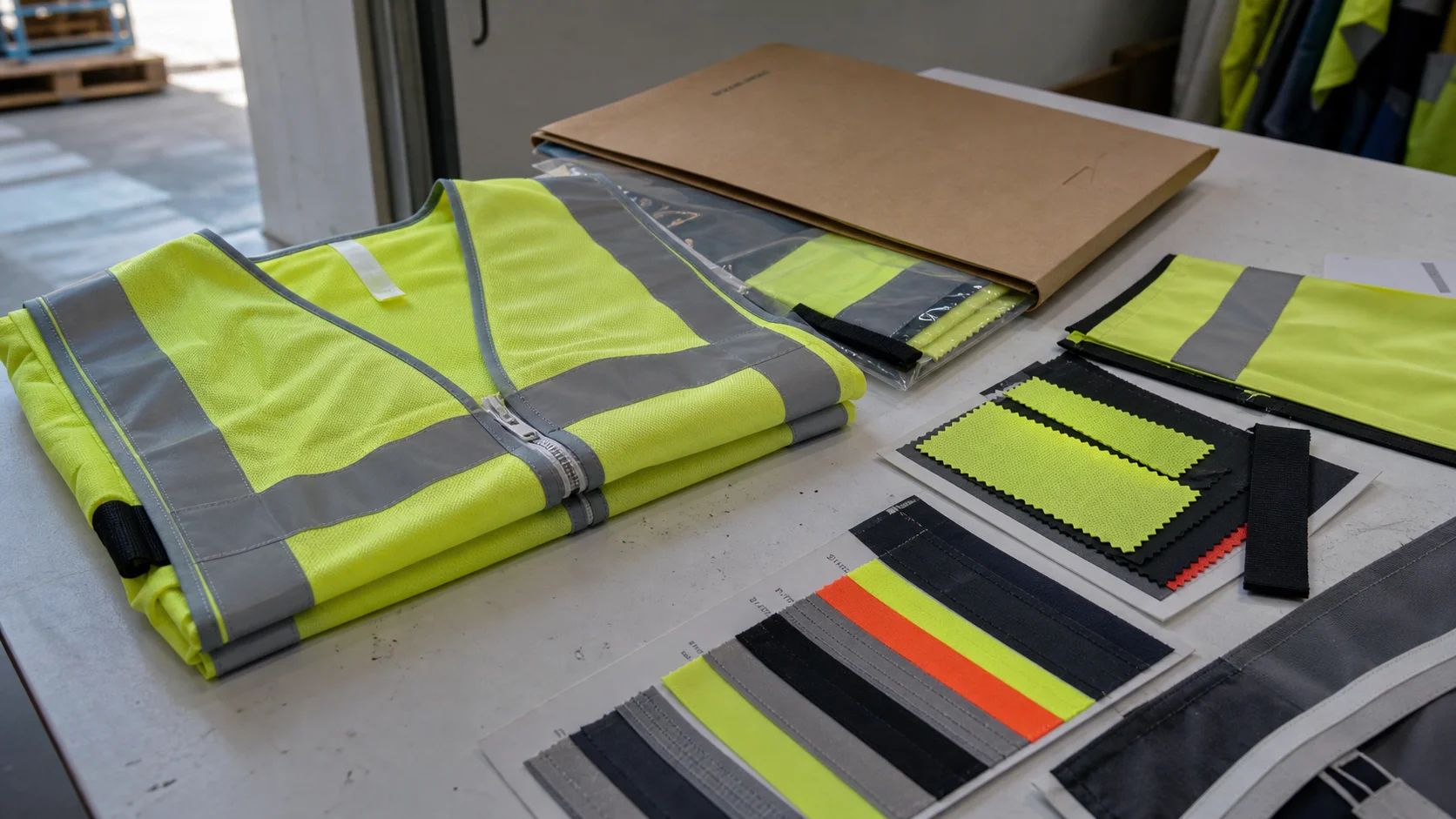
A sourcing review of safety vest trims for airport uniform teams, covering reflective tape, binding, color matching, compliance, MOQ, and cost controls.
Airport uniform programs put safety vest trim under more scrutiny than a basic high-visibility purchase. The trim is not just decoration. It affects visibility, wash durability, compliance perception, size grading, inventory planning, and the final cost per unit. For airport teams, the practical question is rarely “which trim looks best?” It is usually “which trim can be sourced consistently, approved quickly, and held to a predictable cost without creating inspection problems?”
This review is written for buying teams evaluating a safety vest supplier trim sourcing program for airport uniforms. The focus is on MOQ, cost, lead-time, and trim specification choices that matter when a vest must work across operations, ramp support, baggage handling, airside access, and contractor control. The best sourcing decision is usually the one that balances visibility and control with procurement reality. Cheap trim that fails after a few laundering cycles is expensive. Over-specified trim can delay approvals and inflate stock commitments.
Safety Vest Trim Sourcing for Airport Teams - MOQ, Cost & Sourcing manufacturing guide
Trim carries most of the functional value in a safety vest. The base fabric provides the carrier, but the reflective trim determines whether the garment is visible under headlights, floodlights, and low-angle dawn or night conditions. Airport operations make that performance more sensitive because work happens across mixed lighting, moving vehicles, wet surfaces, and frequent layering over uniforms or outerwear.
For sourcing teams, trim also affects the purchasing mechanics. Reflective tape, binding, piping, edge finish, and logo placement all touch different suppliers and different lead times. A vest that looks simple on a tech pack can still require separate trim sourcing, sewing capability, test reporting, and color control. That is where many programs lose time.
In airport settings, the buying decision should be driven by four questions:
Most safety vest programs use one of three trim approaches: retroreflective tape, decorative or functional piping, or a combination of both. The right choice depends on policy, visibility requirements, and what the supplier can actually source at scale.
This is the most common and most defensible option for airport teams. It reflects light back toward the source and is usually the core visibility feature. Buyers should specify width, color, performance standard, backing type, and wash durability. Wider tape usually improves conspicuity, but it can also increase cost and reduce sewing flexibility on smaller sizes.
Piping is useful when a lighter visual touch is desired or when the vest design needs edge definition without a broad tape panel. It is less dominant than tape and may not deliver the same visible area. It is usually better as a supplemental element than as the primary visibility feature for airport workwear.
Binding is often chosen to finish armholes, necklines, or front edges. It helps shape the garment and can improve durability at stress points. For procurement, the issue is colorfastness and shrink behavior. A binding that fades or puckers faster than the shell fabric weakens the uniform appearance, even if the reflective components remain acceptable.
Some programs choose segmented tape to improve flexibility and comfort. This can be useful in layered or high-movement roles. The tradeoff is supplier capability. Not every factory can apply segmented trim with consistent adhesion or stitch quality, and not every airport buyer wants to carry the added validation burden.
Airport buyers should not buy trim by appearance alone. The right question is whether the trim will still meet the program standard after sewing, washing, abrasion, and replenishment.
Airport uniform teams are not sourcing for one type of user. A single vest program may need to cover ramp staff, passenger service teams, baggage handlers, maintenance crews, traffic marshals, and temporary contractors. That creates a useful but strict buying rule: the vest must be easy to issue, easy to size, and hard to misuse.
Key requirements usually include high visibility, a stable size range, easy donning over outerwear, compatibility with radio clips or badge holders, and resistance to dirt and frequent washing. These needs influence the trim package. For example, a narrow reflective trim may be acceptable in low-duty environments, but airport operations often justify broader tape coverage because the vest must remain recognizable at a distance.
Where policy is strict, buyers should align trim choice with the user group. Do not over-engineer every vest to the highest spec if only one department needs that level. A uniform program that splits by role can reduce cost and improve stock control, provided the SKU count stays manageable.
Supplier reviews are stronger when the buyer asks for measurable trim data instead of general claims. A good purchase specification should define the trim clearly enough that another factory could quote the same item without guessing.
When the vest includes logos or lettering near the reflective area, ask for minimum clearances. Crowding trim against print creates visual clutter and can make approval harder. It also increases the risk that a new vendor will shift placement slightly on repeat orders.
MOQ is often the first constraint in trim sourcing. Reflective tape manufacturers, converters, and garment factories do not all work on the same quantity thresholds. A buyer may receive a low garment MOQ but still be forced into a larger trim purchase if the factory needs to import or custom-cut tape in minimum rolls. That mismatch is common and should be priced before sample approval.
Typical MOQ ranges vary by trim type and supplier setup. For standard reflective tape used in workwear, trim MOQ can start from a few hundred meters for stocked items and climb to several thousand meters for custom color, custom width, or branded performance requirements. Garment MOQ for safety vests may range from 300 to 1,000 units for repeatable programs, but some suppliers will quote higher if trim sourcing is custom or if grading across many sizes complicates cutting.
Cost drivers are straightforward, but buyers often underestimate their combined effect:
A practical sourcing decision is usually between a slightly higher unit price on a stocked trim and a lower raw trim cost with more inventory exposure. For airport teams, the stocked option often wins if replenishment speed and consistency matter. The cheapest piece is not always the best program cost.
Cost Factor Lower-Cost Choice Higher-Cost Choice Buyer Judgment Trim source Stock reflective tape Custom-certified tape Use stocked trim when the standard is already acceptable and repeat orders are expected. Attachment method Simple sewing Heat-seal plus sewing reinforcement Heat-seal can save time, but seam failure risk must be tested carefully. Design complexity Single tape layout Multi-panel trim layout Keep airport vests simple unless role differentiation clearly requires more detail. Order size Small pilot order Full program buy Pilot first if the trim source is new or the user group is operationally sensitive.Sample approval should be treated as a controlled process, not a courtesy step. Trim is easy to approve too quickly and hard to fix later in bulk production. A disciplined review usually includes a development sample, a pre-production sample, and then a pilot or top-of-production check if the order is operationally important.
A workable sequence is:
Buyers should also insist on a photo record of the approved sample from front, back, and side views. A simple image set reduces disputes when a reorder arrives and the trim shifts by a few millimeters. If the vest will be used across multiple airport zones, test it under actual lighting conditions rather than only in a showroom or office setting.
Lead time in trim sourcing is rarely just a sewing lead time. It is a chain of dependencies. If the trim must be custom made, the supplier may need time for material procurement, coating or lamination, slitting or cutting, color approval, lab testing, and then garment production. A buyer who only asks for sewing capacity will miss the real bottleneck.
Typical lead-time ranges vary widely. Stock trim on a repeat order can sometimes support a relatively short production cycle. Custom trim, especially if it requires a certified reflective performance level or custom color matching, can add several weeks before cutting even starts. Peak season demand, raw material shortages, and testing backlogs can extend the timeline further.
The sensible purchasing move is to separate the critical path from the nice-to-have items. If the trim spec is fixed, keep it fixed early. If the logo or pocket layout is still flexible, move those decisions out of the critical path. This keeps the program moving while preserving the core safety requirement.
Quality problems on safety vest trim are usually visible, but they are not always caught at the right time. One shipment may pass visual review and still fail after use because the adhesive lifts, the edge frays, or the reflective surface cracks. That is why inspection should include both appearance and construction checks.
The most common risks are:
Inspection should not stop at finished goods. Ask for incoming trim checks, in-line placement verification, and final audit criteria for critical dimensions. If the supplier is hesitant to define measurable checkpoints, that is a warning sign. Good factories welcome clear checkpoints because they reduce rework.
A supplier review for airport uniform trim sourcing should be practical, not theatrical. A polished presentation means little if the supplier cannot maintain trim consistency across repeat orders. The review should confirm where the trim comes from, how it is stored, how the factory tracks lots, and how changes are controlled.
Useful review questions include:
For teams comparing vendors, it is useful to separate garment capability from trim capability. A factory may sew vests well but still depend on a weak trim supply chain. Another vendor may have stronger material control but a slower sample process. The best fit depends on whether the priority is speed, consistency, or price. For airport programs, consistency usually deserves the highest weight.
For suppliers that also support broader uniform programs, the discussion should include service scope and account management. A useful starting point is the service overview at /services/, the company background at /about-us/, and a direct inquiry path at /contact-us/.
Trim sourcing becomes easier when the commercial terms are written clearly. The purchase order should not rely on broad language like “standard reflective trim” unless the approved standard is attached. The goal is to prevent substitutions and keep the reorder path clean.
Strong commercial terms typically include:
If the program is recurring, request that the supplier hold at least one reserved trim lot or keep a re-orderable spec on file. That reduces the risk of a small color or reflective shift on the next buy. Reorders fail most often when the original approval details were never documented well enough to replicate.
For airport teams, the best trim sourcing strategy is usually conservative. Start with a trim spec that is easy to repeat, easy to inspect, and easy to replenish. Do not chase novelty unless the operational value is clear. Reflective performance, consistency, and lead-time reliability matter more than minor design distinctions that procurement cannot control later.
If the supplier proposes a lower-cost trim but cannot explain wash durability, lot traceability, or sample approval discipline, the savings are probably false. If the supplier can provide a clear spec, reasonable MOQ, and a documented approval path, the purchase is more likely to survive the realities of airport use.
For teams building or revising a program, the right sequence is simple: define the trim standard, validate a sample under real conditions, confirm MOQ against forecast, and lock the reorder language before bulk production. That is the difference between a one-time purchase and a usable uniform program.
Get a free quote from Fabrikn — your trusted B2B clothing manufacturer with 10+ years of experience. MOQ as low as 200 pieces.
Get a Free Quote →Retroreflective tape is the most common choice because it provides clear visibility and is straightforward for suppliers to source and sew. Many airport programs use it as the primary safety feature, sometimes with additional binding or piping for edge finishing.
MOQ depends on whether the trim is stocked or custom. Stock reflective tape can be available in relatively small quantities, while custom width, color, or certified performance requirements can push trim MOQ into the low thousands of meters. Garment MOQ is usually separate and may range from a few hundred to about a thousand units, depending on complexity.
Check trim width, color, hand feel, reflective appearance, attachment method, placement, and wash durability expectations. For airport use, sample evaluation should also confirm visibility under actual lighting conditions and fit over the intended uniform layer.
Lead time changes when trim is custom made, when testing is required, when raw materials are not in stock, or when the factory depends on outside converters. The sewing operation may be fast, but the material chain often sets the real schedule.
The most common risk is trim failure after use, especially delamination, fraying, or misalignment. A vest can look acceptable at final inspection and still fail later if the trim was not validated for washing, abrasion, and production consistency.
Consistency should usually come first. A slightly lower unit price is not useful if the trim changes between lots, the supplier misses delivery windows, or the vest fails after normal use. For airport uniforms, repeatability is part of the real cost.