
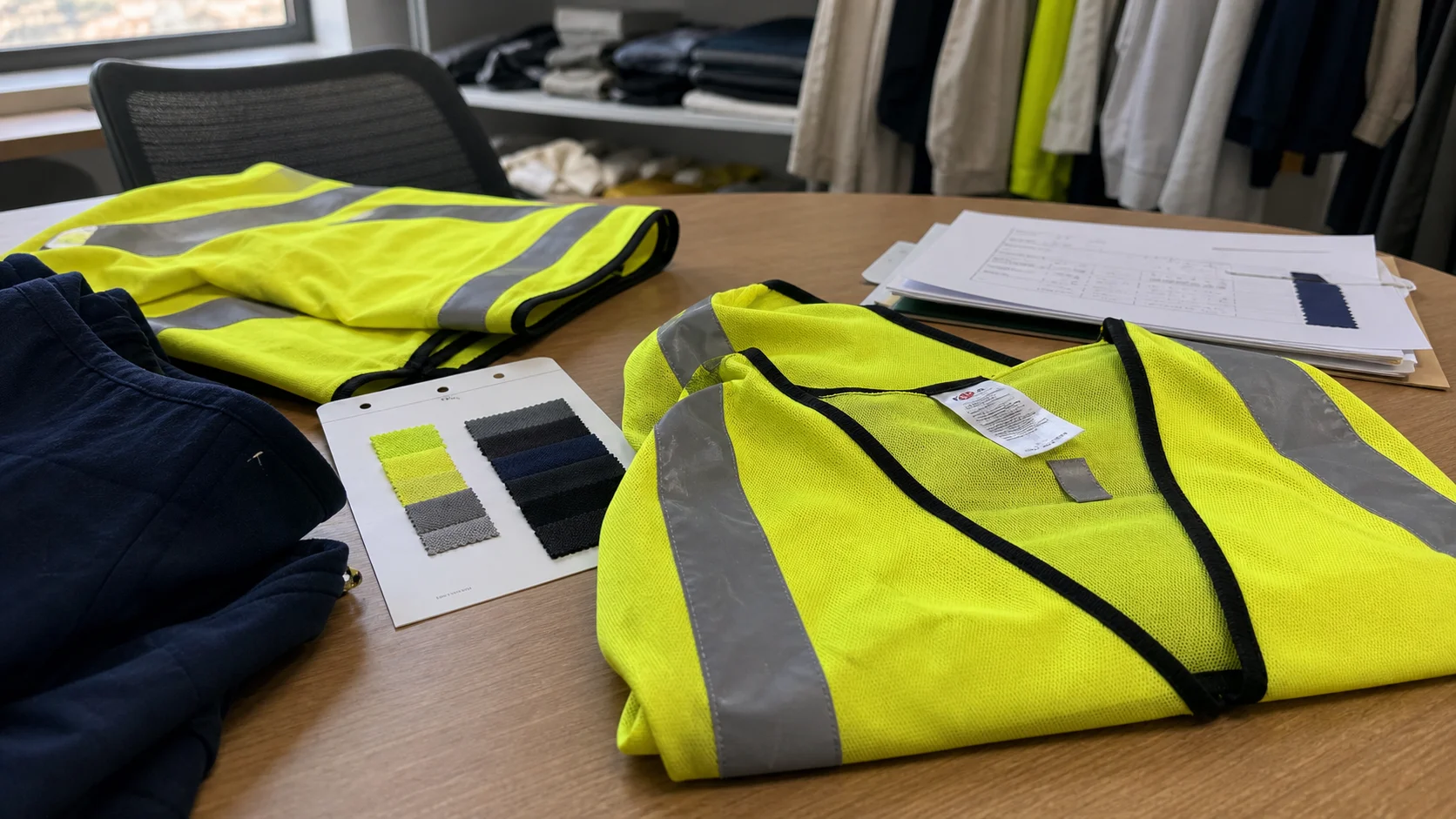
A sourcing-focused outline for buyers evaluating safety vest trim, reflective tape, binding, labels, and order details for cleaning crew programs with MOQ...
Safety Vest Trim Sourcing Review for Cleaning Crews - Fabrikn production reference
Safety vest order trim sourcing review for cleaning crews sounds like a narrow purchasing task, but it affects unit cost, delivery speed, field performance, and compliance positioning. For cleaning companies, janitorial contractors, facility service providers, and building maintenance teams, the vest is often a low-cost garment with high operational visibility. It identifies staff, supports basic site safety, and helps supervisors distinguish crew members in parking lots, loading areas, hospitals, airports, malls, warehouses, and commercial buildings.
The fabric gets most of the attention during early quoting. Buyers ask whether the vest is polyester mesh, solid woven, or lightweight knit. That matters, but trim decisions can create just as many problems. Reflective tape may fail inspection. Binding may pucker. Hook-and-loop closures may scratch uniforms or lose grip after washing. Labels may be missing required care information. Packaging may be too slow for rollouts across multiple sites. Small components can become the reason an otherwise simple safety vest order misses a launch date.
This sourcing review focuses on the practical trim side of safety vest buying for cleaning crews: minimum order quantities, cost tradeoffs, common specifications, sampling steps, lead-time dependencies, and inspection risks. It is written for B2B buyers who need clean purchasing decisions rather than decorative product language.
For buyers building a broader uniform program, it is useful to coordinate vest trim sourcing with garment development, decoration, and packing requirements from the start. Fabrikn’s apparel manufacturing support can be reviewed at fabrikn.com/services/, and buyers who need project-specific sourcing input can use fabrikn.com/contact-us/.
Cleaning crews use safety vests differently from road crews or construction teams. The garment may be worn indoors, outdoors, during early morning shifts, in dim service corridors, around moving carts, near loading docks, or in customer-facing buildings. The vest often needs to be visible without being bulky. It also needs to be easy to issue, replace, and launder.
Trim sourcing should reflect that operating environment. A high-spec reflective tape may be unnecessary for some indoor cleaning programs, while a very low-cost tape may create problems for night-shift crews working around parking areas. A zipper can look neater than hook-and-loop, but it raises cost and size grading complexity. Contrast binding can support brand identity, yet it may increase color matching work and minimums. Printed logos can be cheaper than embroidered patches, but reflective tape placement may restrict decoration areas.
The purchasing judgment is simple: do not over-specify a cleaning crew vest as if it were a highway safety garment unless that level is required. At the same time, do not treat it like a disposable promotional vest if workers need daily visibility and repeated wear. The best trim package is usually a controlled middle ground: reliable reflective tape, stable edge finishing, durable closure, compliant labeling, and packaging that supports distribution.
For cleaning crew safety vests, trim sourcing should be judged by visibility, wash performance, replacement cost, and delivery reliability—not by component price alone.
A safety vest quote should not only say “with reflective tape” or “with Velcro closure.” Buyers need a trim bill of materials that identifies width, material, color, placement, construction, packaging, and approval standards. Vague trim descriptions are one of the main causes of mismatched samples and invoice disputes.
For most cleaning crew programs, the highest-risk trims are reflective tape, binding, and closure. These parts affect both appearance and function. Labeling and packaging are lower-cost items but can still delay shipment if they are missing, incorrectly printed, or inconsistent with the purchase order.
MOQ planning is where many safety vest orders become less simple than expected. The garment factory may accept a modest order, but trim suppliers may have their own minimums for reflective tape, dyed binding, custom labels, printed packaging, or branded patches. A buyer should separate garment MOQ from trim MOQ during the first quote review.
Typical MOQ ranges vary by supplier, region, material availability, and customization level. For basic stock safety vest trims, factories may support orders from around 300 to 500 pieces per color. For custom colors, branded labels, special reflective tape layouts, or private-label packaging, practical MOQ often moves closer to 1,000 to 3,000 pieces. More complex programs with several sizes, colors, and site-specific packing may need higher quantities to keep unit cost stable.
Small orders can still be sourced, but buyers should expect fewer trim choices. If the order is 300 pieces and the buyer asks for custom neon binding, a custom woven label, a special reflective tape, and individual barcode packing, the quote may become inefficient. The factory may either raise the price sharply or push the buyer toward stock alternatives.
The better route is to decide which trim elements truly need customization. For cleaning crews, logo placement and vest color may matter more than custom binding. A standard reflective tape and standard edge finish can free budget for clearer branding or better packaging.
Safety vest trim cost is not only about the price of each component. It includes sourcing time, wastage, sewing labor, machine setup, rejected materials, and inspection effort. Two vests can look similar in a product photo but have very different production costs because the trim package is different.
For cleaning crew programs, the lowest unit cost is not always the best commercial choice. A very cheap closure can fail early and create replacement orders. Poor binding can make the vest look untidy in customer-facing environments. Low-grade reflective tape may be acceptable for basic identification but not for crews working around vehicles or loading areas.
The purchasing tradeoff should be based on use case. If the vest is mainly for indoor identification, prioritize clean finishing, color consistency, and easy distribution. If the vest is used around parking lots, warehouses, service roads, or night operations, allocate more budget to reflective performance and tape durability.
Reflective tape is the most important trim component in a safety vest sourcing review. It is also one of the easiest components to under-specify. A purchase order that says “reflective tape” is not enough. Buyers should state width, color, placement, application method, performance requirement, wash expectation, and whether test documentation is needed.
A cleaning crew vest may not need the same reflective trim used for road work. Still, if a buyer plans to claim compliance with a safety standard, the full garment design and materials must support that claim. Reflective tape alone does not make a vest compliant. Tape placement, background fabric color, garment area, sizing, and documentation all matter.
The main inspection risk is inconsistency. Tape can be slightly wavy, misaligned at side seams, too close to armholes, or uneven between sizes. On low-cost vests, some buyers tolerate minor visual variation. On branded cleaning crew uniforms, uneven tape placement looks unprofessional and may create complaints from end users. A clear tolerance, such as acceptable variation in tape position, should be included in the tech pack where possible.
Hook-and-loop closure is common because it is affordable, adjustable, and fast to sew. It works well for basic cleaning crew vests, especially when the garment is issued across mixed body types and worn over uniforms. The downside is wear over time. Hook-and-loop can collect lint, lose grip, and catch on delicate garments during laundering.
Zippers give a cleaner appearance and better front stability. They are useful for customer-facing cleaning crews in hotels, transport hubs, healthcare facilities, or corporate buildings. The tradeoff is cost. Zippers also introduce size and fit considerations because the vest front cannot adjust as easily as hook-and-loop.
Snaps are less common but can work for certain uniform looks. They add hardware cost and may require reinforcement. Front ties are usually the lowest-cost option, but they can look informal and may not suit professional cleaning teams.
Binding controls the vest’s finished appearance. It is usually applied around the armholes, neckline, hem, and front opening. Poor binding creates twisting, puckering, loose threads, or color mismatch. This is especially noticeable on fluorescent yellow, fluorescent orange, navy, black, or branded color combinations.
Stock black or matching fluorescent binding is usually the safest cost choice. Custom binding can strengthen brand presentation, but it adds MOQ pressure and lab dip approval. If the buyer is ordering multiple small batches, a custom binding color may create unnecessary replenishment problems.
Labels should be treated as production-critical trim. A missing care label can delay shipment. A wrong size label can create receiving problems. A brand label with an unapproved logo version can force rework. For private-label programs, confirm label type, artwork, dimensions, placement, language, care symbols, fiber content, and country-of-origin requirements before the pre-production sample.
Cleaning crew vests may be washed frequently or issued repeatedly to different workers. Heat-transfer labels can be comfortable, but they must be tested for adhesion. Woven labels are durable but may add cost and minimums. Printed care labels are practical for many basic programs.
Packaging is often ignored until the end of the order. That is risky for cleaning crew rollouts. If vests need to be distributed by site, team, shift, or size, packing instructions should be issued early. Bulk packing reduces cost, but it creates sorting work after delivery. Individual polybags with size stickers improve distribution but add labor and material cost.
For large facility service contracts, carton labels and size ratio packing can save time. A carton that clearly shows style, color, size, quantity, and destination is more useful than a slightly cheaper unmarked carton. Buyers should decide whether the priority is lowest landed cost or fastest deployment.
A clear sample process protects both buyer and supplier. Safety vests are simple garments, but trim errors are common when the approval path is rushed. The sample process should confirm not only garment shape but also trim quality, color, placement, branding, and packaging logic.
For urgent or low-MOQ orders, buyers may try to skip trim card approval. That can work if all trims are stock and the order is non-branded. It is not wise when reflective tape quality, custom labels, special binding, or compliance wording matters. A trim card is inexpensive compared with a rejected bulk order.
Pre-production sample approval is the key gate. The buyer should check tape alignment, thread color, binding finish, closure strength, label content, logo position, and overall workmanship. Written comments should be specific. “Looks good” is not enough if the buyer later disputes tape placement or label format.
Safety vest lead time depends on more than sewing capacity. Trim availability can control the schedule. A factory may be ready to cut and sew, but production cannot start if reflective tape, binding, labels, or packaging are not approved.
For basic cleaning crew vests using stock trims, sampling may take roughly 5 to 10 working days after details are confirmed, and bulk production may take around 15 to 30 working days depending on quantity and capacity. Custom trim programs can add 1 to 3 weeks, especially when dyed binding, printed labels, special reflective tape, or branded packaging must be produced. Shipping method and destination add another layer to the schedule.
Lead time also depends on size spread. A vest order with five sizes and balanced ratios is easier than one with unusual size allocations, several colors, and destination-specific packs. Buyers should provide size breakdowns early. Waiting until after sample approval to confirm size ratios may leave the factory unable to reserve enough trim.
A practical sourcing rule: do not approve a delivery date until the supplier confirms bulk trim availability. Sewing speed is not useful if reflective tape is still waiting at the trim supplier.
Cleaning crew safety vests are often cost-sensitive, but inspection should not be skipped. The most common problems are not complicated. They include tape misplacement, weak stitching, uneven binding, incorrect labels, wrong size ratios, color variation, and dirty packing. These defects are easy to catch before shipment if the inspection checklist is clear.
Wash testing should be considered if the vest is intended for repeated laundering. Some low-cost reflective trims look acceptable when new but lose performance or appearance after washing. Hook-and-loop closures can also degrade or collect lint. If the cleaning crew uses industrial laundry services, the trim package needs to be reviewed more carefully than for occasional wear.
AQL inspection can be used for larger orders, but buyers should define critical, major, and minor defects in plain terms. For example, wrong reflective tape type, missing label, incorrect logo, or wrong color may be treated as major or critical depending on contract requirements. Loose thread may be minor unless it affects seam security or appearance standards.
A supplier quoting the lowest vest price may not be the best choice if the trim package is vague. Buyers should compare quotes based on full specification, not only unit price. A quote that includes tape grade, tape width, binding type, closure details, label format, packing method, sample process, and lead time is more useful than a cheap one-line offer.
Supplier selection should also consider communication discipline. Safety vest orders for cleaning crews often involve fast deployment and repeat replenishment. A supplier that confirms trim availability early, flags MOQ conflicts, and provides sample photos clearly is usually easier to manage than one that simply agrees to every request.
There is a clear tradeoff between flexibility and price. A supplier using standard trims may offer faster lead time and lower MOQ, but fewer customization options. A supplier willing to build a fully custom trim package may produce a better branded vest, but the buyer should expect higher MOQ, longer sampling, and stricter approval requirements.
For companies developing a cleaning crew uniform program rather than a one-off vest order, it may help to align sourcing expectations with a manufacturing partner that understands apparel construction, trim sourcing, and order execution. More background on Fabrikn’s role and sourcing approach is available at fabrikn.com/about-us/.
Before placing a safety vest order for cleaning crews, buyers should lock the trim package in writing. The goal is not to create unnecessary paperwork. The goal is to prevent small trim decisions from becoming production delays or field complaints.
The best purchasing decision is rarely the most customized vest at the lowest possible quantity. For cleaning crews, the strongest sourcing plan usually keeps the trim package simple where it can be simple and precise where it must be precise. Standard reflective tape, dependable binding, practical closure, correct labels, and clear packing will outperform a complicated trim package that strains MOQ and lead time.
If the vest order is part of a larger uniform rollout, buyers should connect trim decisions to replenishment planning. A vest that is easy to repeat is often more valuable than a vest that is slightly more distinctive but difficult to reorder. Consistency matters when crews are spread across multiple buildings or service contracts.
Get a free quote from Fabrikn — your trusted B2B clothing manufacturer with 10+ years of experience. MOQ as low as 200 pieces.
Get a Free Quote →For basic safety vests using stock trim, a typical MOQ may start around 300 to 500 pieces per color. Custom logos, dyed binding, special reflective tape, private labels, or detailed packing can move the practical MOQ toward 1,000 to 3,000 pieces or more. MOQ varies by supplier and should be confirmed by trim item, not only by garment quantity.
Reflective tape is usually the most important trim because it affects visibility, appearance, and possible compliance claims. Binding and closures are also important because they influence durability and daily wear comfort. Labels and packaging should not be ignored because errors there can delay shipment or create distribution problems.
Hook-and-loop is usually cheaper and more adjustable, making it practical for basic crew issuance. Zippers look cleaner and hold the vest more securely, but they cost more and require better size planning. For tight budgets and mixed users, hook-and-loop is often the practical choice. For customer-facing teams, zippers may justify the added cost.
Sometimes, but it is often inefficient. Custom reflective tape may require supplier minimums that exceed the garment order quantity. For low-MOQ orders, stock silver reflective tape is usually the safest option. If custom tape is required, buyers should expect higher cost, longer lead time, and more approval steps.
A basic order with stock trims may take around 5 to 10 working days for sampling and roughly 15 to 30 working days for bulk production after approvals, depending on quantity and factory capacity. Custom trims, special packaging, label development, and shipping method can extend the timeline. Bulk trim availability should be confirmed before committing to a delivery date.
The pre-production sample should be checked for reflective tape width and placement, binding quality, closure function, logo position, label accuracy, fabric color, size fit, and overall workmanship. If packaging matters, the buyer should also approve folding, polybag labeling, carton labeling, and barcode format before bulk packing starts.
That depends on the work environment and any contractual or regulatory requirements. Indoor identification vests may not need high-performance certified tape. Crews working around vehicles, loading areas, or night operations may need stronger visibility specifications. Buyers should avoid making compliance claims unless the full garment design and documentation support them.
Use stock reflective tape, stock binding colors, simple hook-and-loop closure, standard labels, and bulk packing where appropriate. Keep customization focused on the parts that matter most, such as logo placement or vest color. Cutting cost from reflective quality, stitching, or label accuracy can create bigger problems than it saves.