
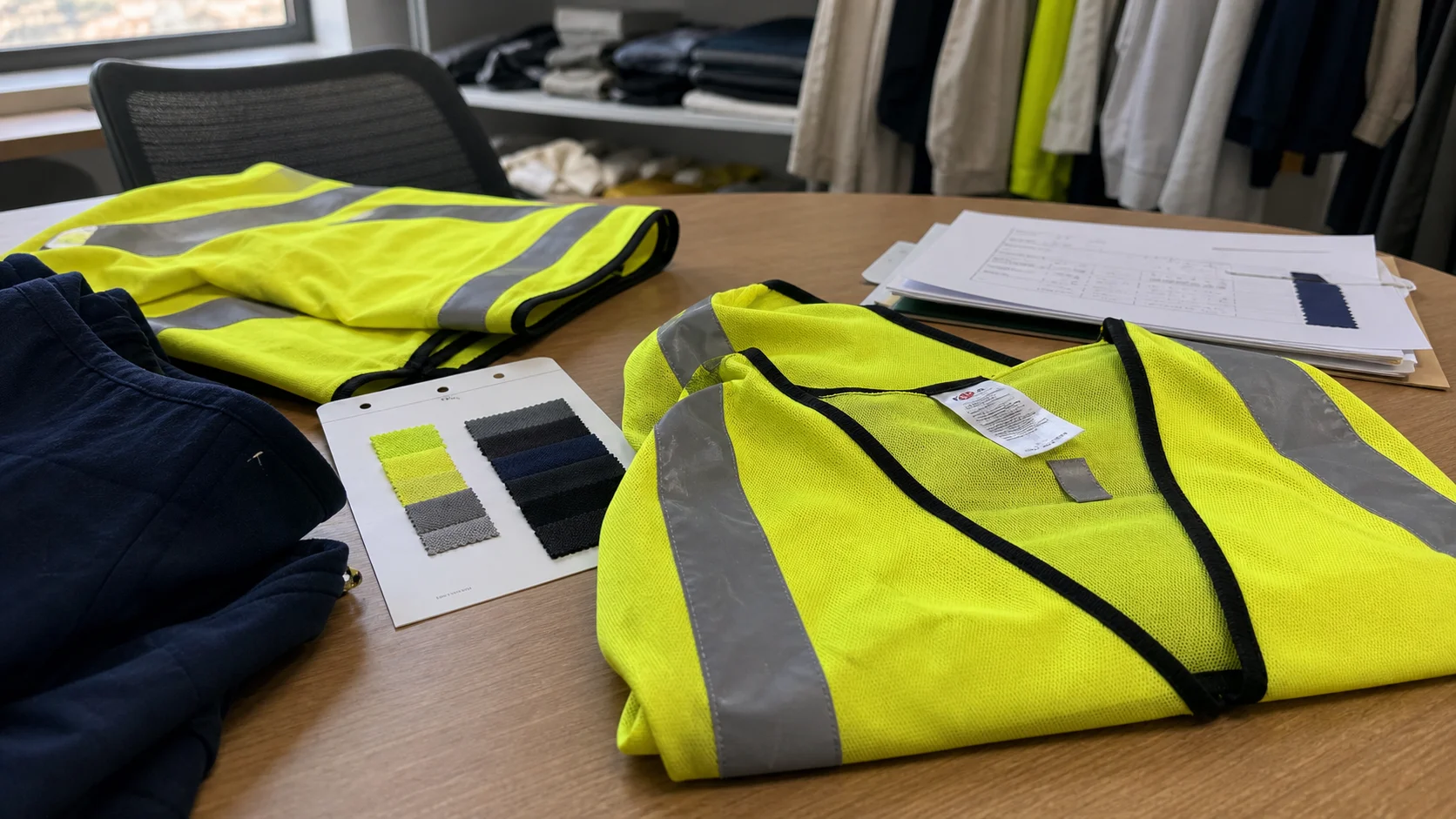
A sourcing-focused review of hi-vis safety vest wash performance for cleaning crews, covering reflective durability, colorfastness, logo methods, MOQ...
Cleaning crews put safety vests through a different kind of wear than warehouse or road crews. The garment gets hit with repeated laundering, detergent chemistry, tumble drying, and constant abrasion from carts, sprayers, buckets, and straps. A vest that looks acceptable on day one can fail quickly once the wash cycle starts to expose weak stitching, poor reflective tape adhesion, or fabric shrinkage. For buyers sourcing at scale, the wash test is not a formality. It is one of the clearest ways to judge whether a safety vest will survive real use.
This review focuses on cleaning crews safety vest wash test review requirements from a sourcing standpoint: what to ask suppliers for, how to read test results, where costs tend to move, and what can go wrong when minimum order quantity is tight and timelines are short. If you are comparing vendors, the right approach is to treat wash performance as part of the commercial decision, not just the compliance file. Useful starting points for sourcing support include services, about us, and contact us.
Safety Vest Wash Test Review for Cleaning Crew Buyers - Fabrikn production reference
A wash test measures how a vest performs after repeated laundering. For cleaning crews, the important question is not whether a vest survives one cycle. It is whether the garment still fits, remains visible, and holds together after multiple cycles under routine commercial laundering conditions. That usually means checking colorfastness, shrinkage, seam integrity, reflective performance, and any printed or heat-applied branding.
Buyers should distinguish between a basic home-laundry test and a proper commercial laundering review. Cleaning crews often wash uniforms more often than general labor teams, and many facilities use hotter water, stronger detergents, and faster drying cycles. A vest that passes a casual home wash can still fail in a work setting.
In sourcing terms, a useful wash test review should answer four questions:
Cleaning crews work around moisture, chemicals, dust, and physical contact with equipment. Vests get damp, soiled, and washed more often than many other PPE items. That creates a practical sourcing problem: lower-cost materials may look fine in a spec sheet, but repeated laundering exposes shortcuts in the construction.
There is also a visibility issue. A vest that loses brightness or becomes frayed after washing can undermine the reason it was purchased in the first place. For facilities that rely on contractors, turnover can be high. Uniforms are reused by different workers, so the vest has to stay presentable and functional longer than a single assignment cycle.
For buyers, the tradeoff is straightforward. A lower unit price can look attractive at order placement, but replacement costs, worker complaints, and failed inspections often erase that saving. The better sourcing decision is usually a vest that balances durable fabric, stable reflective tape, and realistic wash performance with a MOQ that fits the program.
MOQ for safety vests varies by supplier structure, print method, and fabric availability. A simple unbranded vest in a standard color may start around 300 to 1,000 pieces per style and color. Custom colors, special tape patterns, or branded labels can push the MOQ higher, often to 1,000 to 3,000 pieces. If the vest includes zipper fronts, pockets, radio loops, or custom reflective layouts, buyers should expect tighter production constraints.
Cost is usually driven by a handful of factors:
Cleaning crew programs often benefit from a simpler design. Less hardware usually means fewer failure points in the wash. A vest with fewer pockets and fewer sewn-on parts can be easier to keep consistent at scale. That said, if workers need access to ID holders or tool loops, those features should be designed for wash durability from the start rather than added as an afterthought.
Specification area Common buyer choice Tradeoff Base fabric Polyester mesh or tricot Mesh is lighter and cheaper, tricot feels sturdier but costs more Reflective tape Sew-on silver tape Better wash retention than some heat-applied options Closure Hook-and-loop or zipper Zippers can be more durable, hook-and-loop is easier and cheaper Branding Small chest print Lower cost, but print durability depends on ink and wash method MOQ 300 to 1,000+ units Lower MOQ usually means fewer customization choicesSample approval is where many sourcing problems can still be avoided. A vest should not move to bulk until the buyer has reviewed both appearance and wash behavior. The process is usually straightforward, but it needs discipline.
A sensible approval sequence looks like this:
Buyers should be cautious when a supplier offers a visual sample that does not reflect the final construction. A sample made from better material than the bulk order creates false confidence. It is better to ask for the exact fabric lot or at least the same fabric construction and tape type before moving forward.
The safest bulk order is the one approved against a realistic sample, washed under the intended care conditions, and documented before production starts.
For large programs, a pre-production sample pack should also include label mockups, carton marks, and size breakdown confirmation. Small errors in labeling or packing can become expensive when units are distributed across multiple cleaning teams.
Wash performance starts with material choice. Buyers do not need to over-spec every detail, but there are a few areas that deserve attention.
Polyester is common because it dries fast, resists many laundering problems, and holds color reasonably well. Mesh constructions are lighter and improve breathability, which matters for cleaning crews working indoors or in warm environments. Tricot or denser warp-knit options give a more substantial feel and can look better after repeated washing, though they usually increase cost.
Avoid relying on vague language like "high quality polyester." Ask for the fabric weight in GSM, the weave or knit type, and the tolerance range. A small difference in GSM can affect handfeel, shrinkage, and long-term appearance.
Tape quality often determines whether the vest survives wash cycles. Buyers should ask whether the tape is stitched on or heat applied, what standard it is built to, and how many wash cycles the supplier can document. Some tapes hold up well in repeated laundering, while cheaper versions start to peel, crack, or lose reflectivity earlier than expected.
If the vest is for cleaning crews rather than construction or traffic control, the visibility requirement may be moderate, but the wash frequency is usually higher. That makes tape durability more important than elaborate styling.
Seam failure is a common issue after repeated washing. Thread quality, stitch density, and reinforcement at stress points matter. Armholes, side seams, shoulder joins, and tape edges should be checked carefully. A buyer should request a stitch specification rather than assuming all sewn vests are built the same.
Care labels, brand labels, and size tags should be resistant to laundering. Poor labels can fade, curl, or detach. If the vest includes hook-and-loop closures, the tape must be attached securely and tested for repeated opening and closing. Zipper pulls and plastic parts should be checked for heat tolerance if the laundry process uses higher temperatures.
Most wash failures are predictable. Buyers who know what to look for can reduce claim risk before shipment.
Some failures are cosmetic, but buyers should not dismiss them too quickly. A vest that looks tired after a few washes can create pressure for early replacement, which increases annual spend even if the initial unit price was low. Cosmetic degradation also tends to correlate with broader durability problems.
One point worth emphasizing: wash test results should be interpreted in context. A vest may be acceptable after 5 or 10 washes in a simple care cycle, but that may be inadequate for a cleaning team that launders uniforms every few days. Matching the test to the real use case matters more than chasing a generic benchmark.
Suppliers often describe their vest as "washable" or "durable after many washes." Those claims are too vague to support a purchasing decision. A better review asks for documentation and process detail.
Use this checklist when evaluating a supplier:
Buyers should be cautious of one-page test summaries with no method detail. A real wash review is traceable. It should make clear what was tested, how, and against what acceptance criteria. If a supplier cannot explain the test setup, the result is hard to trust.
It helps to compare suppliers on more than wash claims alone. Production capacity, lead-time discipline, and responsiveness to revisions matter just as much. For buyers who need faster quoting or development support, it can be useful to work through a sourcing partner that can coordinate design checks, sampling, and order communication. See services for a broader view of sourcing support.
Before a bulk order is released, a buyer should treat the vest like a production item, not a sample. That means checking for repeatability across size runs and cartons.
Focus on these inspection points:
Inspection risk increases when order quantity is split across multiple production lots or when the supplier substitutes materials late in the process. A clean approved sample is only useful if the bulk production matches it. Buyers should make material substitution a formal approval point, not a casual update.
Lead time depends on several variables: whether the fabric is in stock, whether reflective tape is standard or custom, whether artwork is ready, and whether the factory must run a wash-test iteration before cutting bulk. For a straightforward order, sampling and production may move quickly. For a customized vest, expect the schedule to stretch when the supplier needs more time for lab verification or material procurement.
Not every cleaning crew needs the most expensive vest. Some orders are straightforward uniform refreshes, and the buying target is simply decent durability at controlled cost. Still, there are cases where paying more is the rational choice.
Pay more when:
Saving a small amount per unit rarely matters if the vest fails early. A stronger fabric, better tape, and more controlled stitching usually cost more up front, but they can reduce reorders and field issues. Buyers should think in terms of total program cost, not only landed unit cost.
That same judgment applies to supplier selection. A vendor that can explain construction choices, sampling steps, and wash performance clearly is usually a better bet than one that simply offers the lowest quote. For buyers who want to compare development support or request a quote, the contact path at contact us is a practical starting point.
These questions usually surface the important issues fast:
A safety vest for cleaning crews needs more than basic visibility. It needs to survive repeated laundering without losing fit, function, or appearance. That makes wash testing a core part of sourcing, especially when the order will be worn, washed, and reused across multiple shifts. The buyers who get this right do not rely on generic claims. They ask for material detail, realistic samples, and documented wash behavior before approving bulk.
The practical approach is simple: keep the design clean, set a realistic MOQ target, control the sample approval stage, and review wash test results with skepticism. That usually produces a better vest and fewer surprises after delivery.
Get a free quote from Fabrikn — your trusted B2B clothing manufacturer with 10+ years of experience. MOQ as low as 200 pieces.
Get a Free Quote →There is no universal number, because it depends on the laundering method and the wear pattern. A useful buyer target is the number of washes the garment is expected to see during its normal service life. For cleaning crews, that can be significantly higher than occasional-use workwear, so the test should reflect frequent laundering rather than a minimal benchmark.
Many suppliers start around 300 to 1,000 pieces for a standard style, with higher minimums for custom fabric, special tape layouts, or branded details. The exact MOQ depends on whether the factory is using in-stock materials and how much setup is needed.
In many cases, sewn tape offers better mechanical retention because the stitch line helps hold the tape in place. The final result still depends on tape quality, sewing consistency, and wash conditions. Some heat-applied systems perform well, but buyers should not assume that all adhesive-backed tape will last equally well.
Check shrinkage, color change, seam integrity, tape adhesion, print durability, closure function, and general appearance. A sample that looks acceptable before washing can still fail on fit or visibility afterward.
It can be useful, but only if the method is clear. Ask for cycle count, temperature, detergent, drying method, and whether the test was run on the exact production material. A vague claim is not enough for purchasing approval.
The most common mistake is choosing the lowest-cost vest without checking how it handles repeated laundering. Early tape failure, shrinkage, or fading usually ends up costing more than a better-built garment would have cost at purchase.