
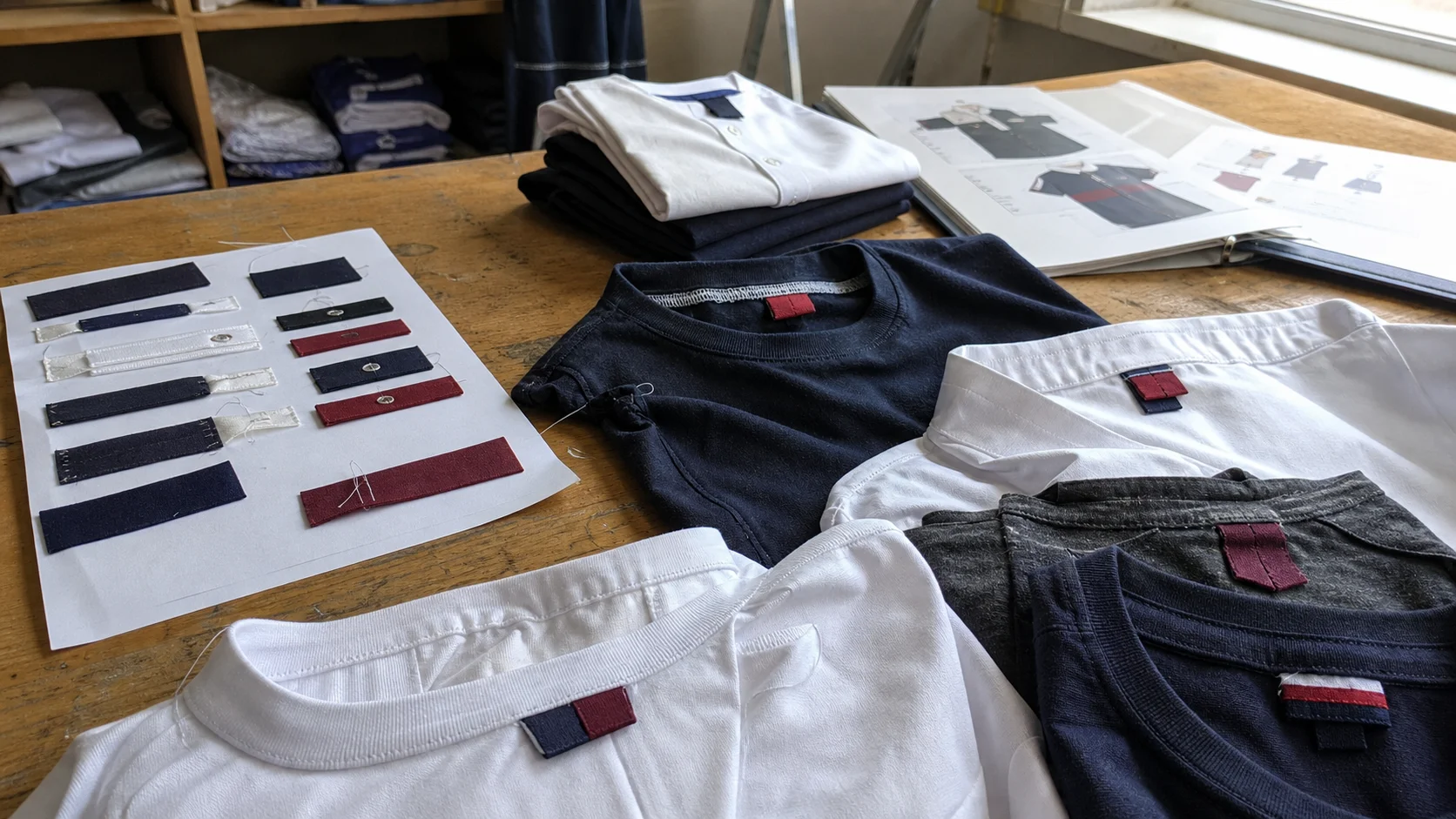
A sourcing-focused outline for school operations teams evaluating back neck tab trim for decorated apparel programs, including trim materials, print...
Back Neck Tab Trim Sourcing Review for Schools - Decoration & Printing manufacturing guide
Back neck tab trim is a small garment detail, but it can create large sourcing problems for school operations teams. It sits at the inside back neck of a polo, sweatshirt, PE top, sports jersey, house shirt, cardigan, fleece, or staff uniform piece. It may carry a school name, size color code, year group marker, care instruction prompt, brand message, anti-mix-up identification, or simply a decorative stripe that makes the garment look more finished.
For schools, the sourcing review should not treat back neck tab trim as a design afterthought. The wrong tab can irritate students, fail wash testing, delay production, create size-label confusion, or push a uniform item outside budget. A practical sourcing process looks at trim type, attachment method, artwork control, minimum order quantities, sampling, inspection points, and reordering discipline before bulk production starts.
This review is written for school operations teams, uniform coordinators, procurement managers, bursars, PE departments, and buyers working with apparel manufacturers or decoration suppliers. The focus is Decoration & Printing, but the same purchasing discipline applies whether the tab is printed, woven, heat-transferred, folded, or sewn into a neck seam.
School apparel is handled differently from general fashion merchandise. It is washed frequently, worn by students who may be sensitive to scratchy labels, distributed across many sizes, and often reordered in smaller top-up quantities after the main annual buy. A neck tab that works for a fashion capsule may not work for a school uniform program.
The back neck area is also a high-contact zone. Students feel the trim directly against the skin, especially on polos, T-shirts, baselayers, and PE tops. If the trim edge is stiff, poorly sealed, or badly positioned, complaints can reach the school office quickly. Parents may not describe the issue as “trim failure,” but they will report that the shirt is itchy, the label is peeling, or the neckline feels rough.
Back neck tab trim also affects warehouse and classroom operations. Color-coded tabs can help separate house groups, sizes, or garment categories. A printed tab can reduce the need for separate sewn labels. A woven tab can reinforce brand consistency across schoolwear ranges. The value is real, but only if the trim is specified clearly and tested under realistic washing and wearing conditions.
Practical purchasing rule: if the tab touches the student, test comfort and wash durability before approving bulk. If the tab supports identification, test legibility after repeated laundering.
Back neck tabs are not all the same. The right option depends on garment type, budget, branding requirement, production volume, and the age group wearing the product.
Woven tabs are commonly used where a school wants a durable, premium-looking trim. They are made with yarns woven into the label or tab design, usually polyester, cotton-polyester, or satin-style woven constructions. They can be center-folded, end-folded, loop-folded, or straight-cut depending on how the factory attaches them.
The advantage is durability. Woven tabs usually withstand repeated washing better than low-grade printed labels. They also give a clean schoolwear finish. The tradeoff is that fine text can become difficult to read if the artwork is too small. Complex crests, thin motto lines, and detailed emblems may need simplification.
Printed tabs are useful when the school needs more text, care symbols, batch codes, or variable information. They can be printed on satin, cotton tape, nylon tape, or polyester tape. They are usually lower cost at scale than woven detail when the design contains small text.
The main risk is print durability. Poor ink selection, weak curing, or unsuitable substrate can lead to fading, cracking, or transfer loss. Printed tabs should be wash tested before bulk approval, especially for white-on-dark or dark-on-light contrast requirements.
Heat transfer labels are popular for T-shirts, polos, and sportswear because they can feel smoother than sewn labels. They are applied with heat and pressure directly to the inside back neck area. This approach can remove the irritation associated with a physical label edge.
The buying risk is application control. Temperature, pressure, dwell time, fabric compatibility, and operator consistency all matter. A transfer that looks good after application may peel after 10 to 20 washes if the process is weak. Stretch fabrics also need compatible transfer materials, otherwise cracking can appear around the neck.
Grosgrain and twill tape can be used as decorative back neck tabs or neck seam covering. They are often visible as a short folded tab or as a longer back neck tape. This option can add structure and a traditional schoolwear look.
The tradeoff is bulk. Heavy tape can feel too thick on lightweight polos or T-shirts. It may be better suited to sweatshirts, rugby shirts, jackets, fleece, and outerwear. Buyers should check whether the tape creates seam ridges or rubbing at the neck.
Jacquard tape can carry repeated school initials, stripes, or brand patterns. It works well where the school wants a consistent identity across a range. For example, the same tape concept may appear on a sweatshirt, sports jacket, and staff fleece.
This option can raise minimum order quantities because the tape is custom woven in continuous rolls. It is a good choice for multi-year programs, not for one-off small runs unless the supplier already holds compatible tape stock.
Because this sourcing review sits within Decoration & Printing, the decoration method should be considered early. Back neck tabs may be small, but they require the same artwork discipline as larger logos.
Screen printing works for simple artwork, clear text, and solid colors. It can be cost-effective where the same tab is used across multiple sizes and styles. The print can be strong if the ink is suitable for the tape and properly cured.
Screen printing is less flexible for variable data. If each year group, house, or size needs a separate version, screen setup costs and production complexity rise. It is best for stable designs.
Digital printing can reproduce more detail and handle smaller custom runs. It can be useful for school crests with gradients or multi-color artwork. Buyers should be cautious with color accuracy and wash resistance. Digital samples can look attractive, but bulk repeatability depends on the supplier’s print control and substrate consistency.
Heat transfer neck labels are often used when comfort is the priority. For school sportswear, this can be a practical option because the inside neck area stays smoother. The purchasing decision should account for fabric composition. Polyester performance fabric, cotton-rich jersey, interlock, pique, and fleece can all behave differently under heat.
Woven execution is not technically printing, but it competes with printed tabs in sourcing decisions. A woven tab can look more permanent and schoolwear-specific. It is usually better for simple initials, stripes, or short school names than for complex crests with small shield details.
Some sportswear suppliers offer silicone, raised, or embossed neck trims. These can look modern, but schools should be careful. Raised surfaces can irritate the neck, trap lint, or fail if poorly bonded. They may be suitable for premium teamwear, but they are rarely the safest default for everyday school uniform.
A school operations team does not need to become a textile laboratory, but it does need a clear trim specification. Without a written spec, suppliers may substitute tape, change print inks, or adjust attachment methods between orders.
Specification Area What to Confirm Why It Matters Trim material Polyester woven, satin printed tape, cotton tape, heat transfer, twill tape, or grosgrain Controls comfort, durability, cost, and wash behavior Width and length Typical tab width may range from 10 mm to 30 mm; length depends on fold and artwork Affects readability, seam bulk, and neck comfort Fold type Center fold, end fold, loop fold, mitre fold, straight cut, or heat-sealed edge Determines attachment method and edge feel Artwork size Minimum readable text height, line thickness, logo simplification, color references Prevents illegible crests and inconsistent branding Color standard Pantone reference, approved lab dip, physical swatch, or supplier standard color Reduces mismatch with school colors Attachment method Sewn into neck seam, topstitched, coverstitched, heat-applied, or bonded Controls durability and wearer comfort Wash requirement Domestic wash cycles, tumble drying expectations, ironing guidance, colorfastness School garments face frequent laundering Compliance Fiber content, care labeling, restricted substances, age-related safety concerns Protects the school and supplier from avoidable riskFor younger students, edge softness should carry more weight than premium appearance. For older students and staff uniforms, branding and finish may matter more. For PE and sportswear, stretch, sweat, and repeated laundering become the main test points.
Schools often have official crest files, but not all crest artwork is suitable for small trim. A neck tab is a restricted space. Thin outlines, tiny Latin text, detailed animals, and multi-section shields may blur when woven or printed at small scale.
The supplier should provide a trim artwork proof before sampling. This proof should show actual tab size, fold lines, logo placement, text size, and color callouts. If the school has strict brand standards, the operations team should send the supplier the approved logo file and color references at the start, not after sampling.
Back neck trim can fail even when it looks correct. Scratchy yarn, stiff tape, sharp heat-sealed corners, exposed label edges, and heavy seam allowance can all create complaints. The issue is more common on lightweight garments and close-fitting sportswear.
Ask for hand-feel samples if the trim is new. For heat transfer tabs, check whether the print feels rubbery, sticky, cracked, or raised after washing. For woven tabs, check whether the cut ends are soft enough and whether the label curls.
Minimum order quantities vary by supplier, trim type, artwork complexity, and whether the tab is custom-made or selected from stock. Schools should treat the following as typical market ranges, not fixed rules.
Trim Type Typical MOQ Range Best Use Case Main Tradeoff Stock size or care label with simple print 100 to 500 pieces Small replenishment runs and budget programs Limited branding and less distinctive finish Custom printed satin tab 500 to 1,000 pieces School name, size, and care details Print durability must be tested Custom woven tab 1,000 to 3,000 pieces Stable uniform programs and premium appearance Higher setup effort and less fine detail Custom jacquard neck tape 1,000 to 5,000 meters or more Multi-style school ranges and long-term programs Excess inventory risk if designs change Heat transfer neck label 300 to 1,000 transfers Sportswear, PE tops, and comfort-focused garments Application control is criticalFor schools, the strongest buying position usually comes from consolidating trim use across several garments. If the same back neck tab can work on a polo, sweatshirt, and PE top, MOQ pressure improves. If every house, year group, and department requires a separate tab, the supplier may quote higher setup costs or longer lead times.
Bulk purchasing can reduce unit cost, but it creates obsolescence risk. School names, branding rules, academy trust identities, sponsor logos, and house colors can change. Do not overbuy custom trim if a rebrand is under discussion or if the school is reviewing uniform policy.
A low unit cost is not always the best value. A cheaper printed tab that fades early can create parent complaints and replacement requests. A premium woven tab may be unnecessary for temporary event shirts or short-run leavers’ apparel. The correct choice depends on garment lifespan and use frequency.
A disciplined sample process prevents most back neck tab problems. Schools should avoid approving bulk production from a flat artwork proof alone. The trim needs to be reviewed on the actual garment or, at minimum, on the same fabric and seam construction.
The approval record should be simple but clear. A photo in an email is helpful, but it is not enough for complex orders. Keep the approved sample, or at least store detailed photographs showing the trim, placement, inside neck construction, and any color standard used.
Look first at comfort. Run a finger across the tab edge, the seam allowance, and the stitching. If it feels sharp in hand, it will probably feel worse to a student during a full school day.
Look next at placement. The tab should sit straight and centered unless the design intentionally places it elsewhere. A crooked back neck tab is a visible quality signal when parents inspect new uniforms. It also suggests weak production control.
Then check readability. Size, school name, house color, and care details should remain legible after washing. Printed text that looks fine before wash may soften or blur. Woven text that is too small may look broken from the start.
Back neck tab trim can affect the whole garment production schedule. It may be small, but the garment factory often cannot close the neck seam or complete finishing until the trim is available.
Typical custom trim lead times may range from 7 to 21 days after artwork approval for standard printed or woven labels. More complex jacquard tape, special yarn colors, silicone trims, or imported materials may take longer. Garment production lead time then depends on fabric availability, cutting schedule, decoration queue, sewing capacity, inspection, packing, and shipping method.
For school uniform projects, timing is especially sensitive before the start of term. Production calendars can become crowded between spring and late summer. A trim approval delay in May or June may cause a delivery problem in August.
The safest schedule gives trim sourcing its own approval milestone. Do not bury it inside general “branding approval.” A crest embroidery approval and a back neck tab approval are different decisions with different risks.
Back neck tab inspection should be part of final quality control. Schools may not inspect every garment themselves, but they can tell suppliers what must be checked before shipment.
Inspection should include both visual review and basic handling. Pulling hard on every tab is not practical and may damage garments, but a light seam-security check on sampled units is sensible. For heat transfer labels, inspectors should check adhesion at the edges and confirm that the transfer has not scorched or distorted the fabric.
Suppliers may use AQL inspection methods for bulk orders. This can be appropriate, but the school should define what counts as a major or minor defect. A missing or wrong back neck tab may be a major defect if the tab carries the size, school identification, or care information. A slightly uneven tab may be minor if it does not affect wear, legibility, or brand acceptability.
For smaller school orders, a tighter practical inspection may be more useful than a formal statistical process. Ask the supplier to check 100% of garments for correct trim version if several tab types are being used in one production run.
Good suppliers should be able to explain how the tab will be made, attached, tested, and controlled. School operations teams do not need to accept vague answers. If the tab is custom, the supplier should provide enough detail for repeat ordering and future comparison.
School buyers comparing manufacturing and decoration support can review broader production capabilities through Fabrikn’s services page. For teams still defining supplier requirements, the about us page gives context on the company’s apparel manufacturing focus. Teams ready to discuss specifications can use the contact us page to start a sourcing conversation.
The best back neck tab choice depends on the garment’s role in the school wardrobe. A one-size purchasing rule will not work across polos, sweatshirts, PE tops, sports kits, and staff apparel.
Comfort and wash durability should dominate the decision. A heat transfer neck label or soft printed tab may be suitable if testing is strong. A woven tab can work, but only if the edges are soft and the seam construction does not irritate the neck.
For high-volume polos, simplify the tab. Use the school name, size, and essential identification. Avoid overloading the space with crest detail and long wording. Parents and students need clear information more than decorative complexity inside the neck.
Sweatshirts can handle slightly heavier trims because the fabric is thicker. Woven tabs, twill tape, or branded neck tape may make sense. This is also where a more traditional schoolwear finish can add value.
Buyers should still watch seam bulk. Heavy rib collars, fleece fabric, neck tape, and a folded woven tab can create a thick stack at the back neck. Ask for a sample in the smallest size, because bulk problems are often worse in smaller garments.
Heat transfer labels are often the strongest option for comfort, but they require process discipline. Polyester sportswear may need lower application temperatures or specific transfer films. Stretch fabrics need transfer materials that flex without cracking.
Sportswear also faces sweat, frequent washing, and sometimes tumble drying. The tab must survive realistic use. A transfer that only passes a gentle wash test may not be enough for school PE kits.
Color-coded tabs can help operations, but they add complexity. Each extra tab version increases the chance of mixed inventory or production error. If houses are already identified by garment color, embroidery, or printed chest detail, a separate back neck tab may be unnecessary.
Use tab color coding where it solves a real distribution problem. Avoid it where it only creates more SKUs to manage.
Staff apparel often has lower volume and a longer replacement cycle. A premium woven tab or branded tape can be appropriate, but MOQ can become inefficient. If staff quantities are small, consider a standard printed neck label and focus budget on visible decoration such as embroidery or outer branding.
Schools rarely buy uniform once and stop. Reorders are where trim sourcing discipline pays off. A supplier should be able to reproduce the same back neck tab without starting from scratch each time. That requires artwork files, color references, trim construction details, and an approved sample record.
Ask whether the supplier keeps custom trim inventory. If excess trim remains after a production run, the school should know who owns it and how it is stored. Holding trim can speed up small reorders, but it also ties the school to a design. If the uniform policy may change, holding thousands of custom labels is not always sensible.
Every custom tab should have a version reference. This can be simple: school initials, garment category, date, and revision number. Version control prevents confusion when the school updates a logo, changes care wording, or introduces new size ranges.
Without version control, a reorder may accidentally use an old crest, old school name, or outdated care instruction. This is a common operational risk in schoolwear programs that rely on informal email trails.
Back neck tab trim is not usually the highest compliance risk in school apparel, but it should not be ignored. The trim material, inks, transfer films, adhesives, and sewing threads should be suitable for children’s apparel where relevant.
Buyers should request confirmation that trim and decoration materials meet applicable restricted substance expectations for the target market. Care labeling should also be correct. If the back neck tab carries size and care information, wrong or illegible printing can become more than a cosmetic issue.
For younger children, avoid loose loops, rough edges, and trims that could detach easily. Small detached parts may create avoidable concerns, especially in nursery and early primary garments. A secure sewn-in or properly bonded label is a basic requirement.
Custom trim is not always necessary. Many school operations teams are under pressure to control uniform costs and reduce purchasing complexity. A plain printed size label with a clean inside neck finish may be better than a decorative tab that increases price and lead time.
Choose simple trim when the order is small, the garment is temporary, the school may rebrand, or the budget is tight. Choose custom trim when the garment is part of a stable multi-year uniform program, the school wants consistent internal branding, or the tab supports useful operational sorting.
The strongest sourcing decision is the one that balances appearance, comfort, durability, and reorder practicality. A back neck tab should not create a problem bigger than the value it adds.
For school operations teams, this checklist is not excessive. It is a safeguard against preventable complaints, delays, and replacement costs. The back neck tab may be small, but it sits at the intersection of branding, comfort, compliance, and production control.
Get a free quote from Fabrikn — your trusted B2B clothing manufacturer with 10+ years of experience. MOQ as low as 200 pieces.
Get a Free Quote →A back neck tab trim is a small label, tape, transfer, or decorative trim placed inside the back neck area of a garment. In schoolwear, it may show the school name, size, house color, care details, or a branded finish.
For polos, comfort and wash durability matter most. Heat transfer labels and soft printed tabs can work well, while woven tabs are suitable if the edges are soft and the seam construction is not bulky.
Typical MOQs range from around 500 to 1,000 pieces for custom printed tabs, 1,000 to 3,000 pieces for custom woven tabs, and higher quantities for jacquard neck tape. Exact requirements depend on the supplier, artwork, and material.
The school should approve the artwork at actual tab size, including fold lines, color references, logo placement, and text size. A physical trim sample or pre-production garment sample should be reviewed before bulk production.
Peeling usually comes from poor fabric compatibility, incorrect temperature, weak pressure, short dwell time, unsuitable transfer film, or insufficient wash testing. Application control is as important as the transfer material itself.
Woven tabs are often more durable and premium-looking, but they may not reproduce fine details well. Printed tabs can handle smaller text and more information, but print durability must be confirmed through wash testing.
Yes. Color-coded or clearly printed tabs can help separate sizes, houses, departments, or garment categories. The tradeoff is added SKU complexity and a higher risk of wrong-tab mixing during production or packing.
Check correct tab version, centered placement, secure attachment, legibility, edge softness, color consistency, and wash-related risks such as fading, cracking, or peeling. For multi-version orders, wrong tab use should be treated as a serious defect.