
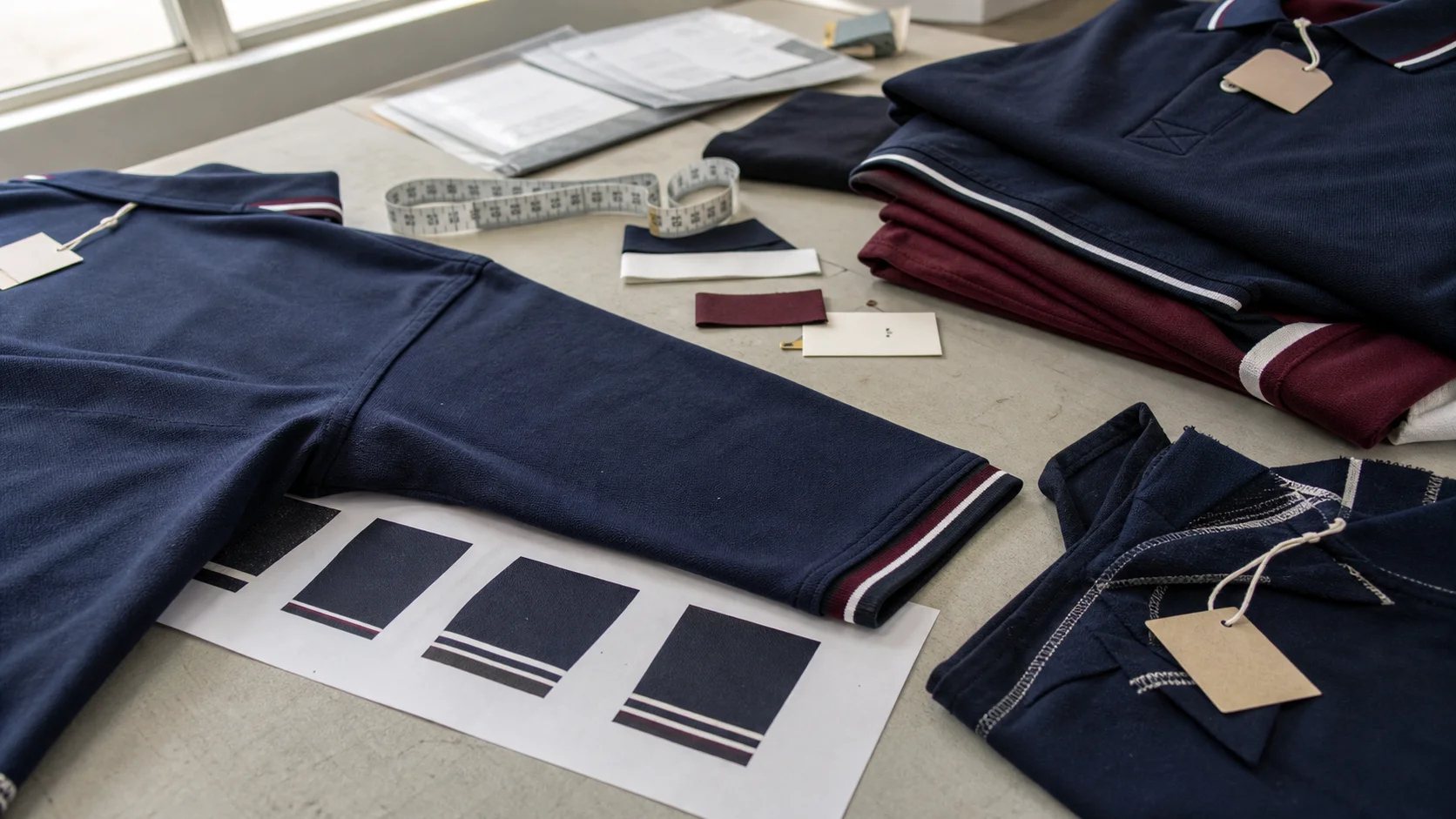
A practical SEO outline for school operations teams creating a sleeve print map and shrinkage control plan that keeps decorated apparel placements...
Sleeve Print Map Control Plan for School Ops - Decoration & Printing manufacturing guide
School operations teams manage apparel programs under a different kind of pressure than most retail buyers. The order window is tight, the size mix is uneven, the decoration must match approved school branding, and every mistake becomes visible on campus. Sleeve printing adds one more layer of risk because the printable area is narrow, curved, and highly sensitive to garment shrinkage, sleeve twist, cuff position, and operator alignment.
A sleeve print map shrinkage control plan gives operations teams a practical way to reduce those risks before bulk production starts. It defines where the print should sit, how the garment will be measured before and after finishing, what shrinkage allowance is acceptable, and what inspection points must be checked before goods ship.
This is not just a design issue. It is a sourcing, production, and quality-control issue. A strong control plan helps schools, distributors, decorators, and cut-and-sew suppliers agree on the same placement standard before blanks are printed or finished garments enter bulk decoration.
Sleeve graphics look simple on a mockup. In production, they are often one of the first places where inconsistency shows. A slogan that appears straight on a flat digital proof can rotate toward the inner arm after sewing. A mascot mark can drift too close to the cuff after garment washing. A vertical school name can look uneven across youth, adult, and extended sizes if the same placement is used without grading.
For school operations teams, the issue is not only aesthetics. Incorrect sleeve placement can cause parent complaints, campus staff reorders, delayed spirit wear distribution, and avoidable chargebacks between the buyer and supplier. When garments are used for athletics, clubs, orientation, events, or staff uniforms, consistency across the group matters.
A sleeve print map control plan turns the decoration target into measurable instructions. Instead of asking for “logo on right sleeve,” the plan defines the reference points, print orientation, tolerance, shrinkage assumptions, and approval gates. That makes the project easier to quote, easier to inspect, and easier to repeat for future terms or school years.
The main purchasing judgment is straightforward: if sleeve placement is part of the visible identity of the program, it should be controlled like a garment spec, not treated as a decorator preference.
A sleeve print map is the placement document used to guide decoration on the garment sleeve. It should be specific enough for a production operator to set up the job without interpreting the design intent. For school programs, it should also be simple enough for non-technical stakeholders to review and approve.
The map should include the garment style, size range, sleeve type, print method, artwork dimensions, placement from fixed reference points, acceptable tolerances, and any size grading rule. If the garment will be washed, dyed, heat-set, or otherwise finished after printing, the map should identify whether placement is measured before or after that process.
The best map is not always the most complex map. For a simple cotton spirit tee, one placement rule by size group may be enough. For a fitted performance sleeve or a heavyweight hoodie with rib cuffs, more detail is usually justified. The buyer should match the control level to the visibility and cost of the program.
Shrinkage control is central to sleeve print map planning because sleeve length and circumference can change after washing, drying, heat curing, garment dyeing, or steam finishing. Even small changes can make a sleeve graphic look too low, too high, or slightly rotated.
School apparel often uses cotton-rich fabrics, fleece, jersey, rib, and performance blends. Each material behaves differently. A 100% cotton jersey tee may shrink more in length than a polyester interlock athletic top. Cotton-poly fleece may remain fairly stable in body width but shift at the rib cuff. A garment-dyed sweatshirt may need placement planning after the dye and wash process rather than before.
A cautious sourcing range for acceptable dimensional change is often around 3% to 5% for many school basics, depending on fiber content, fabric construction, and finishing. More stable programs may target lower shrinkage. Value-driven programs may accept a wider range, but that decision should be made before purchase orders are placed.
The important point is not to assume that shrinkage is uniform. Sleeve length, sleeve opening, bicep width, body length, and chest width may change at different rates. A print placed four inches above the cuff can appear closer to the cuff after laundering if sleeve length contracts more than expected.
A sleeve print map shrinkage control plan should be written as a working checklist. It does not need to be a long technical manual, but it does need to define who approves what, when measurements are taken, and what happens when results fall outside tolerance.
Start by identifying the apparel use case. A one-day field trip tee does not need the same control level as a staff uniform hoodie used all year. Athletic warm-ups, donor events, senior class apparel, and admissions merchandise usually require tighter control because the garments are more visible and often photographed.
School operations teams should classify projects into risk levels. Low-risk items can use standard decorator placement. Medium-risk items should use a sleeve print map with measured reference points. High-risk items should include pre-production samples, shrinkage testing, and final inspection against an approved sealed sample.
The sleeve shape drives the placement plan. Set-in sleeves, raglan sleeves, drop shoulders, fitted sleeves, and rib-cuff fleece sleeves all require different reference logic. A shoulder seam may be a good measuring point on a set-in tee. It may not work on a raglan hoodie because the sleeve seam runs diagonally from collar to underarm.
For raglan styles, the map may need to use the cuff edge and sleeve centerline as the main references. For long-sleeve tees, the print may be centered between the shoulder seam and cuff or placed a fixed distance from the cuff. For hoodies, decoration must account for bulky seams, rib cuffs, and platen access.
Screen printing, heat transfer, direct-to-film transfer, embroidery, and digital printing each create different placement and shrinkage risks. Screen printing is common for volume school programs because it is cost-efficient at scale, but sleeve setup can be more labor-intensive than front chest printing. Heat transfer and direct-to-film can work well for smaller runs or names and numbers, though hand placement must be tightly controlled.
Embroidery on sleeves is possible but not always practical on narrow or stretchy areas. It can distort lightweight fabric and may feel bulky against the arm. For performance garments, decoration chemistry and curing temperature are important because polyester can be heat-sensitive.
For more support on decoration choices and production planning, school buyers can review service capabilities at fabrikn.com/services/.
Every sleeve print map needs reference points that can be measured on actual garments. Avoid vague instructions such as “centered on sleeve” unless the centerline is clearly defined. Operators need a repeatable method, especially when production is split across sizes.
Common references include distance from cuff edge, distance from sleeve hem, distance from shoulder seam, distance from armhole seam, and alignment to sleeve fold. For long vertical sleeve prints, the print may be centered along the sleeve length with a defined top starting point. For short horizontal logos, the center of the artwork may be placed a fixed distance from the cuff or shoulder seam.
School orders often include youth small through adult 3XL or 4XL. One sleeve print size may not look balanced on every garment. A six-inch vertical print may dominate a youth small sleeve while looking undersized on adult 3XL.
A practical approach is to create size groups. Youth sizes may use a smaller print and adjusted placement. Adult small through XL may use the standard print. Extended sizes may use the same artwork if budget is tight, or a slightly larger version if brand appearance is more important.
Size Group Possible Print Strategy Purchasing Tradeoff Youth XS-L Reduced artwork size and shorter placement distance Better proportion, but may require separate setup Adult S-XL Standard artwork and standard placement Most efficient production setup Adult 2XL-4XL Standard or enlarged artwork depending on budget Enlarged artwork improves balance but adds setup costTolerance defines the difference between acceptable variation and a defect. For sleeve prints, a common production tolerance may be plus or minus 0.25 inch to 0.5 inch for placement, depending on the print method, fabric, garment shape, and order requirements. Rotation tolerance should also be considered for long vertical prints.
Tighter tolerances increase inspection burden and may raise cost. Loose tolerances reduce rejects but may produce a less uniform school presentation. The right tolerance depends on the program. For a high-visibility uniform, tighter control is usually worth the extra planning. For a low-cost giveaway tee, an overly strict tolerance may create unnecessary expense.
Fabric and trim details should be locked before the sleeve map is finalized. A print map built around one garment blank may not transfer cleanly to another blank with a different sleeve length, cuff depth, armhole shape, or shrinkage profile.
Rib cuffs deserve special attention. A sleeve print measured from the cuff edge can shift visually if cuff depth varies across sizes or if the rib shrinks differently from the main sleeve fabric. If the design sits close to the cuff, the supplier should confirm cuff height tolerance before production.
For custom programs, school teams should request a full specification sheet that includes garment measurements, fabric construction, trim details, decoration map, wash care, and packaging requirements. If the program requires supplier coordination, a project inquiry through fabrikn.com/contact-us/ can help align scope before quoting.
Sample approval is where many sleeve print issues should be caught. A digital mockup is useful for concept approval, but it cannot prove shrinkage behavior, sleeve rotation, print feel, or actual placement on a curved garment. Physical samples are worth the time when the program has visibility, repeat potential, or a large order value.
For basic stock blank programs, the sample path can be shorter. A decorated pre-production sample may be enough if the blank is known and the decoration is simple. For custom garments, garment-dyed fleece, performance tops, or high-volume district programs, a fuller sample process is the safer route.
School operations teams should avoid approving sleeve placement only from a flat-lay photo. Ask for the garment to be shown flat and on a form or hanger if possible. Sleeve graphics can look acceptable when flat but rotate awkwardly when worn.
Minimum order quantity depends on garment type, decoration method, number of colors, size range, and whether the garment is stock or custom. School buyers should treat MOQ as a planning variable, not just a price hurdle.
These ranges are directional. A supplier may accept lower quantities with a higher unit price or setup charge. A factory may require higher quantities if fabric is custom dyed, trims are custom, or sleeve artwork needs multiple size versions. School teams should ask whether MOQ is based on total order quantity, per color, per design, per size, or per decoration setup.
When budgets are tight, consolidating designs is usually more effective than pushing for unrealistic MOQ exceptions. One sleeve print used across multiple school groups can reduce setup cost. Changing ink color, mascot, or sleeve side for each club may look attractive on paper but can increase production complexity quickly.
Lead time for sleeve-printed school apparel depends on more than the print date. Artwork approval, blank availability, sample review, curing, finishing, packing, and shipping all affect the calendar. School operations teams should build timelines backward from the actual distribution date, not from the desired order placement date.
For stock blank decoration, simple programs may move in one to three weeks after final approval, depending on capacity and inventory. More complex custom programs can require six to twelve weeks or longer, especially when fabric sourcing, dyeing, or multiple samples are involved. Rush orders reduce the time available for shrinkage testing and increase the chance of approval shortcuts.
The most common timeline mistake is treating the approval date as flexible. If a pre-production sample sits unapproved for a week, the production schedule usually moves. School teams should assign one decision-maker for final sleeve map approval and set a clear response deadline.
Inspection should compare bulk goods against the approved sleeve print map and sealed sample. The goal is not to reject goods for normal manufacturing variation. The goal is to catch defects that affect wearability, branding, or program consistency.
A reasonable inspection plan may include inline checks during the first production units, mid-run checks, and final random inspection. For larger school or district programs, inspection should be documented with photos, measurement records, and defect categories. For smaller local orders, a simpler checklist may be enough.
Inspection should include measurement on the garment as it will be delivered. If the garment is decorated before washing, then washed, final inspection should measure after washing. If the garment is a stock blank that will not receive additional finishing, final inspection can focus on post-decoration placement and print quality.
Clear communication reduces errors. School operations teams can use the following structure when briefing a supplier or decorator. The objective is to remove assumptions before pricing and sampling.
These questions may feel detailed, but they prevent larger problems later. A supplier that cannot explain sleeve placement tolerance or shrinkage handling may still be fine for simple, low-risk orders. For high-visibility programs, that lack of control should make the buyer cautious.
A sleeve print map shrinkage control plan should support better purchasing decisions, not slow every order to a crawl. The buyer’s job is to decide where control creates value and where it adds cost without much benefit.
For small club orders, short-term event tees, or low-cost giveaways, a standard sleeve placement with a basic proof may be enough. In these cases, the buyer can accept broader tolerance and focus on correct artwork, garment color, and delivery date. Paying for multiple samples and wash testing may not be justified.
For staff uniforms, athletics, district-wide apparel, premium spirit wear, and recurring school store products, stronger control is usually worth it. These garments are worn repeatedly, reordered, photographed, and compared side by side. A poorly controlled sleeve print can make a good garment look cheap.
Every added control point has a cost. Separate youth and adult artwork sizes can improve proportion but add setup. Shrinkage testing can reduce risk but adds calendar time. A tighter placement tolerance improves consistency but may increase rejects. Custom garments allow better control of fabric and construction but require higher MOQ and longer lead time.
The right plan balances visibility, budget, quantity, and deadline. If the school needs 50 shirts for a weekend volunteer event, speed may matter more than perfect sleeve grading. If the school is buying 1,000 hoodies for a district program, sleeve mapping, shrinkage testing, and inspection documentation are not extras. They are risk controls.
Supplier selection should be based on fit for the program. A local decorator may be ideal for fast, small-batch stock blank work. A manufacturing partner may be better when the school needs custom garments, coordinated trims, private label, packaging, and repeatable production across seasons.
Buyers reviewing supplier capability should ask for process clarity rather than unsupported claims. A strong supplier can explain artwork preparation, sample stages, shrinkage assumptions, MOQ, lead time, inspection steps, and remake policy. General company information can be reviewed at fabrikn.com/about-us/ when evaluating whether the operating model fits the project.
A school operations team ordering long-sleeve cotton spirit tees might define the sleeve print as follows: right sleeve, vertical school name, adult artwork height of 10 inches, youth artwork height of 8 inches, centered on sleeve fold, top of print 3 inches below shoulder seam for adult sizes and 2.5 inches below shoulder seam for youth sizes. Placement tolerance may be plus or minus 0.375 inch, with rotation not to exceed an agreed visual limit.
If the same school orders fleece hoodies, the map may change. The team may choose to measure from the cuff edge because the shoulder shape is less consistent due to bulk and drop-shoulder styling. The print may need to sit higher above the cuff to avoid rib distortion. The decorator may also need to test platen fit and pressure before approving bulk production.
A performance team top would require a different plan again. The school may need low-temperature decoration, dye migration testing, and stretch recovery checks. The print may need to be shorter to avoid distortion on a fitted sleeve. This is why one universal sleeve placement rule rarely works across all school apparel.
This checklist is deliberately practical. It can be scaled up or down depending on the order. The main discipline is to define the sleeve map before production and inspect against it after production.
School operations teams do not need to become print engineers to manage sleeve print quality. They do need a repeatable control plan that turns artwork approval into measurable production instructions. The plan should connect garment construction, shrinkage behavior, decoration method, sample approval, and final inspection.
The strongest programs make decisions early. They confirm the garment before finalizing the sleeve map. They approve physical samples when the order value justifies it. They set realistic tolerances. They understand that lower MOQ, faster delivery, tighter placement, and lower price cannot all be optimized at the same time.
For school apparel, sleeve printing is a high-visibility detail on a small production surface. Treat it with the right level of control, and the finished goods look intentional. Ignore shrinkage and placement mapping, and even a good design can look inconsistent across the order.
Get a free quote from Fabrikn — your trusted B2B clothing manufacturer with 10+ years of experience. MOQ as low as 200 pieces.
Get a Free Quote →A sleeve print map is a production document that shows where sleeve artwork should be placed on a garment. It usually includes sleeve side, artwork size, distance from cuff or shoulder seam, print orientation, size grading, and placement tolerance.
Shrinkage changes sleeve length, width, and sometimes twist. If a print is placed before washing or finishing without allowance for shrinkage, the final position may look too close to the cuff, too high on the arm, or slightly rotated.
Many sleeve print programs use a tolerance around plus or minus 0.25 inch to 0.5 inch, depending on garment construction and print method. Narrow sleeves, bulky fleece, and hand-applied transfers may require more realistic tolerance than flat front chest prints.
Not always. One artwork size is cheaper and simpler, but it may look too large on youth sizes or too small on extended adult sizes. For visible school programs, separate youth and adult artwork sizes can improve proportion.
Stock blank sleeve printing may start around 24 to 72 pieces, while screen-printed programs often become more cost-effective around 72 to 300 pieces. Custom cut-and-sew garments commonly require 300 to 1,000 or more pieces, depending on fabric, trims, and decoration.
A physical sample is strongly recommended for high-visibility, high-quantity, or repeat programs. For small, low-risk orders, a digital proof and standard placement may be acceptable, but it offers less protection against sleeve twist, shrinkage, and print feel issues.
Inspect sleeve side, print orientation, placement from the approved reference point, artwork size, print quality, curing, shrinkage, sleeve twist, size ratio, and packing accuracy. Bulk goods should be compared against the approved sleeve print map and sealed sample.
Use a written sleeve print map, approve the garment before decoration, confirm shrinkage expectations, set realistic tolerances, review a pre-production sample when needed, and require first-article checks before bulk production continues.