
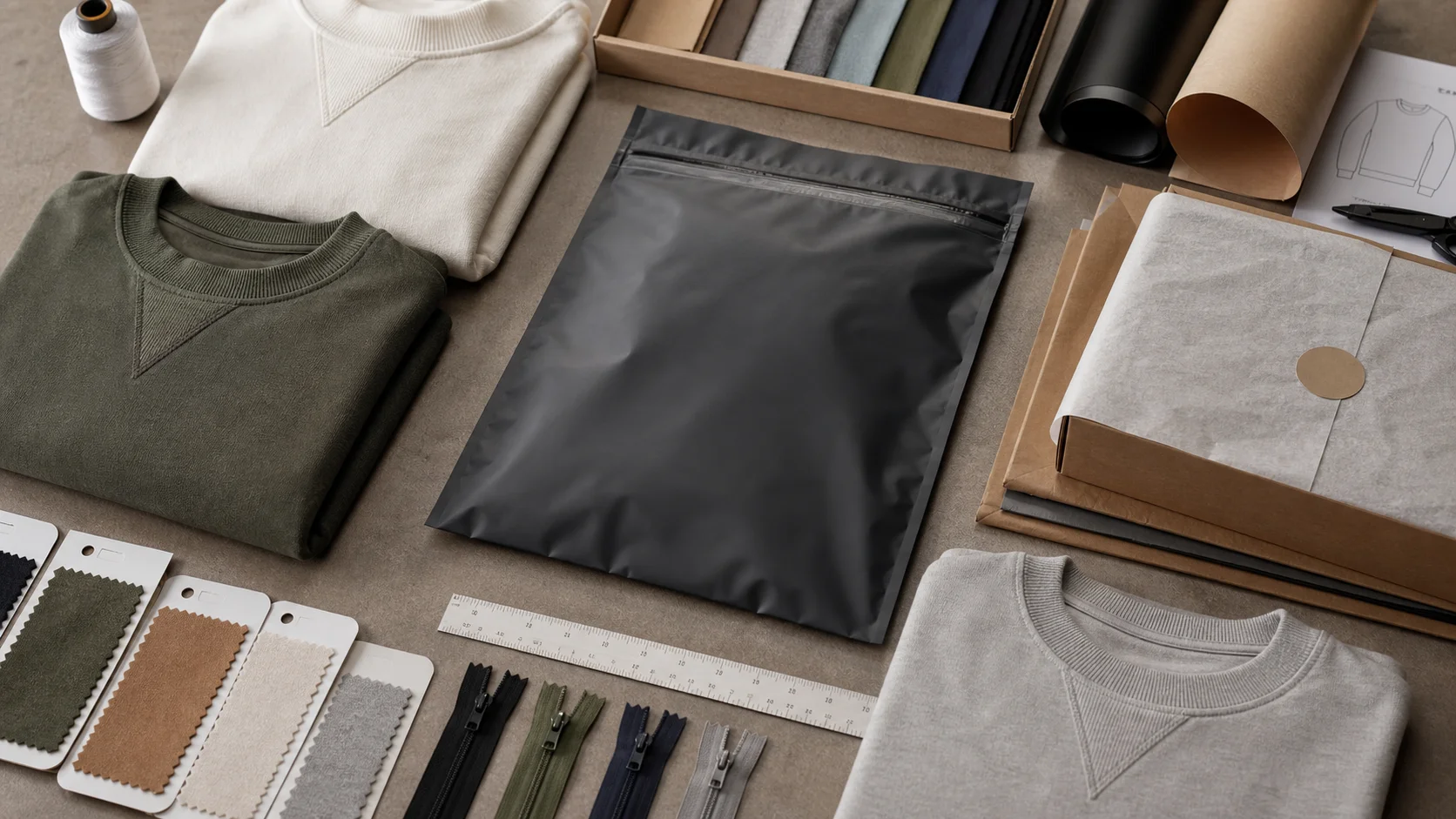
Screen Printing on Mailer Bags for Fashion Brands compared by sample evidence, fabric or trim specs, MOQ, AQL terms, cost lines, delivery timing, and...
Fast answer: Screen Printing on Mailer Bags for Fashion Brands: Material, Print, MOQ, and QC Terms should be judged by production evidence, not by a generic sourcing promise. The buyer needs sample proof, cost breakdowns, QC checkpoints, and delivery buffers in writing.
Ask for recent sample photos, measurement tolerances, fabric or print test assumptions, decoration test notes, packing examples, and a named inspection checkpoint. These details show whether the team can repeat an approved sample at bulk volume.
Separate garment cost, decoration, labels, packaging, sampling, testing, freight, and rush charges. Clear cost lines make it easier to reduce colorways, adjust size depth, or reserve more time for sampling.
A good mailer can do the work of a box, an insert, and a thank-you card without asking for the shelf space.
Plain poly mailers can come in under $0.12 each at scale. A printed mailer can replace a $0.30 insert, a $0.45 branded box, or both. That’s why screen printing on mailer bags for fashion brands keeps showing up in the budgets I review. I’ve watched brands spend less on packaging by spending more on the right bag.
After 2020, factory orders shifted hard. Tiny capsule drops began asking for 500 to 2,000 printed mailers instead of 10,000 generic ones, while larger labels pushed for consistency across three regions and two fulfillment centers. Across factory visits in Vietnam, China, Turkey, and Portugal, the same thing kept appearing: the bag became the cheapest place to look expensive.
Premium and value brands use printed mailers for different reasons, but both are chasing efficiency. Indie labels often make the mailer their main brand touchpoint because a $28 tee shipped in a plain gray poly bag can feel invisible. Luxury and bridge brands lean on the same tool to protect margin, especially when a $120 blouse leaves the warehouse without a rigid box.
The business case is real. Unboxing clips have outperformed paid ads for some labels by 2x to 4x on engagement, especially when the packaging reads clearly on camera. A clean logo on a mailer can travel farther than a glossy lookbook. A brand paying $1.80 on Meta for a click may prefer a $0.22 printed bag that photographs well and cuts back on extra collateral.
Buyers now want packaging that works for fulfillment and content creation. A mailer that looks sharp in a studio, survives a 4,000-mile transit, and stacks neatly in cartons is easier to justify than a box-heavy setup with a bigger freight cube. Same packaging line, different price points: a $35 streetwear drop and a $450 luxury knit can both use it. Price changes the artwork, not the logic.
The process looks simple on paper and gets fussy fast. Artwork prep comes first, with the printer converting a logo into a limited-color file, usually one to three spot colors. Then a screen is made, ink is pushed through the mesh, the bag dries or cures, the print is inspected, and the finished stack is packed into cartons. Industrial. No mystery there.
Polyethylene mailers do not all behave the same. Standard PE accepts ink well when the surface treatment is right, but recycled-content film can be less consistent because the resin blend shifts from batch to batch. Paper-based mailers bring a different headache: some water-based inks work fine, but too much heat can warp them. I’ve seen factories lower cure temperature by 10 to 15 degrees Celsius just to protect seal lines.
Screen printing likes bold graphics and limited colors. That’s why many brands settle on one to three spot colors instead of full-coverage art with gradients, thin serif type, or photographic imagery. Strong contrast means fewer rejects. A dark navy logo on a natural or white mailer usually prints cleaner than a four-color pattern with micro text on recycled film.
Ink choice matters more than many buyers expect. Some factories use solvent-based systems for adhesion; others choose water-based or low-VOC options depending on the material and local rules. Cure time can be 20 seconds in a fast line or five to eight minutes in a slower tunnel, and that affects lead time as much as labor does. A supplier that trims drying time to win the order can create smudging, and smudging becomes customer service.
If a brand already uses print across multiple categories, the packaging team should think in systems. The same artwork logic that works for a screen printing services order on tees may need simplification for a mailer surface. Thin lines migrate, small text blurs, and crowded logos lose authority once they’ve been folded, taped, and handled three or four times at packing stations.
Unit price is where buyers look first. Wrong move. A plain stock mailer at $0.10 to $0.18 per piece can look cheapest until you add stickers, inserts, and outer boxes. A stock printed mailer may run $0.16 to $0.30, with setup fees near $40 to $150 depending on screens and colors. A fully custom mailer can land at $0.24 to $0.55, but the branding is built in.
The spread changes with volume. At 500 units, a $120 screen setup adds $0.24 per bag before ink or labor. At 10,000 units, the same setup contributes just $0.012 per bag. That’s why small orders feel painfully expensive and large orders suddenly look rational. I’ve seen founders reject printed packaging at launch, then reorder later at a higher total cost because their unboxing content started to matter more than their spreadsheet.
Minimum order quantities usually sit at 500, 1,000, 3,000, or 5,000 pieces, depending on the factory. If you need seasonal art, ask whether the manufacturer can hold a base bag and change only the print plate; that can keep a refresh under seven to 10 days after approval. Hybrid options, like a stock bag with one-color logo and a separate branded sticker, can bridge the gap for a 300-piece test run.
Turnaround time is another divide. Plain stock can ship in two to five days if inventory is on hand. Custom screen-printed orders often need three to seven days for artwork approval plus one to three weeks of production. Then there’s freight. A supplier in southern China may quote lower unit prices, but three to five weeks of ocean transit can erase the savings if you miss a launch window. Nearshore suppliers in Mexico, Portugal, or Turkey may cost more per unit, yet they can cut lead time to five to 12 days and reduce freight risk.
Last year I worked with a brand that switched from imported plain mailers to regionally printed versions and trimmed emergency air freight by 38% over one quarter. The economics improved because the packaging matched the fulfillment model. For brands building adjacent categories too, I’ve seen the same planning discipline used in custom bra manufacturing and even private label clothing services, where packaging, product, and transit all have to hold together.
Premium mailers do not shout. They signal. Oversized logos, restrained typography, and a high-contrast palette usually beat complex illustration, especially on a surface that creases at the seams and folds at the flap. A one-color wordmark on a recycled white bag often looks more editorial than a crowded graphic trying to do too much at once.
I usually recommend one or two brand colors for seasonal drops. That keeps costs predictable and cuts the chance of registration errors across 2,000 or 20,000 units. If a label insists on a third color, I ask what story it tells. If the answer is only “visual interest,” the packaging has already lost.
Placement matters as much as artwork. Centered logos work well for e-commerce, but a lower-left mark can feel more fashion-house if the bag material is matte and the copy is minimal. Keep text short: a brand name, a size code, maybe a single line about care or recycling. Anything more starts to look promotional.
Matte finishes and recycled textures help a lot. A slightly crinkled recycled mailer with sharp black ink can read more expensive than a glossy bag with metallic red print. The contrast is real. So is restraint. Overprinting can make sustainable packaging look busy, and it can raise ink use by 20% to 40% without improving recall. Waste in costume.
Brands that already understand visual consistency in garment labels or trims tend to make better packaging choices. The same discipline that keeps a hem label clean also keeps a mailer credible. If the print has to fight the bag to be noticed, it will not win.
Screen printing can affect recyclability, but not in a simple yes-or-no way. Heavy ink coverage, mixed coatings, and incompatible additives can make recovery harder. A lightly printed polyethylene mailer is usually easier to process than one coated with dense, multi-color artwork across both sides. The bag itself matters. So does how much ink you put on it.
Virgin poly mailers are durable and cheap, often $0.08 to $0.15 in volume, but they rely on fossil feedstock. Recycled-content mailers can cost 10% to 25% more, yet they reduce demand for new resin and often support better brand messaging if the supplier can prove content levels. Paper-based mailers may weigh 15% to 35% more and can tear under wet handling, which is a problem if a brand ships from rainy fulfillment centers or long-distance lanes.
According to OEKO-TEX, chemical transparency and restricted substances are central to safer material choices, and that applies to packaging inks too. Textile Exchange also provides useful context on recycled-content standards and responsible sourcing, while Trade.gov is a practical reference for cross-border sourcing and market access considerations when comparing suppliers in China and beyond.
Here’s what most people miss: the lightest package is not always the best environmental choice if it tears in transit and triggers a replacement shipment. I have tracked brands that saved 4 grams per mailer, then lost the savings when returns and reships rose by 6% to 9%. A stronger 12 to 15 GSM bag with moderate print can outperform a thinner one that fails at the corner seam.
My rule is blunt. If a supplier cannot explain resin content, ink type, and end-of-life expectations in numbers, the eco claim is marketing, not evidence. Sustainable packaging should survive the route first, impress second, and only then claim virtue.
The best supplier conversations sound boring. That’s a good sign. I ask for MOQ, screen limits, ink durability, sample timing, color matching tolerance, and defect rate. If the supplier cannot answer with numbers, I keep moving. A serious vendor will tell you whether the tolerance is within 5% Pantone variance, whether the defect rate stays under 2%, and whether samples take three days or two weeks.
Samples need a real inspection, not a polite glance. Check registration accuracy. Rub the print by hand for 20 to 30 strokes. Fold the mailer along the intended seam and look for cracks. Test seal integrity. Then inspect alignment where the print crosses the edge or zipper area. A logo can look perfect on a flat sheet and fail completely after packing.
Small specialist printers often win on detail. Large packaging factories win on coordination. If you need 20,000 mailers, five box styles, and carton labels in one shipment, the larger plant may be more efficient. If you need a sharp one-color logo on a limited run of 800 pieces, a specialist can give better attention to mesh tension, curing, and visual consistency.
In my factory visits, the best-looking sample did not always come from the fastest line. One facility in Guangdong produced a gorgeous prototype in 45 minutes, but the print drifted by 2 to 3 millimeters over the next 4,000 pieces. Another shop took two extra days to dial in registration and delivered 98% consistency across the run. That second result saved the brand from a reprint.
For brands that also use sublimation printing services on garments, the packaging supplier should understand color drift, batch matching, and how different substrates behave under heat. Packaging and apparel are not separate problems. They’re one supply chain with different surfaces.
Start small and treat the bag like a test product. I tell founders to launch with one or two SKUs, 500 to 1,500 units total, and track damage rates, customer comments, and fulfillment speed for at least 30 to 45 days. If a bag tears, smudges, or slows packing, the problem shows up quickly in return reasons and warehouse notes.
Build your forecast around collection cadence, not wishful thinking. If you drop every six weeks, reorder stock four to five weeks before you need it. That buffer protects you from port delays, color mismatches, and last-minute art changes. Before peak shipping periods, I prefer to see 15% to 20% more packaging on hand than the forecast suggests, especially if a brand ships into multiple regions.
Seasonal color changes should be planned, not improvised. A winter drop may justify black-on-cream mailers; a summer collection might need off-white on recycled gray. Keep the base size consistent if you can. Changing sizes, colors, and finishes all at once multiplies risk. If one option underperforms, you will not know which choice caused the issue.
My scaling rule is simple. Do not commit to large print runs until a bag size, a color, and a finish survive one full sales cycle. That means through shipping, returns, and reorder. I keep seeing the same pattern: brands that rush to 10,000 pieces without live data end up with 2,000 leftovers and a storage bill they never planned for.
Packaging is not a static purchase. It is a moving forecast. Brands that manage it that way save money, reduce waste, and avoid the ugly moment when a warehouse is full of the wrong bag.
Below are the questions buyers ask most often before placing a PO. I’ve kept the answers direct because procurement teams do not need poetry. They need numbers, timing, and a clear yes or no.
In volume, simple printed mailers usually land around $0.16 to $0.30 each, while fully custom versions can run $0.24 to $0.55. Setup fees often add $40 to $150 per color or screen, so 500 units will look far more expensive than 5,000 units. Freight can add another 8% to 20% depending on origin and delivery speed.
Most factories ask for 500, 1,000, 3,000, or 5,000 pieces. Smaller specialist printers may accept 300 to 800 units if the design is one color and the bag size is standard. If you need multiple colors, expect the MOQ to rise because each screen adds labor and setup time.
Stock mailers can ship in two to five days if inventory is on hand. Custom screen-printed orders usually need one to three weeks of production after artwork approval, and some factories need an extra three to seven days for sample sign-off. International transit can add five to 35 days depending on route and method.
Yes, if the material and ink are chosen carefully. Recycled-content mailers, lighter ink coverage, and single- or two-color designs can reduce impact compared with heavily printed mixed-material bags. The key is to avoid overprinting, confirm resin content, and make sure the bag survives transit without replacement shipments.
Check registration, rub resistance, seal integrity, and alignment across the seam. I also test whether the print cracks after folding and whether the color stays consistent across at least three samples. If the factory cannot hold color tolerance within about 5%, expect problems at scale.
Recycled polyethylene is often the best balance of print quality, cost, and durability. It usually handles one to three spot colors well and costs less than many paper-based alternatives. If sustainability claims matter, ask for proof of recycled content and test whether the bag survives normal warehouse handling.
Heavy ink coverage across both sides can raise cost, reduce recyclability, and increase the chance of smudging. A single logo or a restrained wordmark usually prints cleaner than a full-pattern design. I prefer coverage that keeps the base material visible for most fashion brands.
Center placement works well for broad brand recognition, but lower-left or upper-center placements can feel more editorial. Keep clear space around the logo so folds, seals, and tape do not cut through the art. On most bags, a logo spanning 20% to 35% of the front panel is enough.
Yes, but it increases complexity and often raises cost. Multiple sizes usually mean separate screens, separate carton labels, and more opportunities for packing errors. If you are testing the market, keep one size for the first 500 to 1,500 units and only expand after you see stable demand.
Ask for defect rates, color tolerance, and recent production photos from runs of 5,000 units or more. Then request samples from the same line, not just a hand-finished prototype. A supplier with a 2% defect rate on paper and a clean 1,000-unit sample can still fail if they cannot hold registration across a full shift.