
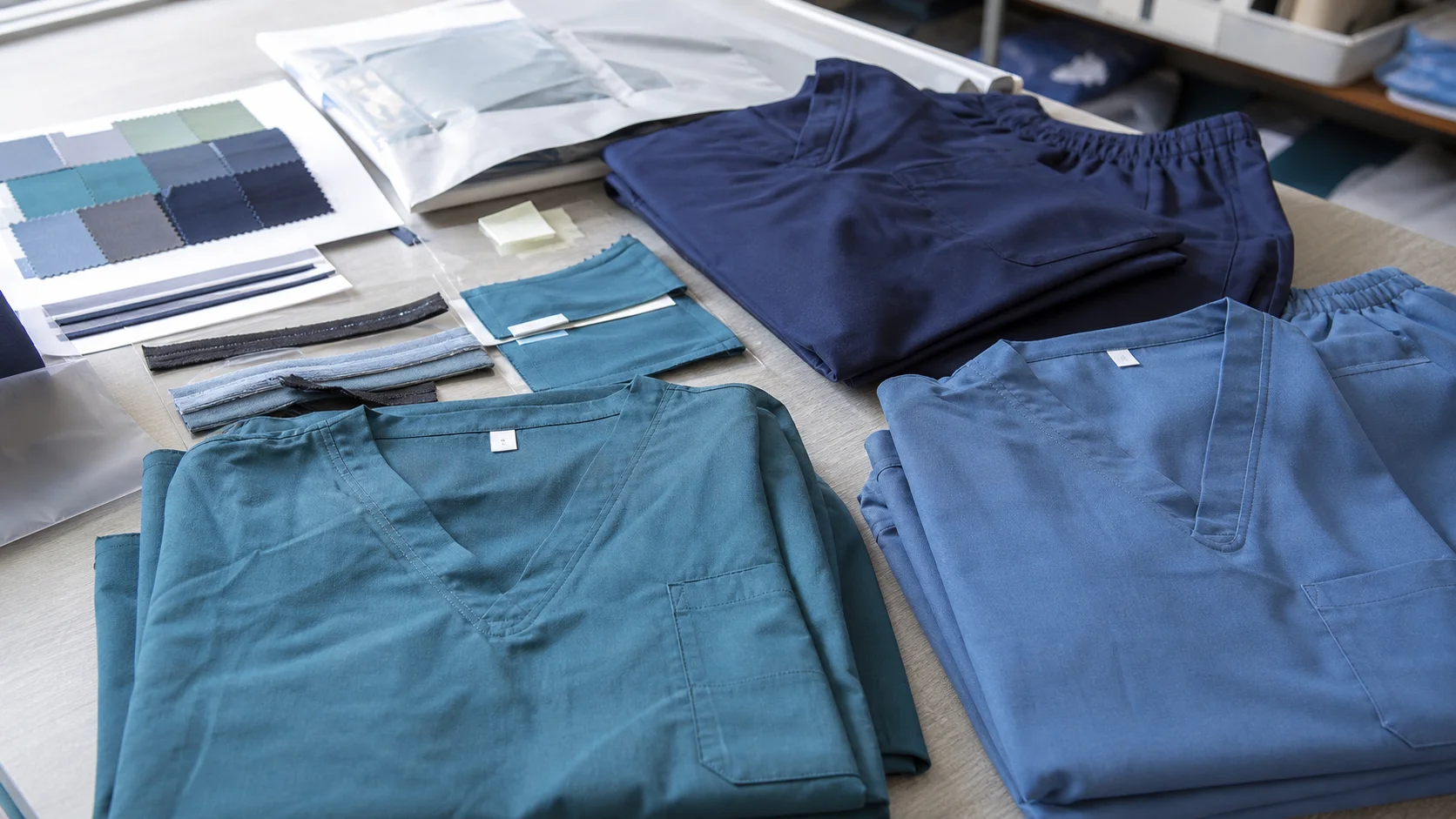
A quality and inspection focused guide for pharmacy operations teams ordering scrubs in bulk, covering fabric performance, fit grading, embroidery checks,...
Scrubs Bulk Order Guide for Pharmacy Operations - Fabrikn production reference
Category: Quality & Inspection
Bulk scrubs for pharmacy operations are not the same purchase as general clinic uniforms. Pharmacy teams need garments that look clean in a controlled retail or clinical environment, withstand frequent laundering, support shift movement, and keep staff visually consistent across multiple locations. A scrub program also has to work for pharmacists, pharmacy technicians, inventory staff, compounding support, delivery-facing personnel, and sometimes front-of-house patient service teams.
The buying mistake is treating scrubs as a simple commodity. Low-cost garments may pass a quick visual review, then fail during store rollout because the shade varies by batch, the pocket layout is wrong for daily tools, or sizes do not cover the actual workforce. Pharmacy operations teams should approach bulk ordering as a quality-controlled uniform project, not a one-off apparel order.
A practical sourcing process starts with role requirements, fabric performance, color standards, size planning, sample approval, inspection criteria, and replenishment strategy. The right supplier should be able to translate these into production documents, not just quote a price per set. If your team needs support building a uniform specification or sourcing structure, review relevant manufacturing capabilities at Fabrikn services.
Purchasing judgment: for pharmacy operations, consistency is usually more valuable than the lowest unit price. A slightly higher-cost scrub that repeats well across reorders can save time, complaints, and replacement spending.
A buying brief is the control document for the order. It should be prepared before contacting vendors, especially when purchasing for several branches or departments. Without a clear brief, each supplier will quote against different assumptions, which makes pricing hard to compare and quality harder to enforce.
For most pharmacy operations, two to five sets per employee is a practical starting point. A full-time staff member typically needs more garments than a part-time employee, especially where laundering is handled by the employee rather than centrally. If the organization has high turnover or seasonal staffing, add extra stock in core sizes rather than waiting for emergency replenishment.
Pharmacists may prioritize a polished appearance and comfortable standing fit. Technicians need pockets that hold pens, scissors, small tools, labels, and handheld devices without sagging. Compounding-related teams may require stricter clean appearance, secure closures, and low-lint fabric choices depending on internal protocols. Delivery or stockroom support may need more abrasion resistance and easier movement.
One scrub design can serve multiple roles, but the specification should not ignore job function. A top with too few pockets or pants with a weak waistband will generate complaints even if the fabric looks acceptable in a sample review.
Fabric choice drives comfort, appearance, durability, and final cost. Pharmacy scrubs are often worn through long standing shifts, exposed to repeated washing, and expected to look professional in front of patients. The best option is usually a balanced performance fabric rather than the cheapest woven available.
Typical fabric weights for scrubs range from about 145 gsm to 220 gsm, depending on composition and hand feel. Lightweight fabrics improve comfort in warm pharmacies but can look thin, wrinkle more easily, and show pocket contents. Heavier fabrics can feel more durable but may be too warm for staff working near equipment or under layered uniforms.
Trim specifications should be written clearly. Thread should match the garment unless contrast stitching is intentional. Drawcords should be secured and colorfast. Elastic waistbands should recover after stretching and washing. Zippers, snaps, buttons, and badge loops need durability checks because small trim failures cause high employee dissatisfaction.
Fit is one of the largest hidden risks in a bulk scrub program. Pharmacy teams usually include a broad range of body types, ages, and preferences. A single unisex scrub may reduce SKU complexity, but it often creates fit complaints. Separate men’s and women’s fits improve acceptance but increase SKU count and inventory planning work.
Unisex sizing can work for budget-sensitive programs, temporary staff, or backup inventory. It is not always ideal for employee-facing uniform programs where comfort and appearance influence adoption. Women’s fit tops and pants tend to perform better for mixed teams, especially when paired with inclusive size ranges and petite or tall options where needed.
A practical structure is to offer one core scrub top and pant in women’s and men’s patterns, with unisex backup sizes for emergency stock. For larger operations, maternity options and tall inseams may be necessary. For smaller teams, those needs can be handled through planned special-order windows rather than holding deep inventory.
Program Type Recommended Fit Approach Tradeoff Small pharmacy team Unisex or limited men’s/women’s size range Lower MOQ pressure but more fit compromise Regional pharmacy group Men’s and women’s core patterns Better acceptance but more SKUs Large multi-site operation Full size range with replenishment planning Best coverage but requires inventory controlDo not order equal quantities of every size. That creates overstock in slow-moving sizes and shortages in core sizes. Use employee size survey data where possible. If no data exists, build a conservative curve around common sizes and hold flexible reserve stock.
For a first order, many buyers plan heavier quantities in S through XL, moderate depth in XS and 2XL, and smaller but necessary coverage in 3XL and above. The exact split should reflect the workforce, region, gender mix, and whether the garment runs slim or relaxed. A fit sample set can reduce ordering errors before full production.
Minimum order quantity depends on fabric availability, dyeing requirements, decoration, pattern complexity, and supplier structure. For standard stock fabrics and basic embroidery, some suppliers may support lower MOQs. Custom fabric colors, private-label trims, and multiple fit blocks usually push minimums higher.
These ranges are directional. Actual MOQ may be quoted by style, color, fabric batch, or size ratio. A buyer may hear “500 pieces MOQ” and assume that means 500 sets. It may mean 500 tops plus 500 pants, or 500 units per style and color. Clarify this before comparing quotes.
The cleanest approach is to calculate demand by employee, then add reserve. A basic planning formula is: total employees multiplied by sets per employee, plus 5% to 15% buffer for new hires, exchanges, damages, and size corrections. For large organizations with frequent hiring, the buffer may need to be higher in common sizes.
Purchasing judgment: if the first order is close to the supplier’s MOQ, avoid too many colors, fits, and pocket variations. Complexity spreads units thin and increases the chance of production mistakes.
Sample approval is where pharmacy operations can prevent most bulk-order failures. A single photo or catalog sample is not enough for a custom or semi-custom program. The team should review fabric, fit, construction, decoration, and wash performance before bulk production begins.
The pre-production sample should be treated as the production standard. Keep one sealed approval sample with the buyer and one with the supplier. During inspection, finished goods should be compared against this standard for shade, measurements, workmanship, logo position, and hand feel.
If time is tight, buyers often skip wash testing. That is risky for pharmacy scrubs because staff may wash garments frequently and sometimes use hot drying cycles. A garment that looks good before washing but shrinks, twists, or pills quickly will not support a professional uniform program.
Scrub color communicates department identity and brand consistency. Pharmacy teams often choose navy, ceil blue, royal blue, pewter, black, wine, hunter green, or teal. Lighter colors can look clinical and clean but may show stains and underlayers. Dark colors look polished and hide wear better, but crocking, fading, and lint visibility need attention.
Use a Pantone reference only as a starting point. Fabric dyeing rarely matches a paper guide perfectly because fiber content, finish, and lighting affect the shade. Ask for lab dips or fabric swatches, then approve under consistent lighting. If the program involves reorders, set an acceptable shade tolerance and keep a physical standard.
Batch-to-batch variation is a common issue. It becomes visible when employees at the same site wear scrubs from different production runs. If exact shade consistency matters, plan larger fabric lots or hold replenishment stock from the same dye batch. Smaller repeat orders may be convenient, but they can increase color variation risk.
Embroidery is common for pharmacy scrubs because it looks stable and professional. It can also distort lightweight fabric if the stitch density is too high. Heat transfers can work well on performance fabrics, but wash testing is essential. The decoration choice should match the laundering method, fabric surface, and expected garment life.
Quality inspection should be planned before production starts. The inspection team needs a clear checklist, approved sample, measurement chart, packaging instructions, and defect classification. Waiting until cartons are packed makes corrections harder and more expensive.
Before cutting, fabric should be checked for shade, weight, width, hand feel, holes, stains, bowing, skewing, and visible defects. Rolls should be shade-lot controlled so panels from different dye lots are not mixed within the same garment. Trims should be checked for color, strength, size, and compatibility with the garment.
In-line inspection catches problems while the factory can still correct them. Key areas include pocket placement, neckline shape, seam allowance, waistband attachment, topstitching, drawcord length, and logo positioning. For pants, check rise, inseam, pocket openings, crotch seam strength, and elastic tension. For tops, check shoulder slope, sleeve mobility, side vents, and chest pocket alignment.
AQL sampling is often used for garment inspection. Common general inspection levels may use AQL 2.5 for major defects and AQL 4.0 for minor defects, though the buyer should set standards based on risk tolerance. Critical defects should have zero tolerance. Examples include sharp objects, contamination, severe stains, incorrect branding, or unsafe trim issues.
Measurement tolerance should be realistic. A typical tolerance might be around half an inch for key garment dimensions, with tighter control on logo placement and pocket alignment. The exact tolerance depends on garment type, fabric stretch, and size grade. Overly tight tolerances can create unnecessary rejects; overly loose tolerances create fit problems.
Lead time depends on fabric availability, sample rounds, decoration approval, production capacity, inspection timing, and shipping method. Pharmacy operations teams should separate sample lead time from bulk production lead time. A supplier quoting only the sewing lead time may not be including fabric dyeing, lab dip approval, packaging preparation, or freight.
For a standard logo order using available stock garments, a shorter timeline may be possible. For custom scrubs, pharmacy operations teams should plan several months from brief to delivery, especially if the program includes many sizes and locations. Rush production increases the risk of skipped approvals, poor shade control, and packing mistakes.
Lead-time risk is best managed by freezing the specification before bulk cutting. Changes after fabric is cut are expensive and often impossible to correct fully. If rollout timing is critical, reserve extra time for sample review and final inspection rather than compressing those steps.
Packing is not an afterthought for pharmacy uniforms. A clean rollout depends on cartons that are easy to receive, count, allocate, and distribute. This matters even more when orders are split by branch, department, or employee.
Some buyers prefer set packing, with one top and one pant together. This can simplify employee distribution, but it may create problems if top and pant sizes differ. Separate garment packing is more flexible for size exchanges and inventory control. The better choice depends on how the pharmacy operation distributes uniforms.
If uniforms are shipped directly to stores, carton-level accuracy is essential. Wrong size ratios or mixed cartons can disrupt a launch. If uniforms are shipped to a central warehouse, sorting labor and storage space should be planned before delivery. A lower factory packing cost can become a higher internal labor cost if the carton plan is weak.
Pharmacy operations teams should evaluate suppliers on more than price. The supplier needs garment knowledge, repeat production control, documentation discipline, and the ability to support inspection. A vendor that only sells catalog scrubs may be fine for small urgent orders, but larger programs need stronger production management.
Documentation quality is a useful signal. A supplier that can clearly confirm specs, tolerances, sample status, and packing requirements is generally safer than one that provides only a low quote and short message. For company background and sourcing approach, buyers can review Fabrikn about us.
If the order involves multiple sites, confirm who owns the allocation file. The supplier can pack against a final allocation, but the buyer should approve the logic. Mistakes in the allocation file are not factory defects, yet they still create operational problems.
Scrub pricing is shaped by fabric, pattern, size range, order volume, decoration, testing, packing, and shipping. A quote that looks cheaper may exclude important work. Always compare landed cost and operational cost, not just garment unit cost.
The cheapest route is often stock scrubs with a simple logo. That may be sensible for a pilot, small team, or interim uniform. A custom scrub program makes more sense when the organization needs consistent branding, repeat ordering, better fit, and stronger control over quality. The decision should be based on program life, not only first-order budget.
A pharmacy scrub bulk order should be built around repeatable quality. Start with a clear buying brief, control the fabric and fit, approve real samples, and inspect against written standards. The most common failures are not dramatic manufacturing problems. They are ordinary preventable issues: wrong size mix, loose pocket stitching, inconsistent shade, poor logo placement, fabric shrinkage, and cartons that are hard to distribute.
For a small operation, stock scrubs with logo decoration may be the right balance. For regional and multi-site pharmacy teams, semi-custom or custom scrubs offer stronger control if the order volume supports it. Buyers should avoid adding design complexity without operational value. Every added color, fit, trim, and pocket detail increases the chance of MOQ pressure and production variation.
When the program affects many employees or locations, involve sourcing, pharmacy operations, HR, brand, and warehouse teams early. Each group sees a different risk. Operations knows role needs. HR understands employee acceptance. Brand controls appearance. Warehouse teams know packing and distribution reality. A good scrub program brings those inputs together before the purchase order is placed.
For help scoping a pharmacy scrub order, production specification, or inspection plan, contact the team through Fabrikn contact us.
Get a free quote from Fabrikn — your trusted B2B clothing manufacturer with 10+ years of experience. MOQ as low as 200 pieces.
Get a Free Quote →For stock scrubs with logo decoration, typical MOQs may start around 50 to 300 sets. Semi-custom programs often fall around 300 to 800 sets, while custom fabric, color, fit, or packaging can require 800 to 2,000 sets or more. The quoted MOQ may apply by style, color, or garment type, so buyers should confirm the exact basis.
Two to five sets per employee is a common planning range. Full-time employees usually need more sets than part-time staff. Add a reserve of 5% to 15% for exchanges, new hires, damaged garments, and size corrections, with extra depth in the most common sizes.
There is no single best fabric for every operation. Poly-cotton is cost-effective and durable. Stretch woven fabrics improve comfort and mobility. Performance polyester can offer good color retention and quick drying. The right choice depends on budget, laundering method, climate, employee preference, and appearance standards.
Embroidery is durable and professional for chest logos, but it can pucker lightweight fabrics if stitch density is too high. Heat transfers can show fine detail and work well on some performance fabrics, but adhesion must be wash tested. Approve a physical decoration sample before bulk production.
Key inspections include fabric shade and defects, measurements, seam strength, pocket placement, waistband recovery, logo position, loose threads, stains, and packing accuracy. For pharmacy operations, carton labeling and size allocation are especially important because rollout errors can disrupt multiple sites.
A custom order can take several months from specification to delivery. Sampling, lab dips, pre-production approval, bulk production, inspection, and shipping all affect the timeline. Stock scrub orders with logo decoration may move faster, but buyers should still allow time for logo approval and packing checks.
Approve a physical color standard, document shade tolerance, and hold enough inventory from the same dye lot when consistency is critical. Smaller frequent reorders can increase shade variation risk, especially for custom colors.
The biggest mistake is ordering on price alone without controlling specifications, samples, size curves, and inspection. A low unit price can become expensive if the order creates fit complaints, quality rejects, inconsistent branding, or distribution problems.