
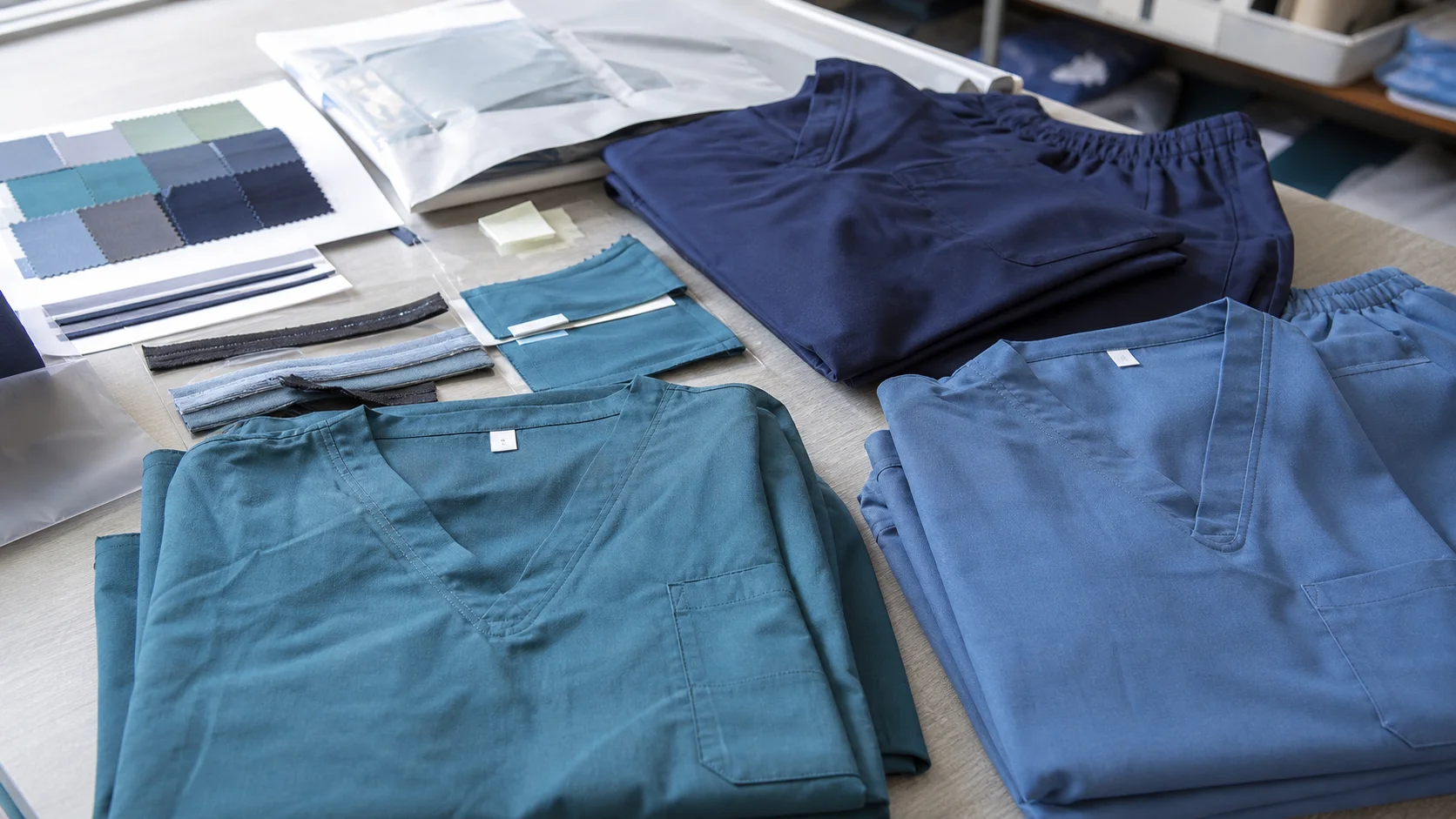
A practical review of scrub print durability for retail operations teams, covering factory decoration methods, wash testing, handfeel, and merchandising...
Print durability is one of the fastest ways a scrub program can move from dependable to disappointing. For retail operations teams, the issue is not only whether a graphic looks sharp on day one. The real question is whether the print still looks acceptable after repeated home laundering, long shifts, disinfectant exposure, folding, packing, and shelf handling. In scrub assortments, weak print performance can create returns, complaints, markdown pressure, and a brand image problem that is difficult to reverse.
This review is written for buying, sourcing, and retail operations teams evaluating scrub factories for printed styles, logo placement, department branding, seasonal graphics, and private-label programs. It focuses on what affects print durability, how to test it, where factories often cut corners, and what tradeoffs matter when you are balancing MOQ, cost, and speed to market.
Scrubs Factory Print Durability Review for Retail Teams - Fabrikn production reference
Scrubs are not fashion tees. They are washed frequently, often at higher temperatures than casual apparel, and they need to stay presentable across many wearing cycles. That puts extra pressure on prints used for branding, trims, decorative panels, size markings, and department identification.
Retail teams usually care about print durability for four reasons:
In practical sourcing terms, print durability is a shared responsibility. The factory controls the method, ink, curing, and application process. The buyer controls the specification, wash expectations, approval process, and quality standard. If either side is vague, durability becomes a guess instead of a measurable requirement.
Not every print method behaves the same on scrub fabric. The choice depends on fabric type, garment design, order volume, and price point. Retail teams should know the basic strengths and limitations before approving artwork.
Screen printing is common for large logos, simple graphics, and higher-volume orders. It can be durable when the ink system and curing are correct. It is usually best on stable knit or woven fabrics with a smooth surface. Fine detail can be limited, and thick ink deposits may feel heavy if the print area is large.
Durability note: Screen prints can hold up well through wash cycles, but poor curing or low-grade ink leads to cracking, peeling, or dulling. Dark garments and stretch fabrics make this more sensitive.
Heat transfer includes a range of techniques, from basic vinyl-style applications to more advanced film or digital transfer systems. It is useful for smaller runs and variable personalization. The appearance can be sharp on delivery, but some transfer types are more vulnerable to edge lifting, cracking, and gloss change after laundering.
Durability note: Transfers can be acceptable for short-run retail programs, but the buyer should test them carefully if the scrub is expected to be washed often or dried at higher heat.
Sublimation works best on polyester-rich fabrics and creates prints that become part of the fiber structure rather than sitting on top of it. That gives it strong wash resistance and good color stability. It is less suitable for cotton-rich fabrics and does not work on every color base.
Durability note: When the fabric content is right, sublimation is often one of the most durable options. The tradeoff is limited fabric compatibility and a different visual hand than surface printing.
Digital print methods are useful for detailed artwork and lower minimums. They can be flexible for design changes and sampling. Performance depends heavily on pretreatment, fabric composition, curing, and the specific ink system.
Durability note: Digital prints can work well, but inconsistency between batches is a common concern if the factory lacks tight process control.
Some scrub programs use reflective details, specialty labels, or decorative transfers for visibility or styling. These can add value, but they also create more failure points. Peel resistance, edge stability, and wash adhesion need explicit checking.
Durability note: Specialty materials often look strong at first and then fail earlier than expected if cure conditions or substrate compatibility are not controlled.
Print durability is not determined by the print method alone. A factory can use a good method and still deliver poor results if the supporting variables are wrong.
Scrub fabrics often include polyester, rayon, cotton, spandex, or blends. Each fiber behaves differently under heat, moisture, and washing chemicals.
If the print sits on a fabric with high stretch, the buyer should treat adhesion and flex testing as non-negotiable. A graphic that survives one wash on a hanger may fail once the wearer bends, sits, or reaches repeatedly.
Ink quality and adhesive chemistry are major drivers of performance. Lower-cost materials may save pennies per garment but create expensive quality problems later. Factories sometimes optimize for appearance under showroom lighting rather than long-term wear.
The practical tradeoff is simple: premium inks and transfer films usually cost more, but they reduce the risk of early degradation. For retail teams, that often means fewer claims and less need to replace stock mid-season.
Even a good print can fail if it is not properly cured. Under-curing is a classic reason for cracking, poor wash durability, and early peeling. Over-curing can make prints brittle or affect fabric hand.
Buyers should ask the factory to define curing parameters, not just say the print is “heat set.” The team should know the target temperature, dwell time, and equipment type used during production.
Prints placed over seams, pocket edges, or high-flex zones are naturally more vulnerable. This matters in scrubs because pocket placement, yoke structure, and decorative panel lines can all interfere with print life.
Where possible, place critical branding on flatter, less mobile parts of the garment. If the design requires printing over shaped areas, expect a higher inspection burden.
Real-world care instructions can be harsher than factory assumptions. Hospitals, clinics, and home users may wash in warm or hot water and tumble dry frequently. Detergents, softeners, bleach exposure, and disinfectant residue all influence durability.
Retail teams should align the print spec with the likely consumer care pattern, not the gentlest possible wash profile.
Factory claims are useful only if they are specific. “Durable print” means little without test conditions, material details, and acceptance criteria. The buyer should ask for evidence that can be compared from one supplier to another.
The factory should name the process, such as plastisol screen print, water-based print, sublimation, or a specific transfer type. It should also identify the ink family, adhesive layer, or film structure where relevant. Vague descriptions usually indicate weak process discipline.
Ask for wash testing that reflects the garment’s intended use. A factory may offer internal wash test results, but the details matter more than the headline claim.
Useful questions include:
Print behavior can shift when the same graphic is placed on different sizes. Larger garments may stretch the print less aggressively, while smaller sizes may compress it near seams. Retail teams should review samples across the size curve, not only the sample size.
Durability and comfort can conflict. A very thick print may survive wash well but feel heavy or stiff. A softer print may be more comfortable but less resistant to repeated laundering.
For scrubs, a balanced result is usually better than an oversized decorative effect. Buyers should judge whether the print supports the program’s commercial purpose or simply looks strong in a flat sample image.
Retail operations teams do not need a laboratory to catch most issues. A structured sample review can expose common defects before production scale-up.
A practical process usually includes:
If the program is time-sensitive, at minimum the buyer should require a pre-production sample and a documented wash test. Skipping both is usually false economy.
Most print problems show up in predictable ways:
A strong inspection plan should record where the defect appeared, how many pieces were affected, and whether the issue is isolated or systematic. That distinction matters because print failures are often process-driven, not random.
Retail teams should define what “acceptable” means for fading, cracking, and edge wear. Some programs tolerate minor aesthetic change after repeated laundering. Others require a much stricter standard because the branding is customer-facing and visible from a distance.
Good sourcing practice is not demanding perfection. It is making the factory responsible for a clear, testable standard before the order is cut.
Printed scrub programs often sit at the intersection of lowish order sizes and high consistency requirements. That creates tension between MOQ and quality control.
MOQ depends on print method, garment type, and whether the factory is printing in-house or outsourcing the decoration. Typical ranges are often seen as follows:
Print approach Typical MOQ range Cost behavior Screen printing 300-1,000 pcs per color/design Lower unit cost at volume; setup cost can be meaningful Heat transfer 100-500 pcs Higher unit cost; better for smaller or variable orders Sublimation 200-1,000 pcs depending on fabric and setup Cost-effective when fabric is compatible and artwork is stable Digital print 50-300 pcs Flexible for small runs; unit cost usually higherThese are practical market ranges, not fixed rules. Some factories can go lower, especially on sample or development runs, but buyers should expect a premium when MOQ drops.
Cost pressure often leads to one of three compromises:
Each one increases the risk of downstream failure. Retail teams should look beyond the unit decoration price and ask what is being sacrificed to get that rate. A small increase in decoration cost can be justified if it reduces claims, markdowns, and reorders.
Printed scrubs may take longer than plain styles because decoration adds process steps and approval gates. Lead time depends on sample signoff speed, artwork complexity, print method, fabric availability, and the factory’s decoration capacity.
A reasonable plan usually builds in time for:
If any of these steps are rushed, quality risk rises quickly. The fastest order is not always the cheapest order once rework and delays are counted.
A strong tech pack reduces argument later. It tells the factory what to produce, how to produce it, and what results are acceptable.
One useful detail is fabric weight. A lightweight scrub may show print distortion faster than a denser fabric, even if the decoration system is the same. Another useful detail is stretch percentage. If the garment stretches materially during wear, the print has to move with it.
Retail teams should be cautious when a factory is strong on price but weak on documentation. The following signals deserve attention.
If the factory cannot explain how it tested wash durability, the claim is not very useful. A supplier should be able to describe cycle count, wash temperature, drying conditions, and the observed result.
Many prints look strong at first glance. The real test is what happens after laundering. A supplier that resists wash testing before bulk is taking a shortcut.
Inconsistent information about ink type, curing process, or MOQ often means the sourcing team is not getting a dependable manufacturing picture.
Very small quantities and very short timelines can be possible, but they usually carry a cost premium or a quality tradeoff. If the factory promises both low cost and high durability with no caveats, buyers should verify carefully.
Printing one sample size and assuming the rest of the range will behave the same is not a safe approach. Retail operations teams should ask for at least a partial size-run check where possible.
For broader sourcing support, teams can review the company’s services page, learn more on the about us page, or use the contact us page to request garment development and production support.
Before approving a printed scrub program, a buyer should be able to answer the following questions:
That list may look basic, but it is usually enough to separate a controlled production program from a hopeful one.
Print durability on scrubs is not a decorative detail. It is a sourcing quality issue tied directly to product life, customer satisfaction, and repeat sales. The best factory choice is not always the one with the lowest decoration cost or the widest print menu. It is the supplier that can match the print method to the fabric, document the process, and pass a realistic wash test before bulk production begins.
For retail operations teams balancing MOQ, cost, and sourcing speed, the safest path is a structured approval process with clear specs and no ambiguity about wash performance. When the factory gives precise answers, print risk goes down. When answers stay broad and promotional, the order deserves caution.
Get a free quote from Fabrikn — your trusted B2B clothing manufacturer with 10+ years of experience. MOQ as low as 200 pieces.
Get a Free Quote →That depends on fabric content and the artwork. Sublimation can be very durable on polyester-rich fabrics. Screen printing can also perform well if the ink and cure are correct. For small runs, some transfers are acceptable, but they usually need closer wash testing.
MOQ often ranges from 50 to 1,000 pieces depending on print method, artwork complexity, and whether the decoration is done in-house. Lower MOQ usually means higher unit cost.
There is no universal rule, but retail teams commonly ask for enough wash cycles to reflect expected use. The key is to test under realistic conditions, including dry method and temperature, rather than relying on a simple visual check.
Common causes include under-curing, low-quality ink or film, fabric stretch, poor adhesion, or a print placed in a high-flex area. The garment may look acceptable at packing but fail once worn and washed.
Not automatically. A print system that works on polyester may not behave the same on cotton or spandex blends. The factory should confirm compatibility for each fabric and colorway.
Ask for the exact print method, wash-test evidence, sample approval, placement dimensions, and clear acceptance standards. If possible, test a garment after laundering before releasing bulk production.
Sometimes, but the cost per unit generally rises. The key question is whether the supplier can maintain the same ink, curing discipline, and inspection controls at the smaller quantity.