
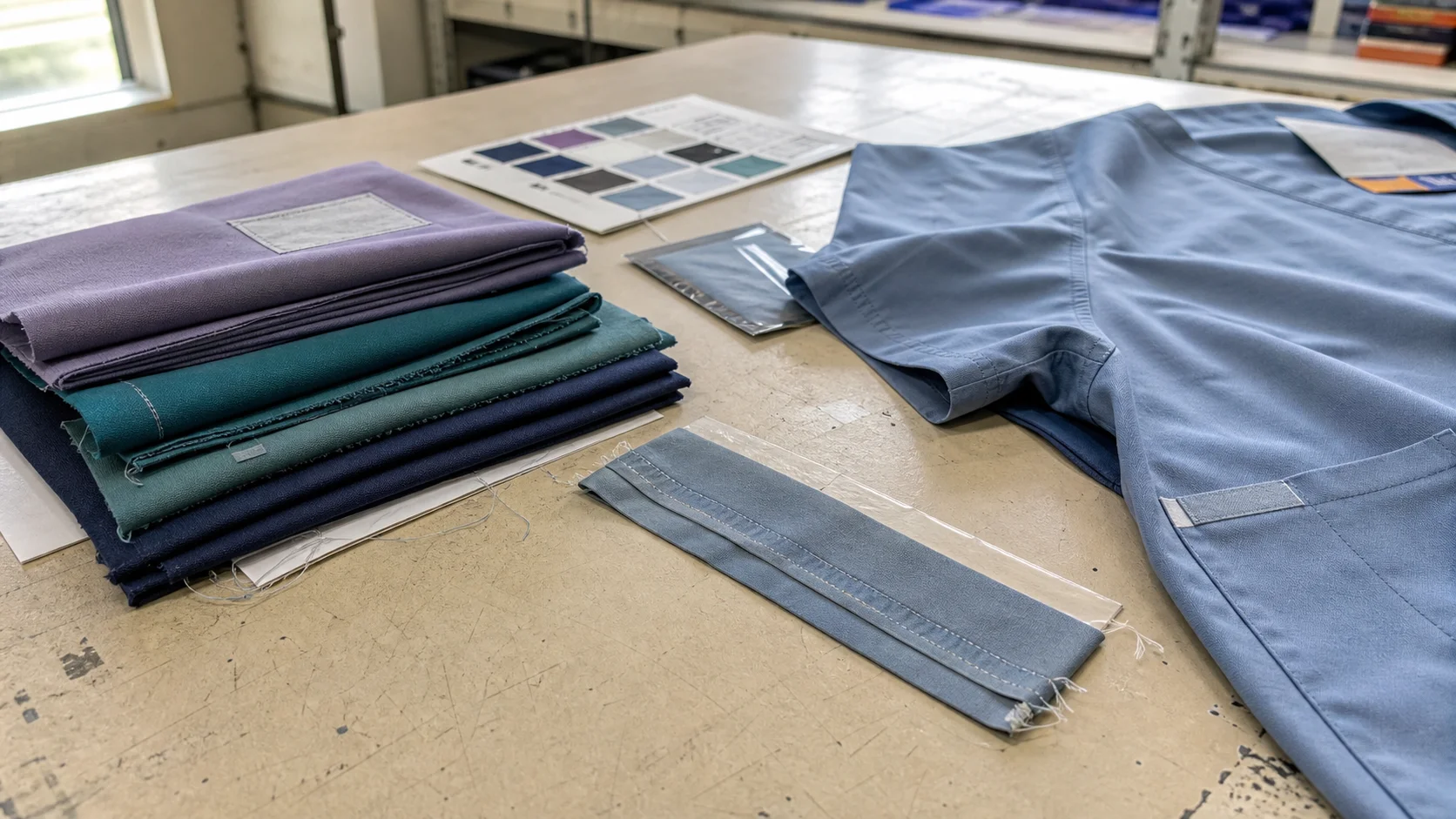
Practical breakdown of scrubs manufacturer needle policy audit for pharmacy operations teams, covering MOQ, cost, timeline, quality checks, and supplier...
Scrubs Manufacturer Needle Policy Audit For Pharmacy - Quality & Inspection manufacturing guide
Pharmacy operations teams do not usually buy scrub uniforms for style. They buy them for risk control, compliance discipline, and day-to-day practicality in an environment where sharps, contamination, controlled access, and emergency response all sit close together. A scrubs manufacturer needle policy audit for pharmacy operations teams is a focused supplier review that checks whether the manufacturer’s material, construction, packaging, and handling policies are suitable for pharmacy work where accidental needle contact, puncture concerns, and cleanroom-adjacent expectations may all matter.
This audit is not a substitute for facility safety policy or infection-control procedures. It is a sourcing tool. The goal is to verify whether the scrub supplier can consistently support the pharmacy’s requirements for durability, low-lint performance where relevant, seam integrity, fast replenishment, labeling control, and predictable quality across production lots. In practice, the best audits are not about chasing the cheapest unit price. They are about reducing the hidden costs of rework, complaints, returns, and inconsistent uniform appearance.
For teams that want a supplier baseline before issuing an RFP, it is useful to compare manufacturing capabilities, audit readiness, and service scope through the provider’s core pages such as services, about us, and contact us.
A needle policy audit for pharmacy scrub manufacturing should be narrower than a full social compliance audit, but more specific than a simple fabric hand-feel check. It should confirm that the manufacturer’s policies and production controls align with the intended use environment.
Pharmacy teams often focus on the final garment only. That is not enough. A scrub top can look correct and still fail in the field if the manufacturer has loose controls on needle counts, poor thread tension, weak stress points, or inconsistent finishing. For operational buyers, the important question is whether the supplier can keep product quality stable across repeat orders, not just whether one sample passed review.
Pharmacy uniforms live in a demanding middle ground. They are not theatrical garments, yet they are not disposable basic apparel either. Staff move between storage zones, preparation areas, patient-facing counters, and administrative rooms. If needle contact or sharps handling is part of the work environment, the uniform policy has to support safety discipline without creating heat stress or limiting movement.
A good audit gives pharmacy operations teams a way to answer practical questions:
The tradeoff is simple. Lower-cost manufacturers may offer attractive pricing, but they can create more risk if they rely on inconsistent fabric lots, weak sewing standards, or poor quality control. A slightly higher unit cost is often easier to justify when it reduces replacement frequency and avoids the administrative overhead of chasing defects.
The supplier’s own policy documents should be the first layer of review. A serious manufacturer should be able to explain how it handles needle-related risks in production, even if it does not market its process in highly technical language. The audit should not assume perfection; it should look for discipline and traceability.
Ask how needles are counted, issued, replaced, and recorded on the sewing floor. The manufacturer should be able to describe controls for broken needles, machine maintenance, and end-of-shift verification. If the supplier cannot explain how it prevents missing needle fragments or undocumented changes, that is a warning sign.
For pharmacy scrubs, fabric is not just about softness. The reviewer should ask for fiber composition, weave or knit type, GSM, shrinkage range, pilling grade, colorfastness, and wash durability. Blends such as polyester-rayon-spandex may offer comfort and drape, while poly-cotton blends can offer easier laundering. The right choice depends on the work setting, laundering frequency, and budget. Avoid making the fabric decision on weight alone.
Inspect seam type, stitch density, bar-tacks, pocket reinforcement, collar finishing, and hem strength. A weak pocket seam may not sound serious until staff begin carrying pens, notepads, scissors, or light tools. If needle exposure or sharps interaction is possible in the work area, a fragile garment is a poor operational choice.
Ask whether garments are packed in polybags, carton liners, or sealed bundles, and whether the packing area is separated from cutting and sewing waste. The packaging method should protect finished goods from dust, grease, moisture, and transit damage. If garments arrive with loose threads, stains, or compressed creases that do not recover well, the packing system may be too weak for pharmacy use.
Document review is where many audits become useful or superficial. The goal is to verify that the factory can back up its claims with real records, not just promotional language.
Document What to Check Why It Matters Material specification sheet Fiber content, GSM, shrinkage, colorfastness, stretch recovery Confirms the scrub behaves as expected after repeated laundering Trim specification sheet Thread type, zipper grade, snap quality, elastic spec, label material Reduces early failure in high-use areas In-line inspection records Defect categories, rejection counts, corrective actions Shows whether the manufacturer controls problems before packing Final inspection report Sample size, defect rate, AQL target, measurement tolerances Helps buyer assess lot stability and shipment readiness Traceability records Style code, size run, color lot, production date Useful when a pharmacy needs restock matching or complaint resolutionDo not overvalue polished paperwork. A factory can produce neat forms and still miss critical controls. Still, the absence of basic records is a problem. For a pharmacy buyer, poor traceability usually becomes a service issue later, especially when a repeat order must match an earlier delivery exactly.
Sample approval should be treated as a staged decision, not a one-step yes or no. The more exact the pharmacy requirement, the more disciplined the sample flow needs to be.
The first sample confirms style lines, pocket placement, closure type, and basic proportion. It should not be approved solely on appearance. Use this sample to catch functional errors early, such as awkward pocket depth or poor mobility at the shoulders and hips.
Approve the exact fabric swatch, thread, zipper, snap, elastic, and label type before bulk production. If the vendor substitutes materials without written consent, stop the process. Small substitutions can change shrinkage, color tone, or wash performance.
For pharmacy operations, at least a basic wash-and-wear evaluation is usually worth the time. Track shrinkage, hand feel, seam distortion, and surface pilling after several wash cycles. If the team uses industrial laundering, the test should reflect that reality rather than a domestic wash assumption.
The pre-production sample should match the bulk plan exactly. This is the last practical checkpoint before fabric is cut at scale. Buyers should sign off only after confirming measurements, stitching quality, thread color, and label placement.
A rushed sample approval process often creates the problems that later appear as “factory errors.” In reality, many failures begin with buyer-side shortcuts. If the sample is not locked properly, the bulk order can drift away from the intended spec even when the factory technically followed instructions.
Inspection is where paper standards meet real garments. This is the stage where a pharmacy buyer learns whether the supplier has true process discipline or only acceptable prototypes.
The most expensive quality issue is not always visible at the warehouse dock. Some faults only show after repeated laundering, repeated bending, or long shifts. That is why the audit should ask how the supplier tracks durability claims, not just what it promises in sales material.
For buyers who want a broader view of what the manufacturer can support beyond a single scrub program, the supplier’s scope and process detail on services can help set expectations before sample development begins.
Typical minimum order quantities vary by factory setup, fabric availability, and customization level. For standard scrub styles, a practical MOQ is often in the range of 200 to 500 pieces per style or color, though some suppliers will quote lower quantities for stock fabrics and higher quantities for custom-dyed programs. If the order includes embroidery, special pocket layouts, premium trims, or multiple size curves, the MOQ can rise quickly.
Lead time depends on whether the factory is using stock fabric, greige goods, or custom-milled material. A simple replenishment order can sometimes move in 3 to 6 weeks after sample approval, while new development with custom fabric or specialty trims may take longer. Production schedules also shift based on cutting capacity, line loading, printing or embroidery requirements, and seasonal demand.
Specification planning should be explicit. Define fabric composition, GSM, stretch percentage, shrinkage tolerance, stitch density, seam allowance, pocket depth, label method, size set, and color standard before bulk production starts. If the buyer leaves critical details open, the supplier will fill gaps with its own assumptions. That usually saves time in the short term and costs money later.
Planning Item Common Buyer Mistake Practical Better Practice Fabric Approving by feel only Set composition, GSM, shrinkage, and wash test requirements Trim Accepting generic “equivalent” parts Lock exact thread, zipper, snap, and label specifications Measurements Using one sample size as the whole standard Approve full size grading and tolerance sheet Packaging Leaving pack method unspecified Define fold, bag, carton, and barcode requirementsA useful audit template should be short enough to complete and detailed enough to be decisive. If the checklist is too long, teams stop using it. If it is too short, it misses the risks that matter.
Use a scorecard with weighted sections such as:
Each section should have a simple pass, conditional pass, or fail outcome. That format works better than vague comments because it forces a sourcing decision. If a factory fails traceability, that is not a minor issue. If a factory passes only because it provides strong sales support but weak production documentation, the buyer is accepting a future problem in exchange for present convenience.
When the relationship is still early, it helps to use the audit not only as a scorecard but also as a conversation guide. The best suppliers will not be defensive about questions. They will explain where they are strong, where they use subcontractors, and what controls exist between sample and bulk production. If the supplier cannot talk through these points clearly, the buyer should slow down.
Teams that need help shaping supplier documentation requests or service expectations can start with the manufacturer overview on about us and then open a direct discussion through contact us.
Not every audit failure requires a full supplier exit. Some issues can be corrected through a development cycle, a pilot order, or a tighter inspection plan. Others are structural and should trigger escalation.
Escalate if the supplier shows any of the following patterns:
Switch suppliers when quality variation becomes routine rather than occasional. A factory that regularly misses measurements, changes materials without approval, or sends mixed-size cartons is not just having a bad month. It is showing a system problem. In pharmacy operations, system problems matter more than excuses because uniform reliability affects staff readiness and purchasing labor.
A scrubs manufacturer needle policy audit for pharmacy operations teams is ultimately about controlling risk in a practical way. It checks whether the supplier has the production discipline to support uniform quality, repeatability, and safe handling expectations in a demanding healthcare environment. The strongest audits focus on fabric specification, sewing-floor controls, sample approval, traceability, packaging, and the supplier’s response when defects appear.
For pharmacy buyers, the right supplier is not always the one with the lowest quote. It is the one that can produce the same usable garment repeatedly, document what it is doing, and correct problems without delay. That is the standard worth applying before signing off on bulk production.
Get a free quote from Fabrikn — your trusted B2B clothing manufacturer with 10+ years of experience. MOQ as low as 200 pieces.
Get a Free Quote →It is a supplier review that checks how a scrub manufacturer controls needle use, sewing-floor quality, garment construction, traceability, and packaging. For pharmacy operations, it helps confirm whether the supplier can support a consistent and reliable uniform program.
Many suppliers quote 200 to 500 pieces per style or color for standard programs, but the number can be lower or higher depending on fabric, customization, and trim complexity. Custom materials and special labeling usually raise the minimum.
At minimum, the buyer should review style, measurements, fabric, trim, stitching, labels, and packaging. A wash test is worth adding if the uniforms will be laundered frequently or under industrial conditions.
Common risks include stitching defects, measurement drift, color variation, trim failure, loose threads, and packaging contamination. In repeated use, weak seams and unstable fabric performance usually become the most costly issues.
Lead time commonly ranges from 3 to 6 weeks after sample approval for standard programs, but custom fabric, embroidery, or complex trims can extend the schedule. Raw material availability and factory capacity also affect timing.
Stock styles are faster and usually cheaper, while custom styles give better control over fit, function, and branding. The better choice depends on whether the priority is speed, budget, consistency, or specification control.