
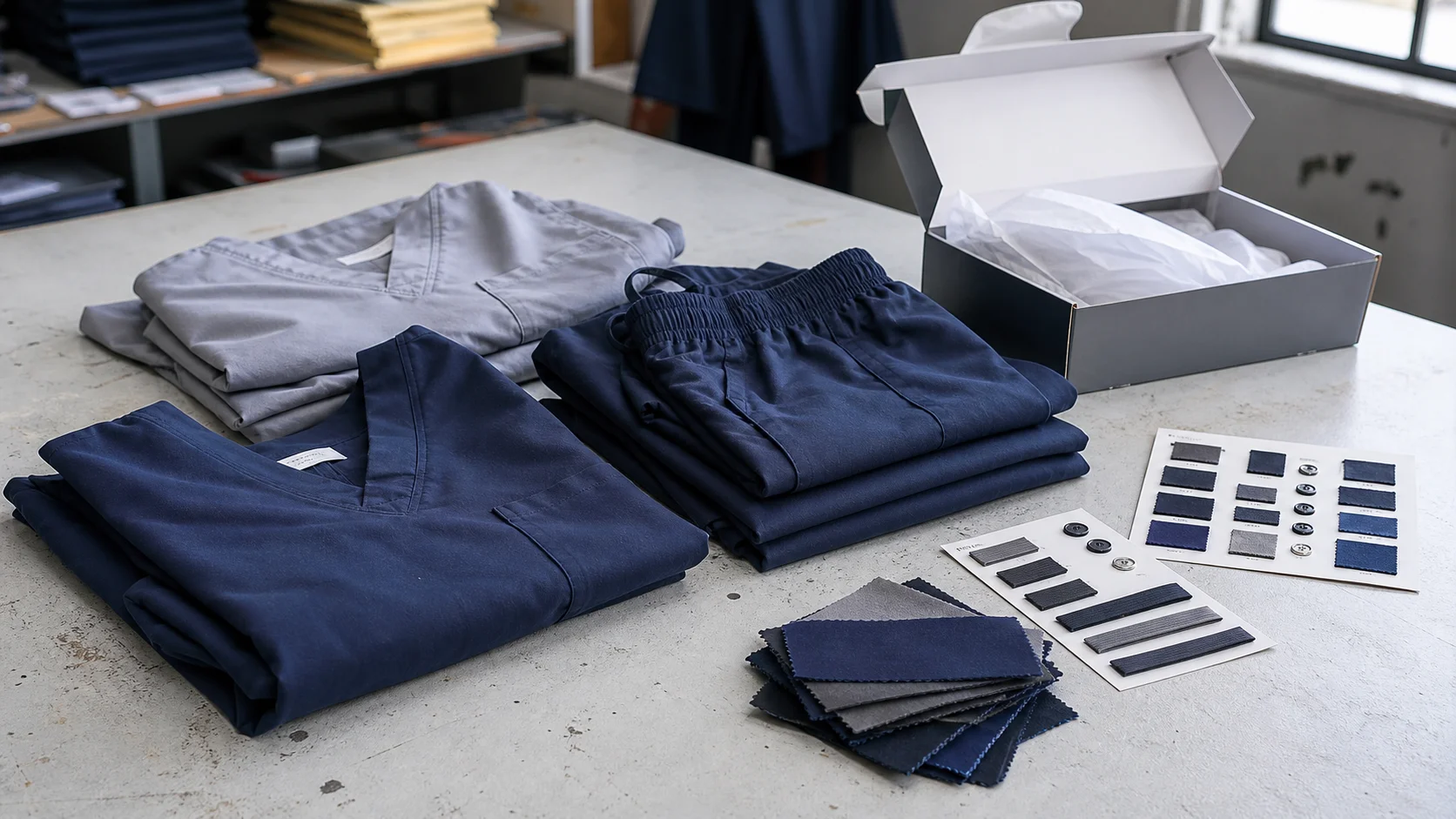
A product-specific vendor audit outline for hotel procurement teams sourcing branded scrubs for spa, wellness, housekeeping, or clinical-adjacent staff,...
Scrubs Vendor Audit Brief for Hotel Buyers - Quality & Inspection manufacturing guide
Hotel procurement teams buying scrubs for housekeeping, spa, medical wellness, laundry, engineering, kitchen support, or back-of-house service roles need a vendor audit brief that is more practical than a generic factory questionnaire. Scrubs look simple on a line-item sheet, but poor fabric choice, weak seam construction, unstable sizing, and loose color control can quickly create complaints across departments.
This brief is written for hotel buyers sourcing from a scrubs manufacturer, private label uniform supplier, or apparel vendor that offers scrub tops, scrub pants, tunics, lab-style jackets, and related workwear. The goal is to help procurement, quality, and operations teams evaluate suppliers before issuing bulk orders.
For buyers comparing broader apparel manufacturing options, Fabrikn’s services page is a useful reference point for understanding production support and sourcing scope. If your team needs to discuss a specific uniform program, the contact page is the right next step.
Scrubs are no longer limited to hospitals. Hotels use scrub-style uniforms because they are washable, easy to size, relatively cost-efficient, and suitable for teams that need mobility. Spa therapists, housekeeping supervisors, clinic staff in wellness resorts, laundry teams, and some kitchen-adjacent roles often prefer scrub sets because they balance comfort with a clean, standardized appearance.
The buying risk is that many scrub suppliers build for healthcare use only. Hotel environments can have different requirements. The garments may need softer hand feel, more refined color consistency, discreet branding, flatter seams, better presentation after laundering, and a cleaner fit across mixed-gender teams. A low-cost medical scrub set may pass basic wearability but fail hotel brand standards.
A vendor audit protects the buyer before deposits are paid. It confirms whether the manufacturer can control fabric quality, shade matching, garment measurements, workmanship, packing, labeling, and repeat orders. It also helps procurement compare vendors beyond quoted unit price.
A cheap scrub set that shrinks, pills, or twists after hotel laundry is not a saving. It becomes an operational cost, a replacement cost, and a staff satisfaction issue.
Hotel buyers should treat scrub sourcing as a uniform quality project, not just a commodity apparel purchase. The audit brief should be shared before sampling and used again before bulk production.
A good scrubs manufacturer vendor audit should cover commercial capability, technical capability, production control, quality assurance, compliance documentation, and after-sales support. The audit does not need to be overcomplicated, but it must be specific enough to catch the common problems seen in uniform programs.
The scope should include at least the following garment types if they are part of the hotel program:
The audit should also clarify whether the supplier is a true manufacturer, a trading company, a cut-make-trim unit, or a sourcing agent managing multiple factories. None of these models is automatically wrong. The risk level changes depending on how much control the vendor has over production, fabric sourcing, inspection, and reorders.
For hotel procurement teams, the strongest supplier is usually the one that can repeat the same fabric, color, measurements, and trims over multiple purchase cycles. A vendor that can deliver a first bulk order but cannot control reorders may create inconsistent uniforms across properties or departments.
Start the audit by checking whether the vendor’s business model matches the hotel’s buying pattern. Some scrub manufacturers are built for large medical distributors and prefer high-volume, limited-style programs. Others are small private label vendors that handle many styles but struggle with consistent bulk output. Hotel buyers need a middle ground: reliable volume, enough customization, and disciplined quality control.
Audit Area What to Ask Buying Judgment Business Type Are they a manufacturer, trader, or hybrid supplier? Direct factories may offer better control, while traders may provide wider sourcing options. Confirm accountability either way. Product Focus Do they specialize in scrubs, uniforms, or general apparel? A uniform-focused vendor is usually stronger on repeat sizing and durability than a fashion-only supplier. Customization Can they handle hotel colors, embroidery, labels, and department variations? Customization is useful only if the supplier controls shade, placement, and reorder consistency. Reorder Support Can they maintain fabric, trim, and pattern records? Reorder reliability matters more than a slightly lower first-order price.Ask for a clear company profile, production photos, product range, quality control workflow, and standard order terms. Be cautious if the vendor cannot explain where fabric is sourced, how measurements are checked, or who performs final inspection. A polished catalog is not the same as manufacturing control.
Hotel buyers should also check communication discipline. Delayed replies during quotation often become larger delays during sampling and production. A good supplier should answer technical questions clearly, identify risks early, and confirm details in writing.
Fabric is the most important cost and quality driver in scrub procurement. For hotels, the fabric must balance comfort, durability, easy care, appearance, and laundry performance. The best choice depends on job function, climate, laundering method, and brand positioning.
Common scrub fabric options include polyester-cotton blends, polyester-rayon-spandex blends, cotton-rich blends, and stretch woven fabrics. Polyester improves durability and drying speed. Cotton improves breathability and hand feel. Spandex improves mobility but can raise cost and may require tighter laundry controls. Rayon or viscose can improve drape but may create shrinkage or strength concerns if not tested properly.
Fabric Type Typical Use Tradeoff 65/35 Polyester-Cotton Twill or Poplin General housekeeping, laundry, back-of-house Durable and cost-efficient, but may feel less premium without good finishing. Polyester-Rayon-Spandex Spa, wellness, guest-facing support roles Better drape and comfort, but higher cost and more testing needed for shrinkage. Mechanical Stretch Polyester Blend High-mobility roles Good movement without elastane, but hand feel varies by mill quality. Cotton-Rich Blend Warm climates or premium comfort programs Breathable, but may wrinkle more and dry slower in hotel laundry.Procurement teams should request fabric specifications before sampling. At minimum, the vendor should provide fiber composition, fabric weight, weave or knit type, shrinkage expectation, colorfastness target, pilling resistance target, and care instructions. For most hotel scrub programs, fabric weight often sits around 150 to 220 gsm depending on style, climate, and opacity requirements. Very light fabrics may be comfortable but can look transparent or flimsy. Heavy fabrics may feel durable but create heat complaints.
Trim quality also deserves attention. Drawcords, elastic, buttons, snaps, zippers, labels, thread, and embroidery backing can all affect wearer comfort and durability. Elastic waistbands should recover after repeated laundering. Drawcord tips should not fray. Labels should not irritate the wearer. Embroidery should not pucker the fabric or bleed color during wash.
If the hotel uses centralized or outsourced laundry, test the fabric against that process before bulk approval. Domestic wash results do not always predict industrial laundry performance.
Fit failure is one of the most common issues in hotel uniform programs. Scrubs need to allow bending, lifting, stretching, and long hours of movement. The garment should not pull across the shoulder, gape at the neckline, restrict the thigh, or sit awkwardly at the waist.
Ask the vendor for a full size chart with measurement tolerances. Do not accept generic S-M-L sizing without garment measurements. For scrub tops, review chest, shoulder, sleeve length, armhole, body length, neckline depth, and hem sweep. For scrub pants, review waist relaxed, waist extended, hip, thigh, rise, inseam, outseam, knee width, and leg opening.
Hotel teams often include a wide range of body types. A unisex pattern may simplify buying, but it rarely fits everyone well. Men’s, women’s, and unisex options should be evaluated against the workforce profile. In premium hotel settings, poor fit can weaken the entire brand presentation.
Procurement should not approve bulk production from a flat photo. Fit must be checked on real wearers across sizes and departments.
Size-set samples are useful before bulk production. A typical size set may include XS through 3XL, depending on staff demographics. For larger programs, consider extended sizes and maternity options where needed. The supplier should explain any surcharge or MOQ requirement for special sizes before the purchase order is issued.
The sample process should be structured, documented, and tied to measurable approval points. Rushing from one attractive prototype to bulk production is risky. A hotel scrub program should usually pass through several sample stages.
Sample Stage Purpose Approval Focus Proto Sample Confirms style, silhouette, construction concept Design, pocket placement, basic fit, fabric direction Fit Sample Checks measurements and wearer comfort Size chart, mobility, neckline, rise, sleeve, inseam Pre-Production Sample Represents bulk fabric, trims, labels, colors, workmanship Final approval before cutting bulk fabric Shipment Sample Drawn from finished goods Confirms bulk output matches approved standardFor hotel buyers, the pre-production sample is the most important control point. It should use actual bulk fabric, actual trims, approved color, approved logo application, correct labels, and final packaging method. If the vendor uses substitute fabric or temporary trims at this stage, approval is incomplete.
Keep one approved sample in procurement or quality control records and one with the vendor. Each sample should be signed or digitally documented with date, version, fabric code, size, color, and style number. This prevents disputes later when bulk goods do not match the agreed standard.
Typical sample lead times can range from 7 to 21 days for basic scrubs, depending on fabric availability, pattern work, logo application, and communication speed. Custom fabric, custom dyeing, or extensive size development can extend sampling to 4 to 8 weeks. Buyers should build this into the procurement calendar rather than pressuring the vendor into shortcuts.
Minimum order quantity is a practical constraint in scrub manufacturing. MOQs vary by supplier, fabric availability, dyeing method, trim customization, and whether the order is made from stock fabric or custom-developed material.
As a general market guide, basic stock-fabric scrub styles may start around 100 to 300 pieces per style or color with some vendors. More customized programs often require 300 to 1,000 pieces per style or color. Custom-dyed fabric, exclusive trims, or special size grading may push the MOQ higher, sometimes 1,000 to 3,000 pieces or more depending on the mill and production setup.
Hotel buyers should not evaluate MOQ alone. A low MOQ can be useful for a pilot program, boutique hotel, or department trial. The tradeoff may be higher unit cost, limited fabric choice, or weaker reorder certainty. A higher MOQ may reduce unit price and improve consistency, but it increases inventory risk if sizing, fit, or color is not fully approved.
Ask the supplier about monthly production capacity, peak-season constraints, and line allocation. A vendor may quote attractive timelines when the factory is quiet, then struggle during busy months. Confirm whether the order will be produced in-house or subcontracted. Subcontracting is not automatically unacceptable, but it should be disclosed and controlled.
Scrubs have repetitive construction, which makes defects easy to multiply. If one pattern error or seam issue enters production, hundreds or thousands of garments may carry the same problem. The vendor audit should check how the supplier prevents, detects, and corrects defects.
Key inspection risks include shade variation, shrinkage, seam slippage, twisted legs, uneven pockets, skipped stitches, loose threads, poor bartacks, label errors, measurement deviations, embroidery puckering, and packing mistakes. For hotel programs, visible shade variation between tops and pants is especially damaging. Staff may look mismatched even when the garments are technically usable.
Risk Inspection Method Buyer Action Shade Variation Compare bulk pieces under consistent lighting against approved lab dip or standard. Approve shade bands before production and reject mixed lots outside tolerance. Shrinkage Wash test fabric and finished garments before bulk approval. Set acceptable shrinkage limits by fabric type and garment area. Measurement Deviation Measure samples from each size and production lot. Use written tolerances, commonly around 0.5 cm to 2 cm depending on measurement point. Weak Seams Check stress points, crotch seams, armholes, pockets, and side seams. Require bartacks or reinforced stitching where movement is heavy. Poor Packing Review size, color, department, and property labeling on cartons. Use a packing list format that matches hotel distribution needs.For inspection standards, many buyers use AQL sampling as a reference. A common apparel inspection approach may use AQL 2.5 for major defects and AQL 4.0 for minor defects, though the right standard depends on contract terms and risk tolerance. Critical defects should not be accepted. Hotel buyers should define defects clearly before production, not after disputes begin.
Inline inspection is valuable for larger orders. It catches problems while production can still be corrected. Final inspection checks finished goods before shipment. For high-risk new suppliers, both are advisable. For repeat vendors with stable performance, final inspection may be enough, but only if previous orders have been reliable.
Inspection should include both appearance and function. Have the inspector check pocket strength, drawcord function, waistband recovery, closure performance, seam security, and overall garment balance. A scrub pant that passes visual inspection but twists after wash is still a quality failure.
Hotel procurement teams may not need the same documentation as medical device buyers, but they still need responsible sourcing records. At a minimum, the supplier should provide business registration details, product specifications, fabric composition, care label information, country-of-origin details where relevant, and production accountability.
If the hotel group has sustainability, labor, or brand compliance policies, include those requirements in the audit brief. Ask whether the supplier can provide available certifications, test reports, or social compliance documentation. Be careful with unsupported claims. Terms such as “eco-friendly,” “antibacterial,” “organic,” or “recycled” should be backed by documentation from relevant material or testing sources.
For antimicrobial or fluid-resistant claims, procurement should be especially cautious. These finishes may be regulated in some markets and can lose effectiveness after repeated washing. If such claims are important, request test methods, performance data, wash durability results, and labeling guidance. For most hotel use cases, comfort and wash durability may be more valuable than technical claims that are not needed operationally.
Traceability also matters for reorders. The vendor should keep records of fabric mill, fabric lot, dye lot, trim supplier, pattern version, size chart, and approved sample. Without these records, a reorder may arrive in a slightly different shade, weight, or fit.
Fabrikn’s about page gives buyers context on the company’s sourcing and manufacturing orientation, which can help when assessing whether a partner is aligned with long-term apparel procurement rather than one-off transactions.
Lead time depends on fabric availability, sample approval speed, order size, factory capacity, trim sourcing, printing or embroidery, inspection schedule, and shipping method. Hotel buyers should separate sample lead time, production lead time, inspection time, and transit time instead of asking for one vague delivery date.
Typical production lead times for basic scrub orders may range from 30 to 60 days after approval of the pre-production sample and receipt of deposit. Custom fabric, custom dyeing, complex embroidery, special trims, or large size sets may require 60 to 90 days or more. Air freight can shorten transit but may destroy the cost advantage of offshore sourcing. Sea freight is cheaper but requires stronger planning.
Reorders should be planned before the first order is placed. Ask the supplier how long fabric remains available, whether greige fabric can be reserved, and whether the same dye lot can be repeated. Exact shade reproduction is difficult across dye lots, so hotels should consider holding buffer stock for visible guest-facing departments.
Size ratios can make or break inventory efficiency. A supplier may suggest a standard ratio, but hotel buyers should use staff data wherever possible. Ordering too many small or large sizes creates dead stock. Ordering too few middle sizes causes emergency reorders at higher cost.
A scorecard helps procurement compare vendors consistently. It also prevents the cheapest quote from winning without enough quality evidence. The scorecard does not need to be complicated, but it should weight the factors that matter most for hotel operations.
Audit Category Weight What Good Looks Like Fabric Quality 20% Clear specs, acceptable shrinkage, good opacity, strong wash performance, consistent hand feel. Fit and Sizing 15% Detailed size chart, size-set samples, practical tolerances, inclusive sizing options. Workmanship 15% Clean stitching, reinforced stress points, accurate pockets, stable seams, minimal loose threads. Production Control 15% Documented process, clear capacity, controlled subcontracting, reliable production schedule. Inspection System 15% Inline checks, final inspection, AQL understanding, defect classification, corrective actions. Commercial Fit 10% Reasonable MOQ, transparent pricing, reorder support, clear payment and delivery terms. Communication 10% Fast, accurate, written responses with technical clarity and proactive risk warnings.Buyers should set minimum pass criteria. For example, a vendor may need to score at least 75% overall with no critical failure in fabric quality, compliance, or production control. A vendor that performs well commercially but poorly on quality should not be approved for hotel-wide rollout.
Use the scorecard during vendor selection and again after the first shipment. Supplier performance should be measured against actual delivery, inspection results, complaint rates, shrinkage results, and reorder accuracy. A vendor that improves after feedback may be worth developing. A vendor that repeats the same defects should be replaced before the uniform program becomes unstable.
The best scrubs manufacturer for a hotel procurement team is not always the cheapest, the largest, or the most flexible. It is the supplier that can deliver consistent garments that staff will wear comfortably and operations can replenish predictably.
For budget-sensitive back-of-house programs, a durable polyester-cotton blend with strong construction may be the best value. For wellness, spa, or guest-facing support roles, a softer stretch blend may justify the extra cost. For large hotel groups, reorder reliability and technical documentation are often more important than small unit-price savings.
Buyers should avoid over-customizing early. Every custom color, pocket shape, trim, logo, and size extension can increase MOQ and lead time. Start with the operational essentials: fabric performance, fit, color, durability, and laundry compatibility. Add branding only when the garment foundation is stable.
A practical vendor audit gives procurement leverage. It shows suppliers that quality expectations are defined, approvals are documented, and inspections will be enforced. It also helps internal stakeholders understand why a slightly higher-priced vendor may be the safer long-term choice.
Not every vendor will have perfect documentation on the first request. That does not automatically disqualify them. The key question is whether they can produce accurate information, accept clear specifications, and operate to a controlled approval process. A supplier that resists documentation is a risk.
A scrubs vendor audit brief helps hotel buyers move from price shopping to controlled procurement. It clarifies the difference between a basic apparel supplier and a manufacturer capable of supporting a hotel uniform program across departments, properties, and reorder cycles.
The strongest audit focuses on fabric, fit, construction, inspection, documentation, MOQ, and lead time. It also recognizes tradeoffs. Low MOQ may cost more. Stretch fabric may need better testing. Custom colors may increase lead time. Fast delivery may reduce quality control time. A sound procurement decision weighs these factors before the purchase order is issued.
Hotels that formalize this process usually get cleaner sampling, fewer production surprises, and better long-term uniform consistency. For procurement teams preparing a new scrub program or reviewing an existing supplier, a written audit brief is one of the simplest tools to reduce risk.
Get a free quote from Fabrikn — your trusted B2B clothing manufacturer with 10+ years of experience. MOQ as low as 200 pieces.
Get a Free Quote →Start with fabric quality, production capability, and fit control. These three areas drive most scrub uniform problems. A vendor should provide fabric specifications, garment measurements, sample approval steps, and a clear explanation of how bulk quality is inspected.
Typical MOQ can range from 100 to 300 pieces per style or color for stock-fabric programs. More customized scrubs often require 300 to 1,000 pieces per style or color. Custom-dyed fabric or exclusive trims may require higher quantities, sometimes above 1,000 pieces depending on the supplier and mill requirements.
Basic production may take 30 to 60 days after pre-production sample approval and deposit. Custom fabrics, custom colors, embroidery, special trims, or large hotel group orders may take 60 to 90 days or longer. Sampling, inspection, and freight time should be planned separately.
There is no single best fabric for every hotel. Polyester-cotton blends are durable and cost-efficient for housekeeping or laundry teams. Polyester-rayon-spandex or other stretch blends can work better for spa and wellness roles where comfort and drape matter. The right choice depends on laundry process, climate, role, budget, and brand standard.
Yes. A pre-production sample should be approved before bulk fabric is cut or bulk sewing begins. It should include the final fabric, trims, labels, logo application, color, construction, and packing standard. Without this step, disputes over quality and appearance become much harder to resolve.
Common risks include shrinkage, shade variation, measurement errors, seam weakness, twisted pant legs, uneven pockets, loose threads, embroidery puckering, and packing mistakes. Hotel buyers should define acceptable tolerances and inspection standards before issuing the purchase order.
Yes, but only if the supplier can maintain technical records, fabric continuity, size ratios, reorder planning, and consistent packing by property or department. Multi-property programs need stronger documentation than one-time small orders.
Contact the manufacturer before finalizing budget and rollout dates. Early discussion helps confirm MOQ, sampling time, fabric options, customization limits, and realistic delivery schedules. Buyers can use Fabrikn’s contact page to start a sourcing discussion.