
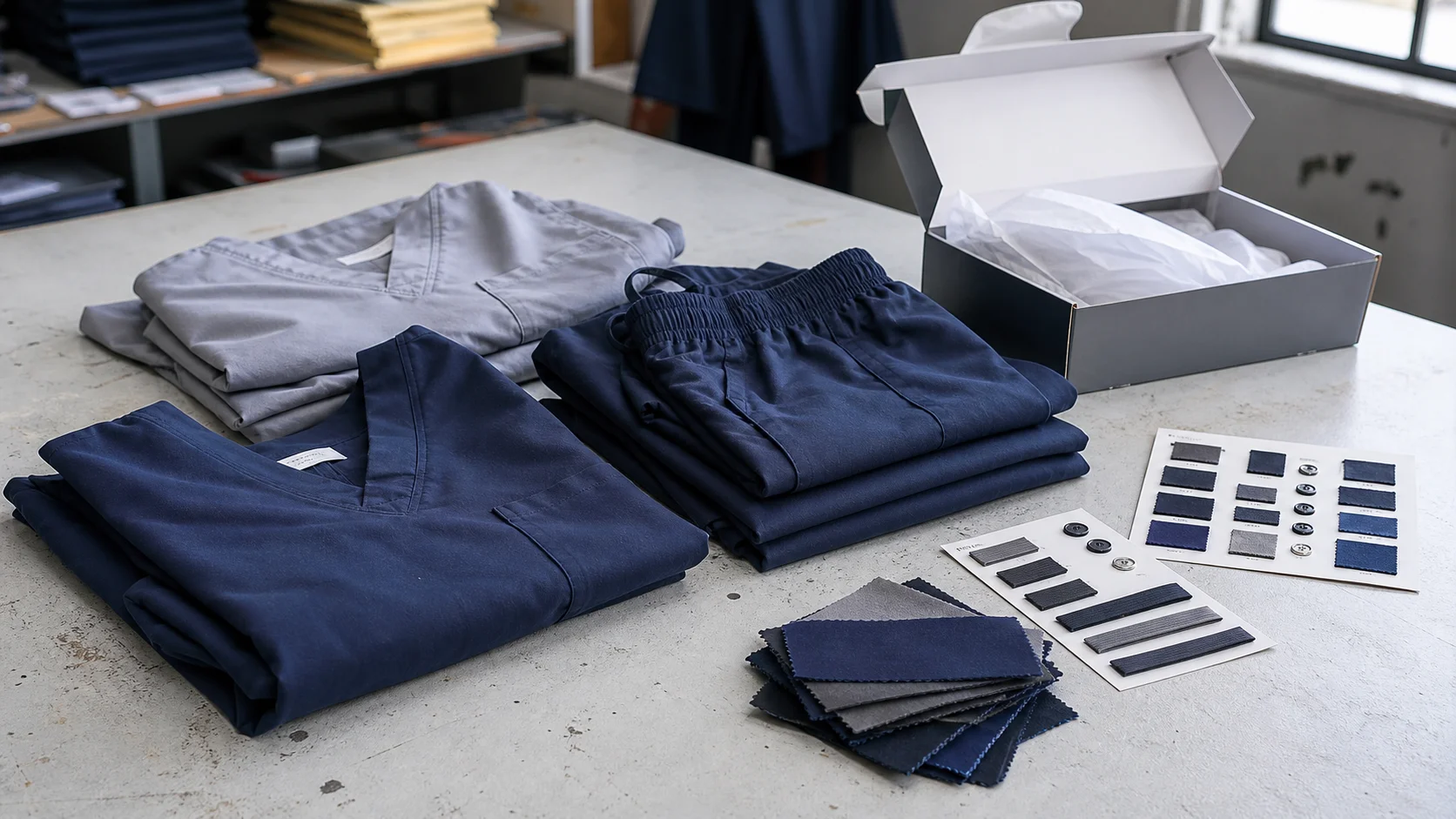
A quality and inspection outline for pharmacy operations teams auditing scrub manufacturers, with focus on fabric controls, construction checks, compliance...
Scrubs Vendor Audit Brief for Pharmacy Buyers - Fabrikn production reference
Pharmacy operations teams buy scrubs differently from fashion retailers, clinics, and general uniform distributors. The garment has to look consistent across locations, survive repeated laundering, support mobility during long shifts, and match brand or department rules without creating unnecessary inventory risk. A weak scrubs supplier can cause late store openings, uneven staff presentation, poor fit adoption, excessive replacement claims, and avoidable compliance questions.
This audit brief is written for pharmacy buyers, procurement managers, quality teams, and operations leaders assessing a scrubs manufacturer for multi-site pharmacy use. It focuses on practical supplier checks: factory capability, fabric and trim control, sample approval, sizing, inspection, packaging, lead times, and purchasing tradeoffs. The goal is not to create paperwork for its own sake. The goal is to decide whether a vendor can reliably supply scrubs at the quality, cost, and service level pharmacy operations require.
Scrubs are often treated as simple garments, but pharmacy uniform programs create hidden complexity. A buyer may need several sizes, men’s and women’s fits, multiple colors, embroidery or heat-transfer branding, stock replenishment, and consistent appearance across locations. A small issue in garment specs can multiply quickly when hundreds or thousands of employees are involved.
For pharmacy operations, the most common failures are rarely dramatic. They are usually practical problems: pants shrink after wash, tops twist at the side seam, neckline shape varies between batches, pocket placement interferes with work tools, or black and navy shades shift between deliveries. These defects may not make the garment unusable, but they create complaints, returns, and inconsistent staff presentation.
A vendor audit gives the buying team a structured way to separate a scrubs manufacturer that can manage repeat programs from one that only knows how to ship a one-time apparel order. The audit should verify whether the supplier can control fabric lots, grading, stitching, inspection, packaging, and replenishment timelines.
A pharmacy scrubs vendor should be assessed as a program supplier, not just a cut-and-sew source. Repeatability matters as much as the first sample.
A useful scrubs vendor audit should cover both manufacturing capability and program management. Some buyers focus only on price, fabric weight, and delivery date. That is not enough for pharmacy operations. Scrubs are daily-use workwear, so quality failures are visible and costly over time.
The audit scope should include the following areas:
The audit should not become a generic checklist copied from another category. A T-shirt factory and a scrubs manufacturer may both sew knit or woven garments, but scrubs need reliable durability, practical pocket construction, stable sizing, and predictable replenishment. Pharmacy buyers should weight the audit toward repeat production control.
The first audit question is simple: does this manufacturer fit the buyer’s order profile? A supplier that looks strong on paper may still be a poor match if its normal customer base, minimums, or production calendar do not align with pharmacy operations.
Commercial fit matters because a pharmacy buyer may need continuity more than the absolute lowest unit cost. A factory optimized for large one-color bulk orders may resist smaller size replenishment. A trader with good communication may lack control over sewing quality. A small workshop may deliver good samples but struggle with rollout volume.
Buyers comparing scrubs sourcing options can review broader apparel production support through Fabrikn’s services to understand how manufacturing, sourcing, and quality planning can be structured before vendor selection.
Scrubs manufacturing capacity is affected by fabric availability, labor allocation, other uniform contracts, and seasonal production peaks. A supplier may quote a 45-day production lead time, but that timeline can stretch if fabric is greige goods, dye-to-order, or imported from another mill.
During the audit, ask for the manufacturer’s realistic monthly capacity by garment type, not just total factory capacity. Tops with multiple pockets, bartacks, contrast trims, or embroidery take longer than simple pull-on pants. A facility may claim it can produce 100,000 pieces per month, but that figure may refer to basic garments under ideal conditions.
Fabric is the center of any scrubs audit. Pharmacy scrubs usually need comfort, durability, color stability, and easy care. The right fabric depends on budget, workplace climate, brand expectations, and laundering habits.
Fabric specifications should be documented before sampling. At minimum, the buyer should define fiber content, construction, weight, color standard, finish, stretch requirement if applicable, shrinkage tolerance, and care instructions. If antimicrobial, fluid-resistant, or stain-release claims are requested, the audit should verify test evidence and whether the finish survives repeated laundering. Marketing claims without test reports should not be accepted as a substitute for technical validation.
Trim control is just as important. Drawcords, waistband elastic, snaps, zippers, thread, labels, hangtags, and logo applications can cause delays or defects. Pharmacy buyers should be cautious with trims that are hard to replace across repeat orders. A custom zipper pull or uncommon drawcord color may look good in the sample stage but create replenishment delays later.
Scrubs should include accurate care labels, size labels, fiber content labels, and country-of-origin information as required for the destination market. If the garments are sold or distributed across multiple regions, label requirements may vary. The audit should confirm who approves label artwork, who checks regulatory wording, and how label changes are controlled during repeat production.
A proper sample approval process prevents costly mistakes before bulk production. Pharmacy buyers should not approve bulk production based only on a good-looking photo sample. Fit, measurement accuracy, fabric performance, pocket function, and decoration placement must be checked physically.
The pre-production sample is the key approval point. It should reflect the actual bulk garment. If the vendor submits a pre-production sample made with substitute fabric, temporary thread, or missing labels, the buyer should not treat it as final approval.
Pharmacy staff may work standing for long hours, reach for stock, bend, sit, and move between customer-facing and back-of-house tasks. Scrubs that look acceptable on a hanger may not perform well during a shift.
Fit review should cover shoulder mobility, sleeve opening, armhole comfort, chest ease, hip ease, waistband recovery, inseam length, pocket access, and fabric recovery after movement. For women’s fits, buyers should review bust shaping, neckline coverage, side seam shaping, and pant rise. For men’s or unisex fits, buyers should review shoulder width, sleeve proportion, torso length, and pant seat comfort.
Size grading deserves special attention. A supplier may create a good medium sample but use poor grading rules for XS, XL, 2XL, and beyond. Pharmacy buyers should request size set samples for the most important size range before approving a multi-location rollout.
Minimum order quantity is one of the biggest commercial pressure points in scrubs sourcing. The best MOQ depends on whether the buyer needs stock uniforms, private label scrubs, custom colors, or fully developed designs.
These ranges are typical market references, not fixed rules. A vendor may accept a lower MOQ at a higher unit price, especially for reorder business or when fabric is available. A very low MOQ for a fully custom dyed program should be questioned because someone must absorb the fabric minimum, leftover cloth, or production inefficiency.
Pharmacy buyers should plan size ratios using employee data where possible. Generic size ratios can cause overstock in slow sizes and shortages in core sizes. If the workforce has regional variation, one national ratio may not fit all locations.
For initial orders, buyers often need a buffer for onboarding, damaged garments, employee exchanges, and new store openings. Replenishment logic should be agreed before rollout. A vendor that can produce the first order but cannot support small replenishment quantities may create operational friction within months.
Quoted lead time is often too simple. A supplier may say production takes 45 to 60 days, but the real calendar depends on sample approval, fabric availability, trim sourcing, production scheduling, inspection, packing, and freight.
For repeat orders using approved fabric and trims, timelines can be shorter. Buyers should still confirm whether the vendor keeps fabric on hand, orders fabric after receiving a purchase order, or depends on mill schedules. A repeat order is only fast if key materials are available.
A practical audit question is: “What must be true for your quoted lead time to hold?” This forces the vendor to explain dependencies. It also helps the pharmacy team build a realistic calendar for rollout, onboarding, and replenishment.
Scrubs quality is built during production, not fixed at final inspection. A good vendor should control cutting accuracy, seam construction, pocket placement, decoration alignment, pressing, and packing before the goods reach the final audit table.
Cutting errors create measurement variation and twisting. The audit should review how the supplier spreads fabric, controls fabric relaxation for stretch materials, prevents shade mixing, and identifies cut bundles. Shade control is especially important for navy, black, charcoal, ceil blue, and branded custom colors.
Garments from different fabric shade lots should not be mixed within the same set if visible variation exists. For pharmacy programs where tops and pants are worn together, shade matching between garment types is important.
Scrubs must handle repeated wear and laundering. Sewing review should include seam allowance, stitch density, thread type, bartack placement, pocket reinforcement, waistband construction, drawcord security, hem finishing, and seam strength.
Common sewing risks include uneven topstitching, skipped stitches, puckering, twisted legs, weak crotch seams, loose pocket corners, uneven side vents, and inconsistent neck binding. Some of these are cosmetic. Others affect durability and wearer satisfaction.
Pharmacy scrubs often include embroidered logos, heat transfers, woven patches, or department identifiers. The audit should verify placement tolerance, color matching, thread quality, backing comfort, and wash durability.
Embroidery can add a premium look but may irritate the wearer if backing is rough or poorly trimmed. Heat transfers can be cleaner and lighter, but they need wash and adhesion testing. A buyer should not approve decoration based only on a fresh sample; laundering performance matters.
Final inspection for scrubs should be stricter than a basic visual review. The inspection plan should include measurements, workmanship, fabric defects, shade variation, labelling, packing, and functional checks.
Key measurement points usually include chest, shoulder, sleeve length, body length, neck opening, waist, hip, rise, inseam, outseam, thigh, leg opening, and pocket dimensions. Tolerances should be realistic. Very tight tolerances can create unnecessary rejections, while loose tolerances can cause fit inconsistency.
A common approach is to apply tighter tolerance to critical fit points and slightly wider tolerance to less critical areas. For example, waist and inseam control may be more important than minor pocket width variation. The buyer and vendor should agree before production.
Shade variation can be a serious issue in scrubs programs because employees may pair tops and pants from different production lots. If the top is dark navy and the pant is slightly purple navy, the set looks inconsistent. The audit should check the supplier’s process for shade banding and garment pairing.
Fabric defects such as slubs, holes, oil marks, crease lines, and dye streaks should be classified based on visibility and garment location. A minor defect inside a pocket is different from a visible defect at center front.
Many apparel inspections use AQL sampling, often with general inspection levels and defect classifications agreed between buyer and supplier. For pharmacy scrubs, buyers may use normal inspection for stable repeat vendors and stricter inspection for first orders, new fabrics, or new factories.
The audit should confirm whether the supplier understands critical, major, and minor defect classification. A missing care label, unsafe sharp object, incorrect size breakdown, or wrong logo may require different handling than a loose thread. Buyers should define defect severity in the purchase agreement.
Packaging is often treated as an afterthought, but it directly affects pharmacy rollout. If scrubs must be distributed by location, department, employee, or size set, packing accuracy matters as much as sewing quality.
Set packing is convenient for rollout but can create problems if tops and pants have different replacement rates. Separate packing gives more inventory flexibility but may require more work during internal distribution. Pharmacy buyers should choose based on how the uniforms are issued and replenished.
Cartons should be marked clearly with style number, color, size, quantity, purchase order, carton number, gross weight, net weight, and destination where applicable. Incorrect carton marking can slow warehouse receiving and create misallocation across branches.
If the buyer uses a third-party logistics provider or internal distribution center, carton specifications should be shared with the manufacturer before production. Waiting until goods are packed to discuss carton size, barcode format, or packing list structure is a common mistake.
A scorecard helps pharmacy buyers compare vendors consistently. It should not replace judgment, but it creates a clear record of why one supplier is approved and another is not.
Audit Area What to Check Rating Guidance Product specialization Scrubs, uniforms, medical workwear experience High rating if repeat uniform programs are proven through documentation Fabric control Lab dips, shrinkage, shade bands, fabric testing Low rating if fabric source changes without approval Sampling process Fit samples, size sets, pre-production samples High rating if approvals are documented and repeatable Production quality Cutting, sewing, pocket reinforcement, waistband control Low rating if final inspection is the only quality checkpoint MOQ flexibility Initial rollout and replenishment support High rating if replenishment terms are realistic Lead-time reliability Material readiness, capacity, shipment planning Low rating if quoted timelines ignore fabric and trim dependencies Inspection readiness AQL knowledge, defect classification, measurement control High rating if inspection reports and corrective actions are structured Packaging accuracy Carton labels, SKU labels, size sorting, packing lists Low rating if packing is manual without verification checksFor a first order, a buyer may assign more weight to sampling, fabric control, and inspection. For a long-term replenishment program, lead-time reliability and MOQ flexibility may become more important.
A scrubs vendor does not need to be perfect to be usable. The question is whether the risks are known, manageable, and priced correctly. Pharmacy buyers should separate correctable issues from structural problems.
These issues may be solvable. A hold decision gives the supplier a chance to provide samples, documentation, test reports, revised timelines, or a corrective plan.
The lowest quote is not always the lowest cost. Poor scrubs can create exchange costs, employee dissatisfaction, brand inconsistency, and operational delays. A slightly higher unit price may be justified if the vendor reduces quality risk, supports replenishment, and keeps sizing consistent across batches.
Pharmacy buyers that need help structuring a sourcing brief or vendor comparison can contact Fabrikn through the contact page. For background on the company’s approach to apparel manufacturing support, visit Fabrikn’s about page.
Before issuing a purchase order, the buyer should request a document pack that proves the vendor understands the program. This does not need to be excessive, but it should cover the order’s critical controls.
A supplier that resists basic documentation may still be able to sew garments, but it is less suitable for pharmacy operations where repeatability and distribution accuracy matter. Written approvals protect both sides. They reduce disputes when bulk goods are inspected.
Some audit findings deserve immediate attention because they point to deeper risk. Pharmacy buyers should watch for these red flags:
A red flag does not always mean the vendor is unusable. It does mean the buyer should not proceed without correction. In uniform programs, small uncontrolled variables become repeated problems.
A scrubs manufacturer vendor audit should be practical, specific, and tied to how the uniforms will be used. Pharmacy operations teams need more than a clean sample and a low quote. They need a supplier that can manage fabric consistency, fit, grading, trims, production quality, packaging, and repeat orders.
The strongest vendor is usually not the one that promises everything. It is the one that explains tradeoffs clearly. Lower MOQs may raise unit cost. Custom colors may improve brand consistency but increase lead time and inventory exposure. Premium stretch fabric may improve wearer satisfaction but requires better testing for pilling, shrinkage, and heat performance. Set packing may simplify rollout but reduce replenishment flexibility.
Good purchasing judgment comes from matching the supplier’s real capability to the pharmacy’s operating needs. A structured audit turns that decision from a price comparison into a risk-controlled sourcing process.
Get a free quote from Fabrikn — your trusted B2B clothing manufacturer with 10+ years of experience. MOQ as low as 200 pieces.
Get a Free Quote →Pharmacy buyers should check product specialization, fabric control, trim sourcing, sample approval, size grading, sewing quality, inspection methods, MOQ flexibility, lead-time reliability, and packaging accuracy. The audit should focus on repeatability, not only the first sample.
Typical MOQs range from 500 to 1,500 pieces per style or color for custom scrubs using available fabric. Custom dyed fabric programs may require 1,000 to 3,000 or more pieces per color. Stock scrubs with logo application can sometimes start at 50 to 300 pieces.
Development and bulk production can take 8 to 16 weeks depending on design complexity, sample rounds, fabric availability, trim sourcing, factory capacity, inspection, and freight. Repeat orders may be faster if fabric and trims are already approved and available.
Employees often wear scrub tops and pants as a set. If fabric shade varies between lots, the uniform can look mismatched. Shade control is especially important for navy, black, charcoal, ceil blue, and custom brand colors.
No. A development sample is useful for design review, but bulk production should be approved only after a pre-production sample is made with final fabric, trims, labels, construction, branding, and packaging details.
Common issues include shrinkage, shade variation, twisted seams, weak pocket reinforcement, skipped stitches, inconsistent sizing, poor waistband recovery, logo placement errors, missing labels, and incorrect size packing.
Not usually. The cheapest vendor may be acceptable for simple stock needs, but pharmacy operations often require consistent fit, replenishment support, accurate packing, and reliable fabric control. A higher unit cost can be justified if it reduces returns, complaints, and operational disruption.