
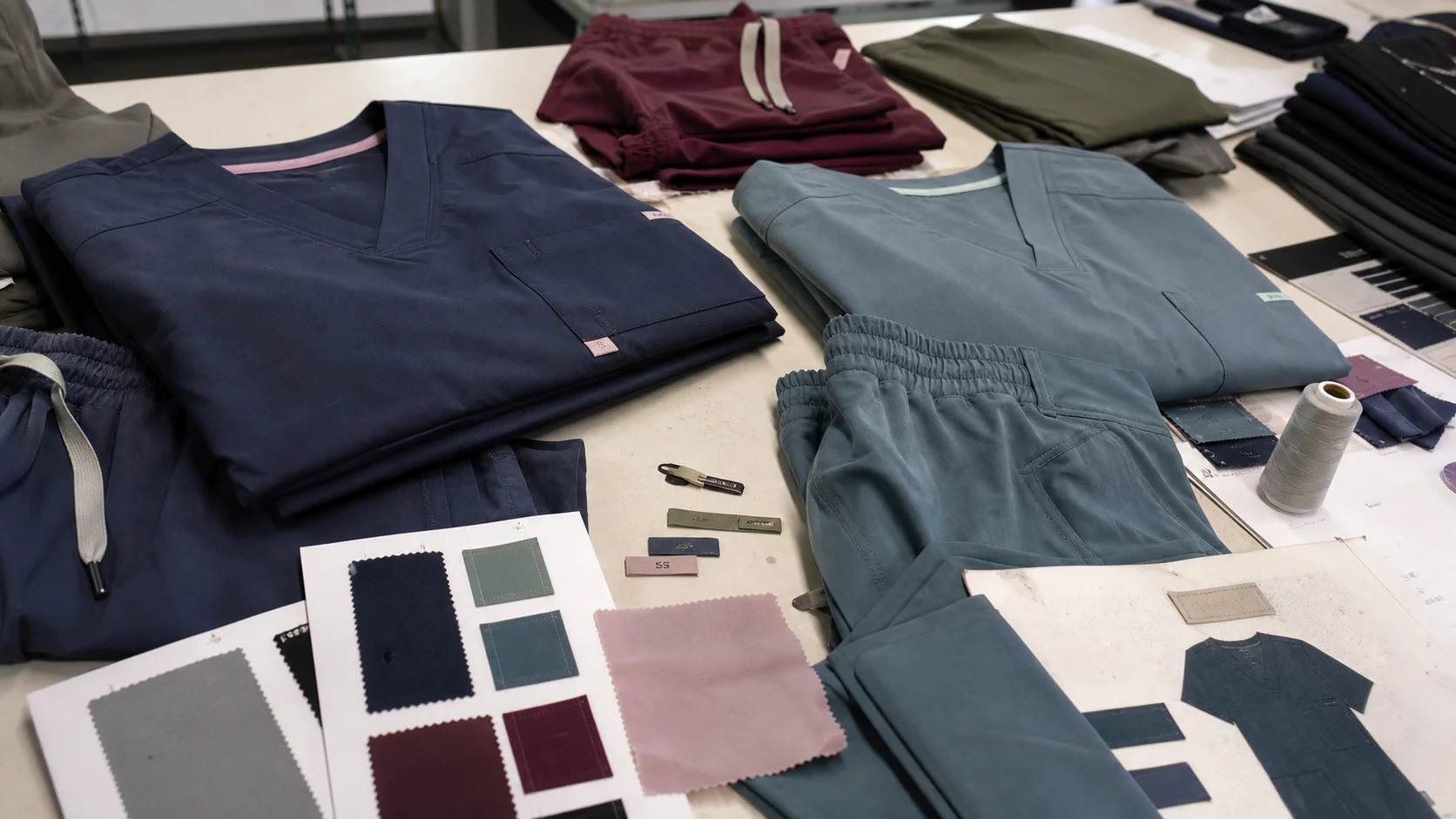
A sourcing-focused outline for gym program buyers creating a scrubs production control brief that manages MOQ, cost, fit, decoration, packaging, and...
Scrubs Production Brief for Gym Buyers - MOQ, Cost & Sourcing manufacturing guide
Scrubs production control for gym program buyers is a different sourcing problem from hospital uniform buying. A gym chain, wellness studio group, recovery clinic, sports therapy network, or branded fitness program may want scrub-inspired uniforms for staff who move between reception, treatment rooms, training floors, recovery lounges, cleaning duties, and member support. The garments need the clean visual language of medical apparel, but the buying priorities are often closer to activewear: stretch, shape retention, easy care, size inclusivity, sweat management, and consistent branding across many locations.
This brief is written for buyers who need to turn a scrub concept into a controlled production order. It covers minimum order quantities, costing drivers, fabric and trim specifications, sample approval, lead-time dependencies, inspection risks, and supplier communication. The aim is not to make scrubs sound simple. The aim is to help gym buyers avoid vague tech packs, surprise surcharges, late approvals, and uniforms that look acceptable on day one but fail after repeated laundering.
Traditional medical scrubs are usually designed for clinical environments where infection control, easy laundering, department color coding, and durability are the main concerns. Gym-oriented scrub programs sit in a more mixed-use environment. Staff may greet members, demonstrate equipment, support physiotherapy sessions, handle towels, clean stations, or assist in recovery areas. A uniform that feels stiff, overheats, or restricts movement will not be worn well.
The practical sourcing issue is that many scrub manufacturers are set up for healthcare basics, while many activewear factories are not disciplined in scrub pocketing, modest coverage, or institutional repeat orders. Gym buyers need a supplier that can bridge both categories. The best production brief should make that requirement clear before pricing begins.
A gym scrub program also carries stronger brand expectations. Color must match the location concept. Logos must sit cleanly on the chest, sleeve, or back neck. Size grading must work for a broad staff base. Reorders must match the first delivery closely enough that new staff do not look different from existing staff.
Purchasing judgment: do not buy gym scrubs only as a low-cost uniform item. If the team moves heavily, washes garments frequently, and appears in customer-facing spaces, poor fabric recovery and inconsistent fit will cost more than a slightly higher unit price.
A production control brief should reduce interpretation. The supplier should not have to guess whether the scrub top is slim, regular, or relaxed; whether the pocket is decorative or functional; whether the fabric should feel crisp or soft; or whether the logo must survive industrial washing. A clear brief is also the basis for comparing quotes from different factories.
A tech pack does not need to be overdesigned, but it must be precise. At minimum, include flat sketches, measurement points, construction notes, fabric specification, trim details, artwork placement, packaging, labeling, and inspection standards. If the buyer does not have a complete tech pack, a sourcing partner can help translate the concept into production language. Buyers reviewing support options can start with the service overview at fabrikn.com/services/.
For scrub programs, the most important technical points are usually body length, chest sweep, shoulder width, armhole depth, pocket size, pant rise, waistband stretch, inseam options, and fabric recovery. These are the areas most likely to create complaints from staff after launch.
Fabric selection drives both wearer satisfaction and cost. Gym buyers often ask for “stretch scrubs,” but that term can mean several different fabric families. The brief should define fiber content, weight, stretch direction, finish, hand feel, shrinkage allowance, and colorfastness expectations.
Buyers should be careful with performance claims. A supplier may say the fabric is antimicrobial, cooling, or quick-dry, but those claims need test standards, wash durability, and legal review before being used in staff manuals or marketing. For internal uniforms, it may be enough to specify easy-care, breathable, stretch, and durable rather than overpay for claims that do not change real use.
Scrubs look simple, yet small construction choices determine whether the garment feels professional or disposable. Gym staff need movement through the shoulders, seat, thigh, and knees. At the same time, the uniform should not look like loose hospital issue if the brand has a sharper retail environment.
Trims are often treated as secondary, but they create many production delays. The brief should list thread color, drawcord type, zipper brand or quality level, snap finish, elastic width, pocket reinforcement, logo method, care label content, size label format, and packaging requirements.
Logo execution needs early testing. Embroidery is durable and premium but can pucker on lightweight stretch fabric. Heat transfer is clean and flexible but must be tested for wash resistance, cracking, and edge lifting. Woven patches add identity but can feel heavy or scratchy if placed near movement areas.
Purchasing judgment: if the uniform will be laundered weekly or more, approve decoration after wash testing. A logo that looks perfect on the salesman sample can fail before the garment fabric does.
MOQ is one of the most important commercial controls in a scrub program. Gym buyers often want multiple colors, many sizes, and separate men’s and women’s fits, but each variation divides the order and creates production inefficiency. The supplier’s quoted MOQ may be per style, per color, per fabric, or per size ratio. Clarify this before comparing prices.
These ranges are only typical planning figures. Actual MOQ depends on fabric availability, mill dye lots, trim sourcing, factory line setup, decoration method, packaging, and whether the buyer accepts shared fabric with other programs. A supplier offering very low MOQ on a fully custom program may be using stock fabric, charging a surcharge, or combining production in a way that limits repeatability.
Size split is a frequent source of waste. Gym programs often need XS through 3XL or wider. Petite and tall inseams may also be needed if the staff base is large. The buyer should avoid ordering equal quantities across all sizes unless staff data supports it. Use current uniform usage, HR size surveys, or a fit trial before locking the purchase order.
Low-volume edge sizes can create MOQ tension. One practical solution is to keep the main order in core sizes and cover rare sizes through a smaller stock customization route. The tradeoff is that rare sizes may have slight fit or fabric differences. For customer-facing teams, consistency usually matters more.
Unit cost is shaped by more than fabric and labor. The total landed cost includes sampling, testing, duty, freight, packaging, warehousing, overage, reorder risk, and quality failures. Gym buyers should evaluate cost at program level rather than only at FOB price.
Spend on fabric recovery, pocket reinforcement, waistband comfort, and color consistency. These are the areas that staff notice and operations teams complain about when they fail. Save by limiting color count, using one shared fabric across tops and pants, avoiding overly complex trims, and standardizing packaging unless location-level sorting is essential.
Private-label gym scrubs do not need luxury construction to work well. They need consistent fit, stable fabric, practical storage, and branding that lasts. A clean mid-market specification often outperforms a trend-heavy design with weak production controls.
Sampling is the control point where the buyer confirms that the concept can become a repeatable garment. Skipping steps may save two weeks at the front end and create months of problems later. The sample path should be agreed before the purchase order is placed.
The buyer should comment on samples in writing using measurable language. “Make it more comfortable” is not a production instruction. “Increase bicep width by 1.5 cm, lower armhole 0.8 cm, and add 2 cm to back body length” is more actionable. Photos are useful, but they should support measurement comments rather than replace them.
A gym scrub fit trial should include sitting, bending, reaching, walking, light squatting, and pocket loading. If the staff will perform demonstrations or assist clients on equipment, test those movements in the sample. For pants, check waistband roll, pocket flare, knee tension, and seat transparency. For tops, check neckline gaping, sleeve restriction, and whether the hem rides up.
Purchasing judgment: approve the pre-production sample only when the buyer would accept bulk goods made exactly the same way. Conditional approvals create disputes when the factory follows the approved sample and the buyer expected further changes.
Scrub program lead time depends on how custom the order is. A stock customization order may ship quickly. A custom dyed, size-graded, branded program needs more time. Buyers planning a gym opening, seasonal staff update, or rebrand should build calendar buffers around approvals, not just sewing time.
For a fully custom gym scrub program, a practical planning window is often 10–16 weeks from confirmed brief to dispatch, assuming approvals move efficiently. Complex fabric development, custom dyeing, multiple samples, and location-level packing can push the timeline longer. Air freight may rescue launch timing, but it can erase the savings from overseas production.
Buyers should set internal approval deadlines. Many delays blamed on factories start with slow buyer-side comments, unclear signoff authority, or late changes from marketing teams. One owner should control the final production brief.
Quality control for scrubs should focus on repeat use. A garment can pass a basic visual check and still fail in real gym operations. The inspection plan should combine measurement checks, workmanship review, shade review, branding review, packaging verification, and functional testing where possible.
The most common failures are not dramatic. They are operationally irritating: pants shrink after wash, black fabric fades unevenly, waistbands twist, pocket corners tear, transfers crack, side seams torque, and size labels do not match actual measurements. These issues create staff complaints and reorder confusion.
Set acceptable measurement tolerances before inspection. For many woven scrub programs, buyers use tolerances around 0.5–1.5 cm depending on the measurement point and garment size, but the exact tolerance should be agreed in the spec. Critical points such as waist, hip, chest, and inseam need tighter control than non-critical points.
Testing should match the claim and risk level. At minimum, review wash shrinkage, colorfastness to washing, rubbing, perspiration, and pilling for daily-use uniforms. If the garment uses special finishes, request supporting test data after a defined number of washes. If the program is sold or promoted externally, claims need stricter verification.
Pre-shipment inspection is useful, but it is not a substitute for good development. Once bulk goods are complete, the buyer has fewer options. Stronger control comes from approving the right fabric, fit, trims, and pre-production sample before cutting.
The right supplier depends on program scale and customization level. A gym buyer running a small pilot may be better served by stock scrub blanks with logo decoration. A national gym chain or wellness group may need a cut-and-sew supplier that can control fabric, fit, packaging, and repeat orders.
Supplier communication should be direct. Give target cost, target delivery date, expected reorder volume, quality expectations, and non-negotiable requirements. If the target cost is unrealistic for the desired fabric and trim package, it is better to find out during quotation than after sampling.
Buyers evaluating a new uniform partner should also consider business fit. A supplier used to fashion capsules may not like reorder discipline. A supplier used to commodity medical scrubs may not offer the brand polish a gym chain needs. For company background and positioning, buyers can review fabrikn.com/about-us/. For direct program discussions, use fabrikn.com/contact-us/.
The checklist below can be used before sending a request for quotation. Missing information does not always stop pricing, but it usually reduces accuracy. The clearer the input, the more useful the quote.
Brief Area Required Detail Why It Matters Style range Top, pant, jacket, underscrub, or set Controls pattern work, MOQ, and line planning. Fabric Composition, weight, stretch, finish, color Drives cost, comfort, durability, and lead time. Fit Silhouette, size range, measurement chart Reduces sample revisions and staff complaints. Construction Seams, pockets, waistband, vents, reinforcement Controls performance under daily movement. Branding Logo method, size, color, placement, durability Prevents late decoration changes and wash failures. MOQ Total units, style split, color split, size ratio Allows accurate production and fabric planning. Packaging Polybag, labels, cartons, location sorting Affects warehouse handling and rollout speed. Testing Wash, shrinkage, pilling, colorfastness, claims Reduces operational and brand risk. Delivery Ship date, destination, freight mode, split shipments Determines production calendar and logistics cost.The strongest buying strategy is usually phased. Start with a controlled pilot, collect fit and wear feedback, then scale the program. This is especially useful when moving from traditional uniforms to scrub-inspired active uniforms. Staff will quickly reveal whether the waistband works, whether pockets are useful, and whether the fabric handles daily washing.
A pilot does not need every final color and size. It should test the highest-risk assumptions: fabric, fit, logo method, laundering, and movement. Once those are proven, the buyer can negotiate larger MOQ, better unit cost, and more stable reorder terms.
For multi-location gym buyers, standardization matters. Too many variations create inventory problems. A practical range might include one scrub top, one jogger pant, one straight pant, and one layering jacket in two core colors. Department color coding can be handled through badges, embroidery color, or small trim differences rather than completely separate garment colors.
Reorder planning should be discussed at the first purchase order, not after stock runs out. Confirm whether the fabric is ongoing or seasonal, whether dye lots can be matched, and whether the factory will maintain patterns and grading. If the program depends on a custom shade, reserve extra fabric or accept that future orders may need shade band approval.
Scrubs for gym programs sit at the intersection of uniform, healthcare apparel, and performance workwear. That makes them useful, but it also makes them easy to underspecify. The buyer’s production brief should define how the garment must perform, not only how it should look.
MOQ pressure is real, especially when buyers want multiple colors and broad sizing. Cost pressure is also real, especially for gyms rolling out uniforms across several locations. The best savings usually come from simplifying the range, consolidating fabrics, and approving samples quickly, not from stripping out the quality features that keep the uniform wearable.
A good scrub production control brief gives the supplier enough information to quote accurately, sample efficiently, and produce consistently. It also protects the buyer from avoidable disputes. When fabric, fit, trim, testing, inspection, and packaging expectations are written down before production, the final goods have a much better chance of matching the program need.
Get a free quote from Fabrikn — your trusted B2B clothing manufacturer with 10+ years of experience. MOQ as low as 200 pieces.
Get a Free Quote →Typical MOQ ranges from 300–800 pieces per style/color for basic cut-and-sew scrubs using available fabric. A more customized stretch scrub program often starts around 800–1,500 pieces per style/color. Stock scrub customization can be lower, sometimes 50–300 pieces, but control over fit, fabric, and color is limited.
For active gym environments, polyester-spandex, polyester-rayon-spandex, or nylon-spandex woven fabrics are common choices. They offer better movement than basic polyester-cotton twill. The right choice depends on budget, desired hand feel, laundering method, opacity, and how polished the uniform needs to look.
A fully custom gym scrub program often needs 10–16 weeks from confirmed brief to dispatch. The timeline depends on fabric availability, lab dips, sample revisions, trim sourcing, production capacity, inspection, and freight mode. Stock customization can move faster, but it gives the buyer less control.
Joggers usually feel more aligned with fitness and wellness branding, and they work well for active staff. Straight-leg pants look more traditional and may suit reception, clinic, or recovery spaces. Many programs carry both if order volume supports the MOQ.
The most important approvals are fit sample, fabric swatch or lab dip, decoration sample, size set, and pre-production sample. The pre-production sample should represent final fabric, trims, labels, construction, and branding. Bulk production should not start until this sample is approved.
Limit color count, use one shared fabric across styles, simplify trims, avoid unnecessary special finishes, and standardize packaging. Do not cut cost from waistband quality, fabric recovery, pocket reinforcement, or wash-tested branding. Those areas have a direct effect on wearability and staff satisfaction.
Check measurements, seam strength, pocket reinforcement, shade consistency, logo placement, transfer or embroidery durability, waistband recovery, fabric defects, and packing accuracy. For gym use, also review shrinkage, pilling, colorfastness, and opacity after washing.
Yes, stock scrubs can work for small teams, pilots, or tight timelines. The tradeoff is limited control over fabric, fit, color, trims, and reorder consistency. Larger gym groups usually move toward custom production once they need stronger brand alignment and staff-wide size control.