
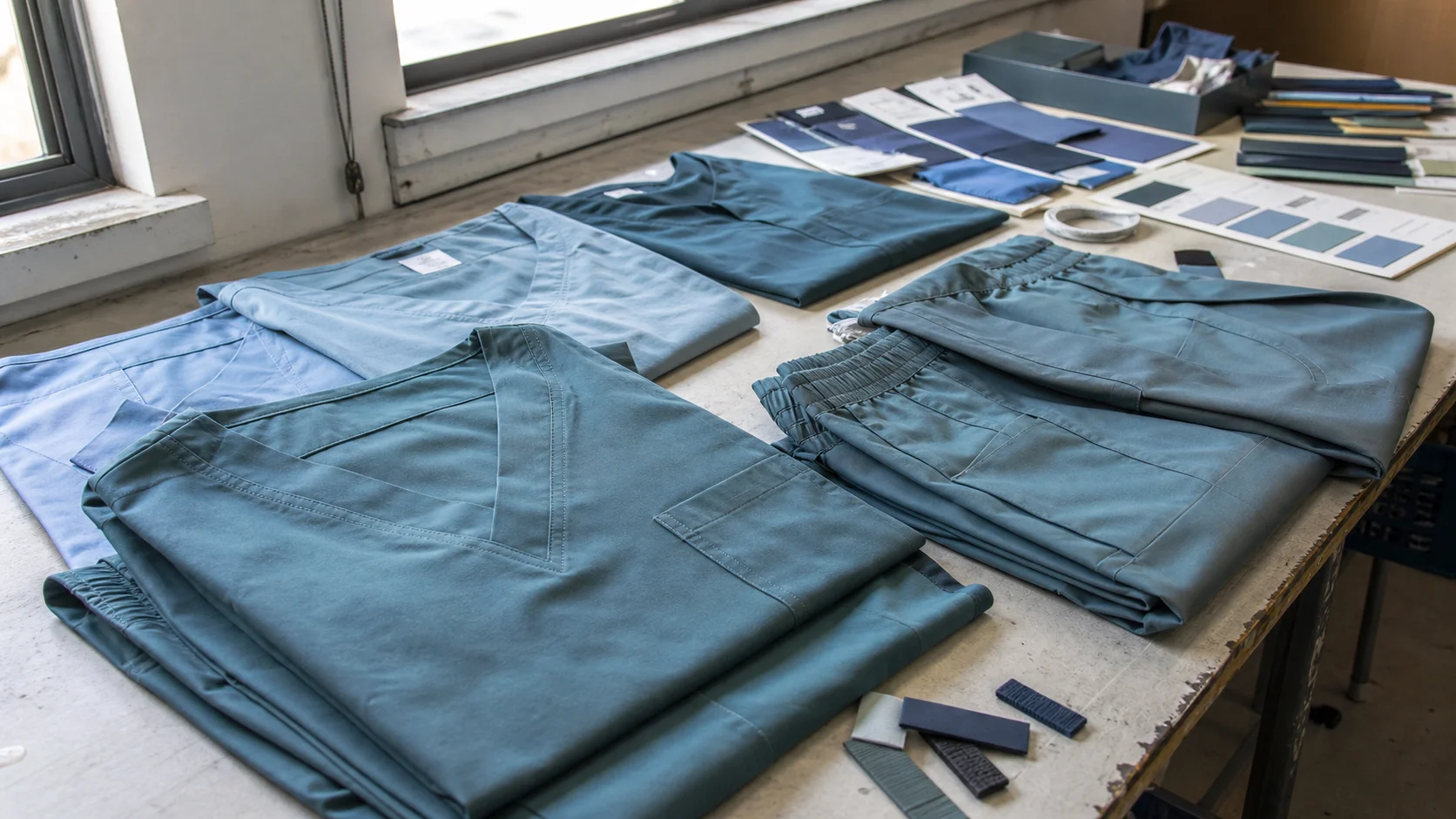
A retail operations-focused outline covering scrub production control checkpoints, quality gates, lead times, cost drivers, and vendor communication for...
Retail teams sourcing medical scrubs need more than a price quote and a pretty sample. A production control brief keeps the order moving in the right direction by defining the garment, the timeline, the quality gate, and the commercial rules before bulk production starts. For scrubs supplier production control brief for retail operations teams, the brief is the document that links buying, technical, merchandising, and compliance decisions into one workable plan.
In scrub programs, small gaps turn into costly problems quickly. A slight fabric shade shift, a weak seam at the crotch, a waistband that twists after washing, or a trim that fails a wash test can disrupt replenishment and damage sell-through. Retail teams need a sourcing structure that is practical, repeatable, and strict enough to protect margin without slowing the season.
This guide breaks down how to structure a production control brief for scrubs, what information suppliers need, where risk usually sits, and how MOQ, cost, sampling, and lead time should be managed.
Scrubs Production Control Brief for Retail Teams - Fabrikn production reference
Scrubs are often treated as a basic apparel item, but they are operationally sensitive. Retail customers expect consistent sizing, durable seams, and fabrics that survive repeated washing. The same style may be reordered across multiple seasons, which means any drift in fit or color becomes visible very quickly.
A production control brief helps retail teams set the rules early. It gives the supplier a clear reference for fabric, pattern, labeling, packaging, testing, and inspection. It also reduces internal confusion. Buying, planning, and quality teams should not be working from different assumptions about the same item.
For a supplier, a complete brief shortens back-and-forth during development. For the retailer, it reduces the chance of late-stage sample rejection or bulk claims. That is especially important when the product is intended for chain distribution, online replenishment, or multi-door uniform programs.
Practical rule: if a detail matters at shelf, on the packing table, or during a wash cycle, it belongs in the brief.
Before requesting pricing, retail teams should align on the product scope. The more complete the brief, the less likely the quote will be built on guesswork. A supplier may quote a lower cost against a lighter fabric, a simpler seam construction, or a looser tolerance than the business actually needs. That creates false savings.
Retail teams should also decide where flexibility is acceptable. A supplier can sometimes reduce MOQ by using stock-supported fabric or standard trims. That may be a smart move for first runs or test-and-learn programs. The tradeoff is lower differentiation and less control over exact color or handfeel.
Scrubs buying looks simple until the technical details are written down. A production control brief should specify the garment in enough detail that the supplier can quote accurately and the factory can cut consistently.
Fabric is the single biggest driver of cost and performance. Retail teams should define the fiber blend, construction, GSM or oz/yd², stretch percentage, and finishing requirements. Common scrubs fabrics include polyester-rayon-spandex, polyester-cotton-spandex, and performance blends with mechanical stretch.
Retail teams should not assume “performance fabric” means the same thing from one mill to the next. The brief should state the minimum acceptable shrinkage, colorfastness, and pilling standards. If the fabric needs to hold shape after repeated industrial or domestic laundering, that requirement should be written explicitly.
For scrubs pants, the waistband is a common failure area. If the brief does not define elastic strength, drawcord anchoring, and stretch recovery, the final garment may fit well on the hanger but fail in wear. Pockets also deserve attention. Too shallow, too narrow, or poorly reinforced pockets often lead to customer complaints after the first wash cycle.
If the retailer is selling into a regulated environment or through a controlled uniform channel, the brief should also cover label placement and country-of-origin marking. That prevents avoidable relabeling costs during packing.
MOQ for scrubs depends on fabric development, color count, style complexity, and whether the supplier is using custom materials or stock-supported inputs. Retail teams should expect different thresholds depending on the sourcing model.
Sourcing approach Typical MOQ range Cost impact Best use case Stock fabric with standard trims 200 to 500 pcs per color/style Lower development cost, moderate unit cost Test orders, fast replenishment Custom fabric, standard construction 500 to 1,000 pcs per color/style Better control, higher development cost Core retail programs Fully custom fabric and trims 1,000 to 3,000 pcs per color/style Higher setup cost, lower long-term cost at scale Private label or signature product linesMOQ should be judged against sell-through, not just supplier convenience. A low MOQ looks attractive if the style is unproven, but it may carry a higher unit cost and limited flexibility on color or fit options. A higher MOQ can improve cost, yet it exposes the business if the first round of demand is weak.
Retail operations teams should ask where the supplier is saving money. Common cost levers include fabric substitution, reduced stitching density, simplified pocketing, and consolidated color runs. These can be acceptable if they do not affect wear life. They are not acceptable if they compromise customer perception or create repeat claims.
At this stage, it is worth comparing supplier capabilities carefully. A good starting point is the services page to understand how a manufacturing partner structures sampling, development, and production support.
A disciplined sample process is one of the best ways to control scrubs production. Retail teams should not move from sketch to bulk order without a defined sequence of approvals.
Fit approval should be based on the actual target customer, not an internal fit model chosen for convenience. Scrubs need ease for bending, reaching, and long wear. If the fit is too slim, the garment may look modern but fail in practical use. If it is too loose, the retailer may face style rejection from younger buyers or premium positioning accounts.
Sample comments should be specific. Instead of “make the pocket better,” retail teams should state: “Increase left chest pocket depth by 1.5 cm and reinforce upper corners with bartacks.” Specific comments reduce interpretation errors and save time.
Retail teams should insist that the final approved sample is clearly labeled and retained as the bulk reference. Without that reference, disputes can arise when production outcomes are compared against memory rather than a controlled standard.
Production control is not a single checkpoint. It is a sequence of controls that starts before cutting and continues through packing. For scrubs, this matters because the same defect can repeat across large quantities if the factory is not watching the right points.
Bulk control should include clear tolerances for garment measurements. Retail teams should define which points are critical and what the acceptable variation is. Chest, waist, inseam, rise, sleeve length, and pocket placement may all matter, but not all points carry equal risk. The brief should identify the critical fit points so the supplier can focus inspection effort appropriately.
Inspection strategy should match order size and risk level. A basic order of a standard style may only need final inspection and sample verification. A new fabric, a first-time supplier, or a high-volume launch may justify inline checks and more detailed testing. That is a better use of time than reacting after packing is complete.
Scrubs are wear-tested more aggressively than many retail basics. They are washed often, worn for long shifts, and expected to hold up under motion. A garment that seems acceptable in a hanging sample can still fail in practical use.
Retail teams should pay close attention to laundering requirements. If the care label allows only a narrow washing process, the product may be rejected by customers who need easy-care garments. If the item is meant for frequent wash and dry cycles, test it under realistic conditions. A supplier can often meet a lab standard and still deliver a garment that underperforms after repeated use.
Packaging risk is another common issue. Scrubs sets can be mixed by size, color, or style if packing control is weak. Barcodes, carton marks, and size stickers should be checked carefully before dispatch. Returns from mispacked units are expensive and preventable.
Lead time for scrubs is driven by more than sewing capacity. Fabric availability, lab dip approval, sample cycles, trim sourcing, and testing all affect the calendar. Retail teams should build the timeline backwards from the target in-store or online launch date.
Any custom fabric program adds time. Any first-order style with multiple sample corrections adds time. Any order placed near peak season or during mill congestion may extend further. Retail teams should build contingency into the plan rather than treating the earliest factory estimate as guaranteed.
A practical approach is to separate “decision lead time” from “manufacturing lead time.” Decision lead time includes internal approvals, sample sign-off, and order release. Manufacturing lead time starts only after the supplier has the final confirmed package. Confusing the two can create unrealistic delivery commitments.
A production control brief works only if the supplier receives complete, organized information. Retail operations teams should send one controlled pack rather than a trail of scattered emails.
Retail teams should also identify the decision-maker for each approval stage. A supplier should not have to guess whether buying, product development, or merchandising has final authority. Delay often comes from internal ambiguity, not from the factory itself.
If the team is evaluating manufacturing support more broadly, the about us page can help frame the kind of sourcing partner structure to look for, while the contact page is the logical route for requesting development discussion or quotation input.
Commercial terms can quietly change the real cost of a scrub program. A low factory price does not matter if the terms create high cash strain, expensive claims handling, or difficult replenishment.
Retail teams should ask whether the supplier can support repeat orders without redoing the entire development cycle. That matters for core scrubs lines where continuity is more valuable than novelty. The right supplier setup should allow predictable replenishment while keeping quality consistent.
It is also wise to clarify whether the order is being built as a one-off or as a repeatable program. A one-off buy can sometimes justify broader tolerance in price and execution. A program account needs tighter control, better traceability, and cleaner repeatability.
Scrubs sourcing is not about chasing the lowest unit cost. It is about controlling the variables that affect fit, durability, and replenishment. Retail teams that use a clear production control brief reduce the risk of late changes, avoidable defects, and poor margin outcomes.
The strongest briefs are specific but not bloated. They define the fabric, trims, measurements, testing, approvals, MOQ assumptions, and delivery logic in a way the supplier can actually execute. They also leave little room for assumptions about wash performance or construction quality. In a category where repeat orders matter, control is worth more than speed alone.
If your team is building a new scrub line or tightening an existing supply chain, start with the brief, then align the supplier, then lock the sample path before bulk commitment. That sequence is usually cheaper than trying to fix a weak order after production has already started.
For sourcing support, production development, or supplier discussion, visit fabrikn.com/services/, fabrikn.com/about-us/, or fabrikn.com/contact-us/.
Get a free quote from Fabrikn — your trusted B2B clothing manufacturer with 10+ years of experience. MOQ as low as 200 pieces.
Get a Free Quote →It is a sourcing document that defines the product, materials, measurements, approvals, testing, packaging, and delivery controls before bulk production begins. For retail teams, it keeps suppliers aligned and reduces execution risk.
MOQ varies by fabric and customization level. Stock fabric programs may start around 200 to 500 pieces per color/style. Custom fabric and fully branded programs often require 500 to 3,000 pieces or more per style.
Blend, GSM, stretch content, recovery, shrinkage, pilling resistance, opacity, and colorfastness are the main factors. Retail teams should define these in the brief rather than relying on a generic fabric description.
Most programs need at least one fit sample and one pre-production sample. New styles, new fabrics, or complex trims may require more rounds. Cutting sample cycles too short often raises production risk.
Common risks include poor wash durability, color variation, seam failure, waistband issues, pocket weakness, and shrinkage beyond tolerance. Final inspection alone may not catch all of these, so fabric and inline controls matter.
Lead time depends on fabric source, sample approval speed, and production volume. A simple stocked-fabric program may move faster, while custom fabric orders can require several additional weeks for dyeing and development.
Yes. Lab dip or approved shade standard should be confirmed before bulk dyeing. Skipping that step creates a high risk of color mismatch across batches, sizes, or tops and pants.
Yes, but each component should have its own measurement spec, construction notes, and trim requirements. Tops and pants often fail in different ways, so they should not be treated as identical garments in the brief.