
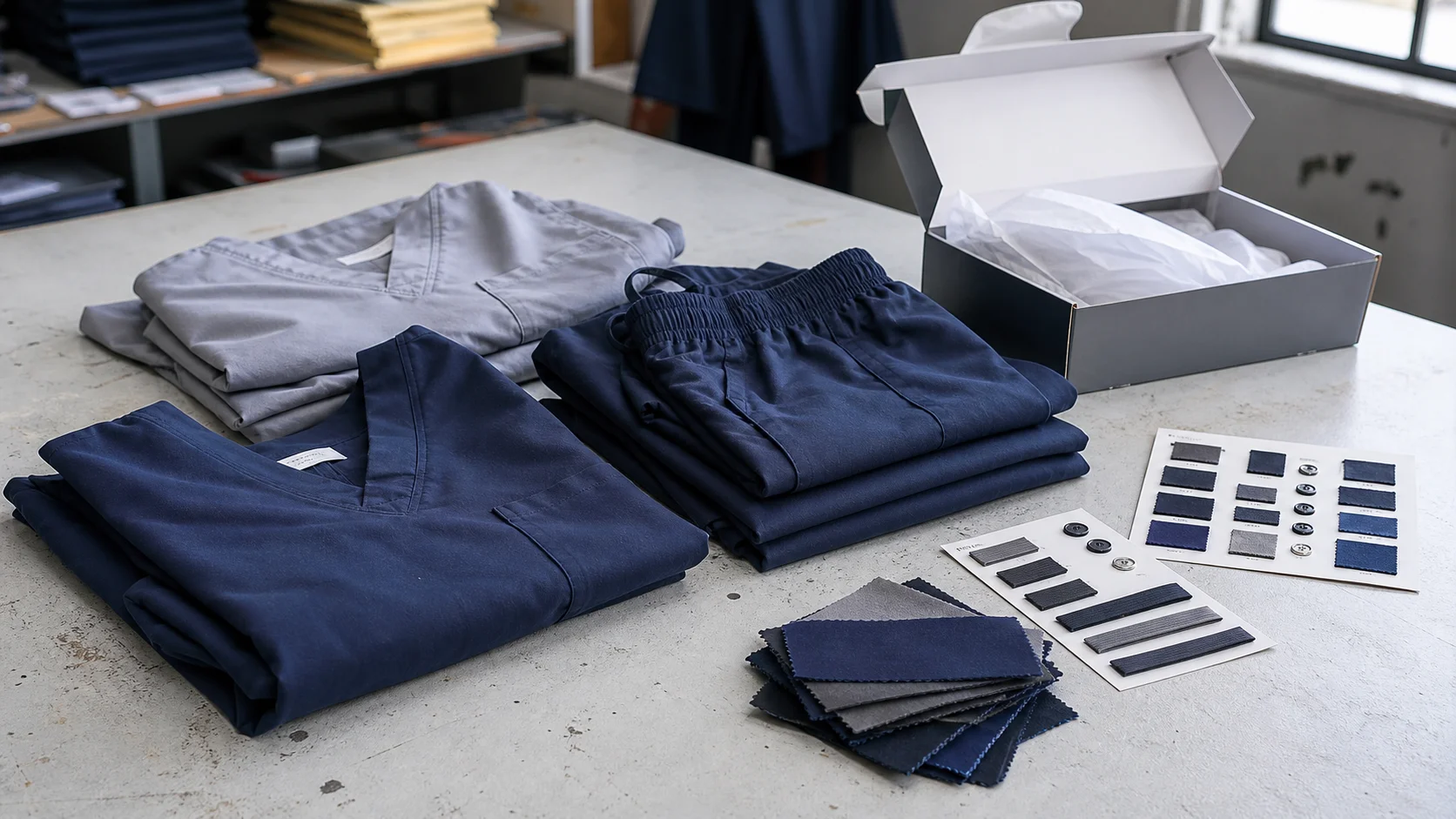
A product-specific quality control outline for hotel procurement teams buying staff scrubs, covering fabric testing, seam inspection, sizing audits,...
Scrubs QC Checklist for Hotel Procurement - Fabrikn production reference
Hotel procurement teams usually associate scrubs with clinical environments, but the garment has become increasingly relevant in hospitality operations. Spa therapists, wellness teams, housekeeping supervisors, laundry staff, back-of-house hygiene teams, and medical-response personnel may all require uniform scrubs that are comfortable, washable, color-consistent, and presentable in guest-facing or semi-guest-facing areas.
The buying risk is not limited to price. A low-cost scrub set can become expensive if the fabric pills after ten washes, the color shifts between replenishment orders, the waistband loses recovery, or the sizing runs inconsistently across departments. Procurement teams need a structured quality control checklist that can be used before bulk production, during production, and before shipment.
This guide is written for hotel procurement teams sourcing from a scrubs manufacturer, private-label uniform supplier, or apparel production partner. It covers the practical QC checkpoints that matter in hospitality: fabric durability, comfort, fit, trims, branding, wash performance, workmanship, packing, inspection, and reorder control.
Hotel uniforms are not judged only by technical performance. They also shape guest perception. A scrub top worn by a spa therapist, wellness attendant, or hygiene team member must look clean, professional, and coordinated with the property’s brand standards. It must also survive frequent laundering, repeated movement, and long shifts.
Scrubs used in hotels often face tougher wash cycles than casual apparel. Some properties launder uniforms daily or several times per week. High-temperature washing, commercial detergents, disinfecting agents, tumble drying, and tunnel finishing can expose weak fabric and stitching quickly. A garment that looks acceptable during sampling may fail after repeated hotel laundry processing.
A QC checklist gives procurement teams a common language with the manufacturer. It reduces subjective discussions such as “the fabric feels cheap” or “the fit looks wrong” and replaces them with measurable checks: fabric weight, shrinkage tolerance, seam strength, colorfastness, pocket placement, barcode labeling, carton markings, and approved measurement specs.
Purchasing judgment: for hotels, the best scrub is rarely the cheapest sample. The better buy is usually the garment that holds appearance after repeated laundering, fits most staff consistently, and can be reordered without shade and sizing surprises.
Quality control begins before the manufacturer cuts fabric. A vague inquiry produces vague samples. A strong procurement brief should tell the scrubs manufacturer exactly how the garment will be used, washed, branded, packed, and replenished.
Hotel scrub requirements differ by department. Spa teams may prioritize soft handfeel and flattering fit. Housekeeping supervisors may need durability and deep pockets. Back-of-house medical or hygiene staff may need a more functional, easy-care fabric. Procurement should separate departments instead of forcing one design to serve every use case.
A scrub order may include tops, trousers, jogger pants, tunics, warm-up jackets, or maternity options. Each item needs its own measurement chart, fabric specification, trim list, and QC standard. Do not assume that a good scrub top means the trousers will pass the same quality level.
For a hotel program, the basic product brief should include garment type, gender fit, size range, color standard, fabric composition, fabric weight, pocket configuration, closure type, logo method, label requirements, packing method, wash instructions, and reorder expectations.
Hotels usually need uniforms to sit within a wider visual identity. Scrub colors should be checked against approved Pantone references, existing uniform ranges, or interior brand palettes. Black, navy, charcoal, sage, sand, cream, white, and muted green are common choices, but each has a different maintenance risk.
White and cream show staining quickly. Black can fade after repeated washing. Navy may shift toward purple or grey if dye control is weak. Pale spa colors can vary noticeably between dye lots. Procurement teams should request lab dips before bulk fabric dyeing and should keep approved shade standards for future reorders.
Teams building a wider uniform program can review related sourcing support through Fabrikn’s services, especially when scrub quality needs to align with other hospitality apparel categories.
A scrubs manufacturer should be assessed before sampling. The goal is not to create unnecessary paperwork. The goal is to confirm whether the supplier can repeatedly produce hospitality-grade uniforms, not just one good showroom sample.
Ask what scrub categories the manufacturer regularly produces. A factory that mainly makes fashion tops may struggle with scrub trousers, reinforced pockets, elastic waistbands, and consistent utility stitching. A factory that mainly produces disposable medical garments may not be strong in hospitality appearance standards.
Procurement teams should request a basic explanation of the supplier’s quality control flow. Useful checkpoints include fabric inspection, shade segregation, pre-production sample approval, inline inspection, final inspection, needle control, measurement checking, and packing verification.
Not every hotel order requires a complex audit, but higher-volume and multi-property programs should request documentation. At minimum, the manufacturer should be able to share inspection records, measurement reports, fabric test reports where relevant, and production status updates.
Hospitality uniforms may need to comply with buyer-specific chemical restrictions, labeling rules, and country-of-import requirements. The exact requirements depend on market, fiber content, and destination. Procurement should not leave this until shipment booking.
For supplier discussions, procurement teams can use the contact page to start a structured conversation around uniform specifications, production planning, and QC checkpoints.
Fabric is the largest driver of scrub quality. It affects comfort, durability, appearance, wash performance, and cost. A good scrub manufacturer should provide fabric options with clear specifications, not just generic descriptions such as “poly cotton” or “premium stretch.”
Hotel scrubs are usually made from polyester-cotton blends, polyester-rayon-spandex blends, cotton-rich blends, or performance stretch fabrics. Each option has tradeoffs.
Fabric Type Typical Use Advantages Risks Polyester-cotton blend General hotel operations Durable, cost-effective, easier care Can feel stiff if low quality; may pill if yarn and finishing are weak Cotton-rich blend Spa and wellness uniforms Breathable, natural handfeel Higher shrinkage risk; more wrinkling Poly-rayon-spandex Premium spa or front-facing teams Soft drape, comfort stretch, polished appearance Higher cost; needs careful wash testing Performance polyester stretch High-movement roles Quick-dry, flexible, color retention May look too sporty for luxury settingsFabric weight should be specified in GSM or oz/yd². Many scrub fabrics fall roughly between 145 and 220 GSM, depending on composition and end use. Lightweight fabric can be comfortable in warm climates but may become transparent, clingy, or less durable. Heavier fabric may look more structured but can feel hot during long shifts.
For hotel use, procurement teams should handle the fabric after washing, not only as a new swatch. Finishing agents can make a first sample feel smoother than it will after five or ten commercial laundry cycles.
Shrinkage should be tested before bulk approval. A practical tolerance for many woven scrub fabrics is often around 3% after washing, though the acceptable range depends on fabric composition and garment construction. Cotton-rich fabrics may need more careful control. Stretch fabrics should be checked for both shrinkage and recovery.
Procurement should ask the manufacturer which wash method was used for shrinkage testing. Domestic wash results may not represent hotel laundry conditions. If the property uses high-temperature washing or industrial drying, test under similar conditions before approving bulk production.
Colorfastness matters because hotel teams wash uniforms frequently. Test risk areas include washing, rubbing, perspiration, chlorine exposure where relevant, and light exposure for resort environments. Dark colors should be checked for crocking, especially if staff may wear light underlayers or work around pale linens.
Pilling can make scrubs look old quickly. It often appears at underarms, side seams, trouser inner thighs, and pocket openings. Abrasion resistance is also important for housekeeping and laundry teams who move against carts, counters, shelves, and equipment.
Do not approve a fabric based only on new appearance. Request pilling and abrasion information where possible, or run an internal wear and wash trial before bulk commitment. For high-volume hotel programs, this step can prevent costly replacement cycles.
Trims are small components, but they often create major failures. A strong fabric cannot compensate for weak thread, loose snaps, poor elastic, or labels that irritate staff. Hotel procurement teams should include every component in the bill of materials.
Thread should match the garment’s durability needs and color standard. Polyester thread is common for scrubs because it provides strength and wash resistance. Cotton thread may shrink differently from the garment fabric and is usually less suitable for frequent commercial laundering.
Check thread color under consistent lighting. Tonal thread can shift appearance on dark or muted hotel colors. Contrast stitching may look intentional in a design sample, but it magnifies sewing defects in bulk production.
Scrub trousers usually rely on elastic, drawcords, or both. Elastic must retain recovery after repeated washing and drying. A waistband that rolls, twists, or stretches out will create staff complaints even if the garment fabric is acceptable.
Many scrub designs avoid complex closures, but jackets or specialized trousers may include zippers or snaps. These must be rust-resistant, secure, and suitable for commercial laundering. Metal trims should be assessed carefully if uniforms are washed with chemicals or exposed to moisture.
Labels should be durable, legible, and comfortable. Printed heat-transfer labels can reduce irritation but may crack or fade if poor quality. Woven labels can last longer but may scratch if placed poorly. Care labels must reflect actual laundering instructions, not generic retail recommendations.
Logo application should be approved before bulk production. Embroidery is durable and premium, but dense embroidery can pucker lightweight scrub fabric. Heat transfer can look clean but must be tested for cracking, peeling, and color change. Woven patches may suit some resort properties but can feel too casual for spa teams.
Purchasing judgment: embroidery is often safer for long-term hotel laundering, but it can distort lightweight fabric. Heat transfer can be elegant on spa scrubs, but only if it passes wash testing under the property’s real laundry conditions.
Fit is one of the most common uniform complaints. Hotel teams include different body types, roles, and movement needs. A procurement team should not assume that unisex sizing will satisfy everyone. It may reduce SKU complexity, but it often compromises fit for part of the workforce.
Most hotel scrub programs need a practical size range from XS to 3XL, with larger sizes if the staff profile requires them. Trouser inseam options may also be needed. A single inseam can create hemming costs, safety risks, or poor appearance.
Procurement should collect staff size data before placing bulk orders. Guessing size ratios creates avoidable stockouts and excess inventory. For replenishment programs, maintain usage data by size, department, and property.
Every approved style needs a measurement chart with points of measurement and tolerances. Key scrub top measurements include chest, shoulder, body length, sleeve length, armhole, sweep, pocket position, and neck opening. Key trouser measurements include waist relaxed, waist extended, hip, thigh, rise, inseam, leg opening, and waistband height.
Reasonable tolerances depend on the measurement point and garment size. Small points may allow around 0.5 cm to 1 cm, while larger widths may allow more. The tolerance should be agreed in writing before bulk production, because final inspection depends on it.
Hotel staff do not stand still. Scrubs should be tested for reaching, bending, squatting, lifting, sitting, walking, and carrying. Spa therapists need arm mobility. Housekeeping teams need bending and lifting comfort. Laundry staff need heat and movement tolerance.
A disciplined sample process prevents expensive bulk mistakes. The number of sample rounds depends on design complexity and supplier reliability, but hotel procurement teams should expect at least a fit sample, pre-production sample, and approved sealed sample before bulk production.
The development sample confirms concept, fabric direction, silhouette, and construction approach. It may not be in the final fabric or color, but it should be close enough to evaluate design feasibility. Use this stage to correct pocket placement, neckline shape, sleeve length, and trouser fit.
The fit sample should be made in the intended fabric or a very close substitute. Fit approval should involve the wearer profile, not only the purchasing office. A scrub that looks fine on a hanger can restrict staff movement during real work.
For larger orders, request size set samples across the approved size range. This checks grading. Poor grading can make small sizes too tight and large sizes shapeless. Size set approval is especially important when ordering men’s and women’s fits or extended sizes.
The pre-production sample should represent exactly what the manufacturer will produce in bulk: final fabric, final color, final trims, final logo, final labels, final stitching, and final packing approach if possible. Bulk production should not begin until this sample is approved in writing.
A sealed sample is the physical reference for production and inspection. Keep one with the manufacturer and one with the procurement or QC team. It should be signed, dated, and identified by style code, fabric code, color, size, and order reference.
Production quality control is not a single final inspection. It should start when fabric arrives and continue through cutting, sewing, finishing, and packing. Waiting until finished goods are packed makes defects harder and more expensive to correct.
Fabric should be inspected before cutting. Key issues include shade variation, holes, stains, barre, skewing, bowing, uneven finishing, width variation, and fabric weight inconsistency. For dyed fabrics, shade lots should be segregated to avoid visible panel mismatch within the same garment.
Procurement teams should confirm whether the manufacturer uses a 4-point fabric inspection system or another documented method. The exact system matters less than having a clear pass/fail standard and a process to isolate defective rolls.
Cutting errors affect fit, symmetry, and production consistency. The manufacturer should verify marker placement, fabric relaxation where needed, ply height, grain direction, and cut panel accuracy. Stretch fabrics require particular attention because improper relaxation can create twisting or size instability.
Inline inspection should catch defects before they multiply. Common scrub sewing defects include uneven topstitching, skipped stitches, broken stitches, open seams, puckering, twisted seams, uneven pockets, misaligned side seams, and poor bartack placement.
High-stress points need reinforcement. Pocket corners, side slits, crotch seams, drawcord exits, and pocket openings should be checked carefully. If staff carry keys, phones, small tools, or treatment items, pocket strength becomes a real performance issue.
Measurements should be checked during production, not only at the end. If the first bulk output runs small in chest or short in inseam, the manufacturer can adjust before the entire order is completed. Procurement should request measurement reports by size and style.
Finishing includes thread trimming, pressing, stain removal, metal detection where applicable, folding, tagging, and packing. Poor finishing can make acceptable garments look cheap. Loose threads around pockets and necklines are especially visible on scrubs because the design is simple and clean.
Final inspection should be based on an agreed AQL standard or another clearly defined acceptance method. Many apparel orders use AQL sampling, with critical, major, and minor defect categories. The chosen level depends on order size, buyer risk tolerance, and end use.
For hotel scrubs, procurement teams should pay close attention to visible defects, functional defects, and consistency across sets. Scrub tops and trousers are often worn together. If the top and trouser shade do not match, the whole set looks defective even if each garment passes individually.
Critical defects are defects that create safety, legal, or severe brand risk. Examples may include sharp broken needle fragments, hazardous contamination, unauthorized branding, severe chemical odor, incorrect fiber labeling for regulated markets, or packaging that creates safety issues. The manufacturer should have needle control and broken needle procedures if sewing operations use machine needles, which they will for standard scrubs.
Minimum order quantities and lead times vary by supplier, fabric availability, customization level, and production location. Procurement teams should treat quoted figures as planning ranges, not guarantees, until the manufacturer confirms fabric, trims, capacity, and payment terms.
For standard scrub styles using available fabric, a manufacturer may accept lower MOQs, sometimes around 100 to 300 pieces per style or color. For custom-dyed fabric, custom branding, special trims, or full private-label development, MOQs may commonly rise to 500 to 1,000 pieces per color or more. Smaller boutique programs may be possible, but unit cost usually increases.
Order Type Typical MOQ Range Procurement Notes Stock fabric, simple logo 100-300 pieces per style/color Good for pilot programs, but color continuity may depend on fabric availability Custom color, standard style 300-800 pieces per color Lab dip approval and dye lot control become important Custom fabric and custom pattern 500-1,500 pieces per style/color Better for multi-property programs with repeat demand Full uniform program with replenishment Negotiated by annual volume Requires forecasting, size ratio planning, and stock agreementsLead time depends on more than sewing capacity. Fabric sourcing, dyeing, lab dip approval, sample revisions, trim ordering, logo approval, production scheduling, inspection, packing, and shipping all affect delivery. A simple repeat order may move quickly. A custom hotel scrub program can take significantly longer, especially if fabric color and fit require multiple approval rounds.
Procurement teams should compare total cost of ownership, not only unit price. A cheaper scrub that lasts three months may cost more than a better garment that lasts nine months. Poor sizing also creates hidden cost through returns, staff dissatisfaction, and emergency reorders.
Price differences often come from fabric quality, dye method, fabric weight, stretch content, stitch density, trim grade, logo application, order quantity, inspection requirements, and packing method. Ask the manufacturer to explain cost drivers. If the price is reduced, confirm what has changed. It may be fabric weight, pocket reinforcement, thread quality, or packaging.
Purchasing judgment: if a supplier cuts cost without changing the written specification, the risk has moved somewhere else. Procurement should ask where the saving came from before approving the lower price.
Packing is part of QC because hotel receiving teams need accurate, clean, and traceable shipments. Mixed sizes, wrong carton labels, or incomplete set packing create operational problems even when garment quality is acceptable.
Scrubs may be packed individually or as sets. Set packing can simplify hotel distribution, but it requires careful size matching. Individual packing can support separate top and trouser size selection, which is useful because many staff do not wear the same size in both garments.
Cartons should be labeled by style, color, size, quantity, purchase order, destination, and carton number. Mixed cartons should be avoided unless clearly documented with a packing list. For multi-property rollouts, carton routing must be controlled carefully.
Hotels should keep a technical file for each approved scrub style. This file should include the approved sample, measurement chart, fabric specification, trim sheet, logo artwork, care label copy, packing standard, supplier contact, purchase order history, and inspection reports. Reorders become much safer when the original specification is controlled.
Information about company background and sourcing approach can be reviewed on Fabrikn’s about page when procurement teams are assessing potential support for repeat uniform programs.
A supplier scorecard helps procurement compare manufacturers beyond price. It should be simple enough to use consistently. Score each supplier on product quality, sampling responsiveness, technical communication, lead-time reliability, documentation, corrective action, price stability, and reorder performance.
Track defect rates by order. If a manufacturer repeatedly has shade, measurement, or stitching issues, the low unit price may not be worth the operational risk. Use inspection results and staff feedback to build a realistic supplier history.
A good manufacturer answers technical questions clearly. It should be able to explain fabric choices, MOQ logic, lead-time risks, and production constraints. Vague answers during sampling often become bigger problems during bulk production.
Defects can happen even with capable suppliers. The important question is how the manufacturer responds. Does it isolate the issue, identify the root cause, repair or replace affected goods, and prevent recurrence? Procurement should document corrective actions after each problem order.
Hotel uniform programs often need replenishment. A manufacturer that performs well on the first order but cannot match color, fabric, or fit six months later creates long-term risk. Ask whether fabric can be reserved, whether color standards are retained, and how long patterns and technical files are stored.
For a first hotel scrub order, avoid over-customizing before the fit and fabric are proven. Start with a controlled pilot if possible. Put a small group of staff through real shifts and real laundry cycles. Collect feedback on comfort, heat, pocket function, waistband stability, and appearance after washing.
Once the pilot passes, lock the specification. Procurement should resist changing fabric, trims, or supplier without reviewing QC impact. A minor substitution can change shrinkage, shade, handfeel, and durability.
For multi-property hotels, standardize core specifications but allow controlled adjustments by climate and department. A resort spa in a hot climate may need a lighter fabric than an urban property with climate-controlled interiors. The same brand color can be maintained while fabric weight or sleeve design is adapted.
For luxury hotels, visible appearance after laundering is critical. Spend more attention on fabric recovery, seam smoothness, color stability, and logo execution. For back-of-house departments, durability, comfort, and inventory control may carry more weight than premium drape.
A strong scrubs QC checklist protects more than garment quality. It protects brand consistency, staff comfort, hotel operating efficiency, and replacement budgets. The best procurement outcomes come from clear specifications, realistic testing, disciplined sample approval, and suppliers that can repeat the same standard over time.
Get a free quote from Fabrikn — your trusted B2B clothing manufacturer with 10+ years of experience. MOQ as low as 200 pieces.
Get a Free Quote →Start with the use case, fabric specification, fit requirements, and laundry process. These four points determine most quality risks. A scrub used by spa therapists in a luxury hotel may need a different fabric and fit from one used by laundry or housekeeping staff.
Typical MOQs vary by supplier and specification. Stock fabric programs may start around 100 to 300 pieces per style or color. Custom color, custom fabric, or private-label scrubs may require 500 to 1,000 pieces per color or more. Smaller orders are sometimes possible, but the unit price is usually higher.
Most hotel scrub programs should include at least a fit sample and a pre-production sample. Larger or more customized orders should also include size set samples and a sealed sample. Bulk production should begin only after the final fabric, color, trims, labels, logo, and measurements are approved.
There is no single best fabric for every hotel. Polyester-cotton blends are durable and cost-effective. Cotton-rich blends feel breathable but may shrink and wrinkle more. Poly-rayon-spandex blends can suit premium spa uniforms but need careful wash testing. Performance stretch fabrics work well for active roles but may look too sporty for some luxury settings.
Check shrinkage, colorfastness, pilling, seam durability, logo durability, waistband recovery, and overall appearance after repeated laundering. The test should reflect the hotel’s actual laundry process as closely as possible, especially if commercial washing, high heat, or disinfecting chemicals are used.
Common failures include shade mismatch, incorrect measurements, weak seams, skipped stitches, pocket defects, waistband twisting, logo errors, loose threads, stains, wrong labels, and mixed-size packing. Shade mismatch between scrub tops and trousers is especially visible in hotel environments.
Unisex scrubs reduce SKU complexity and may lower cost, but they often compromise fit. Separate men’s and women’s fits usually improve wearer satisfaction, especially for guest-facing spa or wellness teams. A practical compromise is to use unisex fits for some back-of-house roles and more tailored fits for visible departments.
Keep a technical file with the approved sample, fabric code, color standard, measurement chart, trim sheet, logo artwork, care label copy, packing instruction, and inspection reports. Ask the manufacturer to reference the same file for every reorder and to confirm any fabric or trim change before production.
Final inspection is important, but it is not enough on its own. Fabric inspection, sample approval, inline checks, measurement control, and wash testing catch problems earlier. Final inspection should confirm that the finished goods match the approved standard, not discover preventable issues after the full order is packed.
Evaluate the manufacturer on fabric knowledge, sample accuracy, fit control, QC process, documentation, communication, lead-time reliability, and reorder consistency. Price matters, but the lowest quote can become expensive if the garments fail laundry, fit poorly, or cannot be repeated consistently.