
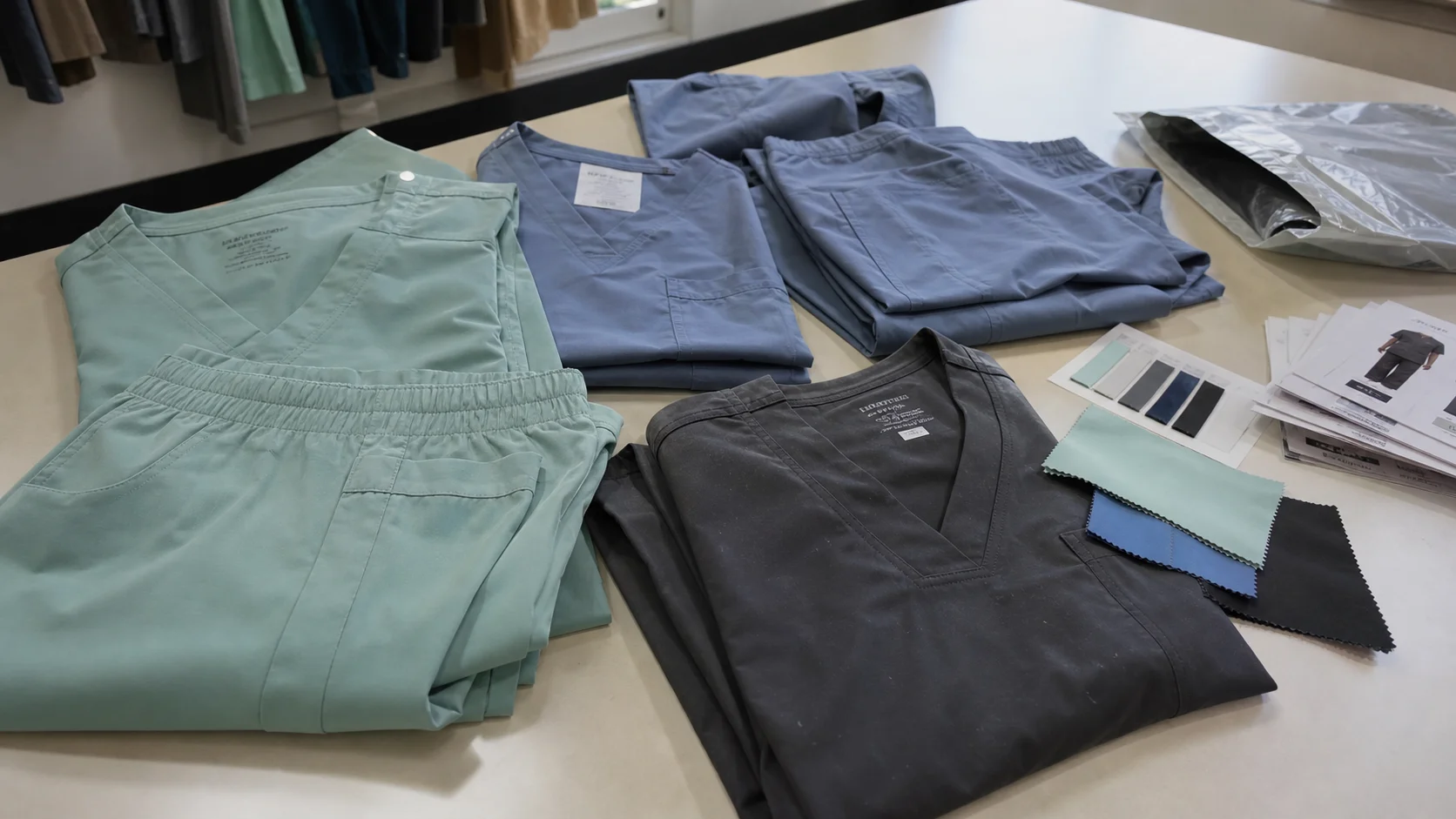
A quality inspection outline for pharmacy operations teams reviewing scrub size grading, fit consistency, measurement tolerances, and supplier...
Scrubs Size Grading Review for Pharmacy Buyers - Quality & Inspection manufacturing guide
Scrubs are not only clinical workwear. For pharmacy operations teams, they are part of staff identification, hygiene control, workplace comfort, and brand presentation. A size grading issue can turn a straightforward uniform order into a daily operational problem: staff exchange requests increase, inventory sits in the wrong sizes, and supervisors spend time resolving avoidable fit complaints.
Pharmacy buyers often focus on color, logo placement, price, and delivery date. Those points matter, but size grading should be reviewed with the same discipline as fabric quality or seam strength. A scrub top that fits correctly in medium but becomes too boxy in 2XL, or a pant that grades too aggressively through the hip, can create inconsistent fit across a mixed staff group.
Size grading is the method used to scale a garment pattern from one base size into a full size range. In scrubs, this usually means moving from XS through 5XL or beyond, with separate men’s, women’s, and unisex fits depending on the program. Pharmacy operations teams may also need petite, tall, maternity, or relaxed-fit options. Each added size type increases complexity.
Purchasing judgment: a lower unit price is not a saving if the size curve is wrong. In pharmacy scrub programs, poor grading often shows up as reorders, exchanges, staff dissatisfaction, and fragmented inventory.
A good supplier should provide a measurement chart, grading rules, garment tolerances, size set samples, and production inspection support. Buyers should not accept “standard sizing” as a complete answer. Standard for which market, which fit, and which body type? A scrub size chart built for one hospital system, e-commerce market, or fashion silhouette may not serve pharmacy staff working long shifts, bending, reaching, and carrying stock.
For pharmacy buyers comparing suppliers, size grading review belongs in the same sourcing conversation as cut-and-sew capability, quality control systems, and reorder reliability. If the program is being developed with a manufacturing partner, it is worth discussing specifications early through a structured apparel sourcing process. A supplier that supports product development, sampling, and inspection can reduce downstream risk. Buyers can review related support options at Fabrikn services when planning a controlled scrub program.
The first review point is the intended user group. A retail pharmacy team, hospital pharmacy department, compounding lab, warehouse pharmacy operation, and clinic-based pharmacy desk may all need different scrub fits. Staff movement patterns differ. Some roles spend more time standing at counters. Others handle inventory, refrigerated products, or back-room packing. Fit should follow actual work use, not only a catalog image.
Buyers should start with a clear brief. The brief should include gender mix, expected size range, department use, laundering method, logo requirements, color standard, pocket needs, and whether staff will wear layers under the scrubs. This information helps the supplier recommend a realistic size curve and base pattern.
The second review point is whether the program uses unisex or gender-specific sizing. Unisex scrubs are easier to buy and stock, especially for large pharmacy networks or multi-location operations. They can also reduce SKU count. The tradeoff is fit compromise. Unisex tops may be too broad in the shoulder for some wearers and too narrow through the hip for others. Gender-specific scrubs usually improve fit satisfaction but increase SKU complexity and forecasting risk.
The third review point is the size distribution. Pharmacy buyers should not assume an even spread across sizes. Many uniform programs over-order middle sizes and under-order edge sizes. If historical staff uniform data is available, use it. If not, ask the supplier for a conservative size curve recommendation and run a small fit trial before bulk ordering.
Review Area Buyer Question Purchasing Risk Fit Type Unisex, men’s, women’s, petite, tall, or mixed? Wrong fit model increases exchanges and staff complaints. Size Range Does the range cover all staff without special reorders? Late edge-size orders can delay onboarding. Fabric Stretch Is the pattern built for woven, mechanical stretch, or spandex blend? Changing fabric can change perceived size. Laundering Will garments be home-washed or industrially laundered? Shrinkage can make approved sizing fail after use. Inventory Plan How many backup units are needed by size? Poor size forecasting creates dead stock.Buyers should also confirm whether the supplier’s size chart is based on body measurements or garment measurements. Body measurements describe the wearer. Garment measurements describe the finished item. Both are useful, but they are not interchangeable. Scrubs need ease for movement. A finished garment chest measurement will normally be larger than the wearer’s chest measurement. The same principle applies to hips, waist, thigh, and across-back measurements.
A size grading review should be grounded in actual measurement points. Pharmacy buyers do not need to become pattern makers, but they do need to know which points control fit and which points are easy to overlook.
For scrub tops, the key measurements usually include chest width, sweep, shoulder width, front length, back length, sleeve length, armhole, bicep, neck opening, and pocket placement. For scrub pants, buyers should review waist, hip, rise, inseam, outseam, thigh, knee, leg opening, waistband width, and pocket placement. Jogger scrubs also require review of cuff length and cuff stretch recovery.
Tolerance is the acceptable measurement variation in production. A common tolerance for many scrub garment measurements may be around plus or minus 0.5 inch for major body points, though this depends on size, fabric, construction method, and buyer standard. Smaller parts such as pocket placement, label position, or cuff width may need tighter control. Large sizes sometimes require slightly different tolerance handling because small proportional errors can be more visible at seams, rises, and armholes.
Buyers should ask for a measurement specification sheet, often called a spec sheet. This document should list each point of measure, the base size measurement, grading increments by size, and tolerance. A supplier that cannot provide this information may still produce acceptable goods, but the buyer will have less control if production sizes drift.
One practical issue is proportional grading. If every measurement increases at the same rate, larger sizes may become too long, too wide at the shoulder, or too deep in the armhole. Good grading is not just “add width.” It balances wearer anatomy, intended silhouette, and functional movement. Pharmacy buyers should look closely at the extremes of the size range, not only the sample size.
The most common scrub fit models are unisex classic fit, women’s shaped fit, men’s classic fit, modern athletic fit, relaxed fit, and jogger fit. Each has a place. The right choice depends on staff preference, brand policy, and operational simplicity.
Unisex classic fit is often the easiest to manage. It usually has a straighter body, functional ease, and fewer fit assumptions. It can work well for pharmacy teams that prioritize easy distribution and simple reordering. The downside is that it may not satisfy staff who prefer a more tailored fit.
Women’s shaped fit typically uses a narrower shoulder, shaped waist, and different hip balance. It often improves appearance and comfort for many wearers, especially when paired with a women’s pant block. The tradeoff is added SKU count, and buyers must be careful that the fit does not become too fashion-oriented for active pharmacy work.
Men’s classic fit generally carries broader shoulders, straighter torso shaping, and a different rise structure in pants. It may work well for teams that want a cleaner fit than unisex sizing provides. Buyers should check whether the supplier grades men’s sizes from a separate block or simply renames a unisex pattern.
Modern athletic fit can look sharper in front-of-house pharmacy settings. It may also appeal to younger staff. The risk is restricted movement if the fabric does not have enough stretch or if the size grading is too narrow through bicep, thigh, or rise. For long shifts, a sharp silhouette is only valuable if comfort holds up after laundering.
Jogger scrub pants are popular, but they need closer review. Cuffs, ankle opening, rise, and thigh ease all affect wearability. A jogger that looks good in a showroom may not suit all staff body types or footwear choices. Pharmacy buyers should avoid making joggers the only pant option unless staff feedback supports it.
Purchasing judgment: for mixed pharmacy teams, a dual-option program often performs better than a single fashion-led fit. One classic or relaxed option plus one shaped or modern option can reduce complaints without overcomplicating inventory.
Size grading does not stand alone. Fabric behavior can make the same pattern feel larger, smaller, softer, stiffer, or more restrictive. Pharmacy buyers should review fabric specifications before approving the size chart.
Common scrub fabrics include polyester-cotton blends, polyester-rayon-spandex blends, polyester-spandex mechanical stretch fabrics, and cotton-rich woven fabrics. Each behaves differently. Polyester-cotton blends are often durable and cost-effective, but they may feel less flexible without stretch. Rayon blends can improve drape and softness but may need closer shrinkage and pilling review. Spandex blends improve movement, yet they require attention to recovery, heat exposure, and long-term laundering.
Typical scrub fabric weights may range from about 150 gsm to 220 gsm, depending on market, opacity, and season. Lighter fabrics can be more comfortable in warm pharmacies or back-room environments, but they may show pocket contents, underlayers, or seam stress. Heavier fabrics can feel more substantial and durable, but they may reduce comfort during long shifts. There is no universal best weight; the right decision depends on climate, laundering, opacity requirements, and price target.
Stretch percentage also affects fit. A garment developed in a non-stretch woven fabric should not be moved into a spandex blend without fit review. The reverse is also true. A pattern approved in stretch fabric can become restrictive if produced in a lower-stretch substitute. Buyers should lock fabric composition, weight, weave, finish, and stretch performance in the specification.
Trims also influence fit. Elastic waistbands must be tested for recovery. Drawcords should hold securely without excessive bulk. Rib cuffs on joggers should not become loose after repeated washing. Zippers, snaps, and pocket reinforcements should be placed consistently across sizes. Labels should not irritate the neck or waistband area, especially for staff wearing scrubs for long shifts.
Construction affects perceived size as well. A narrow seam allowance, inconsistent overlock tension, or distorted pocket attachment can change how the garment sits on the body. Topstitching at pocket openings should support durability without pulling the fabric. Reinforced stress points are useful, especially at side vents, pocket corners, crotch seams, and waistband joins.
A controlled sample process is one of the best ways to prevent bulk production sizing problems. Pharmacy buyers should avoid moving from a single showroom sample directly into a large order, especially when the program includes logos, custom colors, or extended sizes.
The first step is the fit sample. This is usually made in a base size, often medium or large, depending on the supplier’s grading system. The buyer checks silhouette, comfort, measurement accuracy, pocket function, neckline, sleeve movement, pant rise, and inseam. Fit sample approval should be written, not casual.
The second step is the size set. A size set includes multiple sizes across the range. At minimum, buyers should review the base size, one small size, one large size, and one edge size. For high-volume programs, a full size set is safer. This is where grading problems become visible. A medium may look acceptable while XS has a tight armhole and 3XL has an overextended shoulder.
The third step is the pre-production sample. This sample should use approved bulk fabric, trims, labels, logo method, and construction. If embroidery or heat transfer branding is included, placement must be checked on each relevant garment type. Logo placement can shift visually across sizes if it is not anchored to a consistent measurement point.
The fourth step is wash testing. Buyers should review shrinkage and appearance after the expected care cycle. If staff will home-launder garments, test a realistic home wash and dry process. If garments will be industrially laundered, requirements should be stricter and confirmed before production. A scrub that fits before washing but shrinks beyond tolerance is not acceptable for operational use.
The fifth step is production approval. This should include signed-off specs, approved samples, color standard, trim card, packaging instructions, and inspection criteria. Buyers should keep one approved reference sample for comparison against production.
Approval Stage Purpose Buyer Decision Fit Sample Confirms base silhouette and comfort. Approve, revise, or reject the base pattern. Size Set Checks grading across the size range. Adjust specific sizes before bulk cutting. Pre-Production Sample Confirms final fabric, trims, branding, and sewing. Approve production standard. Wash Test Checks shrinkage, twisting, color, and handfeel. Confirm care label and size stability. Inspection Standard Defines measurement and defect criteria. Reduce disputes during final QC.Buyers managing custom scrub programs can benefit from supplier support that combines development and quality review. If the program is still being scoped, it is reasonable to discuss technical expectations through a sourcing contact point such as Fabrikn contact.
MOQ, or minimum order quantity, varies by supplier, fabric, color, customization, and production location. For stock scrub programs with existing styles and colors, MOQs can be relatively low, sometimes starting around 50 to 100 pieces per style or color. For custom colors, private label trims, special fabrics, or full size-set development, typical MOQs may range from 300 to 1,000 pieces per style and color. More complex programs can require higher quantities.
Pharmacy buyers should ask whether MOQ applies per style, per color, per size, or per purchase order. This distinction matters. A quoted MOQ of 500 pieces may sound workable until the buyer learns that the factory expects 500 per color, or that very small size quantities cannot be cut efficiently.
Size distribution also affects production. A balanced size curve is easier to manage than a program with very high demand for edge sizes. Large sizes consume more fabric. Petite and tall options may require separate markers and cutting plans. If the buyer needs an unusually broad size range, the supplier may need more planning time and may apply different pricing.
Lead time depends on several factors: sample rounds, fabric availability, lab dips or color approvals, trim sourcing, logo development, production capacity, inspection, packing, and transport. A stock scrub reorder might move in a few weeks if inventory exists. A custom scrub program often needs longer, commonly 8 to 16 weeks after approvals, depending on the supply chain. That estimate can stretch if fabric must be dyed, if size grading requires multiple revisions, or if approvals are slow.
Buyers should separate development lead time from production lead time. Development includes fit samples, size sets, lab dips, trim approval, and wash testing. Production lead time starts after final approval and material readiness. Mixing the two creates unrealistic launch dates.
A sensible approach is to pilot the size curve before committing to a large buy. This can be done through a limited staff fitting, a controlled launch in selected locations, or a smaller first order where MOQ allows. Pharmacy operations teams should capture exchange data and staff feedback before scaling.
Final inspection should not only count cartons and check labels. For scrub programs, measurement inspection is a core quality step. If sizing is wrong, even visually clean garments can fail operationally.
Inspection should include random measurement checks across sizes and colors. The inspector should compare finished garments against the approved spec sheet and tolerance. Buyers should define which measurements are critical. Chest, hip, rise, inseam, shoulder, and waist are usually high priority. Pocket placement, logo position, and garment length should also be reviewed because they affect appearance and usability.
One common risk is size ratio packing errors. A carton may be labeled with the correct style and color but contain incorrect sizes. Another risk is shade variation between sizes if garments are cut from different fabric lots. This can happen when suppliers combine available fabric rolls without tight shade control. For pharmacy teams, visible color inconsistency can weaken uniform presentation.
Measurement drift can occur during cutting, sewing, pressing, or packing. Fabric relaxation matters, especially with stretch fabrics. If fabric is cut before proper relaxation, garments may shift after sewing or washing. Heat pressing can also affect spandex-containing fabrics. Waist elastic can be stretched unevenly during sewing, causing inconsistent waist measurements.
Logo application creates another inspection point. Embroidery can slightly tighten fabric in the placement area, especially on lighter fabrics. Heat transfers can distort or leave impressions if temperature and pressure are poorly controlled. Buyers should check logo placement by size, not only on the base sample. A logo that looks centered on medium may sit too high or too close to the armhole on XS.
Pharmacy buyers should also consider AQL inspection levels if placing bulk orders. AQL, or acceptable quality limit, helps define sampling size and defect thresholds. Critical defects should have little or no tolerance. Major defects may include wrong measurements, open seams, incorrect labels, or shade mismatch. Minor defects may include loose threads or small appearance issues, depending on the buyer’s standard. The classification should be agreed before production inspection, not after a dispute.
For repeat orders, buyers should compare new production against the original approved sample and previous shipment data. Reorders are not automatically identical. Fabric lots, trim suppliers, sewing lines, and cutting markers can change. A repeat order should still go through measurement checks, especially if the supplier has adjusted fabric or size specs.
A good pharmacy scrub program is built on clear specifications, realistic fit expectations, and disciplined approval. Buyers do not need to over-engineer the process, but they should control the points that create the most operational risk.
Pharmacy buyers should view size grading as a commercial control point. It protects budget, staff comfort, and uniform consistency. A supplier that can explain grading decisions, provide technical documentation, and support inspection is usually a better long-term option than a supplier offering only a low catalog price.
The best decision is not always the most customized one. A stock scrub program can be the right choice for small pharmacy teams, urgent onboarding, or limited budgets. A custom program makes more sense when the buyer needs consistent branding, controlled sizing, predictable reorders, and a broader operational rollout. The key is to match the sourcing model to the risk level.
Buyers evaluating a manufacturing partner should also consider company transparency, service scope, and communication process. Background information about a sourcing partner can help buyers judge whether the supplier’s capabilities match the program requirements. For general company context, see Fabrikn about us.
Get a free quote from Fabrikn — your trusted B2B clothing manufacturer with 10+ years of experience. MOQ as low as 200 pieces.
Get a Free Quote →Size grading is the process of scaling a scrub pattern from one base size into a full size range. It controls how measurements such as chest, shoulder, hip, rise, and inseam change from size to size.
Pharmacy teams often need consistent, comfortable uniforms across many staff sizes and roles. Poor grading can cause fit complaints, exchange costs, inventory imbalance, and inconsistent appearance across locations.
Unisex scrubs simplify ordering and inventory, but they may not fit all staff well. Gender-specific scrubs usually improve fit but add SKU complexity. For larger teams, offering more than one fit option can be a practical compromise.
Stock scrub orders may start around 50 to 100 pieces per style or color, depending on supplier inventory. Custom scrub programs often require around 300 to 1,000 pieces per style and color, with higher MOQs possible for special fabrics, colors, or trims.
A custom scrub program often takes 8 to 16 weeks after final approvals, depending on fabric availability, sampling, trims, production capacity, inspection, and shipping. Development time for fit samples and size sets should be planned separately.
For tops, chest, shoulder, armhole, body length, and sweep are key. For pants, waist, hip, rise, thigh, inseam, and leg opening are important. Logo and pocket placement should also be checked across sizes.
Yes. Stretch, fabric weight, shrinkage, and drape can all change how a scrub fits. A pattern approved in one fabric should be rechecked if the supplier changes composition, weight, or stretch performance.
A size set sample includes multiple sizes from the proposed range. It helps buyers check whether the garment grades correctly from small to large sizes before bulk production begins.
Common risks include out-of-tolerance measurements, inconsistent grading between sizes, wrong size labels, poor elastic recovery, shrinkage after washing, shade variation, and logo placement errors across sizes.
Buyers can reduce returns by reviewing a full spec sheet, approving fit samples and size sets, testing wash shrinkage, using realistic staff size data, and tracking exchange rates after delivery for future order adjustments.