
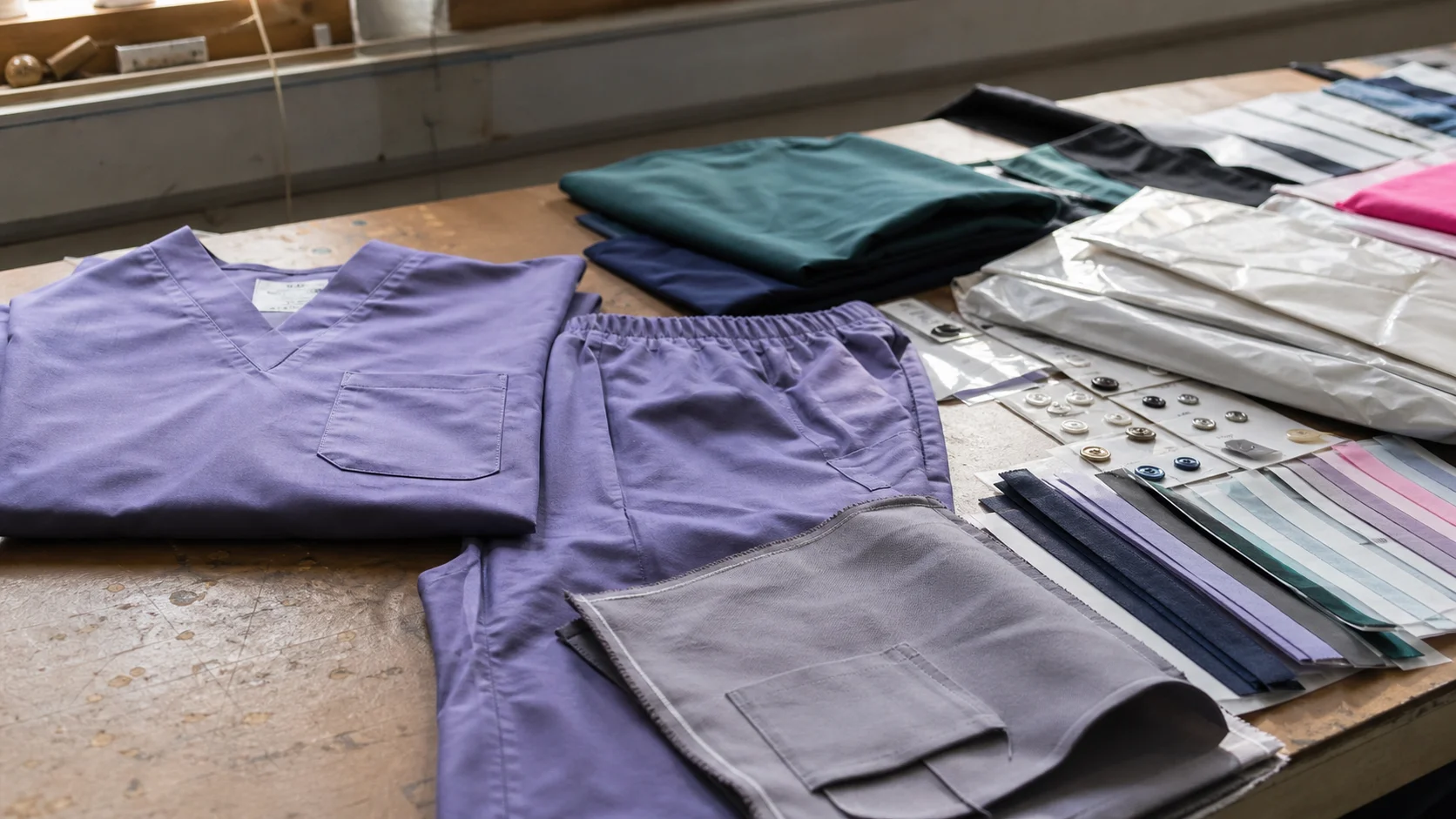
A retail operations-focused outline for evaluating scrub trims, including drawcords, elastics, snaps, labels, pocket reinforcements, compliance artifacts,...
Scrubs Trim Sourcing Review for Retail Ops Buyers - MOQ, Cost & Sourcing manufacturing guide
Scrubs look simple on a retail shelf, but trim sourcing can decide whether a program ships cleanly or gets stuck in production rework. For retail operations teams, trims are not decorative afterthoughts. They affect garment function, wearer comfort, compliance labeling, packing efficiency, durability, and size-level consistency across repeat orders.
A scrub top or pant may use only a few visible trims: a drawcord, elastic waistband, woven label, size pip, hangtag, care label, zipper, snap, badge loop, or pocket tape. The sourcing risk sits in the details. A drawcord that bleeds dye, an elastic that loses recovery after washing, a label that irritates the neck, or a zipper that fails after industrial laundering can create returns well beyond the value of the trim itself.
Retail operations buyers usually work under pressure from calendar, margin, replenishment demand, and packaging requirements. The best trim sourcing approach is not to buy the cheapest component. It is to lock the correct specification early, match it to fabric and laundry expectations, and control small variations before they become bulk problems.
For scrubs, trim decisions should be judged by repeatability, wash durability, comfort, and replenishment stability. A low-cost trim that disrupts production or causes returns is not a saving.
This review focuses on scrubs trim sourcing for retail operations teams handling MOQ, cost, supplier coordination, sample approvals, and inspection control. For buyers building a broader apparel supply chain, it can also be useful to review manufacturing support options through Fabrikn services before finalizing production planning.
Scrubs trim sourcing starts with a component map. Retail teams should identify every trim by function, placement, specification, color, supplier, MOQ, and approval status. This avoids late-stage confusion between design, merchandising, production, and quality control.
The highest-risk trims are usually those exposed to stress, heat, moisture, friction, or repeated washing. Elastic, drawcords, zippers, snaps, heat transfers, and care labels deserve stricter review than a basic paper hangtag. Packaging trims still matter, especially for retail operations, but they are usually easier to replace if caught early.
MOQ is one of the biggest friction points in scrubs trim sourcing. Apparel teams may approve a style with several colorways and size ranges, then discover that trim suppliers quote MOQs that exceed the garment production quantity. This is common when the program uses custom-dyed cords, branded elastics, custom zipper pulls, molded snaps, silicone badges, or specialized packaging.
Typical trim MOQ ranges vary by supplier, material, customization level, and region. The ranges below are practical planning references, not fixed rules.
Trim Type Typical MOQ Range Main MOQ Driver Retail Ops Risk Woven labels 1,000-5,000 pieces Loom setup, artwork, yarn colors Wrong size split or outdated branding Printed care labels 1,000-10,000 pieces Print method, label roll setup Compliance errors and relabeling cost Elastic waistbands 500-3,000 meters Width, fiber, dye, branding Poor recovery or shade mismatch Drawcords 1,000-5,000 meters Construction, color, tipping Dye bleed, fraying, uneven cutting Zippers 500-3,000 pieces Length, tape color, slider, puller Delayed production if length is wrong Snaps or buttons 5,000-20,000 pieces Mold, plating, logo, finish Rust, weak attachment, color variation Heat-transfer labels 1,000-10,000 pieces Artwork, color count, material Peeling after washing or heat damage Hangtags 1,000-5,000 pieces Paper stock, print finish, string Barcode or price-ticket mismatch Polybags 5,000-20,000 pieces Gauge, print, adhesive, warning text Incorrect suffocation warning or sizingBuyers should separate trims into stock, semi-custom, and custom categories. Stock trims reduce MOQ pressure and speed up sampling, but they may limit brand differentiation. Semi-custom trims, such as stock zipper types with custom tape color, offer a balanced route. Fully custom trims can support premium positioning, but they need stronger calendar control and higher order visibility.
For smaller scrub launches, the cleanest approach is often to standardize trims across multiple styles and colors. One waistband elastic, one care label format, one drawcord construction, and one packaging system can support several SKUs. This reduces inventory fragmentation and improves the chance of meeting MOQ without overbuying.
Trim cost looks minor when reviewed as a line item, but it becomes meaningful across high-volume replenishment. A few cents per garment can shift margin when applied to thousands of scrub tops and pants. Retail operations buyers should compare trim cost in garment context, not only by unit price.
Direct cost includes the price of each trim consumed in one garment. For example, scrub pants may include elastic, drawcord, two cord tips, labels, pocket zipper, thread, hangtag, polybag, and carton markings. A scrub top may use fewer functional trims but still require labeling and packaging. Buyers should calculate cost per garment and cost per order, then compare the impact across styles.
Hidden cost appears when trims create operational inefficiency. Common examples include excess trim inventory, air freight for late trims, inspection failures, re-labeling, production line downtime, and size-level mismatches. A cheaper zipper that arrives two weeks late can cost more than a higher-priced approved zipper from a more reliable supplier.
Custom logo pulls, branded elastic, molded toggles, special hangtag finishes, and color-matched drawcords add setup cost and MOQ exposure. They may support brand value, but they need commercial justification. A private-label scrub program with stable replenishment can absorb custom trim investment better than a test order with uncertain sell-through.
Care labels, content labels, warning labels, and packaging text must be accurate. Label mistakes are not small defects. They can block shipment, trigger repacking, or create downstream regulatory risk. Retail ops teams should treat compliance-related trims as controlled documents, not generic accessories.
A useful rule: save money on trims that do not affect wear, wash, compliance, or retail scanning. Be cautious when reducing cost on elastic, zippers, drawcords, snaps, and labels tied to legal or customer-facing information.
Scrubs fabrics are often polyester-cotton blends, polyester-rayon-spandex blends, mechanical stretch polyester, or performance fabrics with moisture-wicking, antimicrobial, or fluid-resistant finishes. Trim sourcing must align with those fabric choices.
Elastic waistbands need recovery that matches the garment’s expected use. For scrub pants, elastic should recover after sitting, bending, repeated washing, and heat exposure. A waistband that feels acceptable in a fit sample can still fail after wash testing. Buyers should request width, composition, elongation, recovery percentage, thickness, and wash performance data where available.
Common elastic widths for scrubs pants may sit around 25-40 mm depending on style and size range. Wider elastic can improve comfort and support, but it adds cost and may feel bulky in lighter fabrics. Narrow elastic lowers cost but may twist or roll if not secured correctly.
Drawcords should be checked for construction, hand feel, colorfastness, shrinkage, fraying, and tip security. Polyester cords are common because they are durable and stable. Cotton cords can feel softer but may shrink or fade depending on dyeing and wash conditions. Cord tips can be plastic, metal, heat-sealed, or wrapped. Metal tips can look premium but may introduce rust, nickel, or laundry noise concerns if not specified carefully.
Color matching is a common trap. A drawcord dyed to match navy scrub fabric may look acceptable under office lighting but shift under retail lighting or after washing. Teams should approve trim shade under agreed light sources and compare it against both fabric lab dips and bulk fabric.
Zippers in scrubs are often used on cargo pockets, chest pockets, or fly openings. Buyers should define zipper type, teeth size, tape color, slider finish, puller shape, length, end type, and lock function. Coil zippers are flexible and lightweight, while molded zippers can feel more rugged. Metal zippers may not be ideal for some healthcare settings due to laundering, weight, or scratch concerns.
On scrub pants, zipper placement must be comfortable when bending or sitting. A stiff zipper on a cargo pocket can irritate the wearer or distort the garment. The trim may pass a desk review and still fail in actual wear.
Healthcare workers wear scrubs for long shifts. Neck labels, side seam labels, and care labels should not scratch, curl, or become stiff after washing. Heat-transfer labels reduce irritation but must be tested for adhesion after repeated laundering. Printed satin labels can be cost-effective, but edge finish and placement matter.
Label print must remain readable after washing. This is especially important for care instructions and fiber content. Faded labels create service issues for customers and can complicate returns or compliance checks.
A disciplined sample approval workflow prevents trim mistakes from reaching bulk production. Retail operations teams should not rely on verbal confirmation or supplier screenshots. Physical approval is still the safest route for trims that affect color, feel, size, performance, or compliance.
The trim card should be treated as a production control tool. It should include actual physical trims, supplier references, approval dates, signatures or digital approval records, and garment style references. When multiple factories or lines are involved, the approved trim card becomes even more important.
Sample approval should also include packaging trims. Retail operations teams often focus on garment components and leave hangtags, polybags, barcode stickers, and carton labels until late. That creates avoidable receiving problems. Incorrect carton marks or barcode labels can delay distribution even when the garments are acceptable.
For buyers coordinating new programs, early alignment with a sourcing partner can reduce trim churn. Teams evaluating production support can use the Fabrikn contact page to start a discussion around sampling, trim planning, and order readiness.
Trim lead time is rarely one single number. It depends on artwork approval, material availability, dyeing, molding, plating, testing, packing, customs, and factory delivery. Retail operations teams should plan trims backward from the garment production start date, not the shipment date.
Trim Category Typical Development Time Typical Bulk Lead Time Main Delay Risk Stock labels 3-7 days 7-14 days Artwork or size breakdown changes Custom woven labels 7-14 days 14-25 days Loom setup and color approval Elastic waistband 7-21 days 15-35 days Dyeing, width, recovery failure Drawcords 7-14 days 10-25 days Color matching and tipping Custom zippers 10-21 days 20-40 days Tape color, puller mold, length change Heat transfers 7-14 days 10-25 days Adhesion testing and artwork correction Printed packaging 5-14 days 10-30 days Barcode, warning text, carton mark errorsThese ranges can compress if trims are stock and suppliers have stable capacity. They can extend if the order falls near holidays, peak production periods, or if testing is required. A retailer launching new scrub colors should pay special attention to trims dyed to match fabric. Fabric lab dip approval and trim color approval need to move in parallel, not in sequence.
Trim delays often create a production bottleneck because factories cannot start key operations without the correct component. Pants cannot proceed efficiently without approved elastic or drawcords. Labeled goods cannot be packed without compliant care labels and barcodes. A production line waiting for one missing trim may shift capacity to another order, which can push the scrubs program further back.
Inspection should not focus only on garment measurements and sewing defects. Scrubs trim inspection needs a clear checklist covering function, appearance, durability, and regulatory accuracy. Retail operations buyers should share the trim checklist before production starts, not after goods are packed.
Incoming trim inspection occurs when trims arrive at the factory. This is the best point to catch shade mismatches, wrong widths, incorrect labels, defective zippers, or missing size quantities. Waiting until final inspection is too late. By then, defective trims may already be sewn into finished garments.
In-line inspection confirms trims are being applied correctly during sewing. This is where waistband twisting, uneven drawcord exits, wrong label placement, weak bartacks, and zipper puckering can be caught. Scrubs are workwear-like garments, so functional trim attachment matters as much as appearance.
Elastic must sit flat and be secured correctly. Drawcord openings should be clean and reinforced if needed. Zippers should not wave, twist, or catch pocket fabric. Labels should be placed consistently and should not create irritation points. Any trim that affects wearer comfort should be checked on-body during fit approval and again during production review.
Final inspection should include trim count, placement, security, color, print accuracy, and packaging. Retail ops teams should confirm barcode scanning, carton ratio, size stickers, and hangtag position. A garment can pass sewing inspection and still fail warehouse receiving if external labels do not match the order system.
Inspection risk increases when the same scrub style runs across several colorways, factories, or replenishment drops. Reorders should not assume the previous approval remains valid. Suppliers may change yarn lots, elastic batches, zipper sliders, label rolls, or packaging vendors unless controls are in place.
A strong trim supplier brief reduces negotiation waste and sample loops. The brief should be specific enough for suppliers to quote accurately, but not so narrow that it blocks better alternatives. Retail buyers should state mandatory requirements and areas where equivalent options are acceptable.
Retail operations teams should ask suppliers to quote both the preferred specification and one practical alternative. For example, a custom dyed drawcord may be quoted alongside an available stock color that is close enough for a lower-cost tier. A branded elastic may be compared against a plain elastic with external branding handled through hangtags. This gives the buyer options when margin or calendar pressure increases.
The brief should also ask whether the supplier can support repeat orders. Scrubs are often replenishment products, so the first order is only part of the sourcing decision. A supplier that can handle initial development but cannot maintain shade, width, or performance consistency on repeat orders may not be suitable for retail operations.
Smart trim sourcing is not about upgrading every component. It is about knowing which trims carry business risk and which trims can be simplified. For scrubs, the most important buying judgment is to protect comfort, wash durability, compliance, and production continuity.
Brand teams may prefer visible custom trims because they create differentiation. Retail operations teams should challenge whether the sales value justifies the operational burden. A custom zipper pull may be worth it on a premium scrub jogger with strong volume. It may not be worth it on a small test colorway with uncertain demand.
The strongest programs usually use a hybrid strategy: reliable core trims, selective branding, and disciplined packaging control. This protects margin without turning every component into a custom development project.
Before committing to bulk trim orders, retail operations buyers should run through a basic readiness check. This helps prevent late changes and makes the factory’s job clearer.
Checkpoint Buyer Question Action If Not Clear BOM accuracy Does every trim have a code, spec, color, and placement? Freeze a controlled trim BOM before bulk ordering. MOQ fit Does order volume absorb trim MOQ? Standardize trims or approve a stock alternative. Color approval Are trims approved against fabric under correct lighting? Request physical trim cards and fabric headers. Performance Have functional trims passed wash and stress checks? Test elastic, zippers, drawcords, snaps, and heat transfers. Compliance Are labels legally and commercially accurate? Review care, content, origin, warning, and barcode data. Production timing Will trims arrive before the sewing start date? Prioritize long-lead trims and track delivery by component. Inspection Does QC know the approved trim standard? Issue trim cards, photos, measurements, and defect limits.This checklist is especially important for replenishment orders. Repeat orders can fail when buyers assume old approvals are still active. A supplier may substitute elastic yarn, change label substrate, use another zipper slider, or ship packaging from a different batch. Retail operations teams should require confirmation that bulk trims match the approved standard for every order.
Scrubs trim sourcing works best when responsibilities are clear. Retail teams should own brand, compliance, commercial approval, and final quality expectations. Factories should own production feasibility, consumption, application method, and sewing quality. Trim suppliers should own material specification, sample accuracy, testing support, MOQ, and delivery commitment.
Problems occur when each party assumes someone else has checked the detail. The factory may receive labels but not know whether legal copy was approved. The trim supplier may produce drawcords based on an old shade reference. The retail team may approve a zipper pull without confirming it works in the pocket construction. These are ordinary sourcing failures, and they are preventable with better documentation.
Centralized communication is valuable. A shared approval tracker can list each trim, approval status, pending issue, responsible party, and required date. This is not complicated, but it needs discipline. Retail operations teams that manage scrubs across multiple seasons should build a trim library with approved components, supplier data, test notes, and reorder history.
Companies reviewing broader supply chain capabilities may also find context on team structure and sourcing approach through Fabrikn’s about page. The main point for buyers is to connect trim decisions with production execution rather than treating them as isolated purchasing tasks.
Scrubs trim sourcing is a margin, quality, and calendar control issue. The components may be small, but they touch every stage of retail operations: product development, costing, production, compliance, inspection, warehousing, and customer use. A trim that fails in washing or arrives late can damage the entire order.
For MOQ management, standardization is the strongest lever. Use common trims across styles where possible, especially for labels, packaging, elastic, drawcords, and zipper types. For cost management, compare trims by total landed impact and operational risk, not only unit price. For quality management, approve physical samples, test functional trims, and inspect incoming trims before they enter production.
The best buying posture is selective control. Spend where trims affect comfort, compliance, durability, and delivery. Simplify where trims add complexity without clear retail value. That approach gives retail operations teams a stronger chance of shipping scrubs on time, within margin, and with fewer preventable returns.
Get a free quote from Fabrikn — your trusted B2B clothing manufacturer with 10+ years of experience. MOQ as low as 200 pieces.
Get a Free Quote →The most important trims are elastic waistbands, drawcords, zippers, snaps, care labels, size labels, heat-transfer labels, and packaging labels. These affect fit, comfort, wash durability, compliance, and retail receiving.
Typical MOQs range from 1,000-5,000 pieces for labels, 500-3,000 meters for elastic, 1,000-5,000 meters for drawcords, and 500-3,000 pieces for custom zippers. Highly customized trims can require higher MOQs.
Buyers can reduce MOQ pressure by standardizing trims across styles, using stock or semi-custom components, limiting color-specific trims, and consolidating packaging formats. This is especially useful for new scrub launches with uncertain volume.
Elastic, zippers, drawcords, heat-transfer labels, care labels, snaps, and buttons should not be selected only by lowest price. These components can cause returns, compliance issues, or production delays if quality is weak.
A trim approval card should include physical trim samples, supplier references, color standards, measurements, placement notes, approval dates, and the related garment style numbers. It should match the final bill of materials.
Trims should be ordered after specification and sample approval, but early enough to arrive before the planned sewing start date. Long-lead trims such as custom zippers, branded elastic, molded trims, and custom packaging need earlier tracking.
Common failures include wrong label copy, mismatched drawcord shades, elastic with poor recovery, zipper length errors, weak snap attachment, peeling heat transfers, barcode mistakes, and incorrect carton markings.
Stock trims are often acceptable, especially for core programs where cost and speed matter. The tradeoff is reduced brand customization. Buyers should still test stock trims for wash performance, shade consistency, comfort, and compatibility with the garment fabric.