
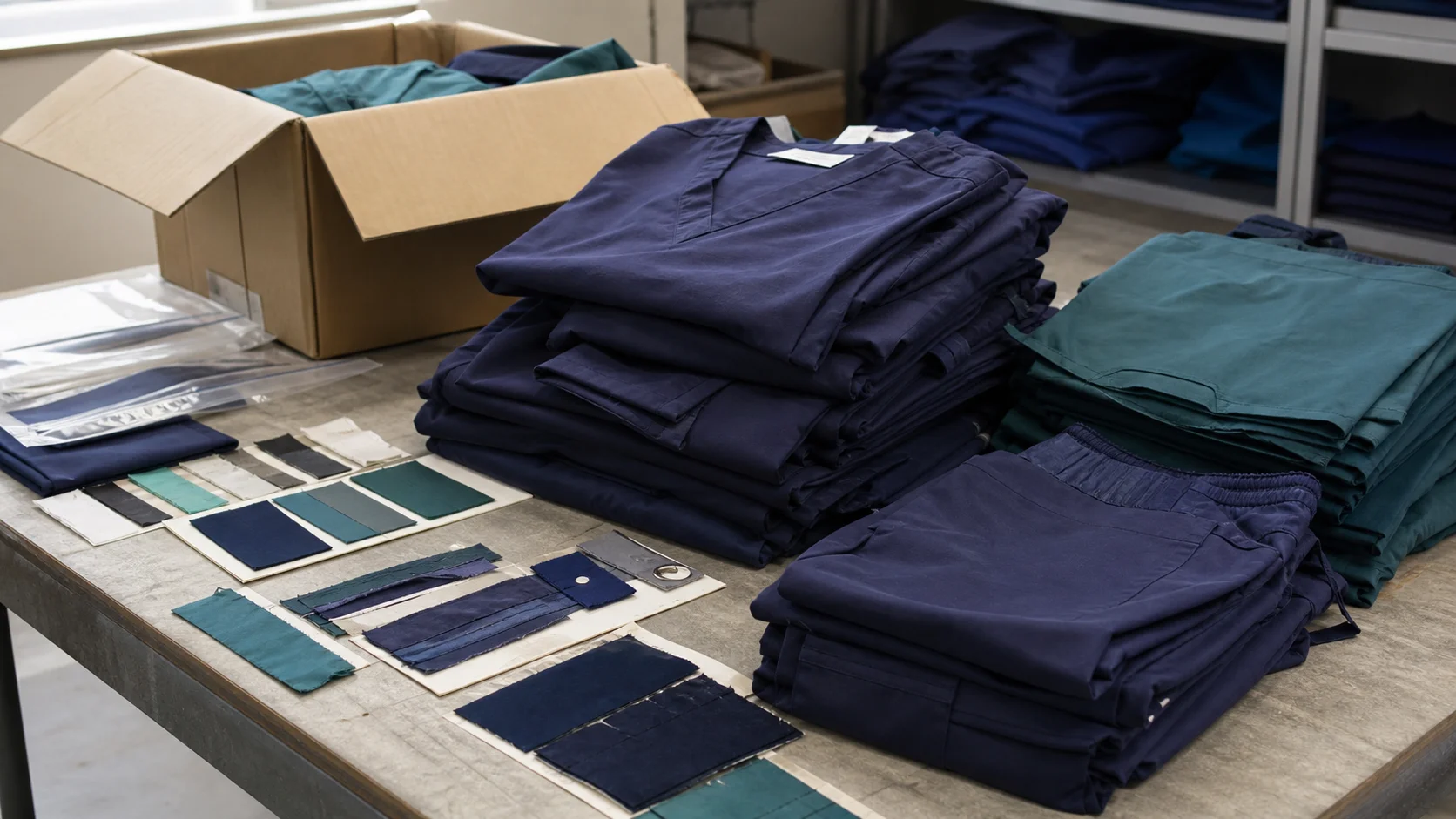
A practical quality and inspection outline for hotel procurement teams evaluating scrub durability, colorfastness, shrinkage, seam integrity, and...
For hotel procurement teams, a scrubs wash test review is not a lab exercise for its own sake. It is a practical check on whether the garment can survive repeated laundering, stay presentable, and keep its fit and function under real housekeeping or medical-style duty cycles. When hotels source scrubs for spa staff, wellness teams, clinic partners, housekeeping supervisors, or in-house laundry programs, wash performance becomes part of the buying decision, not just a quality note after the PO is signed.
This review matters because scrubs are expected to handle frequent washing, strong detergents, heat, and daily abrasion. If the fabric fades, shrinks, twists, pills, or loses seam strength too early, the buyer ends up with replacement costs, complaints, and inconsistent staff presentation. A good wash test review helps procurement compare vendors on measurable results instead of sales claims.
Scrubs Wash Test Review for Hotel Procurement - Fabrikn production reference
A scrubs wash test review is the process of evaluating how sample garments perform after controlled washing and drying cycles. For hotel procurement teams, the goal is to confirm that the garment keeps its appearance, dimensions, and functional details after repeated care cycles that resemble the hotel’s actual laundry conditions.
In many sourcing programs, procurement teams ask suppliers for pre-production samples, then run wash testing before final approval. That is the right sequence. Bulk production should not start until the team has reviewed fabric behavior, color stability, seam durability, and trim performance after washing.
Wash testing is especially important when scrubs are expected to maintain a consistent brand look. A dark navy set that fades unevenly after five washes is not just a garment issue. It becomes a uniform consistency issue, and in hotel environments that affects the guest-facing standard.
Hotel procurement teams usually focus on price, size runs, delivery time, and visual approval. Wash performance deserves the same attention because it affects total cost of ownership. A lower unit price can be misleading if the garment fails early and must be replaced sooner than expected.
Key reasons wash performance matters:
Hotels often wash uniforms under stricter conditions than a retail buyer would expect. Hotter temperatures, stronger chemistry, tumble drying, and commercial pressing can expose weaknesses fast. That is why a supplier’s “passes wash test” statement should never be accepted without test method details.
A meaningful wash test starts with the right technical baseline. If the spec sheet is vague, the test result is hard to interpret. Procurement should ask for a simple but complete material and trim breakdown before approving samples.
Procurement teams should confirm the sewing thread type, seam construction, stitch density, and any reinforcement in stress areas such as side seams, crotch seams, pocket corners, and waistbands. Small construction choices often determine whether the garment survives repeated industrial laundry.
A hotel procurement wash test does not need to be overly complicated. It does need to be consistent. The test should reflect the laundering process the hotel actually uses or plans to use. A sample washed in gentle home conditions tells you very little about commercial reality.
Agree on the wash method, drying method, temperature range, detergent type, and number of cycles before samples are produced. If the hotel laundries with industrial tunnel washers or high-heat tumble dryers, the test should mirror that use case as closely as possible.
Samples should be cut from the same fabric, trims, and construction methods intended for bulk production. A beautiful sales sample made from upgraded material is not useful if the production run uses a cheaper substitute.
Record chest, waist, hip, inseam, sleeve length, and overall length if relevant. Photograph front, back, inside seams, and close-up trim details. This gives the buyer a clear baseline for shrinkage and distortion review.
A single wash only shows basic color transfer or obvious construction failure. Most hotel buyers should ask for at least 3 to 5 cycles for a first decision, and more if the garment will be used in harsh laundry conditions. For critical programs, 10 cycles or more is more meaningful.
Check the garment after every wash and dry cycle for:
Procurement should define pass/fail limits in advance. Typical requirements may include acceptable shrinkage thresholds, color fastness expectations, seam integrity, and minimum appearance retention. The exact standard depends on brand position and laundry conditions, but the buyer should always set the bar before the test begins.
Wash test results are useful only when they are read in context. A garment may shrink slightly but still be acceptable if the pattern was adjusted for that outcome. A color may soften a little and still be within tolerance if the set remains uniform across all sizes.
Focus on the following decision areas:
Look for shrinkage in length, width, and sleeve or inseam measurements. Excessive shrinkage changes fit, affects staff satisfaction, and creates size inconsistency across reorders. For hotel programs, predictable sizing is often more important than chasing the lowest price.
Color loss after washing is one of the most visible defects in uniforms. Dark colors are especially risky. A navy or black scrub set that fades unevenly can look old long before the fabric is actually worn out.
Twisting legs, skewed side seams, and warped necklines indicate construction or fabric balance issues. These problems are not cosmetic only. They often signal instability that will worsen over time.
Pilling, fuzzing, and abrasion matter in guest-facing hotel environments. A garment can still function while looking tired. Procurement should decide whether the visual standard allows that level of wear.
Pockets, closures, waistbands, and seams must hold up through repeated laundering and daily use. A scrub top that loses pocket strength quickly becomes a complaint item even if the fabric itself is acceptable.
In procurement terms, the right question is not whether a sample survived one wash. The real question is whether the garment remains fit for purpose after the number of cycles your operation actually requires.
Wash tests often reveal problems that were not obvious in the first sample inspection. Buyers should watch for these common red flags:
One of the most overlooked risks is lot variation. A supplier may send a good sample, yet bulk production from a different fabric lot behaves differently in wash testing. That is why procurement should tie approval to the bulk fabric source, not just the early sample.
Another common issue is label and artwork failure. Heat-transfer neck labels, care labels, and decoration elements can deteriorate faster than the garment itself. A uniform may still pass structurally but fail presentation standards because the labeling looks worn or peeled.
Hotel procurement teams often need practical guidance on order size and timing. For custom scrubs, MOQs commonly range from 100 to 500 pieces per style or color at a basic level, though some suppliers may require higher volumes for customized fits, specialty fabrics, or multiple decoration options. The actual MOQ depends on fabric availability, dye lot requirements, and whether the order uses stock materials or mill-developed textiles.
Sampling usually takes longer than buyers expect. A standard sequence may include:
Lead time depends on sample approval speed, fabric sourcing, lab test requirements, decoration method, and factory capacity. A simple scrub program might move faster if the fabric is already in stock. A custom program with special color matching, embroidery, or performance finish will take longer. Buyers should build enough time for at least one revision round, because rushing approval is one of the easiest ways to let quality problems into bulk production.
For teams sourcing through a garment partner, it helps to ask early how the supplier manages development, inspection, and production control. A clear process reduces rework and keeps the order moving. Fabrikn’s service overview can be a useful starting point: https://fabrikn.com/services/
Not every supplier interprets wash testing the same way. Some are strong at stitching and pattern consistency. Others focus on price and move quickly but cut corners on fabric control or inspection discipline. Procurement should compare suppliers using a simple commercial and technical lens.
If the buying team wants to discuss product development, sample review, or production control, a direct contact page is more efficient than long email chains. See Fabrikn contact options for a starting point.
It also helps to understand the supplier’s wider manufacturing background, not just the product page. An overview such as about Fabrikn can help procurement teams judge whether the partner has the right focus for uniform and apparel programs.
Use this checklist to keep the review practical and repeatable.
Check Area What to Verify Buyer Judgment Fabric content Fiber blend, weight, finish, lot consistency Must match approved spec Sample type Production-representative sample, not showroom-only sample Reject if not representative Wash method Temperature, detergent, drying method, cycle count Should reflect hotel laundry Dimensions Shrinkage, twisting, size balance Within approved tolerance Appearance Fade, pilling, wrinkling, surface roughness Accept only if presentation stays strong Trims Buttons, zippers, elastic, labels, embroidery No early failures allowed Approval path Sample sign-off, correction, bulk release Must be documentedThere is always a tradeoff between comfort, durability, and price. Softer fabrics may feel better to staff but can show wear sooner. Heavier fabrics may last longer but increase heat buildup. A stretch blend improves movement but may need tighter control on shrinkage and recovery. Procurement needs to decide which compromise fits the hotel’s service standard.
Cheap uniforms are often more expensive in the long run if wash performance is weak. That is the key purchasing judgment. Buy for the wash cycle you actually use, not for the sample conditions that look best in the showroom.
A supplier that can explain fabric behavior, sampling steps, and inspection limits clearly is usually easier to work with than one that only emphasizes price. For hotel programs with multiple departments or recurring reorders, that difference matters more over time than a small unit-cost savings.
A scrubs wash test review is a basic but essential tool for hotel procurement teams. It protects the program from premature wear, uneven shade, fit drift, and presentation problems. The process does not need to be complex, but it must be disciplined. Confirm the fabric spec, define the wash method, test production-representative samples, and compare results against clear acceptance criteria.
When procurement treats wash performance as part of supplier qualification, the result is a more reliable uniform program and fewer surprises after launch. That is the right approach for hotels that care about consistency, staff comfort, and long-term value.
Get a free quote from Fabrikn — your trusted B2B clothing manufacturer with 10+ years of experience. MOQ as low as 200 pieces.
Get a Free Quote →It is the evaluation of scrub samples after repeated washing and drying to see whether they keep their size, color, shape, and function under the hotel’s expected laundry conditions.
For a basic procurement check, 3 to 5 cycles can reveal early issues. For higher-risk or higher-use programs, 10 cycles or more is more reliable. The number should match the garment’s expected service life and laundry intensity.
There is no single best answer. Polyester-cotton blends often hold shape well, while stretch blends improve comfort but may need closer review for shrinkage and recovery. The right choice depends on use case, laundry method, and brand standard.
Common issues include shrinkage, fading, seam twisting, pilling, loose buttons, elastic failure, and trim damage. Decoration problems such as peeling labels or cracking prints are also common.
Ask for fabric composition, wash test method, shrinkage tolerance, lot consistency, sample approval steps, and inspection records. The supplier should be able to explain how the bulk order will match the approved sample.
Yes, but the MOQ depends on the supplier, fabric type, color requirements, and customization level. A common starting range is 100 to 500 pieces per style or color, though some programs will require more.
Hotel uniforms need to look consistent and survive frequent laundering. Wash testing helps prevent early replacement costs, staff complaints, and visible quality loss across the uniform program.