
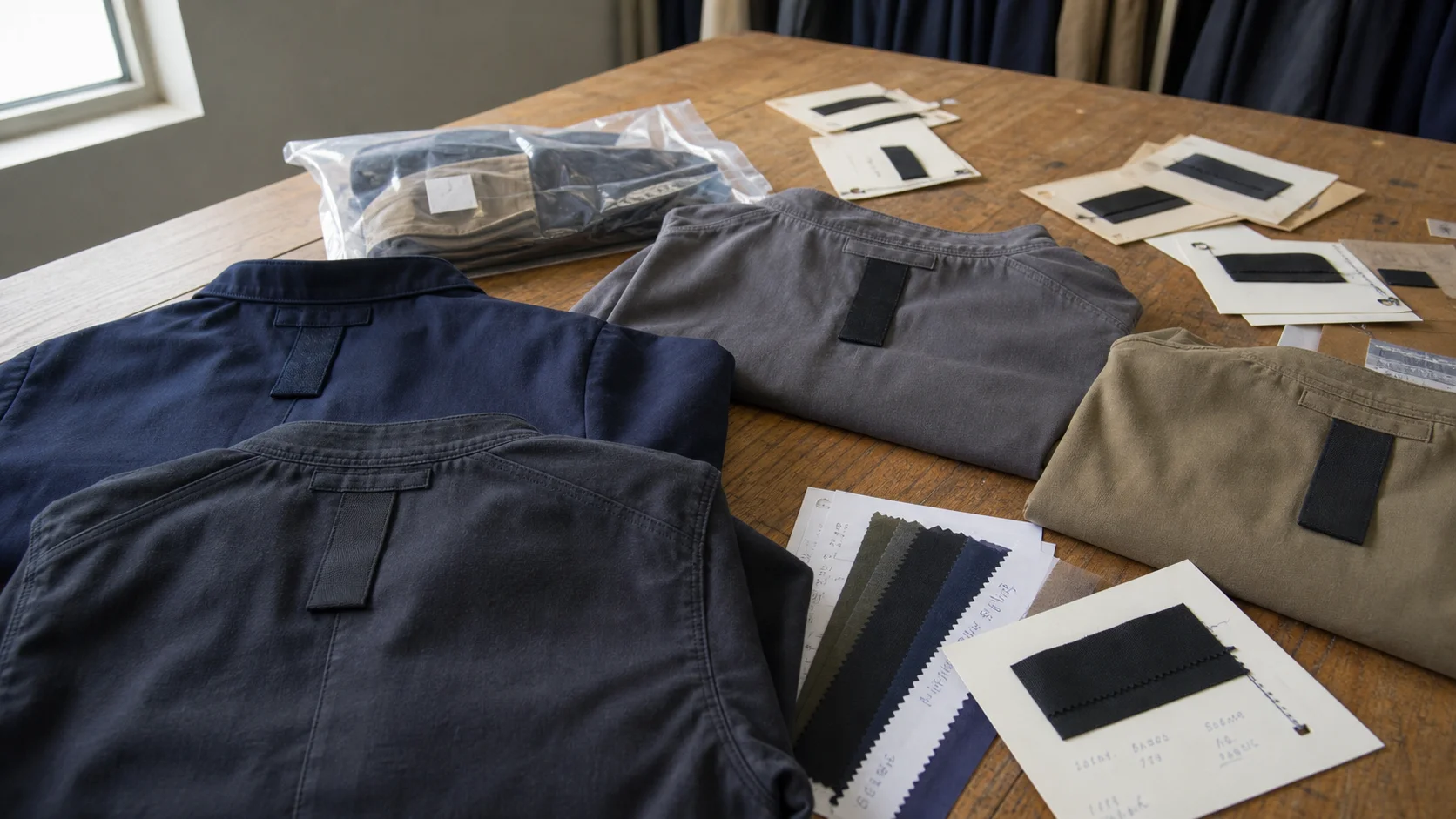
A sourcing-focused review outline for security contractors evaluating branded back neck tab trim, covering decoration methods, durability, compliance,...
Back Neck Tab Trim Sourcing for Security Buyers - Decoration & Printing manufacturing guide
Back neck tab trim looks like a small detail, but for security contractors it can carry more purchasing risk than expected. It may be used for brand identification, size coding, wearer comfort, garment traceability, department segmentation, or a clean retail-style finish inside a uniform shirt, polo, jacket, fleece, or tactical layer. When the trim fails, the issue is not only cosmetic. A scratchy tab can trigger wearer complaints. A poor print can make a uniform look cheap. An inaccurate color can weaken brand consistency. A loose seam can become an inspection failure across an entire production run.
For security buyers sourcing uniforms at scale, back neck tab trim should be treated as a controlled component, not an afterthought left to the sewing line. The right sourcing review covers material, dimensions, artwork, color standard, attachment method, wash performance, skin contact comfort, and replacement availability. It also asks whether the trim supplier can support repeat orders without changing yarn, base tape, ink, adhesive, or edge finish.
This article reviews back neck tab trim sourcing for security contractors from a practical purchasing angle. The focus is on decoration and printing decisions, because most back neck tabs carry some combination of logo, size, care information, QR code, contract code, or color-coded identification. For broader garment development support, buyers can review apparel production capabilities through Fabrikn services. For supplier discussions or trim development questions, the contact page is the most direct next step.
Purchasing judgment: if the back neck tab is visible during hanging, wearer issue, laundry handling, or internal audit, specify it. If it touches skin, test it. If it carries a logo or code, control it like any other branded component.
Security contractors often buy uniforms for multiple sites, departments, climates, and contract tiers. A single operator may need black polos for front-of-house guards, hi-vis outerwear for patrol staff, softshell jackets for supervisors, flame-resistant layers for special environments, and plain garments for low-profile assignments. Back neck tab trim can help organize these product lines, but it can also create problems if the trim is not standardized.
The security uniform market has several sourcing pressures that affect trim decisions:
A fashion brand may accept a slightly softer aesthetic variation from season to season. A security contractor usually cannot. Uniform programs need controlled repetition. The trim should match the practical environment: frequent washing, sweat exposure, body heat, abrasion from collars, and sometimes industrial laundry handling.
A useful sourcing specification should remove guesswork. “Back neck logo tab” is not enough. Suppliers need clear instructions on material, size, artwork placement, color, fold type, stitch position, and tolerance. If this is not documented, every sample room and production line may interpret the detail differently.
Security buyers should request a trim sheet or bill of materials page for each back neck tab. This can be simple, but it must be controlled. A photo of the approved sample, an artwork file name, a color reference, and a supplier code are often enough to prevent avoidable mistakes.
For small trims, tiny deviations can look obvious. A practical tolerance for back neck tab dimensions is often plus or minus 1 mm for narrow labels and plus or minus 2 mm for larger decorative patches. Print placement tolerance may sit around plus or minus 1 mm to 1.5 mm, depending on method. Stitch placement should be defined relative to the collar seam or center back line. If the tab is used as a visible brand detail, center alignment should be checked carefully.
Do not rely only on digital artwork. A real trim sample should be approved before bulk order. Digital files show layout, not texture, edge feel, ink coverage, or true color under production lighting.
The material choice should match the garment, the wearer, and the contract environment. A heavy woven tab may look premium inside a jacket but feel irritating inside a lightweight polo. A printed satin label can be smooth, but it may look too retail-oriented for a rugged tactical garment. A heat-transfer back neck mark removes sewing bulk, but it needs reliable adhesion and wash testing.
Woven tabs are common when the logo or brand mark needs a durable, structured appearance. They are usually made from polyester yarn, with damask weave preferred for finer detail. They can be center-fold, end-fold, mitre-fold, loop-fold, or straight-cut with finished edges.
Printed satin labels are smooth and suitable for fine graphics, small text, size information, and care symbols. They are often cost-effective for moderate-volume programs. Print methods may include screen printing, thermal transfer, digital printing, or rotary printing, depending on order volume and artwork complexity.
Cotton tape and twill tape have a more natural feel and can work well for workwear-inspired security garments. They may be printed or woven, depending on the desired look. Cotton can shrink or fade more than polyester, so it needs testing against the garment’s care instructions.
Heat transfers are not tabs in the traditional sewn sense, but many buyers use them as back neck branding or size marks. They can reduce bulk and improve wearer comfort. They are often used in sportswear-style security uniforms, performance polos, and stretch base layers.
Silicone or TPU trims can create a modern technical look, but they are less common for direct back neck skin contact unless designed carefully. They can be sewn, bonded, or heat-applied. Their main appeal is tactile branding, high durability, and a premium tactical aesthetic.
Because this topic sits within Decoration & Printing, the artwork method deserves close review. Security contractors typically need decoration that is clean, restrained, and repeatable. Overly complex branding inside the neck may add cost without improving uniform performance. Clear logo reproduction, readable size marking, and consistent color are usually more valuable than novelty effects.
Artwork should be simplified for scale. A logo that works on a website may fail on a 20 mm neck tab. Fine gradients, tiny slogans, narrow outlines, and detailed crests often lose clarity. For woven trims, line thickness and yarn count limit detail. For printed trims, ink spread and base texture affect sharpness. QR codes need special caution: small codes may scan in a lab but fail after washing or when distorted by seam tension.
Security uniform buyers often specify black, navy, charcoal, white, silver, red, and high-visibility accent colors. Black and navy sound simple, yet they can vary dramatically between base materials. A black satin label, black woven polyester label, and black TPU patch may not match each other. If the back neck tab sits inside a black garment, the contrast between the tab and body fabric should be intentional.
Use physical references wherever possible. Pantone references are useful, but they do not replace approval of real material. A woven label reflects light differently from printed tape. If brand color is critical, approve the color on the actual trim substrate, not just on paper.
MOQ depends on trim type, supplier setup, artwork complexity, and whether the buyer can accept stock base material. Security contractors should expect higher minimums when trims are custom-woven, custom-molded, color-matched, or made with special yarns. A simple printed satin label usually has a lower threshold than a molded silicone tab.
These ranges are typical market planning ranges, not fixed rules. Suppliers may offer lower MOQs at higher unit prices, especially for sampling or pilot programs. Larger factories may refuse small trim orders unless they are tied to a full garment production order. Buyers should ask whether excess trim can be stored for repeat production, and who owns that inventory.
A disciplined sample route reduces risk before bulk production. Security buyers should not approve a trim from a photo alone unless the trim is non-critical and the supplier is repeating an already approved item.
Trim lead time usually depends on artwork readiness, supplier capacity, raw material availability, color matching, tooling, and shipping mode. A simple printed label may be ready in several days after artwork approval. A custom woven label often needs more time for yarn setup, weaving, cutting, folding, and packing. Silicone or TPU trims can take longer if mold development is required.
As a planning guide, buyers may allow 5 to 10 days for simple trim sampling, 7 to 15 days for custom woven or printed development, and 15 to 30 days for more complex molded or specialty trims. Bulk production may add another 7 to 25 days depending on quantity, approval speed, and production load. These are planning ranges only. Holiday periods, raw material shortages, re-strikes, failed tests, and late artwork changes can extend timelines.
Purchasing judgment: if the uniform delivery date is fixed, do not let custom trim approval sit outside the critical path. Approve the back neck tab before garment bulk production, not after fabric has already been cut.
A back neck tab trim sourcing review should evaluate both the trim supplier and the garment factory using the trim. Many failures happen between those two parties. The trim supplier may produce acceptable labels, but the garment factory may attach them off-center, use the wrong fold, expose a sharp edge, or mix trims between sizes.
Buyers considering a manufacturing partner should also assess communication discipline, technical documentation, and willingness to manage controlled trims. A supplier profile and company background can be reviewed through Fabrikn about us, especially when comparing partners for uniform development and production support.
Back neck trim inspection is easy to overlook because it is small. That is exactly why it should be on the quality checklist. A defect can repeat across thousands of garments before anyone notices. Security contractors should include trim checks during pre-production, in-line inspection, final random inspection, and receiving review.
At sample stage, check the trim as a standalone component and attached to the garment. Run fingers across the edge and underside. Bend the collar naturally. Wash the sample according to the care label. If the garment is likely to be industrially laundered, domestic wash testing alone may not be enough.
At pre-production stage, confirm the approved trim is the same as the bulk trim. Check artwork, dimensions, color, fold, and packaging labels. Confirm that trim cartons are separated by style, size, color, or contract code. If the tab includes size information, compare against the garment size set.
During in-line inspection, check the first production pieces from each sewing line. The key issues are center placement, seam capture, exposed edges, stitch tension, and matching of trim to garment style. In-line review is more valuable than final inspection because misplacement can still be corrected before the full batch is completed.
At final inspection, check a statistically relevant sample across cartons, sizes, and colors. Open cartons from different parts of the shipment. Do not inspect only top pieces. Security uniform orders can contain multiple contract versions that look similar; trim mix-ups often hide inside carton-level variation.
Security garments face repeated use. A guard may wear the same polo several times a week, and the collar area receives sweat, friction, and detergent exposure. Back neck tabs can fail through edge curling, ink fading, adhesive breakdown, yarn fraying, or seam irritation. Testing should reflect the actual garment care route.
Back neck tab trim is a small cost in the total garment, but it can create outsized sourcing consequences. A cheap trim may save fractions of a unit cost and still damage the perceived quality of a security uniform. An over-engineered trim may look impressive but slow down procurement, increase MOQ exposure, and complicate repeat orders.
Spend on comfort when the trim touches skin. Spend on durability when the garment will be washed frequently. Spend on color control when brand identity is central to the contract. Save by simplifying artwork, limiting color count, using a standard base material, and consolidating trim types across garment styles.
A security contractor with many small contracts may benefit from a standardized back neck tab system: one main brand tab, one size label system, and optional contract coding on packaging rather than on the garment. A large national contract may justify custom coded trims if they support asset control, department identification, or anti-mixing procedures.
Buying tradeoff: custom trims improve control and brand identity, but they reduce flexibility. Stock or semi-custom trims speed up replenishment, but they may weaken differentiation.
A clean procurement workflow keeps trim development from delaying the full uniform order. Security buyers should align artwork, garment sample approval, trim sampling, and production booking early. The worst time to discover a back neck tab problem is after fabric cutting or during final inspection.
For a security contractor back neck tab trim sourcing review, the strongest approach is to connect the trim decision to the full uniform program. A trim that works on a polo may not work on a fleece. A tab that looks clean on a hanger may irritate the wearer after ten hours. A supplier that can produce a nice sample may still struggle to maintain consistency over repeat orders.
That is why sourcing should be evaluated through the full chain: artwork, trim supplier, garment factory, inspection process, and replenishment plan. Back neck tab trim is small, but it sits at the intersection of branding, decoration, wearer comfort, and operational control.
Get a free quote from Fabrikn — your trusted B2B clothing manufacturer with 10+ years of experience. MOQ as low as 200 pieces.
Get a Free Quote →Back neck tab trim is a small label, tape, patch, or transfer placed at the inside back neck area of a garment. In security uniforms, it may carry a logo, size, contract code, color identification, care information, or a decorative brand detail.
There is no single best option. Printed satin works well for comfort and small text. Woven labels suit durable brand presentation. Heat-transfer marks are useful for tagless comfort. Silicone or TPU trims fit premium outerwear better than direct skin-contact zones.
Typical MOQs range from 500 to 3,000 pieces for printed labels or heat transfers, 1,000 to 5,000 pieces for woven labels, and 1,000 to 10,000 pieces for silicone or TPU trims. Actual MOQ depends on supplier policy, material, artwork, and setup requirements.
Buyers should approve artwork first, then review a physical trim sample, then check the trim attached to a garment sample. Wash, rub, edge feel, placement, and color should be reviewed before pre-production approval.
The main risks are scratchy edges, off-center placement, fading print, wrong size or code, color mismatch, label twisting, fraying, and heat-transfer peeling. These should be checked during sample review, in-line inspection, and final inspection.
Yes, but small codes need careful testing. The code must scan after printing or weaving, after attachment, and after washing. QR codes can fail if they are too small, distorted by sewing, printed with low contrast, or damaged during laundering.
They can be durable if the transfer type suits the fabric and the application settings are controlled. Temperature, pressure, dwell time, fabric finish, wash temperature, and tumble drying all affect performance. Bulk production should follow the approved application method exactly.
A standardized tab can reduce cost, simplify reorders, and improve brand consistency. It may not suit every garment type. Lightweight polos, fleeces, jackets, and tactical layers may require different materials or attachment methods for comfort and durability.
Approve trim artwork early, use standard materials where possible, avoid unnecessary color complexity, request physical samples before garment bulk production, and keep approved trim records for reorders. Custom molded or jacquard trims should be planned earlier because they often require longer setup time.
Contact a partner during the design and sampling stage, not after the purchase order is ready for bulk production. Early review helps align garment fabric, collar construction, trim material, decoration method, MOQ, lead time, and inspection standards.