
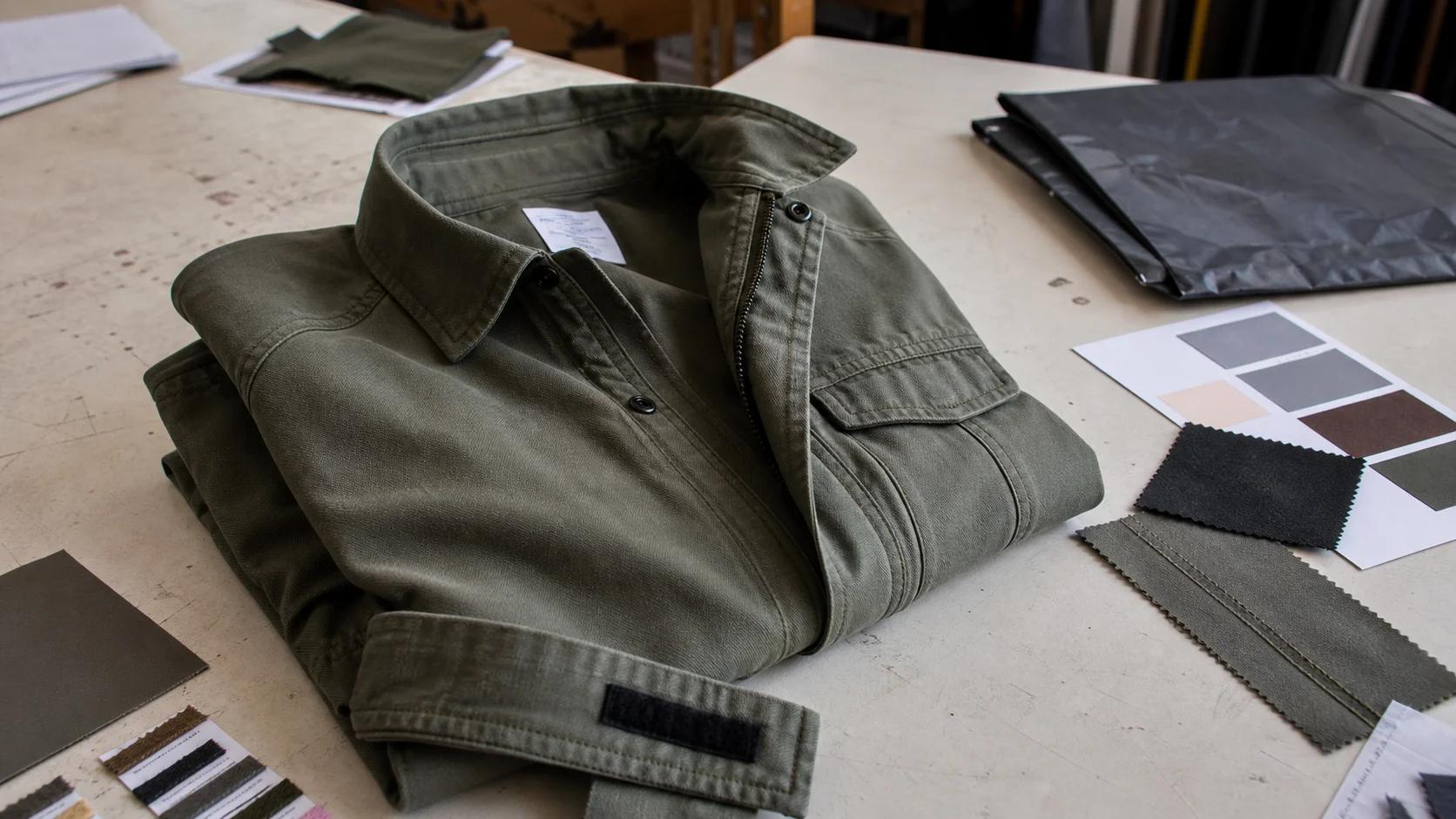
Practical breakdown of security contractors organic cotton work jacket wash test review, covering MOQ, cost, timeline, quality checks, and supplier tradeoffs.
Security contractors need workwear that does more than look professional at the start of a shift. A jacket has to tolerate repeated laundering, preserve a clean appearance, hold its shape, and stay functional when crews move between indoor and outdoor duties. That is where a security contractors organic cotton work jacket wash test review becomes useful. It is not enough for a jacket to feel sturdy on day one. The real question is whether it still performs after a practical wash cycle, several times over, with the sort of handling that uniform programs and workwear buyers actually face.
This review looks at what matters in a wash test for an organic cotton work jacket used by security teams. The focus is on fabric behavior, shrinkage risk, seam recovery, color retention, trim performance, and the sourcing decisions that affect long-term wear. Organic cotton is often chosen for sustainability reasons, but buyers still need disciplined judgment. A greener fiber does not automatically mean a better uniform unless the construction and finishing hold up under laundering.
Security Contractors Organic Cotton Work Jacket Wash Test - Fabrikn production reference
Security contractors often wear the same jacket through long shifts, changing weather, vehicle use, and frequent contact with surfaces. That creates a very different test from casual outerwear. A jacket that looks fine on a hanger may shrink, twist, fade, or lose structure after laundering. For uniform buyers, the wash test is a procurement filter. It separates garments that are merely comfortable from garments that are dependable in bulk use.
Organic cotton raises expectations because buyers often associate it with premium quality and lower environmental impact. That assumption is only partly useful. Organic cotton can be excellent, but the final result depends on yarn quality, fabric weight, finishing method, stitching, and how the garment is sewn. A lower-grade fabric can still be organic. It can also still pill, fade, and distort after a few washes. The sourcing decision should be based on performance evidence, not just fiber claims.
For security uniforms, laundering frequency is rarely occasional. Jackets may be washed weekly or more often if the role is demanding. That means a realistic review should include repeated cycles, not a single clean look after one wash. Buyers should expect a uniform jacket to keep its dimensions reasonably stable, maintain pocket integrity, and avoid a sloppy appearance that can undermine a professional image.
A security contractor jacket is usually judged on a few practical details. The fabric must feel substantial enough to present well, but not so heavy that it becomes tiring in mild weather. The cut should allow movement without excess bulk. Pockets need to be secure and placed where they are useful. Closures should survive repeated opening and washing without weakening.
Buyers should also examine the stitching method. Reinforced seams and bartacks are not decorative details. They matter when the garment is washed often and used under load. A jacket used by security staff can experience stress at the shoulder, elbow, pocket, and hem areas. Weak stitch density or poor thread selection will often show up after laundering through seam puckering or minor opening at stress points.
If the jacket includes lining, interlining, or reinforcement patches, those layers should be tested too. Differential shrinkage between shell fabric and inner components can distort the garment and create twisting at the front panel or sleeve. This is one of the most common reasons a jacket loses its shape after washing.
A useful wash test review should be simple, repeatable, and honest about tradeoffs. The goal is not to produce a perfect score. The goal is to understand what a buyer can reasonably expect after real use. A sensible test usually includes several wash and dry cycles, preferably with the laundering method that the end user is likely to follow.
Review Factor What to Check Buyer Concern Shrinkage Measure before and after multiple washes Fit consistency across uniform sizes Colorfastness Check visible fading and shade change Professional appearance over time Seam recovery Inspect puckering, twisting, and seam opening Garment shape and construction quality Surface wear Look for pilling, abrasion, and fuzzing Uniform neatness and perceived value Trim performance Test zipper action, button strength, and labels Function after repeated launderingA jacket that passes one wash can still fail later. Organic cotton can behave well if the yarn is compact and the fabric is properly finished, but untreated or lightly finished cotton can show more shrinkage than buyers expect. Pre-shrunk fabric helps, yet the term is not a guarantee. Buyers should ask for allowable shrinkage limits in writing. In many workwear programs, a total shrinkage range near 3% to 5% for key measurements is a practical benchmark, though tolerance depends on garment design and customer expectations.
Color tests matter just as much. Security uniforms are often dark, and dark shades reveal uneven fading quickly. If the jacket is dyed poorly or the wash chemistry is not stable, the body, collar, elbows, and pocket areas may fade at different rates. That creates a worn-out look long before the garment is structurally unusable. For uniforms, visual consistency is part of performance.
Another point worth noting is recovery after drying. Some garments look acceptable after line drying but lose shape after tumble drying. Buyers should decide in advance which care method reflects actual use. If end users will tumble dry on standard settings, the supplier should test that route. If the program requires hang drying, the jacket should still come back to spec without excessive wrinkling or stiffness.
For an organic cotton work jacket, fabric spec is not a side note. It is the foundation of the wash test. Buyers often ask for organic cotton and stop there. That is too broad. The better conversation is about yarn count, weave or knit structure, fabric weight, and finishing. A twill shell may perform differently from canvas or brushed cotton. Each choice affects hand feel, durability, and wash behavior.
A practical spec sheet should cover the following points:
Organic cotton buyers should also ask whether the fabric has been tested for dimensional stability after repeated wash cycles. A jacket can meet fiber requirements and still fail the buyer’s practical standard if the fabric twists too much. The more elaborate the garment design, the more important this becomes. Pockets, plackets, and cuffs can amplify distortion.
Trim selection deserves careful attention. Decorative buttons are a weak point in workwear if they are not selected for industrial laundering. Zippers should not snag after repeated washing, and zipper tape should not shrink out of alignment. Printed or heat-applied labels can deteriorate faster than woven labels. That may seem like a minor issue, but a label that curls or disappears makes the garment look lower grade and complicates size identification in shared uniform systems.
For security contractors who need a clean, uniform appearance, reflective accents or badge placement areas may also be part of the design. If those components are included, they need separate wash validation. Reflective tape can crack, peel, or lose brightness if the adhesive or stitching is not suitable for repeated laundering.
Buyer judgment is especially important when ordering from a supplier for the first time. MOQ expectations for custom work jackets can vary widely, but a common starting point is around 300 to 500 pieces per style and color for many OEM programs. Smaller quantities may be possible, though unit cost usually rises and fabric sourcing flexibility can narrow. If the jacket requires special fabric finishing, organic certification paperwork, or custom trim sets, lead time and MOQ can both increase.
Sample approval should be treated as a stage, not a formality. A proper process usually includes a proto sample, a fit sample, and a pre-production sample. If wash performance matters, a lab dip and fabric swatch approval should happen before bulk cutting. Buyers should ask for wash test results on the exact fabric lot or the closest approved lot. A sample made from one fabric batch is not enough proof that bulk production will match.
Lead time depends on several variables: fabric availability, certification verification, trim sourcing, sample revisions, production load, and inspection scheduling. For a custom organic cotton jacket, buyers often see a realistic timeline of 30 to 60 days for sampling and another 45 to 75 days for bulk production once approvals are complete. That range shifts when the order includes special dyeing, branded trims, or seasonal congestion.
Inspection risk should not be overlooked. Even a solid wash test result can be undermined by inconsistent bulk stitching or wrong trim substitution. The most common issues are shade variation, mislabeled sizes, seam inconsistency, and incomplete shrink control. Buyers should request inline inspection, final random inspection, and a clear AQL standard before shipment. If a program is sensitive to appearance, a post-wash garment measurement check on finished units is worth the extra time.
For buyers comparing suppliers, the right question is not only whether the jacket is organic cotton. It is whether the supplier can prove control over the whole chain: fabric source, finishing, workmanship, wash stability, and packing accuracy. If those pieces are not documented, the sustainability claim is weaker than it sounds.
If you need to review manufacturing capability or discuss a custom workwear program, see the information on services or learn more about the company background on about us. For direct project inquiries, use the contact us page.
The wash test is where hidden weaknesses appear. Buyers should be alert to a few common failure modes. First is shrinkage that is uneven across panels. The body may shorten more than the sleeves, or one side may twist more than the other. That ruins fit consistency and can make size grading less reliable in future orders.
Second is surface degradation. Organic cotton fabrics can soften nicely, but if the yarn is not compact enough, the jacket may pill or fuzz after repeated abrasion in the wash. This matters most on elbows, pocket edges, and contact points where the jacket rubs against belts or seat backs.
Third is color loss. Dark work jackets are often expected to stay dark. A jacket that fades rapidly can still be technically wearable, but it no longer supports a uniform standard. In security work, appearance and authority are part of the garment’s function.
Fourth is trim failure. A button that loosens or a zipper that shifts after washing can create a maintenance headache. Buyers often underestimate the cost of such defects because they appear small in sampling but become expensive in bulk. One broken component across a large issuance can create returns, rework, or replacement costs that erase any savings from lower fabric price.
Finally, there is comfort drift. Some jackets become stiffer after washing if finishing chemistry is not well balanced. Others soften too much and lose their professional structure. Either outcome can be a problem. The best result is a jacket that becomes more comfortable without collapsing in form.
The strongest procurement decision is usually the one that balances sustainability, durability, and controlled cost. Organic cotton is a sensible choice for a security contractor jacket when the buyer wants a natural fiber story and a professional garment that can be worn regularly. That choice becomes risky only when it is treated as a branding exercise instead of a performance specification.
Buyers should compare candidates on wash behavior, not just on label claims. A slightly heavier fabric with tighter construction may outperform a lighter, softer option even if the lighter version feels more premium in a showroom. Uniform buyers should also be realistic about care standards. If a jacket is intended for frequent industrial laundering, the supplier must know that in advance. If the garment will be home-washed, the buyer should confirm that the specification still holds up in that setting.
There is also a tradeoff between softness and structure. Organic cotton workwear often improves in hand feel after washing, which is attractive to end users. That same softness can reduce crispness if the jacket is over-finished or under-built. Buyers should choose the balance that fits the role. Security staff generally benefit from a jacket that looks neat, resists sagging, and remains easy to move in.
In short, the best jacket is not the one with the longest sustainability story. It is the one that survives repeated wash cycles, keeps its shape, and continues to look like part of a professional uniform system.
In sustainable fashion, workwear often gets less attention than casual clothing, yet it can have a strong impact because it is worn hard and replaced repeatedly if quality is weak. A well-made organic cotton jacket extends service life, which supports sustainability in a practical way. Fewer replacements usually mean less material waste, less shipping, and less procurement disruption.
That said, sustainability should be measured carefully. Organic fiber alone does not guarantee a responsible garment. The jacket should be durable enough to justify its material footprint, and the production process should be transparent enough to support confidence in sourcing. Good procurement decisions often come from asking difficult questions early rather than relying on marketing language later.
A sustainable work jacket earns its place by lasting longer, washing better, and staying presentable under routine use.
For security contractors, that principle is especially relevant. The uniform must communicate order and reliability. If a jacket looks tired after a few washes, the sustainability claim becomes less persuasive because the replacement cycle shortens. A durable organic cotton jacket is a stronger sustainability choice than a fragile one with the same fiber story.
Get a free quote from Fabrikn — your trusted B2B clothing manufacturer with 10+ years of experience. MOQ as low as 200 pieces.
Get a Free Quote →For most uniform programs, buyers should expect the jacket to hold up through many laundering cycles without major shrinkage, distortion, or trim failure. The exact target depends on care method and usage, but repeated wash stability is non-negotiable.
It depends on the garment spec, but many buyers look for roughly 3% to 5% control on key dimensions after washing. A supplier should state the acceptable tolerance before production starts.
It can be, especially for sustainability goals, but only if the fabric weight, finishing, and construction are strong enough for workwear use. Organic status alone does not guarantee durability.
Fit, fabric, color, trims, labeling, and wash performance should all be approved. For custom orders, a pre-production sample is the safest checkpoint before cutting bulk fabric.
Uneven shrinkage and color fading are among the most common problems. Trim failure and seam distortion follow closely behind, especially when the jacket is washed often.
Sometimes, but MOQ requirements often start around 300 to 500 pieces for custom workwear programs. Smaller runs may be possible at higher cost, depending on fabric and trim availability.
If you are evaluating a supplier for an organic cotton work jacket program, the sensible approach is to ask for wash data, sample approval milestones, and clear production tolerances before placing an order. That is the difference between a garment that simply qualifies as sustainable and one that performs as a reliable uniform.