
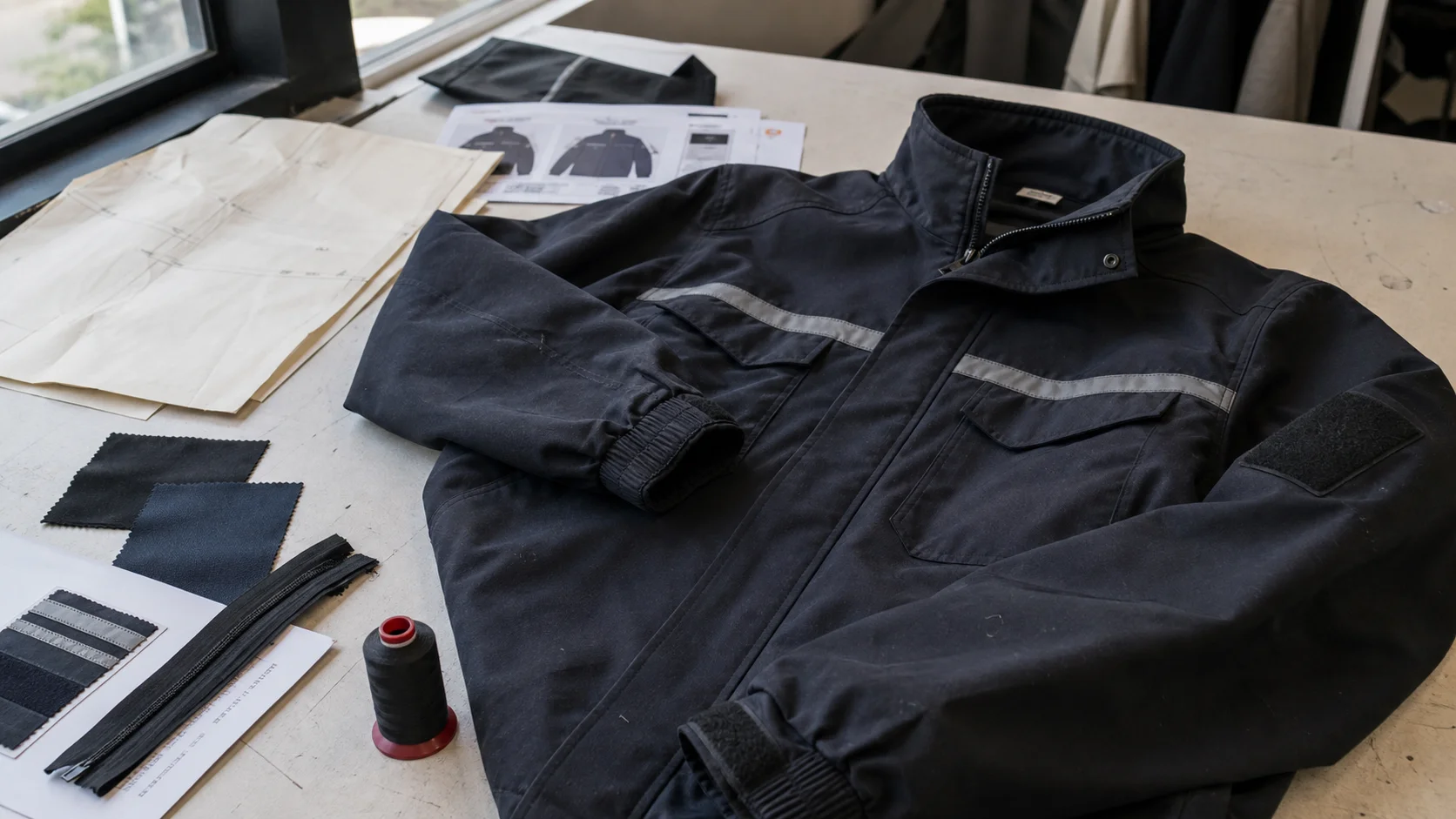
A product-focused outline for evaluating security jacket reorder risk, with practical checks on fit consistency, decoration durability, and production...
Security Jacket Reorder Risk Review for Contractors - Outerwear & Jackets manufacturing guide
Security contractors rarely reorder jackets because the old stock “looks tired.” They reorder because guards need consistent uniform presentation, night-shift visibility, weather protection, pocket functionality, and client-approved branding across multiple sites. A jacket reorder seems routine, but it carries real risk when the original fabric is unavailable, reflective tape standards change, trim suppliers switch, or sizes are repeated without checking field feedback.
This security contractors security jacket reorder risk review is written for buyers, operations managers, uniform coordinators, and procurement teams placing repeat orders for outerwear. The goal is simple: reduce surprises before the purchase order is issued. Reorders should protect continuity, but they should not blindly repeat earlier mistakes.
A reorder is often treated as low effort because the style has already been produced. That assumption is where many problems begin. The previous tech pack may be incomplete, the factory may have changed fabric lots, or the jacket that worked for one contract may not suit a new site with different weather exposure and shift patterns.
Security outerwear has a narrow tolerance for visible inconsistency. If one group of guards wears deep navy jackets and the new batch arrives slightly brighter, the difference is obvious at a lobby desk, airport perimeter, warehouse gate, or event entrance. If reflective tape placement shifts, supervisors notice. If zipper quality drops, field complaints start within weeks.
The buying judgment is straightforward: treat every reorder as a controlled production event, not an administrative repeat. The order may use the same style number, but the risk profile changes when quantities, fabrics, locations, climate, branding, or staffing patterns change.
A good security jacket reorder protects uniform continuity while correcting field problems from the last issue cycle. Repeating the old specification without review is convenient, but it can be expensive.
Before confirming a reorder, review the jacket from four angles: commercial, technical, operational, and inspection. Contractors often focus on price and delivery date, but most reorder failures come from overlooked details in material substitution, size ratios, trim performance, and logo execution.
Risk Area What to Check Purchasing Judgment Fabric Shell weight, color, waterproof rating, breathability, lining, insulation Approve a current fabric swatch even for a repeat order. Trims Zippers, snaps, pullers, Velcro, elastic, drawcords, reflective tape Do not accept unspecified “similar quality” substitutions. Branding Embroidery, woven patch, heat transfer, badge loop, nameplate position Confirm logo size and placement against the client’s uniform rules. Sizing Size curve, sleeve length, shoulder width, layering allowance Use field feedback rather than copying the last size breakdown. Compliance High-visibility requirements, care labels, fiber content, country labeling Ask for documented standards, not verbal assurances. Inspection AQL level, measurement tolerance, shade band, seam strength, packaging Book inspection before final payment or shipment release.Contractors placing multi-site jacket reorders should also confirm whether the jacket remains suitable for each contract. A reception security team may prioritize polished appearance and discreet branding. A mobile patrol team may need waterproofing, thermal insulation, two-way radio access, and stronger abrasion resistance.
Fabric is the largest reorder risk because it affects appearance, comfort, durability, and delivery timing. Many security jackets use polyester or nylon shell fabrics, sometimes with polyurethane coating, TPU membrane, fleece bonding, quilted lining, or removable liners. The same product description can hide very different performance levels.
For a standard security jacket, buyers commonly review shell fabric in the range of 120gsm to 240gsm for lightweight and midweight styles. Heavier winter parkas may use thicker woven shells, quilted insulation, or laminated fabrics. Waterproof ratings may range from basic water-resistant coatings to 3,000mm, 5,000mm, or higher hydrostatic head specifications, depending on the garment and budget.
The tradeoff is cost versus service environment. A low-cost water-resistant jacket may be acceptable for indoor posts and short outdoor exposure. It is a poor choice for gatehouse, patrol, parking, event, or construction access control work in wet climates. A higher-performance shell costs more, but it reduces complaints and replacement pressure.
Color should be treated as a technical specification. Navy, black, charcoal, and high-visibility yellow vary significantly between mills. A contractor reordering jackets for an existing workforce should ask for a shade band or bulk fabric cutting before production. This is especially important when old and new jackets will be worn together.
Fabric performance claims also need caution. “Waterproof” is often used loosely in commercial conversation. A jacket with a coated shell but unsealed seams may resist light rain but leak in sustained weather. If the contract requires actual rain protection, seam taping, storm flaps, waterproof zippers, and hood design all matter.
Trims create many reorder failures because suppliers change components quietly. A zipper may look similar but have weaker teeth. A snap may be a different finish. Hook-and-loop may lose grip faster. Reflective tape may vary in brightness or wash durability. These details are small on a purchase order and large in field use.
Security jackets often carry more gear than ordinary outerwear. Guards may use radios, keys, notebooks, gloves, ID cards, mobile devices, and site documents. Pocket construction and closure strength should be checked carefully. If a previous jacket had pocket tearing, broken zipper pullers, or weak badge tabs, the reorder should correct those points rather than repeat them.
The purchasing decision should be practical. If the jacket is issued to low-turnover supervisors, better trims may justify the added cost. If the jacket is issued to short-term event personnel, simpler trims and lower unit cost may be more realistic. The wrong approach is paying for visible styling while under-specifying zippers and pocket reinforcement.
Security contractors depend on uniform identity. Jackets must show authority without looking inconsistent or improvised. Branding can include chest embroidery, back print, sleeve patches, reflective logos, removable badges, woven labels, or heat transfers. Each method has advantages and risks.
Embroidery is durable and professional, but it can puncture waterproof fabric unless properly sealed or placed away from critical rain zones. Heat transfers are clean and lightweight, but poor adhesion or low-quality film may crack after washing. Woven patches give a traditional uniform look, but edge stitching must be neat and consistent.
For contractors handling multiple client accounts, removable branding can be useful. A jacket with a badge holder, Velcro patch area, or interchangeable ID panel may support different sites. The tradeoff is that removable components can be lost, misapplied, or appear less polished than permanent branding.
High-visibility details require a careful review. Some security teams need reflective elements for visibility, while others need certified high-visibility garments meeting specific standards. A jacket with reflective piping is not the same as a compliant high-visibility jacket. If a contract requires a standard such as ANSI/ISEA 107, EN ISO 20471, or another regional requirement, the supplier should provide documentation for the materials and garment configuration.
Care labels, fiber labels, and country-of-origin labels should not be left until the end. Contractors importing jackets or supplying them to regulated clients should confirm labeling requirements early. For broader sourcing support, buyers can review manufacturing service options at fabrikn.com/services/.
Security jacket reorders often fail because the buyer repeats the old size ratio without checking actual issue data. A purchase order may show 20% medium, 35% large, 30% XL, and 15% XXL because that was the first order. The field may tell a different story: large was too tight over uniform shirts, sleeves were long on smaller guards, and XXL ran out first.
Fit should account for layering. Security staff may wear shirts, sweaters, softshells, body armor, radio harnesses, or high-visibility vests underneath. A slim retail fit can look sharp on a sample but fail during active work. A generous fit improves mobility but may look bulky at reception desks.
The safest reorder approach is to collect size feedback from supervisors before production. Ask which sizes ran short, which sizes were returned, and whether guards complained about movement or warmth. If the contractor has high staff turnover, build in extra stock for common sizes. If the jacket is used by a stable team, order closer to actual measured demand.
Grading should also be checked. A sample in size large may pass, while the 3XL has a short sleeve or the small has an oversized collar. Extended sizes should not be treated as automatic scale-ups. They need measurement tolerances and, where practical, size set review.
Typical minimum order quantities vary by jacket complexity, fabric availability, branding method, and supplier model. For basic stock-body jackets with custom logo application, MOQs may start around 50 to 100 pieces per style or color. For custom-cut jackets using existing fabric, 300 to 500 pieces is common. For fully custom fabric, special colors, private-label trims, or complex outerwear, MOQs may reach 800 to 1,500 pieces or more.
These ranges are typical, not guaranteed. A supplier may accept lower quantities at a higher unit price if fabric is available. A mill may require higher volume for a custom color. Reflective tape, branded zippers, woven labels, and special lining can each create separate minimums.
Reorder Type Typical MOQ Range Best Use Case Main Risk Stock jacket with logo 50-100 pieces Small teams, urgent replacement stock Limited control over fabric, fit, and trim consistency Custom production using available fabric 300-500 pieces Contractor-wide uniform programs Fabric may not match the previous batch exactly Custom color or laminated fabric 800-1,500+ pieces Large programs needing brand consistency Higher cash commitment and longer lead time Multi-site size replenishment Varies by supplier Ongoing uniform replacement Small size splits can raise cost or delay productionOrder planning should include a buffer, but not an uncontrolled surplus. For active contracts, a 5% to 10% overage in key sizes may be sensible. For uncertain staffing or seasonal projects, holding too much branded stock can become a write-off if the client changes logo rules or the contract ends.
Contractors should also separate immediate needs from annual replenishment. If guards need jackets next month, a stock-body solution may be better than a perfect custom program that arrives late. If the contractor is planning a long-term uniform standard, custom development may reduce problems over time.
Reorder sampling is not always as extensive as first development, but it should not be skipped. At minimum, contractors should approve current fabric, trims, logo execution, and one fit sample before bulk production. If there were complaints in the previous batch, sampling must address those issues directly.
A pre-production sample should represent real production materials. If the supplier sends a sample using substitute fabric, temporary trims, or approximate branding, it is useful for shape review but not for final approval. Buyers should label approvals clearly: fit approval, fabric approval, trim approval, logo approval, or full production approval.
The practical tradeoff is time. Sampling adds days or weeks, especially when fabric or trims must be sourced. Skipping sampling may save time on paper but can create a full production problem that costs far more. For urgent security jacket reorders, buyers can approve a limited set of critical items first, but the risk should be documented.
If the contractor needs help translating field requirements into a production-ready specification, contact options are available at fabrikn.com/contact-us/.
Lead time depends on more than sewing capacity. Fabric availability, dyeing, lamination, reflective tape sourcing, branded trim production, sample approval speed, payment terms, inspection booking, and shipping mode all affect delivery.
Typical lead times for stock-body jacket logo orders may be 2 to 4 weeks after artwork approval, assuming inventory is available. Custom jacket production often runs 6 to 10 weeks after sample and material approval. More complex outerwear, custom fabric, certified high-visibility materials, or large size spreads may require 10 to 14 weeks or more. Ocean freight adds further time, while air freight raises cost sharply.
The best purchasing judgment is to build a reorder calendar. Security jackets are often needed before winter, rainy season, event season, or new contract launches. Ordering when weather has already changed increases the chance of accepting weaker specifications just to get stock quickly.
Contractors should also plan for phased delivery if the order is large. A first shipment can cover critical sites, while later shipments replenish less urgent locations. This only works if shade consistency, label control, and packaging identification are managed carefully.
Inspection is especially important for security jackets because defects often become visible in public-facing roles. A crooked logo, mismatched panels, weak pocket stitching, or poor zipper operation reflects badly on the contractor. The inspection plan should be agreed before production, not negotiated after goods are packed.
Common inspection methods use AQL sampling, though the exact level depends on the buyer’s tolerance and order value. For security outerwear, major defects should include broken zippers, incorrect logo placement, poor reflective tape attachment, wrong fabric, incorrect labeling, open seams, skipped stitches, serious shade variation, and measurements outside tolerance.
Packaging should not be ignored. Security contractors often distribute jackets by site, size, employee group, or client account. If cartons are mixed, relabeling and sorting can waste time before deployment. Carton markings should identify style, color, size, quantity, and purchase order. Individual polybags may need barcodes, employee names, or site codes for large programs.
Buyers should also ask how defects will be handled. Minor thread trimming is different from waterproof seam failure. The agreement should state whether the supplier will rework, replace, discount, or reproduce defective goods. Clear defect classification prevents disputes when delivery pressure is high.
A useful reorder conversation is specific. General questions such as “Is it the same as last time?” do not provide enough control. Ask for documents, swatches, photos, and written confirmations.
Supplier capability matters. A company that is comfortable with fashion jackets may not understand security uniform requirements, radio pockets, reflective compliance, or multi-site replenishment. A low unit price is not useful if the reorder creates sorting problems, fit complaints, or client rejection.
Buyers evaluating a manufacturing partner should look for clear communication, practical MOQ options, sample discipline, and transparent risk reporting. Background information about Fabrikn is available at fabrikn.com/about-us/.
A security jacket reorder should be faster than a first production run, but it should not be casual. The safest approach is to preserve what worked, correct what failed, and verify every material that affects appearance, comfort, compliance, and durability.
For small urgent needs, a stock jacket with approved branding may be the right decision. For larger contractor programs, custom production gives better control over fabric, fit, pocket layout, reflective placement, and brand consistency. The tradeoff is MOQ, lead time, and approval workload.
The biggest mistake is treating the reorder as a copy-and-paste purchase. Security contractors operate in visible, regulated, and client-sensitive environments. A jacket reorder is not just outerwear procurement. It is uniform continuity, workforce readiness, and contract presentation in one purchase.
Get a free quote from Fabrikn — your trusted B2B clothing manufacturer with 10+ years of experience. MOQ as low as 200 pieces.
Get a Free Quote →The biggest risk is assuming the new batch will match the previous batch without checking current fabric, trims, color, branding, and sizing. Fabric substitution and shade variation are especially common problems.
Stock jackets with logo application may start around 50 to 100 pieces. Custom production often starts around 300 to 500 pieces, while custom fabrics, special colors, or complex outerwear can require 800 to 1,500 pieces or more.
Yes. At minimum, approve current fabric, trim card, logo strike-off, and a pre-production sample. A repeat order can still fail if materials or suppliers have changed.
Stock-body logo orders may take 2 to 4 weeks after approval. Custom security jackets often take 6 to 10 weeks, and complex outerwear or certified high-visibility garments may take 10 to 14 weeks or more.
Include fiber content, fabric weight, waterproof or water-resistant rating, coating or membrane type, lining, insulation weight, color standard, and care requirements. Vague descriptions create avoidable risk.
Review field feedback, return records, and size shortages before repeating the old size ratio. Check layering allowance, sleeve length, shoulder mobility, and extended-size grading.
Not always. Reflective trim improves visibility, but certified high-visibility compliance depends on the garment design, material area, tape placement, and applicable regional standard.
Inspect measurements, color, logo placement, zipper function, seam quality, reflective tape, labeling, packaging, and carton markings. Security jackets should be checked against an approved sample and written specification.
Stock jackets are faster and better for urgent or smaller needs. Custom production gives better control over fit, fabric, trims, branding, and site-specific features, but it requires higher MOQ and longer lead time.
Contractors often distribute jackets across sites, shifts, sizes, and client accounts. Clear carton labels, size sorting, and site-level packing reduce deployment delays and prevent stock confusion.