
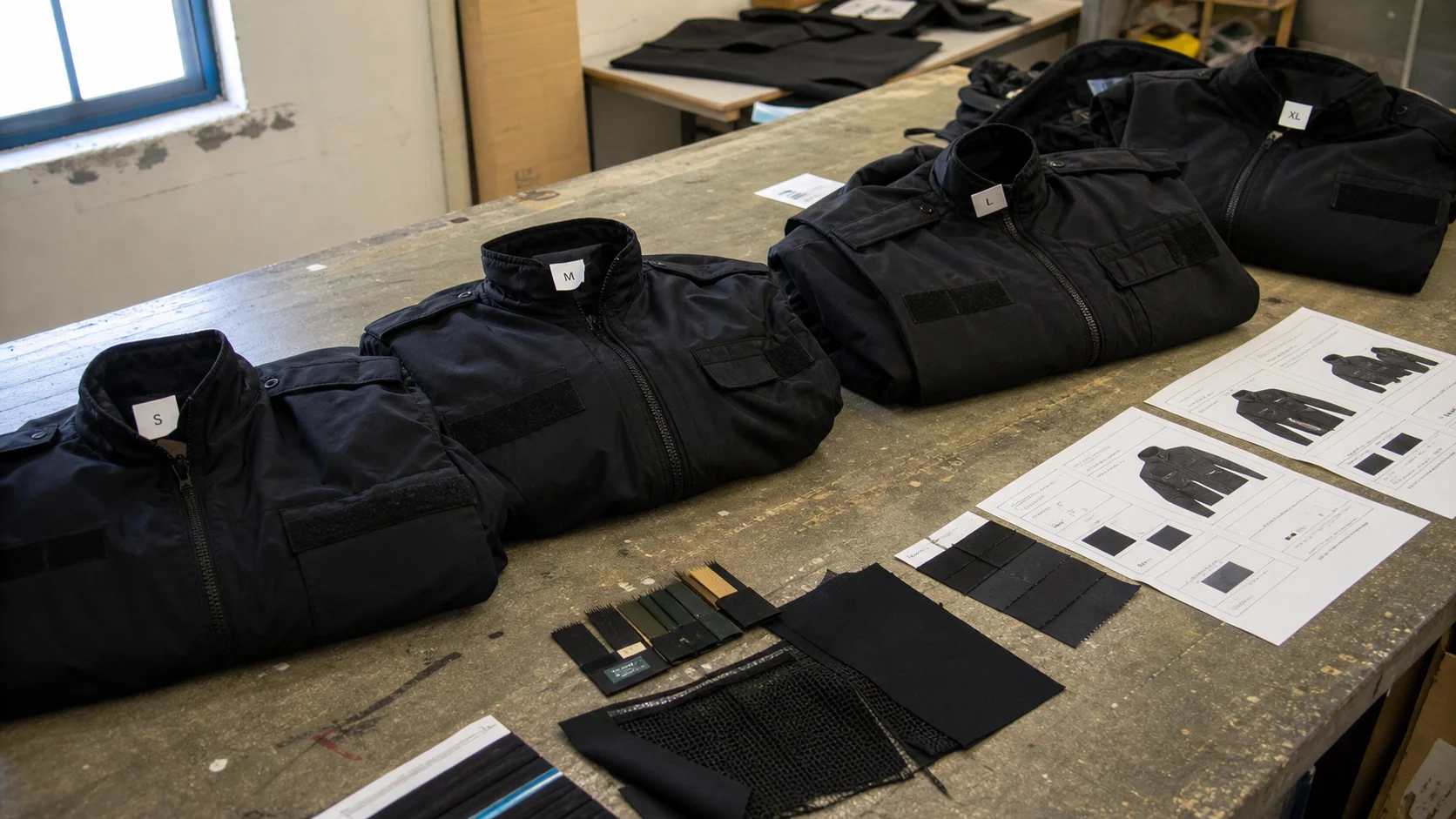
A buyer-focused outline for reviewing security jacket supplier size grading for cleaning crews, including fit blocks, measurement tolerances, layering,...
Buying security jackets for cleaning crews is not just a fabric decision. Size grading affects comfort, mobility, layered wear, appearance on site, and the amount of rework a supplier creates later. A jacket that looks fine on a size medium sample can still fail a real uniform program if the grading spreads are too tight at the chest, sleeves, or hem. For buyers, the review process should focus on measurement logic, consistency across sizes, and how the jacket behaves when worn over a shirt or light fleece during long shifts.
This review is written for sourcing teams evaluating a security jacket supplier size grading review for cleaning crews. The standard is practical: predictable fit, low complaint rates, manageable SKU counts, and a spec that can be repeated in bulk production. If you are still shaping your program, it can help to compare your garment requirements with the supplier capabilities described on Fabrikn services, check the company background on Fabrikn about us, or move a line item into quotation through Fabrikn contact us.
Security Jacket Size Grading Review for Buyers - Outerwear & Jackets manufacturing guide
Cleaning crews usually need outerwear that works in motion. The jacket must fit over base layers, allow repeated arm reach, and stay neat enough for front-of-house or site-compliance use. A poor grading spec can cause several predictable problems: the jacket feels tight in the shoulders, sleeve length becomes inconsistent across sizes, zipper closures distort, and hems ride up when the wearer bends or lifts equipment.
Security-style jackets for cleaning staff also sit in a difficult middle zone. They often need a professional appearance, visible branding space, and practical warmth or weather resistance. That combination makes grading more sensitive than a basic promotional jacket. If the body width grows too fast between sizes, smaller wearers look oversized and larger wearers still feel restricted in movement. If sleeve grading is too conservative, wearers complain first, and uniform managers usually pay for that later through exchanges and slow adoption.
For buyers, the real question is not whether the supplier can cut S to 3XL. The question is whether the supplier can keep the size block coherent across the full range. One size may fit a fit model well while the next size up breaks the proportional balance. That is where many uniform programs lose time and money.
Good grading starts with the base size, usually M or L, and applies measured increments to key points. The increments should reflect garment type and intended use. A security jacket worn by cleaning crews does not need fashion-level tailoring. It does need enough allowance for layered wear, repetitive shoulder movement, and practical site use.
The best grading systems do three things well:
In buyer terms, good grading is visible in the sample set. The small size should not look like a different style. The 2XL should not be bloated in the body while the sleeve cap remains unchanged. Each size should appear to belong to the same family of pattern blocks.
For cleaning crews, comfort often outranks a slim visual profile. A slightly easier fit can be acceptable if it improves motion and reduces uniform complaints. Tight grading, by contrast, is usually a false economy. It saves a little fabric but increases replacement requests and damages wear acceptance.
Most security jacket programs for cleaning crews run from S to 3XL, with some buyers extending to 4XL or adding XS for female staff or smaller body types. The exact range should reflect workforce demographics, seasonal layering, and whether the jacket is used indoors, outdoors, or across both settings.
Grade rules vary by supplier, but buyers should expect a measured increment at the chest, waist, hip, sleeve, and length. The body width generally increases more than the shoulder width. Sleeve length often increases gradually, not aggressively. Hem width should support movement without creating a boxy silhouette.
The following example is not a universal standard. It is a practical reference for review discussions.
Size Chest Circumference Body Length Sleeve Length Hem Circumference S 108 cm 68 cm 61 cm 104 cm M 112 cm 70 cm 62 cm 108 cm L 116 cm 72 cm 63 cm 112 cm XL 120 cm 74 cm 64 cm 116 cm 2XL 126 cm 76 cm 65 cm 122 cm 3XL 132 cm 78 cm 66 cm 128 cmWhat matters in review is not the exact table above. What matters is whether the supplier can explain the logic behind the increments. If the chest jumps by 8 cm while the sleeve only moves 0.5 cm, the grading may be unbalanced. If the body length stays flat across several sizes, taller workers may reject the jacket even if the chest fits.
Buyers should also check whether the supplier grades according to relaxed garment measurements or finished garment measurements with ease built in. That distinction matters. A security jacket for cleaning crews normally needs enough ease for layered wear, but too much ease creates a sloppy fit and undermines the uniform look.
Size grading does not sit alone. Fabric choice changes how the garment fits in production and after wear. A woven shell with low stretch behaves differently from a softshell or bonded fleece. A brushed lining adds bulk. A quilted layer changes armhole pressure. Even pocket placement can affect perceived fit if the jacket pulls across the chest.
Buyers should review these construction factors closely:
For cleaning crews, the jacket often sees repeated laundering. That means shrinkage and distortion should be planned into the size review. A fabric that shrinks 3 to 5 percent after wash may force the supplier to cut larger than the paper spec suggests. Buyers should ask whether measurement tolerances are stated before or after wash testing. If the answer is unclear, the grading review is incomplete.
Collars, cuffs, and hems also matter. Rib cuffs can help hold sleeves in place, but they must be graded carefully or smaller sizes will look compressed. Elastic hems can improve fit range, yet they may trap heat and reduce the professional line of the jacket. A buyer should judge these tradeoffs against the work setting rather than assuming one construction is universally better.
A supplier size chart is only useful when it matches the actual factory pattern and the production tolerance. Buyers should ask for the chart in finished garment measurements, a full grade spec, and the tolerance range for each critical point. A single chart without tolerances is not enough for approval.
Start with the wearer's use case. Cleaning crews may need a jacket over a polo, uniform shirt, or light fleece. If winter use is expected, build in enough ease at the chest and upper back. If the jacket will be used in warmer indoor environments, extra bulk becomes a liability. That is why the same jacket can be too small in one site and too loose in another.
Next, compare the size chart to real body dimensions and intended ease. Buyers do not need fashion-grade fitting logic, but they do need a clear target. If the supplier's medium chest is 112 cm and the intended wearer chest is 104 cm, the ease is 8 cm before underlayers. That may be reasonable. If the garment also has a stiff shell and a narrow armhole, the same measurement may still wear too tight. The chart alone does not tell the full story.
The most useful review questions are simple:
If the supplier cannot answer these clearly, expect problems later. Ambiguity at the review stage usually becomes quality disputes after bulk production.
Size grading review should not end with a single pre-production sample. At minimum, buyers should ask for a size set or a controlled fit set across key sizes, usually S, M, L, XL, and 2XL. For larger programs, 3XL or 4XL should also be tested if those sizes will be ordered in quantity.
A cautious sample approval process usually includes these steps:
Fit testing should be done with actual wear conditions in mind. A security jacket for cleaning crews is not a runway garment. It needs to allow reaching, bending, lifting, and repeated arm extension. When assessing fit, buyers should check shoulder pull, sleeve ride-up, back length when seated or bent, and zipper alignment across the chest.
A sample can pass a static measurement check and still fail in use if the grading does not support arm mobility or layered wear. Measure the garment, then test it in motion.
Sample approval should also include label placement and size marking. Confusing size labels create distribution errors in uniform programs. If the supplier uses different size coding systems across markets, the buyer should insist on a single, clear standard before bulk order release.
Size grading decisions affect production economics. More sizes mean more cutting complexity, more label variations, and more inventory risk. Fewer sizes reduce complexity but can increase complaints from the edges of the size range. Buyers need to balance fit coverage with order efficiency.
Typical MOQ ranges for custom outerwear vary by supplier, fabric, and decoration method. In practice, some factories may accept low hundreds per style, while others prefer larger volume before they start a new jacket block. Special trims, custom zippers, reflective details, or waterproof seams can push the MOQ higher. Embroidery, heat transfer, and printed branding can also affect the minimum.
Lead time depends on the same factors. A simple lined jacket in a standard fabric may move faster than a jacket with bonded layers, multiple pockets, and custom accessories. Buyers should expect sampling, fit approval, fabric booking, trim sourcing, and bulk cutting to add time. A production schedule becomes fragile when any one input is late.
The main tradeoff is clear. A cleaner size system with fewer duplicated options is easier to manage, but it may not fit the full crew well. A broader size range improves coverage, though it increases warehouse complexity and raises the chance of unsold or excess stock in slower-moving sizes. For most cleaning crews, the best answer is a practical core range with enough extended sizes to avoid exclusion.
Size grading problems often appear during inspection, not during design. Common risks include panel mismatch, measurement drift, shrinkage after wash, and trim placement variations. A jacket that passed pre-production can still fail bulk if the cutting marker shifts or the factory changes fabric lot. Buyers should plan inspections around the measurements that matter most for wear.
High-risk points include:
Inspection should not focus only on average measurements. Outliers matter. If a size batch includes pieces near the low and high ends of tolerance, the crew may end up with inconsistent wear experiences. For uniform programs, inconsistency is a hidden cost because it creates distribution complaints even when the carton count matches the purchase order.
Buyers should also check whether the supplier is maintaining size labels correctly throughout the line. Mixed labels in outerwear orders happen more often than they should, particularly when multiple size runs or multiple colorways are cut together. That risk increases when the size block is not clearly documented.
A complete spec pack makes grading review easier and reduces interpretation disputes. It should show the base size, full graded size chart, construction details, artwork location, trim requirements, and tolerance table. The more precise the pack, the lower the chance that the supplier makes assumptions on your behalf.
Include these elements in the spec pack:
When the program involves multiple climate conditions, the spec pack should state whether the jacket is meant for indoor use, light weather protection, or cold-weather layering. That one line prevents a lot of confusion. A jacket designed for indoor cleaning teams should not be overbuilt with heavy insulation. A jacket intended for exterior rounds or night shifts needs a different grading strategy.
Size grading is also the place to decide whether unisex sizing is sufficient. In some cleaning crews it is acceptable. In others, a female-specific block or a shorter-length option reduces returns and improves adoption. The right decision depends on workforce mix, not on supplier convenience.
Some buyers begin with a stock jacket and try to adapt it through branding only. That can work if the base fit is close and the size distribution is straightforward. It usually fails when the crew has varied body types or when the jacket needs to serve as a visible uniform layer.
Custom grading costs more up front, but it gives the buyer control over the most complaint-sensitive points. Stock sizing is faster and often cheaper in the first order, though it may create hidden costs in exchanges, alterations, and leftover sizes. For cleaning crews, those hidden costs are real because fit complaints slow down uniform issuance and can affect staff compliance.
A practical sourcing rule is this: if the jacket is part of a formal uniform program, custom grading is usually worth the effort. If it is a short-run promotional order or a temporary seasonal issue, stock sizing may be acceptable as long as the fit risks are understood and documented.
Before approving production, buyers should confirm the following:
That checklist is basic, but it catches most preventable errors. The biggest mistake buyers make is approving the sample by eye and assuming the size curve will behave in bulk. Bulk production punishes assumptions. A careful review of grading is cheaper than a warehouse of unsellable jackets.
For security jacket programs serving cleaning crews, size grading is a commercial decision, not a pattern-room detail. The fit must support movement, layering, and uniform consistency across a real workforce. Good grading keeps the jacket wearable across sizes without distorting the style. Poor grading creates complaints, returns, and slow adoption, even when the materials and branding are acceptable.
Buyers should evaluate the supplier’s size chart, confirm the logic behind the grade rules, test samples in motion, and write tolerances into the spec pack. That process is straightforward, but it has to be done carefully. A clean fit strategy usually costs less than repeated corrections after bulk production starts.
Get a free quote from Fabrikn — your trusted B2B clothing manufacturer with 10+ years of experience. MOQ as low as 200 pieces.
Get a Free Quote →S to 3XL is a common practical range. Larger programs may need XS or 4XL depending on workforce mix. The best range is the one that covers actual wearers without forcing too much substitution between sizes.
Enough to fit over the intended base layer or light fleece without pulling at the chest or shoulders. The right amount depends on fabric bulk, climate, and whether the jacket is used indoors or outdoors. Overly tight ease is a common cause of rejection.
A single sample is not enough for a size grading review. Buyers should request at least a controlled size set, especially when the jacket will be ordered in multiple sizes. That is the only reliable way to check whether the grading curve stays consistent.
Common causes include inaccurate pattern grading, shrinkage not built into the spec, changes in seam allowance, inconsistent cutting, and trim bulk that alters the final fit. Weak communication between buyer and factory is often part of the problem.
No. Custom grading is better when the jacket is part of a permanent uniform program or when the workforce has mixed body types. Stock sizing can work for short-run or low-risk orders, provided the fit tradeoffs are accepted in advance.
Ask for the full size chart, grading increments, measurement tolerances, sample approval steps, fabric shrinkage assumptions, and MOQ. If the supplier cannot explain those clearly, the order carries avoidable risk.