
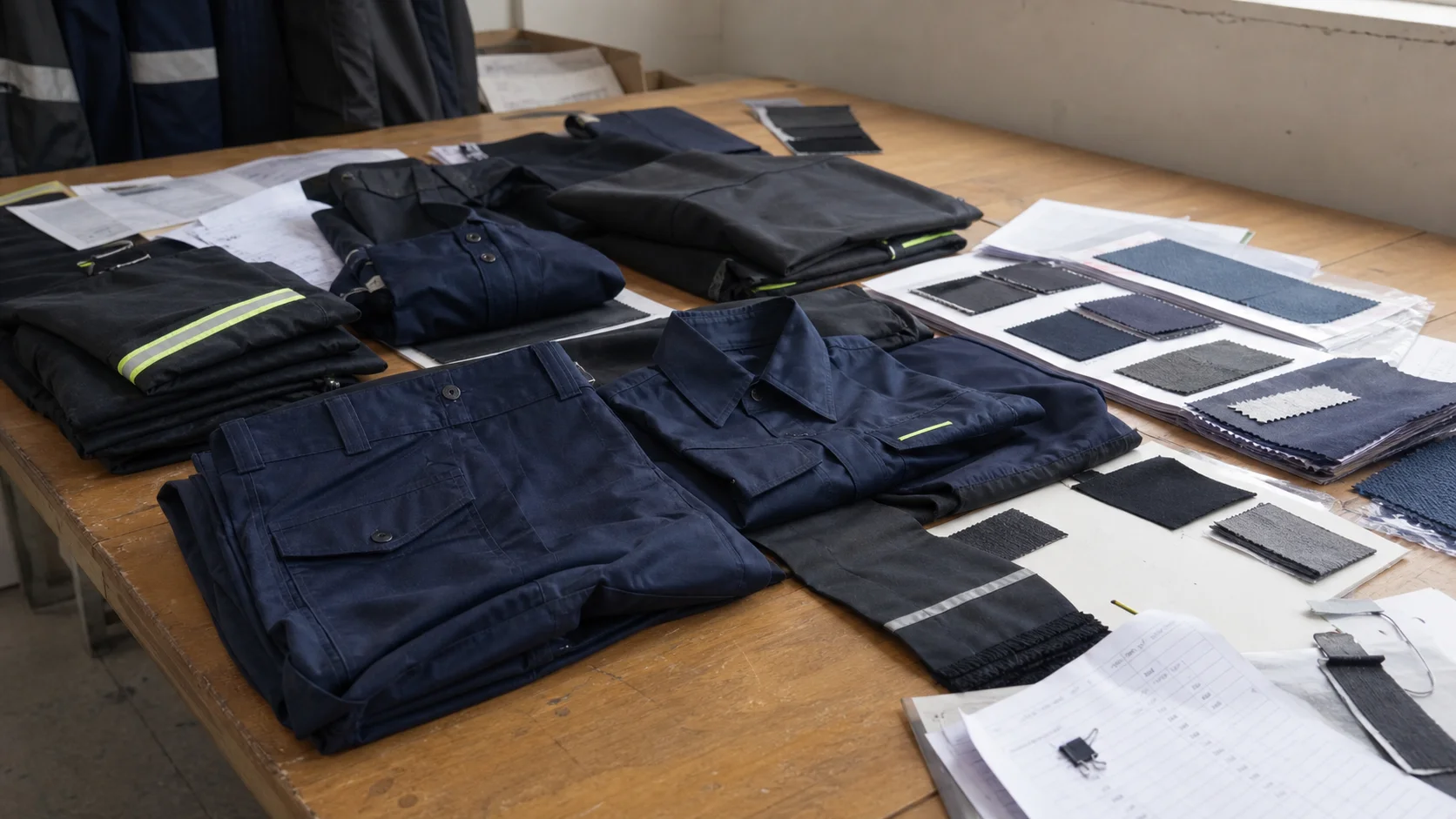
A sourcing-focused risk map for security contractors ordering bulk workwear uniforms, covering fabric durability, sizing, decoration, compliance, lead...
Security Workwear Bulk Order Risk Map - MOQ, Cost & Sourcing manufacturing guide
Security contractors buy uniforms under pressure. A new site contract starts on a fixed date. Guards need to look consistent from day one. Supervisors need different markings. Replacement stock must be available. The client may require navy, black, grey, hi-vis panels, epaulettes, reflective tape, embroidered badges, or a strict brand presentation.
That makes security workwear procurement different from a standard corporate apparel order. The uniform is not just clothing. It is part of site control, authority, public visibility, safety, and contract compliance. If a bulk order is late, incorrectly branded, poorly fitted, or made with weak fabric, the cost is not limited to the garment invoice. It can affect deployment, client confidence, staff morale, and re-order continuity.
A practical workwear uniform manufacturer bulk order risk map helps security contractors identify where problems usually happen before purchase orders are placed. The main risk areas are MOQ planning, landed cost, fabric and trims, sizing, branding, sample approval, lead time, inspection, packaging, and re-order control.
The purchasing judgment is straightforward: the lowest unit price is rarely the safest option for security uniforms. A contractor should look for a manufacturer that can support controlled sampling, clear specifications, reasonable MOQ structure, size-ratio planning, and repeat-order consistency. For buyers reviewing manufacturing support, Fabrikn’s apparel manufacturing services page is a useful starting point for understanding available production capabilities.
A risk map turns a uniform order into buying decisions that can be checked. Security contractors should not treat shirts, trousers, jackets, vests, caps, and knitwear as one simple apparel package. Each product group carries different risks.
Risk Area Typical Problem Purchasing Control MOQ Minimums are too high per style, color, or size Negotiate by total program volume, not only per SKU Cost Quoted unit price excludes embroidery, packing, labels, or freight Request a full cost breakdown and Incoterms Fabric Fabric is too light, fades quickly, or fails abrasion needs Approve GSM, composition, finish, and color standard Trims Zippers, buttons, reflective tape, or Velcro perform poorly Specify trim quality and test high-wear points Sizing Uniforms fit differently across product types Approve size chart, fit sample, and size-set samples Branding Logo placement, thread color, badge size, or rank marking is wrong Use artwork sheets and physical strike-offs Lead Time Production misses the mobilization date Build a calendar from sample approval, not from inquiry date Inspection Defects are found after delivery Inspect before shipment using AQL or agreed checkpointsThe key tradeoff is flexibility versus control. A small, urgent order may need stock fabrics, simpler trims, and standard fits. A large contract can justify custom fabric, private labels, and detailed grading, but it requires more time and stronger approval discipline.
MOQ is one of the first commercial barriers in security workwear sourcing. Buyers often ask for a total quantity, then discover that the manufacturer applies minimums by style, fabric, color, logo method, or size range. A 2,000-piece order can become difficult if it is divided into too many SKUs.
Typical MOQ ranges vary by product and customization level. For standard polo shirts or basic woven shirts using available fabric, a manufacturer may consider 100 to 300 pieces per color. For custom-dyed fabric, MOQ can rise to 500 to 1,000 pieces per color, sometimes more depending on mill requirements. Work trousers and cargo pants often sit around 300 to 800 pieces per style. Outerwear, softshell jackets, tactical vests, or multi-pocket security jackets may require 300 to 1,000 pieces because trims and construction are more complex.
Logo applications create another layer. Embroidery may be practical at lower quantities, while woven patches, custom badges, heat-transfer logos, and molded zipper pulls may carry their own minimums. Reflective tape, branded buttons, private labels, and custom packaging also need to be checked.
A practical buying approach is to group the uniform program into core and optional items. Core items are worn daily by most staff: shirts, trousers, jackets, fleece, caps, and high-visibility pieces where needed. Optional items may include winter parkas, rainwear, maternity options, supervisor shirts, or special event garments. Core items should carry enough volume to justify stable production. Optional items may need stock-body solutions, simplified branding, or a scheduled second phase.
Purchasing judgment: if the supplier’s MOQ forces you to buy excessive quantities of slow-moving sizes or rare supervisor garments, the apparent unit price can turn into dead inventory. A slightly higher unit cost with better SKU flexibility may be safer.
Security contractors usually compare quotes quickly, but workwear pricing is easy to misread. A uniform shirt priced without embroidery, badge backing, swing tags, polybags, carton marks, freight, duty, or testing is not comparable to a delivered uniform program.
The cost of security workwear is shaped by fabric weight, construction complexity, trim selection, branding method, order quantity, size range, compliance testing, packaging, and shipping method. A basic polo shirt is not expensive to construct, but a premium pique fabric, anti-pilling finish, embroidered chest logo, sleeve patch, inside neck label, and individual size stickers can push the cost up. Cargo trousers with reinforced knees, multiple pockets, bar-tacking, metal zippers, elastic waist adjusters, and reinforced belt loops involve more sewing time and higher trim cost.
Security contractors should also ask for price breaks. A quote at 300 pieces, 500 pieces, 1,000 pieces, and 2,000 pieces often reveals whether the supplier is constrained by fabric MOQ, sewing efficiency, or trim sourcing. If the price drops sharply at a certain quantity, that point may represent a practical production threshold.
Air freight can damage the budget on bulky workwear. Jackets, trousers, and tactical vests consume carton volume. Sea freight may be more cost-effective for planned replenishment, while air freight may be reserved for urgent launch quantities. This is where two-stage delivery can help: ship the first deployment quantity by air, then move the balance by sea. The tradeoff is added coordination and potentially higher overall handling cost.
Fabric risk is high because security uniforms are washed frequently, worn for long shifts, and exposed to mixed environments. A guard stationed in a mall needs a clean, smart appearance. A mobile patrol guard needs durability and weather protection. An event security team may need visibility, breathability, and fast replenishment. One fabric cannot solve every use case.
Common fabric options include polyester-cotton blends for shirts and trousers, 100% polyester for some performance polos, cotton-rich twill for comfort, softshell fabric for jackets, fleece for mid-layers, and waterproof-coated fabrics for rainwear. For high-visibility workwear, fabric and reflective tape may need to meet relevant safety standards depending on the market and job site requirements.
Trim specifications need the same discipline. Poor zippers, weak snaps, low-grade Velcro, unstable reflective tape, and loose drawcord ends create field complaints quickly. Security garments include many high-stress points: pocket corners, belt loops, epaulettes, zipper openings, badge areas, knee panels, crotch seams, and side seams. These areas should be reinforced with bar-tacks or stronger stitch settings where appropriate.
Reflective tape needs special attention. Decorative reflective piping is not the same as certified reflective tape. If the uniform is used in roadside, logistics, parking, or industrial security settings, the buyer should confirm visibility requirements before placing the order. A manufacturer can sew reflective trim, but the contractor must know whether the end use requires compliance to a specific standard.
Sizing is a major risk in security uniform bulk orders because the workforce may include varied body types, shift patterns, and gender requirements. A poor size ratio produces two problems at once: some guards cannot be issued uniforms, while excess stock remains in sizes that are rarely used.
Security contractors should not rely only on generic size curves. Existing employee data, previous uniform issue records, and regional body measurements provide better guidance. If the contractor is taking over a new contract, a fitting session or size survey before production is worth the time.
Fit approval should include both measurement and wear testing. A garment can match the size chart but still perform badly when the wearer sits, drives, reaches, patrols stairs, or carries equipment. Security trousers need enough rise and seat room. Shirts should allow arm movement without pulling across the chest. Jackets should permit layering and equipment belts where relevant.
The safest route is a staged approval process: first approve the base measurement chart, then a fit sample, then a size-set sample across key sizes. If the order is large, the buyer may approve a pilot run before full production. A pilot run costs time, but it can prevent a container of poorly fitting uniforms.
Security uniforms carry brand and authority signals. Logo placement, patch shape, rank markers, epaulettes, name badge areas, and color contrast must be controlled carefully. Incorrect branding can make uniforms unusable even if the garment quality is acceptable.
Buyers should prepare a branding sheet for each garment type. The sheet should show logo file, exact position, size, color, application method, and tolerance. For embroidery, stitch count, thread color, backing, and placement should be approved. For patches, confirm patch dimensions, border type, attachment method, and wash durability. For heat transfers, confirm stretch behavior, wash temperature, and risk of peeling.
Security contractors often need several identification levels: guard, supervisor, response team, event staff, concierge security, dog handler, control room, or mobile patrol. Every extra variation increases SKU complexity. The purchasing decision is whether these roles need different garments or only different removable badges. Removable patches or badge holders can reduce inventory risk, but they may look less premium and can be lost or misused. Permanent embroidery looks professional but creates site-specific stock that cannot easily be reassigned.
Tradeoff: permanent branding gives a cleaner brand image; modular identification gives better inventory flexibility. Contractors with frequent site turnover should be cautious about over-customizing every garment.
Color is another risk. Black and navy are common in security workwear, but shade differences are visible when shirts, jackets, trousers, and caps are produced from different fabrics or dye lots. A black polo and black softshell jacket will not always match. The buyer should approve color expectations by product category rather than expecting exact cross-fabric matching.
Sample approval is where many bulk order risks can be removed. Skipping samples saves a few days early and can lose weeks later. A security contractor should treat samples as commercial protection, not a formality.
The pre-production sample should match the bulk order specification exactly. Same fabric, same GSM, same trims, same stitching, same labels, same logo method, same packaging if possible. If the pre-production sample uses substitute fabric or available trims, it is not a reliable approval document.
Buyers should sign off samples in writing. Photos help, but physical samples matter for fabric hand feel, fit, color depth, embroidery texture, and trim function. A clear approval record reduces disputes if production differs later.
For buyers building a program from scratch, it is sensible to discuss sampling expectations early with the manufacturer. The contact page can be used to start a conversation about order scope, timelines, and customization needs before technical details are locked.
Lead time should be calculated from approved pre-production sample and confirmed deposit, not from the first inquiry. That distinction matters. Many contractors ask for delivery in six weeks, but they spend three weeks deciding fabrics, artwork, sizes, and contract quantities. Production cannot reliably begin until specifications are frozen.
Typical production lead times depend on product type and supply chain conditions. Basic knit polos using available fabric may take around 30 to 45 days after approvals. Woven shirts, trousers, and cargo pants may require 45 to 60 days. Jackets, softshells, waterproof garments, or tactical-style vests may need 60 to 90 days, especially if custom fabric, reflective tape, or imported trims are involved. Shipping time, customs clearance, and inland delivery must be added.
Security contractors should use a backward calendar. Start with the date staff need uniforms in hand, then work backward through site sorting, inland delivery, customs, freight, final inspection, production, pre-production approval, sampling, and quotation. This often shows that the buying process must begin earlier than expected.
Urgent projects need controlled simplification. The buyer may need to choose stock fabric, standard trims, limited colors, embroidery instead of custom woven badges, and fewer garment variations. A fast order with too many custom features is a high-risk order.
Inspection is the last major checkpoint before the contractor owns the problem. Once uniforms arrive and are distributed to staff, defects become expensive to collect, replace, and explain. Pre-shipment inspection should not be skipped on medium or large orders.
Common inspection risks in security workwear include shade variation, incorrect size labels, uneven embroidery, misaligned patches, loose threads, weak seams, broken zippers, poor button attachment, missing bar-tacks, incorrect carton ratios, and wrong packing by site or size.
AQL inspection is common in apparel sourcing, but the acceptable quality level must be suitable for the order’s risk. Security uniforms are public-facing, so visible logo defects and shade mismatches should be treated seriously. A minor thread end inside a seam is different from a crooked chest badge on a supervisor shirt.
Buyers should also consider carton-level risk. A perfect garment packed into the wrong site carton can still create operational disruption. If uniforms must be issued by branch, client site, or employee pack, packing instructions need to be confirmed before production finishes.
A security contractor should assess a workwear uniform manufacturer on control, communication, and repeatability, not only price. The right supplier should be able to translate operational requirements into garment specifications and production checkpoints.
Useful questions include: Can the supplier provide fabric options with GSM and composition? Can they support size-set samples? Can they manage embroidery and patch approval? Can they quote by quantity tier? Can they identify MOQ constraints clearly? Can they pack by size, site, or wearer group? Can they support replenishment orders after the initial bulk shipment?
The buyer should also ask what happens after the first order. Security contractors rarely buy uniforms only once. Staff turnover, new contracts, seasonal outerwear, and damaged garments create ongoing demand. If the manufacturer cannot hold specifications, repeat fabric, or maintain logo consistency, re-orders become risky.
Private label support may be useful for larger contractors. Neck labels, care labels, woven brand labels, hangtags, and carton marks can make the program feel more controlled. These details also increase MOQ and approval workload, so they are best used when volume justifies them.
For procurement teams comparing sourcing partners, the manufacturer’s background and service model matter. Reviewing about Fabrikn can help buyers understand whether the supplier’s positioning fits a structured uniform program rather than a one-off commodity purchase.
The safest way to manage a security workwear bulk order is to control each stage rather than trying to fix everything at the end. A simple stage map helps procurement teams assign responsibilities and approval points.
Order Stage Main Risk Control Action Inquiry Requirements are too vague Share garment list, quantities, colors, roles, and target delivery date Quotation Costs are not comparable Request itemized pricing and clear commercial terms Development Wrong fabric or construction direction Approve technical specs before full sampling Sampling Fit, logo, or trims are not production-ready Approve PP sample, logo strike-off, and size set Production Bulk output drifts from approved sample Use production records and mid-line checks where suitable Inspection Defects are discovered too late Inspect before shipment and allow rework time Delivery Cartons are hard to allocate Use clear packing lists, carton marks, and size labels Re-order Repeat uniforms do not match first order Keep approved samples, fabric references, and production specsThis risk map is not only for large national contractors. Smaller security firms also benefit because they have less room for waste. A 300-piece order with the wrong size ratio can be just as painful as a 10,000-piece order with a shade problem. The scale changes, but the buying discipline is similar.
Before confirming a workwear uniform manufacturer bulk order, security contractors should have the following items in place:
The commercial decision should balance unit price against risk exposure. If the contractor has a stable workforce, predictable contract pipeline, and enough storage, larger MOQ commitments may reduce cost. If contracts change often or site branding varies, a smaller MOQ with more flexible replenishment may be more valuable. Cheap stock that cannot be used is not a saving.
A security workwear bulk order succeeds when the uniform program is treated as an operational supply chain, not a last-minute apparel purchase. The strongest buying process begins with a clear risk map: MOQ, cost, fabric, trims, fit, branding, lead time, inspection, and re-order control.
Security contractors should push for clear specifications, physical sample approvals, itemized pricing, and realistic delivery calendars. They should also avoid over-customization unless the order volume and timeline support it. Standardized core garments with controlled branding often deliver the best balance of cost, consistency, and replenishment speed.
The best supplier is not always the one offering the lowest first quote. It is the manufacturer that can help reduce avoidable mistakes before fabric is cut and before uniforms reach the field.
Get a free quote from Fabrikn — your trusted B2B clothing manufacturer with 10+ years of experience. MOQ as low as 200 pieces.
Get a Free Quote →Typical MOQ can range from 100 to 300 pieces for simpler stock-fabric polos or shirts, 300 to 800 pieces for trousers and cargo pants, and 300 to 1,000 pieces for jackets or more complex outerwear. Custom fabric, custom dyeing, reflective tape, private labels, and special trims can increase MOQ.
Standardize core garments, limit color variations, use common trims, consolidate logo methods, and plan size ratios carefully. Ask for quantity-tier pricing and compare total landed cost, not only garment unit price.
At minimum, approve a fit sample, logo strike-off, fabric color reference, and pre-production sample. For larger orders, size-set samples are strongly recommended before bulk cutting.
Basic products may take around 30 to 45 days after all approvals. Woven trousers, shirts, and more detailed garments may take 45 to 60 days. Jackets, rainwear, and tactical-style garments may need 60 to 90 days, plus shipping and customs time.
The most common risks are incorrect measurements, shade variation, poor embroidery placement, loose seams, weak pocket reinforcement, faulty zippers, missing bar-tacks, wrong size labels, and incorrect carton packing.
Permanent embroidery looks more polished and reduces loss of badges, but it creates less flexible inventory. Removable patches support role changes and site reassignment, but they may look less premium and need tighter control.
There is no single best fabric. Polyester-cotton blends are common for shirts and trousers because they balance durability and comfort. Polyester performance knits suit polos. Softshell and waterproof fabrics suit outerwear. The right choice depends on climate, wash frequency, site environment, and appearance requirements.
Many contractors plan extra stock for turnover, damage, size exchanges, and new hires. The right percentage depends on workforce stability, contract length, and re-order lead time. A practical starting range is often 5% to 15% above initial issue quantities, adjusted by historical usage.