
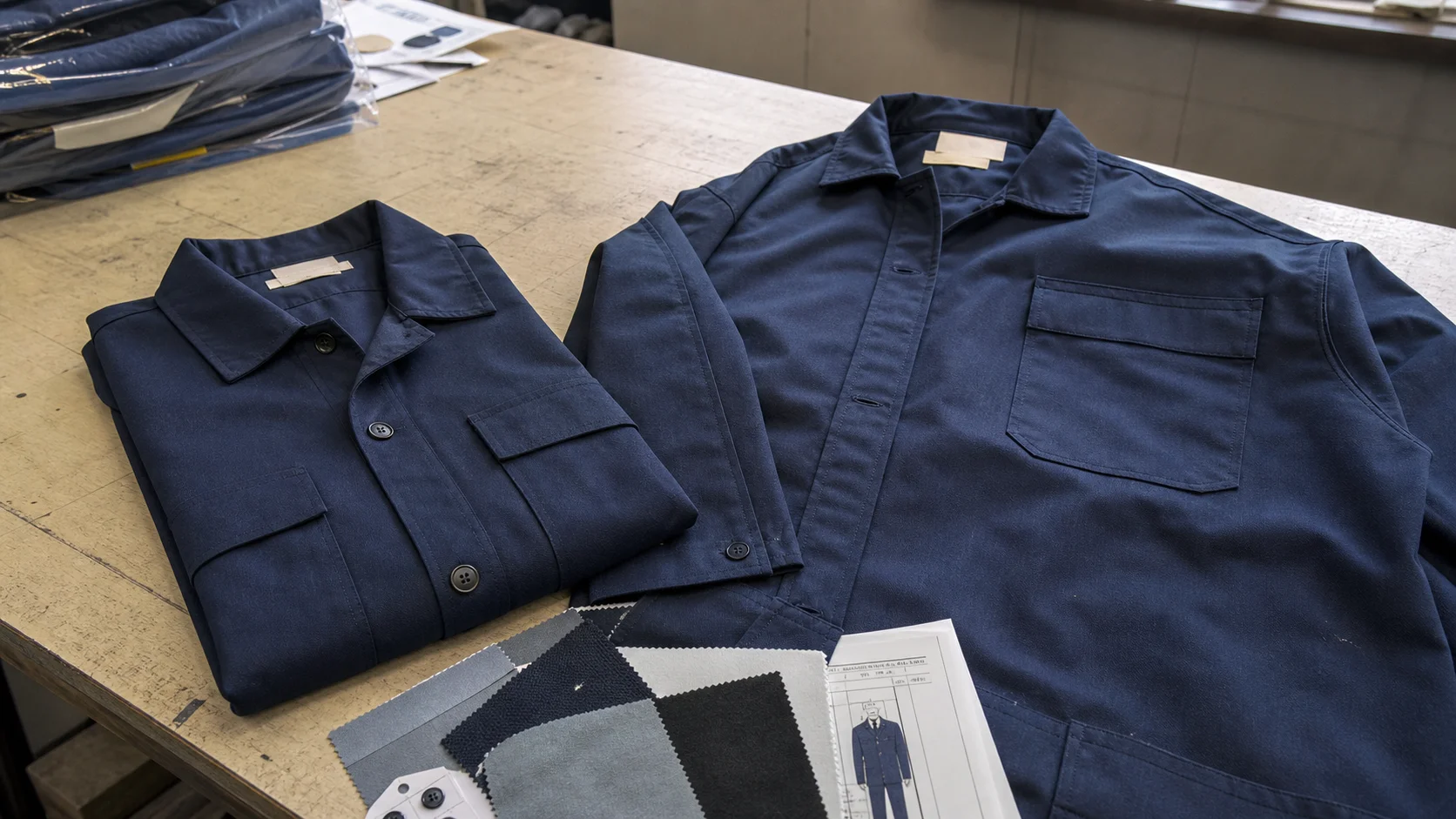
A product-specific SEO outline for corporate uniform buyers evaluating reorder risks, specs, decoration continuity, sizing, shade control, and delivery...
Service Coat Reorder Risk Review for Buyers - Outerwear & Jackets manufacturing guide
Wholesale service coat reorder planning looks simple until the second or third production run exposes weak controls. A corporate uniform buyer may approve the first order, issue garments to staff, receive positive feedback, and assume repeat orders will be straightforward. That assumption is risky. Service coats sit in a difficult category between workwear, corporate outerwear, and branded customer-facing uniform apparel. They need to perform, fit consistently, carry branding cleanly, and remain available across multiple buying cycles.
For corporate uniform programs, reorder risk is not only about stock running out. It includes shade variation between old and new garments, discontinued fabric, inconsistent sizing, pocket changes, logo placement drift, trim substitutions, and missed delivery windows. A small deviation may become visible when new employees stand next to existing staff. A major deviation can force a buyer to reissue coats across a department, which is usually far more expensive than controlling the reorder properly.
Service coats are often used by field technicians, facility staff, automotive service teams, logistics employees, maintenance departments, security support roles, and customer-facing service crews. These users need coats that are durable enough for daily wear but presentable enough for brand standards. In many corporate programs, the reorder is more sensitive than the first order because the new batch must match an installed base.
The practical goal is not to eliminate every risk. That is unrealistic in apparel manufacturing. The goal is to identify which risks matter most, document the approved standard, and make reorder decisions before production pressure forces poor substitutions.
For buyers, the safest reorder is not the fastest reorder. It is the reorder with confirmed fabric availability, approved reference samples, locked specifications, and inspection criteria that match the real use of the garment.
A service coat reorder is not just a repeat purchase of an outerwear item. Buyers are reordering a complete uniform standard. That standard includes garment appearance, brand alignment, employee comfort, seasonal suitability, durability, wash behavior, and operational continuity.
The coat may be part of a wider uniform set that includes trousers, polos, shirts, softshell jackets, work pants, safety vests, or cold-weather layers. If the coat is visible to customers, consistency matters more. If it is used in workshops or back-of-house environments, durability and ease of replacement may take priority. Buyers should be clear about which requirement drives the reorder.
In wholesale manufacturing, a “same as last order” instruction is not strong enough. Mills may change dye lots. Zippers may come from a different lot. Lining fabric may be replaced by a close alternative. Pattern adjustments may have been made informally during the last order and not captured in the tech pack. A reorder that depends on memory instead of documentation creates avoidable exposure.
Buyers should treat each reorder as a controlled production event. The starting point should be the approved original sample, the final production specification, the grading chart, the bill of materials, and any inspection report from the previous shipment. If those records are incomplete, the next reorder should include a pre-production confirmation stage rather than moving directly into bulk cutting.
Corporate uniform buyers should review reorder risk across several connected areas. One weak point can affect the whole program. For example, a fabric change can alter shrinkage, which can affect fit, which can increase size exchange rates. A zipper substitution can reduce garment life, which can create user complaints even if the coat looks acceptable on arrival.
Service coat fabrics may include polyester-cotton twill, cotton canvas, mechanical stretch woven, softshell bonded fabric, nylon taslan, polyester oxford, quilted lining, fleece lining, or water-resistant coated materials. Some are stable season after season. Others are dependent on mill stock, color programs, or minimum dye quantities.
If the original fabric is no longer available, buyers need a controlled substitution process. The replacement should be checked for weight, hand feel, color, shrinkage, pilling, tear strength, abrasion performance, coating quality, and wash behavior. A fabric that looks close on a swatch may behave differently in production and after laundering.
Shade variation is one of the most visible reorder problems. Navy, black, charcoal, dark green, and royal blue service coats can all show variation under store lighting, daylight, or indoor facility lighting. A buyer should ask whether the reorder will use stock fabric from the same color standard or a new dye lot. If the coats will be worn beside previous batches, shade tolerance should be tighter.
Lab dips are useful for new dye lots, but they do not replace finished garment comparison. Fabric shade can shift after fusing, quilting, bonding, washing, or pressing. The better control is to compare the pre-production sample against an approved sealed garment from the previous order.
Trims are often underestimated. Zippers, snaps, buttons, hook-and-loop tape, elastic cuffs, drawcords, stoppers, reflective tape, inner labels, care labels, pocket bags, rib cuffs, and lining quality all affect wearer experience. A cheaper zipper can turn a good reorder into a complaint issue. A slightly different snap finish may be visible on a branded coat.
Buyers should require a trim card for every reorder, not just the first order. If a trim is substituted, the supplier should provide the reason, comparison specification, and sample for approval. For service coats, zipper quality deserves particular attention because it is one of the highest-use components.
Fit drift can happen when factories adjust patterns to improve production efficiency, correct earlier sewing difficulty, or respond to fabric changes. A 1 cm change at the shoulder or sleeve can affect comfort. A change in body length can affect brand appearance across staff. A lining or insulation change can also make the garment feel tighter even if the outer measurement is unchanged.
Corporate buyers should keep a size set from the approved production standard. If that is not available, the reorder should include at least one sample in a core size, and preferably a small size run for key sizes before bulk production.
Service coats often include embroidery, woven patches, heat transfers, reflective branding, name badges, or department identifiers. Reorder risk increases when decoration is handled separately from garment production or when artwork files are not controlled.
Logo placement should be measured from fixed garment points, not estimated visually. For example, chest embroidery may be specified from center front, shoulder seam, or pocket edge. Sleeve logos should be checked against sleeve length and seam position. Buyers should request a decoration strike-off or decorated pre-production sample when brand visibility is important.
Fabric and trim continuity is the foundation of a safe wholesale service coat reorder. For corporate uniform programs, the buyer should define which elements are non-negotiable and which can be substituted with approval. Not every component has the same importance. A hidden pocket bag fabric may allow a controlled substitution. A front zipper, shell fabric, lining, or visible snap usually deserves tighter control.
Useful fabric specifications for a service coat reorder include:
Trim specifications should be equally direct. Zippers should include brand or grade if specified, tape color, teeth type, slider type, puller style, length, and function. Snaps should include finish, cap size, and pull strength expectations. Reflective tape should include width, placement, and compliance needs if the coat is used near traffic or low-light work areas.
For buyers sourcing corporate outerwear and jackets, it is worth separating “performance-critical” trims from “appearance trims.” A drawcord stopper may be replaceable if it looks and functions similarly. A weak zipper is not a minor issue. If the garment is used daily, front closures, pocket closures, cuff systems, and lining attachment should be treated as critical components.
Buyers reviewing factory capability or production service options can compare requirements against broader apparel support through Fabrikn’s services. The key is to convert design intent into measurable production requirements before the reorder is placed.
Service coats must balance movement, layering, and a neat corporate appearance. They are not fashion jackets, but they cannot fit like generic warehouse coats if staff are customer-facing. Reorder fit issues usually come from incomplete measurement records, fabric changes, lining changes, grading errors, or inconsistent tolerance control during sewing.
A practical size specification should include more than chest and length. Buyers should confirm shoulder width, sleeve length, sleeve opening, armhole, across back, sweep, collar height, pocket placement, and inner allowance for layering. For insulated service coats, the pattern should account for bulk. For softshell or stretch woven service coats, the fit can be slightly more shaped, but the buyer must confirm range of motion.
Typical garment measurement tolerances may range from plus or minus 0.5 cm for small details to plus or minus 1.5 cm or more for larger body measurements, depending on garment type and fabric behavior. Tighter tolerances may be possible, but they can increase production rejection rates and cost. Loose tolerances reduce complaints during inspection but may produce visible inconsistency across staff.
The best purchasing judgment is to tighten tolerances only where they matter. Chest, sleeve length, body length, shoulder, and logo placement usually need better control than internal seam allowances. Pocket positioning matters if the pocket is visible or used for tools. Cuff opening matters if employees wear gloves or need wrist mobility.
Reorders often fail because the buyer repeats the same size ratio without checking actual employee demand. Corporate uniform programs may initially order a balanced size curve, then discover that certain sizes turn faster due to workforce demographics, layering preferences, or exchange behavior. If medium and large sizes are constantly depleted while small and 3XL remain in stock, the reorder should not simply copy the first ratio.
Buyers should review issue records, exchange records, damaged garment replacements, new-hire forecasts, and seasonal demand. Larger sizes may require extra fabric consumption and sometimes higher pricing. They may also carry higher inventory risk if over-ordered. A separate plus-size strategy can reduce stock imbalance without delaying the whole program.
Minimum order quantity is one of the main commercial risks in service coat reorders. Typical wholesale MOQ ranges vary by supplier, fabric type, decoration, and whether the fabric is stock or custom dyed. For basic service coats using stock fabric and standard trims, MOQs may start around 100 to 300 pieces per style and color. For custom fabric, special color dyeing, bonded softshell, quilted insulation, or complex trims, MOQs may move into the 500 to 1,000 piece range or higher.
Some suppliers may accept lower quantities for repeat orders if fabric and trims are available. The tradeoff is usually a higher unit price, less trim flexibility, or longer production scheduling. Buyers should not judge MOQ only by unit cost. A low MOQ at a higher price can be better than carrying two years of excess inventory in a corporate uniform program with changing headcount.
Forecasting should include:
A common buyer mistake is placing a reorder only when inventory is already low. This compresses production timing and increases the chance of accepting fabric substitutions, rushed sampling, or incomplete inspection. Service coats are not ideal emergency items because they involve heavier materials, more sewing operations, and more trim dependencies than basic shirts.
Higher inventory protects against stockouts but exposes the buyer to logo changes, staff turnover, size imbalance, storage cost, and obsolete garments. Lower inventory improves cash flow but increases emergency reorder risk. The correct balance depends on the uniform program’s stability.
If the company has stable branding, predictable staffing, and consistent coat usage, a larger reorder may be reasonable. If branding is under review, locations are changing, or job roles are shifting, a smaller reorder with tighter replenishment planning is safer even at a higher unit price.
Sampling is not only for new styles. A reorder sample confirms that the supplier can still produce the same garment standard with current fabric, current trims, and current production setup. Buyers should decide the sample level based on risk.
For a low-risk reorder using the same fabric stock, same trim stock, and no prior complaints, a single pre-production confirmation sample may be enough. For a reorder with a fabric substitution, new factory line, changed decoration method, or customer-facing branding requirement, a fuller sample process is worth the time.
Buyers should avoid approving samples with vague comments such as “acceptable” or “improve if possible.” Comments should be measurable: sleeve length to be reduced by 1 cm, pocket opening to match approved sample, zipper puller to match previous matte black finish, logo to move 0.5 cm away from pocket edge. Ambiguous comments are difficult to enforce during inspection.
Wholesale service coat lead times depend on fabric availability, trim sourcing, decoration, production capacity, inspection, packing, and freight. Buyers often underestimate the time needed before bulk production begins. A stated production lead time of 30 to 60 days may not include sample approval, fabric dyeing, lab testing, brand approvals, or shipping.
Typical reorder timelines may look like this:
These ranges are only planning guides. Actual timing depends on the supplier’s material pipeline and production calendar. Public holidays, peak outerwear season, fabric mill delays, trim shortages, and freight congestion can all affect delivery.
The buyer’s best protection is to start the reorder review before the stock position becomes urgent. For corporate programs, reorder triggers should be set by size and location. A blanket reorder trigger based on total units can be misleading. The warehouse may show 300 coats in stock, but if the remaining units are mostly fringe sizes, the program can still be functionally out of stock.
A rush reorder may be necessary, but buyers should understand what they are giving up. Speed can reduce sample review time, limit fabric options, increase air freight cost, and force the supplier to use available trims. If the service coat is a back-of-house utility item, that may be acceptable. If it is a visible corporate uniform coat, the brand risk may be too high.
When timing is tight, buyers should ask the supplier to identify the critical path. Is the delay fabric, zipper, embroidery, cutting capacity, quilting, or final inspection? A clear answer allows a better decision. For example, if the fabric is ready but embroidery capacity is tight, the buyer may split decorated and undecorated stock. If the zipper is delayed, substitution may be considered only after pull strength, appearance, and function are checked.
Inspection for service coat reorders should focus on both appearance and function. Outerwear has more components than lighter uniform items, so the defect profile is broader. Buyers should not rely only on carton count and general visual review.
Important inspection points include:
AQL inspection can be useful, but buyers should define critical defects clearly. For a corporate service coat, a broken zipper, wrong logo, major shade mismatch, incorrect size label, or unsafe snap attachment should be treated more seriously than a loose thread. If the garment is used in low-light or safety-adjacent environments, reflective trim errors may be critical.
Measurement inspection should include a practical sample across sizes. If only one size is checked, grading mistakes can pass unnoticed. Buyers should request actual measurement reports, not just a pass/fail statement. If previous orders had fit complaints, those specific points should be rechecked.
Corporate uniform programs often distribute coats by department, location, employee group, or launch schedule. Packing errors can create operational problems even when garment quality is acceptable. Buyers should specify carton ratios, polybag labeling, size stickers, barcode requirements, location packs, and any individual employee packing needs.
If the reorder is shipped to multiple locations, carton marking needs to be controlled. Mixed size cartons may reduce warehouse handling, but they can also increase picking mistakes if not labeled clearly. Solid size cartons are easier to count and allocate, but they may require more distribution work after arrival.
A reorder works better when the buyer asks direct questions before purchase order release. The supplier does not need to provide a long presentation, but they should confirm the practical points that affect repeatability.
Buyers should keep all confirmations in writing. A brief email or production record is enough if it clearly identifies the style, season, order number, fabric, trim, and approved changes. Verbal approvals are a common source of reorder disputes.
For buyers who need to discuss a uniform outerwear program or clarify production planning, contacting Fabrikn is a practical next step. The earlier the risk review starts, the more options remain available.
The strongest buyers separate real risk from routine variation. Apparel is not a machined product. Minor variation is normal. The question is whether the variation affects brand consistency, wearer comfort, durability, safety, or distribution. If it does, it needs control. If it does not, over-controlling it may slow production and increase cost without improving the program.
For service coat reorders, the highest-value controls are usually fabric continuity, front closure quality, fit consistency, logo placement, and size availability. These points directly affect user satisfaction and visible uniform consistency. Buyers should spend less time debating hidden details that do not affect performance unless the garment has strict compliance needs.
Price negotiation should be handled with care. A cheaper reorder is not better if it introduces a weaker shell fabric, lower-grade zipper, poor lining, or inconsistent shade. The cost of replacing failed coats, managing employee complaints, and explaining brand inconsistency can exceed the savings. On the other hand, not every premium detail is necessary. If the coat is used for short-duration seasonal issue, a simpler construction may be acceptable.
The most practical sourcing approach is to classify the reorder:
Low-risk reorders can move faster with a confirmation sample and written material check. Moderate-risk reorders need targeted approval of the changed items. High-risk reorders should be treated almost like a new style development, even if the design looks familiar.
Reordering the same coat makes sense when employee feedback is positive, damage rates are acceptable, branding is stable, and the supplier can maintain material continuity. It also makes sense when the coat has become part of a recognizable company image. In these cases, the buyer’s job is to protect consistency and avoid unnecessary changes.
A refresh may be better when the existing coat has repeated zipper failures, poor sleeve mobility, high shrinkage, outdated branding, weak weather protection, or unpopular sizing. If the reorder requires major substitutions anyway, the buyer should consider whether it is smarter to update the style rather than force a poor match to the old one.
A controlled refresh can be positioned as a planned uniform improvement. A failed reorder looks like a sourcing mistake. That distinction matters when internal stakeholders are watching cost, staff satisfaction, and brand presentation.
Service coat reorders rarely sit with one stakeholder. Procurement may focus on cost and lead time. Operations may focus on availability. Brand teams may focus on color and logo consistency. Employees may care most about comfort and pocket function. Finance may resist high inventory. A good reorder risk review converts these competing priorities into clear decisions.
Buyers should agree internally on acceptable tradeoffs before negotiating with suppliers. If delivery is the top priority, the team should be prepared for limited material options. If exact color matching is the top priority, the team should allow time for lab dips and sampling. If cost is the top priority, the team may need to accept larger MOQs or simpler trims. Conflicting priorities create delays and increase the chance of last-minute approvals.
Documentation is the buyer’s strongest tool. A proper reorder file should include the approved garment sample, fabric swatch, trim card, measurement chart, grading rules, artwork file, decoration placement guide, care label copy, packing instructions, previous inspection findings, and reorder comments. This file does not need to be complicated. It does need to be complete enough that a production team can repeat the garment without guessing.
Buyers evaluating long-term apparel partners can also review company background and sourcing approach through Fabrikn’s about us page. For corporate uniform buyers, supplier fit is not only about making one coat. It is about maintaining standards through repeated orders, changing quantities, and practical production constraints.
Before releasing a wholesale service coat reorder, buyers should confirm the following points:
A service coat reorder is successful when the buyer receives garments that match the approved standard, arrive in time, issue smoothly to staff, and perform as expected in daily use. That outcome depends less on luck and more on disciplined review before the purchase order becomes urgent.
Get a free quote from Fabrikn — your trusted B2B clothing manufacturer with 10+ years of experience. MOQ as low as 200 pieces.
Get a Free Quote →The biggest risk is uncontrolled variation from the previous order. Fabric shade, trim quality, fit, logo placement, and sizing can all shift if the buyer does not confirm the approved standard before production. Fabric continuity and zipper quality are usually the first points to verify.
Typical MOQs may range from 100 to 300 pieces for simpler repeat styles using stock fabric. Custom colors, special trims, insulated construction, or bonded softshell fabrics may require 500 to 1,000 pieces or more. Lower MOQs may be possible, but buyers should expect higher unit costs or fewer customization options.
For most corporate uniform programs, yes. At minimum, buyers should approve a pre-production confirmation sample when the coat is visible, branded, or used across multiple locations. If the reorder uses the same confirmed materials and there were no prior issues, the sample process can be shorter.
Keep an approved garment or fabric swatch from the previous order and compare the reorder fabric against it before bulk production. If the new order uses a fresh dye lot, request a swatch, lab dip, or pre-production sample. Finished garment comparison is better than relying only on fabric codes.
Simple repeat orders with stock fabric may take about 30 to 45 days after approvals. Custom fabric, special trims, insulation, quilting, or peak-season production can push timing to 60 to 100 days. Sampling, approval time, inspection, and freight should be included in the buyer’s timeline.
Buyers should check fabric shade, measurements, zipper function, snap strength, seam quality, lining attachment, pocket construction, logo placement, label accuracy, and packing. Functional defects such as broken zippers, wrong sizes, or incorrect branding should be treated as critical.
A refresh is worth considering when the existing coat has repeated fit complaints, zipper failures, poor durability, outdated branding, or material availability problems. If too many substitutions are needed to recreate the old coat, a planned update may be safer than forcing an inconsistent reorder.