
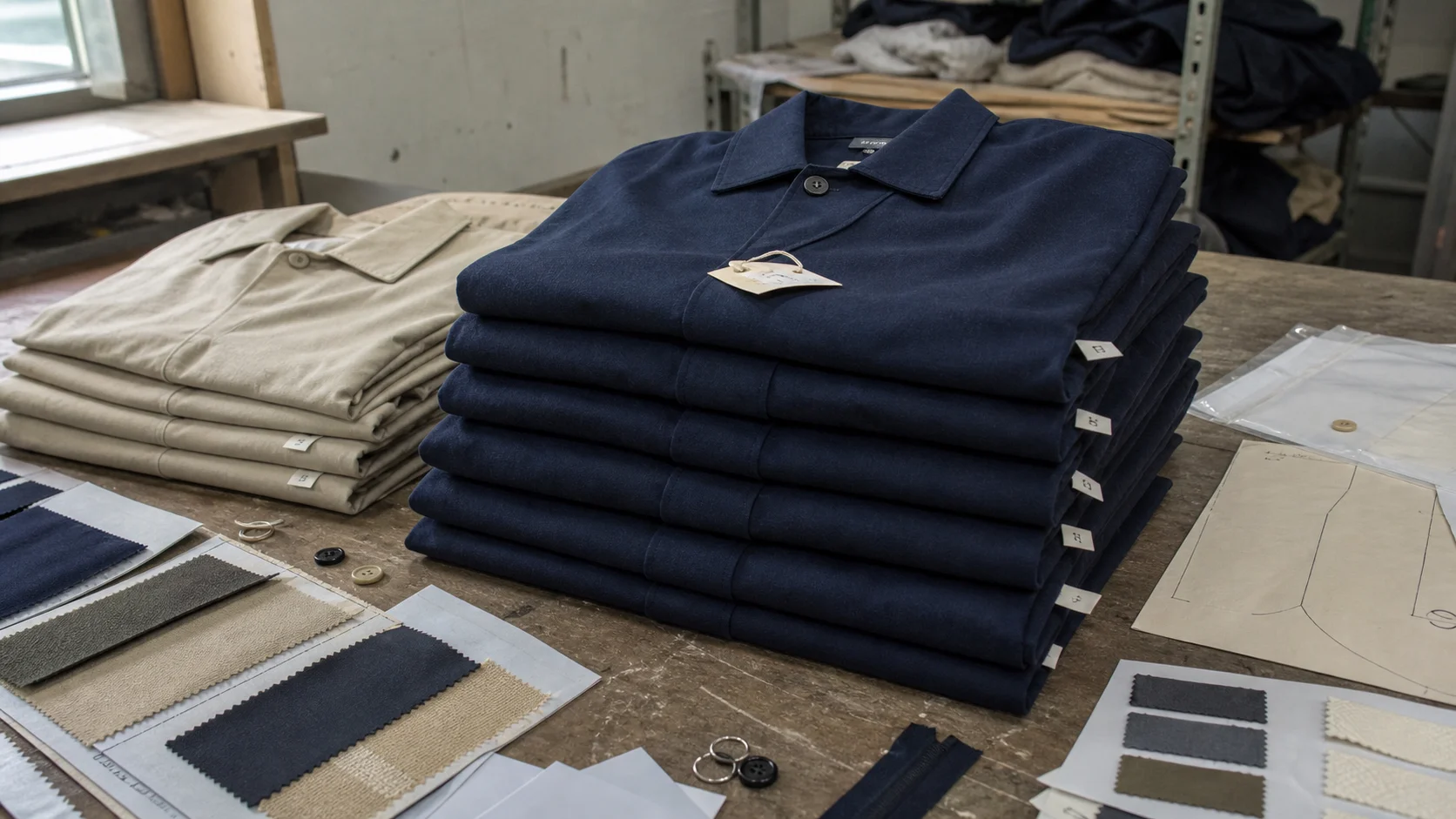
A product-specific SEO outline for resort uniform buyers reviewing service coat factory size grading, fit consistency, measurement specs, wear-test...
Service Coat Size Grading Review for Resort Buyers - Outerwear & Jackets manufacturing guide
Category: Outerwear & Jackets
Service coats are not ordinary jackets. In a resort setting, they sit at the intersection of brand presentation, staff comfort, durability, and operational practicality. A poorly graded coat may look acceptable on one sample model, then fail across the real workforce once sizes are issued to front desk teams, concierge staff, bell service, valet, restaurant hosts, club lounge attendants, or outdoor guest service crews.
For resort uniform buyers, size grading deserves a separate review before bulk production. It is not enough to approve a good-looking medium sample. The factory must show that the pattern can scale logically across the full size range, usually from XS to 3XL or 4XL for men’s and women’s cuts, and sometimes beyond for inclusive uniform programs. The goal is consistent appearance, reasonable movement, and controlled alteration cost after delivery.
A service coat factory size grading review should answer one practical question: will this coat fit the staff population without creating daily complaints, returns, or inconsistent guest-facing presentation?
Resort uniforms create a special challenge because staff body types vary widely, but the visual standard must remain consistent. A slim-cut coat may look polished in a showroom, yet restrict arm movement for luggage handling. A relaxed coat may be comfortable, yet look oversized behind a reception desk. The grading review is where those tradeoffs should be settled before fabric is cut in bulk.
For resort buyers, the safest grading decision is not always the most fashionable one. The best service coat is the one that holds the brand line while allowing staff to work a full shift without fighting the garment.
A serious grading review starts with the technical package. The buyer should not rely only on photos, sketches, or verbal confirmation. For outerwear and structured uniform jackets, the tech pack should include a detailed measurement chart, size range, grading rules, fabric specification, lining and trim details, construction notes, logo placement, and tolerance standards.
The most useful review documents include:
If these details are missing, the factory may still be able to sew a service coat, but the buyer has limited control. That is where avoidable problems begin. One supplier may interpret “regular fit” differently from another. Sleeve length can be measured from shoulder point or center back. Chest may be measured flat, around the garment, or across a curved panel. Small differences in interpretation become large fit problems across hundreds or thousands of uniforms.
Buyers developing a new resort outerwear program can also review broader apparel manufacturing support through Fabrikn’s services page to understand how development, sourcing, and production coordination may be structured for uniform orders.
Service coat grading should be reviewed by measurement point, not only by alpha size. The key issue is how each point increases or decreases from one size to the next. A factory that grades chest, waist, shoulder, sleeve, and body length using the same simple increment across all sizes may create distorted fits at the ends of the range.
For resort service coats, these are the most important measurement points to verify:
Measurement Point Why It Matters Common Review Risk Chest width Controls overall comfort and closure strain. Too tight across larger sizes, causing pulling at buttons or zipper. Waist width Shapes the coat and affects presentation. Overly tapered grading that looks sharp but restricts movement. Hem width Affects ease over trousers, skirts, and radios or tools. Insufficient sweep, especially in women’s sizes or longer coats. Shoulder width Sets the frame of the coat. Shoulders grading too wide, making large sizes look sloppy. Sleeve length Controls professional appearance and hand clearance. Large jumps between sizes, creating alteration work. Bicep width Critical for movement and layering. Often under-specified, leading to tight sleeves. Armhole depth Affects reach, lift, and comfort. Deep armholes may feel loose but restrict upward arm movement. Back width Important for concierge, bell, and valet teams. Pulling across the back when carrying bags or opening doors. Body length Defines brand silhouette and coverage. Long grading can overwhelm smaller staff or shorten visually on larger sizes. Collar and neckline Affects comfort and layering with shirts or scarves. Neck tightness or collar gaping after grading.Many resort buyers focus on chest and body length because these are easy to measure. That is not enough for a structured service coat. Sleeve width, armhole shape, shoulder slope, and back ease often determine whether staff can work comfortably.
A practical grading review should compare the base sample against at least one smaller size and one larger size. For example, if the base sample is men’s medium, review small and 2XL or 3XL before bulk production. If the program includes a women’s cut, do the same for that block. Sampling only the middle size is cheaper, but it leaves the buyer exposed to the most common uniform complaint: “The sample was fine, but the size run does not fit real staff.”
Resort service coats need more movement than fashion blazers. Staff may reach across counters, carry luggage, open car doors, bend to assist guests, manage umbrellas, handle trays, or walk long distances between indoor and outdoor zones. A coat that photographs well but restricts movement will quickly become unpopular.
Fit testing should include simple movement checks:
The buyer should decide early whether the coat is mainly decorative, functional, or weather-protective. A tailored indoor reception coat can have a cleaner shoulder and closer waist. A bell service or valet coat usually needs more back ease, sleeve width, and possibly a water-resistant shell. A luxury resort may accept higher tailoring cost to maintain a formal line. A high-volume resort with seasonal staff may need a more forgiving fit that reduces size exchange pressure.
There is no universal correct fit. The correct fit is the one that matches job function, climate, brand standard, and replacement budget.
Some buyers try to simplify ordering by using a unisex service coat. That can work for certain casual outerwear styles, especially softshell jackets, chore coats, or relaxed utility jackets. It is riskier for structured service coats with shaped shoulders, button placement, waist suppression, or formal lapels.
Women’s grading normally requires closer review of bust, waist, hip sweep, sleeve length, and shoulder width. A men’s block scaled down into smaller sizes can create poor shoulder balance and excess body length. A women’s block that is overly shaped can create fit failures across different body types. Resort buyers should ask for separate fit blocks when the appearance standard is tailored or premium.
For broad staff populations, a slightly more forgiving women’s service coat often performs better than a heavily fitted silhouette. The tradeoff is less dramatic shaping, but fewer returns and alterations.
Extended sizes should not be treated as a simple continuation of the same grade rule. Once sizes move into 3XL, 4XL, or above, shoulder width, sleeve length, chest, waist, and hem proportions may need adjusted grading. The same applies to petite or short-length options if a resort has a large number of shorter staff.
For resort buyers, inclusive sizing is both an operational and brand issue. Staff should not be forced into uncomfortable garments because the size range was planned around a narrow fit model. At the same time, carrying too many sizes increases inventory complexity. The sensible approach is to review staff size data from prior uniform programs, then order size curves based on actual usage rather than assumptions.
Size grading cannot be separated from fabric behavior. The same pattern will fit differently in a wool blend, polyester twill, softshell laminate, stretch suiting, bonded fleece, or water-resistant canvas. A service coat factory should understand how shrinkage, stretch, drape, recovery, and seam bulk affect final measurements.
Common fabric options for resort service coats include:
Fabric weight should be selected by climate and usage. A tropical resort may need a lightweight lined or half-lined coat, often in the range of 160–240 gsm depending on construction. A cooler mountain or coastal property may use heavier woven or softshell materials in the 250–380 gsm range. These are typical planning ranges, not fixed rules. Final selection should be confirmed through sample wear testing and laundering or cleaning evaluation.
Lining is another common source of grading and comfort problems. A full polyester lining can make the coat easier to put on and improve structure, but it may trap heat. A half lining or mesh lining can improve breathability, but it may reduce the formal look. Stretch lining may be useful if the shell fabric has stretch. If the shell stretches and the lining does not, staff may still feel restriction across the back and sleeves.
Buttons, zippers, snaps, shoulder tabs, contrast piping, sleeve braid, badge holders, and pocket reinforcements all influence production consistency. Trims should be specified before size set approval, not added casually after fit is approved.
For example, a heavy metal zipper can change the front drape of a lightweight coat. Thick piping can add seam bulk and reduce flexibility. Decorative sleeve tabs may interfere with sleeve shortening during alterations. Embroidered logos may pucker if placed on unstable fabric or too close to a curved seam.
Resort buyers should request trim cards with actual materials attached, including color references, button size, zipper gauge, puller finish, thread color, label quality, and logo execution. If branding must match a corporate standard, the factory should receive Pantone, embroidery thread, woven label, or approved artwork files.
A disciplined sample process reduces bulk risk. Buyers should expect several sample stages for a new service coat, especially when the style is structured or brand-sensitive.
Sample Stage Purpose Buyer Decision Proto sample Checks concept, silhouette, construction direction, and rough fit. Approve direction or revise design details. Fit sample Tests pattern, measurements, mobility, and comfort in base size. Approve or correct fit before grading. Size set sample Checks graded sizes across the range. Approve grading or request size-specific corrections. Pre-production sample Confirms bulk fabric, lining, trims, labels, logo, and construction. Final approval before cutting bulk fabric. Shipment sample Represents finished bulk production. Keep for inspection reference and future reorders.Skipping the size set sample is one of the most common ways to save money in the short term and create cost later. For a repeat order with proven grading, it may be acceptable. For a new service coat factory or a new resort uniform program, size set sampling is usually worth the cost.
Sample lead time depends on fabric availability, pattern complexity, trims, logo method, and revision speed. A simple unlined service coat may be sampled faster than a structured coat with custom buttons, contrast piping, embroidery, and multiple inner pockets. Typical sample development can take 7–20 days per round when materials are available. Custom fabric, custom trims, or complex approvals can extend this timeline significantly.
Buyers should give consolidated comments after each sample round. Scattered feedback creates version confusion. The best approval record includes the sample date, size, fabric used, measurement results, photos, comments, required corrections, and approval status.
Comments such as “make it better fitted” or “sleeves feel wrong” are not enough. Useful comments are specific: reduce waist by 2 cm, add 1.5 cm bicep width, shorten sleeve by 1 cm, raise armhole by 0.8 cm, increase back width by 1.5 cm, or adjust shoulder slope to reduce back neck fold.
Not every issue should be solved by changing measurements. Some problems come from pattern balance, seam placement, fabric stiffness, sleeve pitch, shoulder pad thickness, or lining tension. A capable service coat factory should explain whether a correction is a measurement adjustment, pattern correction, or construction issue.
Minimum order quantity depends heavily on fabric sourcing, trim customization, size range, color, and factory setup. For resort uniform buyers, typical MOQ ranges may look like this:
These are planning ranges, not guarantees. A factory may accept lower MOQ if it has suitable stock fabric, available production capacity, and simple trims. The same factory may require a higher MOQ for custom color, special lining, logo hardware, or non-standard size distribution.
Lead time should be separated into development lead time and bulk lead time. Sample development may take several rounds. Bulk production often takes 30–60 days after pre-production approval for standard service coats, assuming fabric and trims are ready. Custom fabric, peak season capacity, import logistics, lab testing, and buyer approval delays can push the timeline longer.
For resorts with opening dates, seasonal relaunches, or brand conversions, late uniform delivery is more expensive than many buyers expect. Staff may start work in old uniforms, mixed garments, or temporary apparel, which weakens the launch presentation. The safer buying calendar builds in time for size set review, staff fitting, alteration planning, and reserve inventory.
Ordering the correct size curve matters as much as approving the grade. A well-graded coat still fails operationally if the resort buys too many small sizes and too few larger sizes. Buyers should use historical issue records when available. If no records exist, collect staff size data early and confirm whether the coat will be worn over shirts, vests, sweaters, or thermal layers.
A typical starting curve may lean toward medium, large, and XL for men’s service coats, with smaller quantities in XS, 2XL, and 3XL. Women’s curves often require more care because body shape variation is wider and size labels across brands are less consistent. The buyer should avoid relying on retail size assumptions. Uniform sizing is its own system.
Reserve stock is worth planning. A resort with high turnover, seasonal hiring, or multiple departments should keep extra units in core sizes. The carrying cost is usually lower than emergency reorders, rushed shipping, or inconsistent substitute garments.
Inspection for service coats should cover more than general workmanship. Outerwear and jackets contain more components than simple shirts or polos, which creates more points of failure. Resort buyers should set inspection standards before production starts, then ensure the factory and inspection team use the same measurement method.
Common inspection risks include:
Measurement tolerance should be realistic. A rigid tolerance of plus or minus 0.3 cm across all points may sound disciplined, but it may be impractical for bulk outerwear. Many buyers use different tolerances by measurement point. For example, chest and body length may allow a wider tolerance than collar height or pocket placement. The right tolerance depends on fabric, construction, and the importance of the point.
Inspection should include at least three layers: in-line checking during production, final random inspection, and carton or packing review. For high-risk orders, buyers may request top-of-production samples after bulk sewing begins. This catches early production drift before the factory completes the full order.
Resort service coats often carry visible brand details. A small variation in logo placement can look careless when staff stand together. Embroidery density, thread color, badge alignment, metal trim finish, and woven label quality should be checked against approved standards.
If the coat includes embroidery, the buyer should approve strike-offs before bulk decoration. If it includes metal badges, custom buttons, or branded zipper pullers, the buyer should confirm finish, corrosion resistance, attachment strength, and replacement availability. Decorative choices that look premium at approval can become a maintenance issue if they break, tarnish, or cannot be reordered.
A service coat factory should be evaluated on technical ability, not only price. The buyer should ask how the factory builds patterns, manages grading, controls measurements, handles structured sewing, and records revisions. This is especially important for resorts ordering across multiple departments, genders, climates, or property tiers.
Useful questions include:
The buyer should also review the factory’s approach to fusing, pressing, shoulder construction, sleeve setting, lining attachment, and final finishing. These steps affect the appearance of service coats as much as the cutting pattern does. A low-cost factory that mostly produces simple shirts may struggle with structured outerwear, even if it can technically sew the garment.
Factory capability is not only about equipment. Communication matters. A supplier that flags grading risks early is more valuable than one that quietly accepts every instruction and hopes the bulk order passes inspection. Buyers should expect practical pushback when fabric, fit, timeline, or price targets conflict.
Companies comparing sourcing structures can learn more about supplier coordination and production support through Fabrikn’s about page, particularly when building uniform programs that require both product development and manufacturing oversight.
Unit price matters, but the cheapest service coat is not always the lowest-cost option. A low price can become expensive if the resort faces high alteration rates, staff complaints, urgent replacements, shade variation, broken trims, or poor reorder consistency.
Buyers should compare total landed cost and operational cost. That includes sampling charges, fabric minimums, trim development, testing, inspection, freight, duties, alterations, reserve stock, and reorder risk. A factory charging slightly more may be the better purchase if it controls grading, measurements, and finishing more reliably.
Resort uniform buyers often work under pressure from design teams, operations, finance, and property leadership. The design team wants a polished look. Operations wants comfort and easy replacement. Finance wants a controlled budget. The uniform buyer has to convert these priorities into a manufacturable service coat.
Spend money where failure is visible or expensive. That usually includes pattern development, size set sampling, durable fabric, stable color, reliable closures, and proper inspection. Control cost on details that add complexity without improving guest-facing value or staff performance.
Good places to invest include:
Good places to control cost include:
The best purchasing decision is usually balanced. A resort does not need couture tailoring for every service role. It also should not accept shapeless outerwear that weakens the property image. The practical target is a coat that looks aligned across staff, fits enough body types, survives the season, and can be reordered without starting from zero.
Stock service coats can be useful for small resorts, temporary staffing, pilot programs, or departments with low visibility. They reduce development time and may allow lower MOQs. The tradeoff is limited control over fit, color, fabric, branding, and size grading.
Custom service coats make more sense when the resort has a strong brand identity, multiple properties, high guest visibility, or a long-term uniform program. Custom development allows better control over silhouette, fabric performance, gender-specific fit, logo placement, and reorder standards. The tradeoff is higher development cost, longer lead time, and more responsibility during approval.
A hybrid approach is often sensible. Buyers may use a stock base fabric and standard trims, while customizing pattern, color accents, logo placement, and pocket functions. This can reduce risk while still delivering a more controlled resort look.
Before approving bulk production, resort buyers should confirm the following points with the service coat factory:
If a factory cannot support these basics, the buyer should treat the order as higher risk. That does not always mean walking away. It may mean reducing complexity, ordering a smaller pilot run, increasing inspection, or choosing a less structured style that better fits the supplier’s capability.
A clear process helps keep resort service coat projects on schedule. Buyers should start with the end use, then move into technical development and production control.
Step Buyer Action Key Decision 1. Define role and environment Identify department, climate, movement needs, and brand level. Formal, functional, weather-protective, or hybrid coat. 2. Confirm size range Use staff data or projected hiring profile. Alpha sizes, extended sizes, men’s and women’s cuts. 3. Build tech pack Document measurements, grading, materials, trims, and artwork. Factory-ready specification. 4. Approve fit sample Test base size on movement and appearance. Correct pattern before grading. 5. Review size set Check selected sizes across the range. Approve or revise grade rules. 6. Approve pre-production sample Confirm bulk fabric, trims, color, logo, and construction. Release bulk cutting. 7. Inspect production Check measurements, workmanship, branding, and packing. Accept, repair, rework, or hold shipment.Resort buyers looking to discuss a service coat development or uniform production brief can use the Fabrikn contact page to start a project conversation with clear specifications, quantities, and delivery requirements.
A service coat factory size grading review is not a technical formality. It is one of the main controls that protects the resort’s uniform investment. When grading is weak, the problems show up in staff discomfort, inconsistent presentation, excess exchanges, and higher alteration costs. When grading is handled properly, the coat looks more consistent across the team and performs better during daily service.
The strongest resort buyers review grading with the same seriousness they apply to fabric, price, and delivery. They ask for a full size chart, approve a fit sample, check size set samples, confirm fabric behavior, control trims, and inspect bulk production against clear tolerances. They also make direct tradeoffs: more fit testing for structured coats, simpler trims for easier reorders, better fabric where staff wear the coat daily, and more forgiving silhouettes where workforce variation is high.
The right factory is not just a sewing vendor. It is a production partner that can turn a brand concept into a repeatable uniform garment across real sizes and real working conditions. For resort service coats, that is the difference between a jacket that looks good in a sample room and a uniform that works across the property.
Get a free quote from Fabrikn — your trusted B2B clothing manufacturer with 10+ years of experience. MOQ as low as 200 pieces.
Get a Free Quote →Size grading is the process of increasing or decreasing a garment pattern from a base size into a full size range. For service coats, grading affects chest, waist, shoulder, sleeve, bicep, body length, hem, collar, and other fit points. Resort buyers should review grading because a good base sample does not guarantee that every size will fit correctly.
Resort staff work in guest-facing roles where appearance and comfort both matter. Poor grading can cause tight sleeves, pulling at closures, oversized shoulders, short hems, or inconsistent fit across departments. These problems can lead to complaints, alterations, exchanges, and weak brand presentation.
For a new service coat, buyers should sample the base size plus at least one smaller size and one larger size. If the order includes extended sizes or separate men’s and women’s blocks, those should be reviewed as well. A full size set is safest for high-volume or high-visibility programs.
Typical MOQs vary by supplier and material. Stock fabric orders may start around 100–300 pieces per style or color. Custom fabric or custom trim programs often require 300–800 pieces or more. Small boutique orders may be possible at lower quantities, but the unit price is usually higher and customization options may be limited.
Sampling can take 7–20 days per round when materials are available. Bulk production often takes 30–60 days after pre-production sample approval for standard programs. Custom fabric, branded trims, testing, factory capacity, and delayed approvals can extend the timeline.
Unisex cuts can work for relaxed outerwear or casual jackets. Separate men’s and women’s patterns are usually better for tailored service coats, formal front desk uniforms, and premium guest-facing roles. The choice depends on brand expectations, size range, budget, and fit requirements.
The best fabric depends on climate and role. Indoor formal coats may use polyester-viscose, stretch suiting, or wool-blend fabrics. Outdoor service roles may need softshell, water-resistant polyester, nylon blends, or heavier twills. Buyers should confirm fabric weight, colorfastness, shrinkage, recovery, and cleaning performance before approval.
The main risks include measurement variance, uneven shoulders, poor sleeve pitch, tight biceps, lining pull, misaligned closures, shade variation, loose buttons, zipper defects, and inconsistent logo placement. Structured coats need closer inspection than simple tops because more components can fail.
Buyers can reduce alteration costs by collecting staff size data early, approving size set samples, choosing realistic grading, avoiding overly slim fits, and ordering a practical size curve. Sleeve and hem alterations may still be needed for some staff, but proper grading reduces the volume of corrections.
A service coat tech pack should include design sketches, base measurements, graded size chart, point-of-measure diagrams, fabric and lining specs, trim details, logo placement, construction notes, tolerance standards, label and packaging requirements, and sample approval records.