
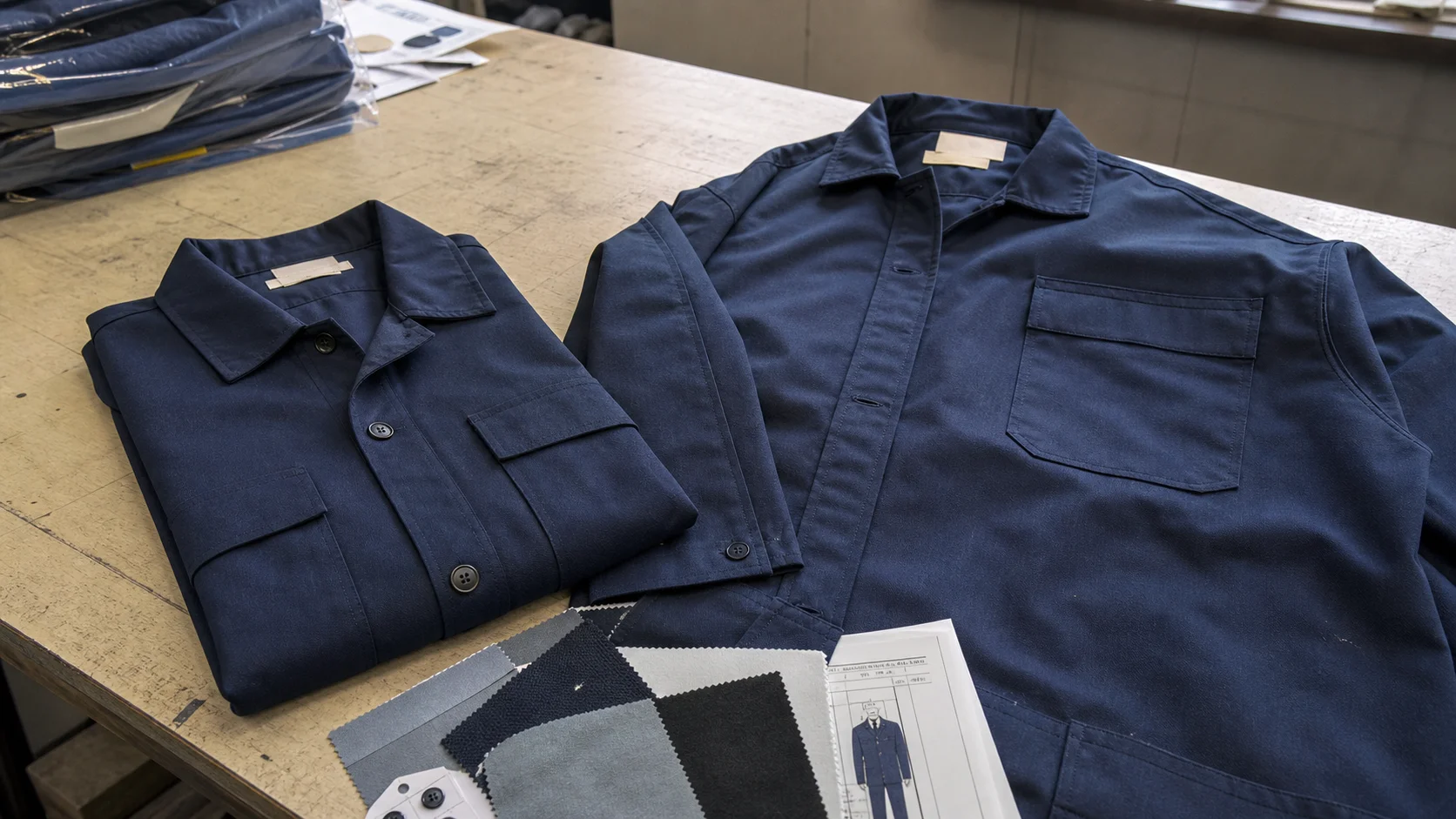
A quality and inspection focused outline for distributor buyers ordering custom service uniforms in bulk, covering fabric specs, decoration checks, size...
Service Uniform Bulk Order Guide for Distributors - Fabrikn production reference
Distributor buyers sit between two pressures: end customers want reliable, branded service uniforms that arrive on time, and factories need clear specifications before they can quote accurately. A custom service uniform bulk order is not complicated when the product is defined well, but it becomes expensive when fabric, sizing, trims, branding, packing, or inspection requirements are left open.
This guide is written for distributors sourcing service uniforms in bulk for maintenance teams, hospitality crews, cleaning companies, logistics staff, security providers, technicians, field service teams, and facility operators. The focus is quality and inspection, because most margin loss in uniform programs comes from avoidable defects: shade variation, unstable sizing, poor seam strength, weak embroidery placement, incorrect packaging, and late approvals.
For broader production support, distributors can review Fabrikn’s apparel manufacturing capabilities at https://fabrikn.com/services/. Buyers preparing a quotation pack can also contact the team through https://fabrikn.com/contact-us/.
Service uniforms are repeat-order products, but the first order often determines whether the program becomes profitable. If the first bulk shipment has inconsistent sizes or incorrect logo placement, the distributor absorbs replacement costs, customer complaints, and rush freight. A clear order process reduces that exposure.
Distributor orders are different from one-brand direct orders. A distributor may handle multiple end users, mixed logos, different departments, separate delivery locations, and reorder requirements. The factory sees one bulk order, but the distributor must manage many small obligations inside that order.
The practical goal is to convert a custom requirement into a repeatable manufacturing file. That file should include garment type, fabric, color standard, trims, measurement chart, grading rules, decoration method, artwork files, packaging method, carton markings, inspection criteria, and delivery schedule.
A service uniform bulk order should be treated as an operating program, not just a garment purchase. The more repeatable the specification, the easier it is to protect quality and reorder consistency.
Before asking for a factory quote, distributors should define the uniform program by use case. A cleaning uniform, security shirt, hotel maintenance set, warehouse polo, and automotive technician uniform may all sit under the “service uniform” category, but they do not need the same fabric, pockets, durability, or branding method.
These answers affect cost. A simple polo for indoor reception staff can use a different fabric and construction standard than a mechanic shirt exposed to oil, tools, and frequent abrasion. Buying the cheapest option across all roles usually creates performance complaints later.
Fabric is the largest quality decision in a custom service uniform bulk order. Buyers should not approve fabric by handfeel alone. The specification should include composition, weight, construction, color standard, finishing, shrinkage tolerance, colorfastness, and intended wash method.
For distributors, the safest route is often a proven stock fabric when the client needs moderate customization and reliable replenishment. Custom-dyed fabric can improve brand color matching, but it raises MOQ, development time, lab dip risk, and shade control responsibility.
Distributors should ask whether fabric is greige-dyed, yarn-dyed, piece-dyed, or stock available. Each route affects color consistency, lead time, and future reorder accuracy. If the end customer expects exact brand color, the buyer should provide Pantone, physical color swatch, or approved previous garment sample. Digital references are not enough for bulk production control.
Service uniforms are worn often, washed often, and judged quickly when they fail. Construction details should be selected for durability and repeatability, not just appearance. A low-cost shirt can become expensive if buttons crack, pockets tear, or seams open after several washes.
For work pants, crotch seams, waistband stretch, belt loop anchoring, pocket bags, and knee reinforcement deserve extra review. These are common failure points. For jackets, zipper smoothness, puller strength, lining attachment, sleeve mobility, and hem adjustment should be checked before bulk release.
Tradeoff matters here. Stronger construction may add cost and slightly increase garment weight, but it usually reduces after-sales claims in uniform programs. If the end customer has high staff turnover and short wear cycles, a mid-tier construction may be enough. If uniforms are expected to last a year of daily use, choose durability over the lowest FOB price.
Branding is where many custom service uniform orders become operationally messy. A distributor may need different logos by branch, department, language, or job title. Each variation should be listed clearly in the purchase order and artwork approval file.
Artwork should include vector files, logo dimensions, placement coordinates, thread or print color references, and an approved strike-off. For embroidery, request a stitch-out on actual or comparable fabric. For print and transfer, request a strike-off and wash test. A beautiful logo on a sample table means little if it fails after repeated laundering.
MOQ depends on garment type, fabric route, color, branding method, trim customization, and factory capacity. Distributor buyers should treat MOQ as a planning variable, not a fixed universal number.
Small MOQs are attractive, but the unit cost may rise sharply because cutting, setup, artwork, sampling, and packing work still exist. Large MOQs reduce unit cost, yet they increase inventory risk if the distributor has uncertain size demand or multiple end-customer logos.
The practical middle ground is to standardize base garments across customers where possible, then customize branding at the final decoration stage. This approach can reduce fabric risk and simplify reorders. It may not work for clients requiring exclusive colors or highly specific designs.
Sample approval protects both the distributor and factory. It should be structured, written, and tied to production standards. Verbal approval is not enough for a custom service uniform bulk order.
The pre-production sample is the most important sample. It becomes the quality benchmark for bulk inspection. If the buyer approves a sample with an unresolved issue, the factory may treat that issue as accepted. Distributors should record comments clearly: approved, approved with correction, or rejected for revision.
Lead time depends on how many elements are custom. A stock-fabric logo order can move faster than a custom-dyed, multi-style, multi-logo program. Distributor buyers should build an order calendar that includes quote clarification, sample making, sample shipping, approval time, fabric booking, production, inspection, packing, and freight.
Rush orders are possible in some cases, but they carry tradeoffs. Faster production often means fewer sample revisions, limited fabric choices, higher freight cost, and reduced buffer for inspection failure. If the distributor is launching uniforms for a fixed date, the safest decision is to lock the pre-production sample early and avoid late artwork or size-ratio changes.
Buyers should also consider peak manufacturing seasons. Factory capacity, fabric mill schedules, holidays, and shipping congestion can extend lead times. A distributor handling annual contracts should plan forecast discussions before the customer’s old stock runs out.
Fit problems create returns even when garment quality is acceptable. Distributor buyers should not rely only on generic size ratios. Workforces differ by region, gender mix, job role, and garment preference. A security team may prefer a looser fit for mobility, while hospitality staff may want a cleaner silhouette.
Measurement tolerance should be realistic. A woven shirt may have different tolerance than a knit polo or stretch pant. Common tolerances may range around plus or minus 1 cm for small points and 1.5-2 cm for larger body measurements, but the final tolerance should be agreed in the tech pack.
Distributors should avoid changing the size chart after sample approval unless the factory confirms the pattern update in writing. Late fit changes are a common cause of shipment inconsistency.
Quality inspection should be built into the order, not added after problems appear. For service uniforms, inspection must cover fabric, measurements, workmanship, decoration, labeling, packaging, and carton accuracy.
Many buyers use AQL-based final inspection, often with different limits for critical, major, and minor defects. Exact AQL levels should be agreed by contract. Critical defects may include safety hazards, sharp objects, mold, wrong logo, incorrect fiber label, or severe contamination. Major defects may include open seams, incorrect measurements outside tolerance, obvious stains, broken zippers, or wrong packaging. Minor defects may include loose threads, slight shading within accepted range, or small cosmetic issues.
Inspection reports should include photos, measurement tables, defect classification, carton count, barcode or label checks where relevant, and final pass or fail decision. If defects are found, the buyer should request a corrective action plan and re-inspection before shipment.
Packing is not just warehouse detail. It affects how quickly distributors can receive, sort, and deliver uniforms to end customers. Poor packing creates hidden labor cost even when the garments are acceptable.
Distributor buyers should confirm if the end customer needs employee-name packing, branch allocation, department bundles, or kit packing. These requirements can be handled, but they must be planned before production packing begins. Late kitting instructions can delay shipment and increase error risk.
Most service uniform problems are predictable. They happen when the order is treated as a simple apparel purchase instead of a controlled program.
A vague tech pack leads to inconsistent interpretation. Terms like “good quality fabric,” “standard fit,” or “logo on chest” are not production instructions. The buyer should define fabric, measurements, tolerances, placement, trims, and finishing.
Custom colors, custom buttons, special labels, multiple logo versions, and unique packaging can make sense for a large contract. At low volume, these details can raise MOQ and cost quickly. Distributor buyers should separate essential customization from nice-to-have customization.
Service uniforms are washed frequently. A product that looks good before washing may shrink, fade, twist, pill, or lose logo adhesion after laundering. Wash testing is especially important for dark colors, stretch fabrics, heat transfers, and industrial laundry use.
Changing logo size, thread color, or placement after strike-off approval can disrupt production. It also creates a risk that some units follow the old approval and others follow the revised file. Distributor buyers should freeze artwork before pre-production sample approval.
A first order may pass, but the reorder may differ if fabric, trim, and color standards are not recorded. Keep approved samples, lab dip records, trim codes, measurement charts, and inspection reports for future orders. Reorder consistency is one of the strongest profit drivers in distributor uniform programs.
Before issuing a purchase order, distributors should confirm the order file is complete. Missing details at this stage usually become production delays or quality disputes.
Buyers evaluating a manufacturing partner should also review company background, operating approach, and service scope. Fabrikn’s company information is available at https://fabrikn.com/about-us/.
The best custom service uniform bulk order is not always the cheapest. It is the order that satisfies the end customer’s wear requirements, keeps defects within acceptable limits, protects reorder consistency, and leaves the distributor with workable margin.
If the customer is price-sensitive and needs a short campaign uniform, choose stock fabric, simple branding, and standard packing. If the customer is a long-term facility, hotel group, maintenance provider, or logistics operator, invest more time in fit, wash testing, construction, and fabric continuity. The additional development work can reduce claims and make future reorders smoother.
Distributors should also be careful with promises. Do not promise exact delivery before samples are approved, fabric is secured, and artwork is frozen. Do not promise perfect shade matching without physical standards and dye-lot control. Do not promise industrial wash durability unless the garment and decoration have been tested under comparable conditions.
A disciplined order file helps both sides. The buyer gets clearer pricing and fewer surprises. The factory gets production instructions that can be followed and inspected. The end customer gets uniforms that look consistent, fit acceptably, and support their brand in daily service environments.
Get a free quote from Fabrikn — your trusted B2B clothing manufacturer with 10+ years of experience. MOQ as low as 200 pieces.
Get a Free Quote →Typical MOQ can range from 100-300 pieces per style and color when using stock fabric with custom logo decoration. Custom-dyed fabric, special trims, or private-label packaging may push MOQ toward 500-1,000 pieces or more, depending on the fabric mill and trim supplier.
A practical timeline is often 45-90 days from specification confirmation to finished bulk goods, though simpler stock-fabric orders may be faster. Lead time depends on sample approval speed, fabric availability, trim sourcing, order quantity, decoration complexity, inspection requirements, and freight method.
Distributors should check fabric, color, measurements, fit, construction, logo placement, decoration quality, trims, labels, care instructions, packaging, and workmanship. The pre-production sample should represent bulk production as closely as possible.
There is no single best fabric for every service uniform. Poly-cotton twill is common for work shirts and pants, polyester pique is common for polos, and ripstop or softshell fabrics may suit outdoor or field roles. The best choice depends on wear environment, wash method, comfort, durability, and budget.
Use vector artwork, approve a decoration strike-off, confirm exact placement measurements, define thread or print colors, and inspect the first bulk production pieces before full decoration continues. Logo errors are visible and often costly to repair.
Common issues include shade variation, shrinkage, poor seam strength, inconsistent sizing, logo misplacement, weak buttons or zippers, incorrect labels, loose threads, stains, and mixed packing. Most can be reduced with a complete tech pack, sample approval, inline inspection, and final random inspection.
Yes, it is often sensible to order extra units in core sizes if the end customer expects ongoing staff changes or replacements. The right buffer depends on workforce size, turnover, historical demand, storage cost, and reorder lead time.
Embroidery gives a professional and durable look on many polos, shirts, and jackets, but it can pucker lightweight fabric or distort detailed logos. Printing can work well for large designs and high-volume orders. The better method depends on fabric, logo detail, wash requirements, and budget.
Each logo variation should have its own artwork file, placement instruction, quantity breakdown, and packing allocation. Mixed-logo orders need strict SKU control so the factory can decorate, inspect, and pack without confusing customer-specific items.
Many buyers use AQL-based final random inspection with defined critical, major, and minor defects. The exact inspection level should be agreed before production. For higher-risk programs, add material inspection and inline inspection before final inspection.