
A distributor-focused outline for reviewing service uniform trim sourcing, with practical checks for quality, consistency, compliance, and buyer approval...
Service Uniform Trim Sourcing Review - Fabrikn production reference
For distributor buyers, a service uniform order is not just a garment purchase. It is a repeatable supply decision that has to hold up across branches, programs, and replenishment cycles. Trim sourcing is one of the easiest places for quality to drift and one of the hardest places to recover once production starts. A trim review should look beyond price and focus on consistency, fit-for-use, wash durability, lead time, and the supplier’s ability to match the same components across multiple production runs.
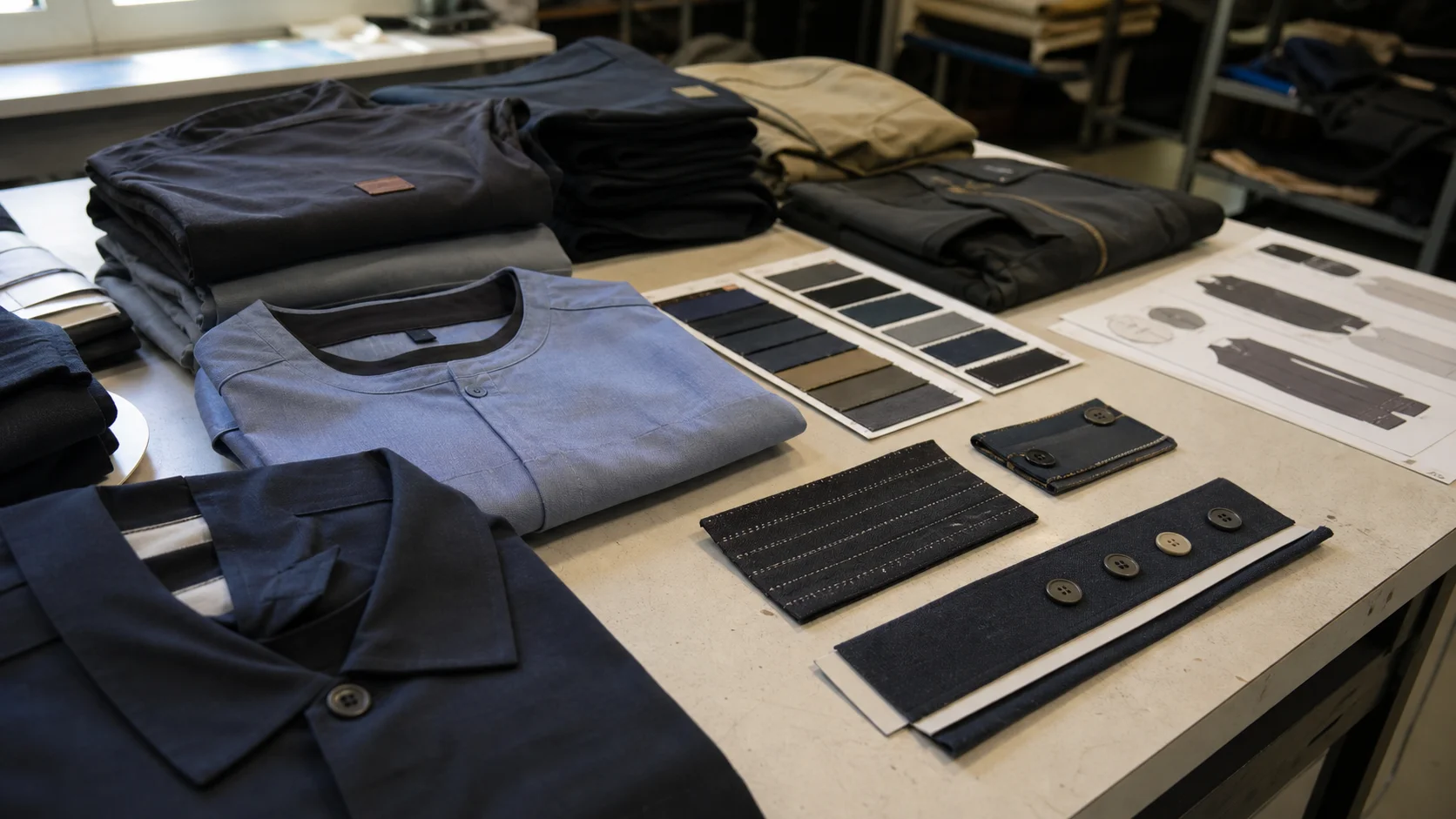
In service uniforms, trims are rarely decorative. Buttons, zippers, snaps, hook-and-loop tape, labels, badges, shoulder epaulets, piping, reflective tape, waistband elastics, drawcord tips, and pocket reinforcements all affect how the garment performs in the field. Small differences in these parts can create real issues: failure in industrial laundering, color mismatch, complaints about comfort, or a brand presentation that looks inconsistent across an entire route or staff group.
Distributor buyers usually need a sourcing approach that is practical and conservative. The right review process does not chase the cheapest trim line item. It asks what will stay consistent after the first order, what can be repeated at scale, and what inspection checkpoints are needed to reduce expensive surprises.
A proper trim sourcing review checks whether each component supports the garment’s intended use. That means reviewing technical specs, sample quality, supplier stability, packaging method, and whether the trim can survive the same wash and wear cycle as the uniform fabric. For service programs, especially hospitality, facilities, security, healthcare support, and field service, trims must do more than look acceptable in a showroom sample.
The review should answer a few basic questions. Is the trim material appropriate for the garment weight and fabric type? Can it be replicated across replenishment orders? Does the supplier understand shade tolerance, size tolerance, and performance testing? Are component approvals documented before bulk production? If the answer to any of those is unclear, the buyer is carrying unnecessary risk.
Trim sourcing also needs to account for how the garment will be distributed. A centralized program with regular replenishment can tolerate a slightly longer approval cycle if the trim is well controlled. A fast-moving distributor program with multiple customer locations needs more defensive sourcing: stable trims, clear alternate approvals, and tighter packaging and labeling control.
Distributor buyers tend to make stronger decisions when they rank trim criteria in order of impact rather than assuming all trims are equal. The first priority is function. The second is consistency. The third is presentation. Price sits inside those three, not above them.
This is where many programs lose money. A small savings on a button or zipper can turn into costly rework if the part breaks, the dye lot shifts, or the replacement trim is visibly different from the initial order. For distributor buyers, a trim line should be treated as a controlled component, not a commodity afterthought.
Different trims create different risk profiles. Some are easy to source, some are deceptively complex, and some need strict compatibility with fabric and laundering conditions. The review should treat each category separately.
Buttons seem simple, but they can fail in several ways. They may crack, discolor, loosen, or lose shape after laundering. If a garment has a polished front, a badge loop, or a visible placket, button finish becomes part of the customer-facing appearance. Buyers should specify material type, diameter, color reference, shank or sew-through style, and minimum pull strength if available.
For uniforms exposed to frequent washing, polyester resin or heat-resistant plastic buttons are often more practical than decorative alternatives. Metal buttons may be suitable for certain service styles, but they can introduce corrosion or discoloration risk if the finishing is not stable.
Zippers are a common source of complaints because one weak element can make the entire garment unusable. Review the coil width, tape composition, slider grade, top stop quality, and whether the zipper brand or generic equivalent is acceptable. For workwear-style service uniforms, buyers should also confirm whether the zipper is intended for light duty or repeated daily use.
Lead time for zippers can affect garment production if the supplier depends on a specific tape color or custom puller. If the trim is branded or color-matched, buyers should expect longer approval cycles and higher MOQ commitments than standard stock components.
Snaps and concealed closures are common in healthcare support, food service, and clean presentation uniforms. The main concern is retention strength. Poorly set snaps create returns, while weak hook-and-loop tape loses performance after repeated washing. Buyers should request sample pull tests or at least a documented quality standard for closure retention.
When a program has multiple size runs, closure placement should also be reviewed carefully. A part that looks correct on a medium sample may be slightly off-center or under tension on larger sizes if grading is not considered early enough.
Woven labels, heat transfer labels, size tabs, and brand badges can create both brand value and compliance risk. They need clarity in content, durable attachment, and acceptable comfort against the skin. If a uniform will be worn for long shifts, the inside label should not scratch or peel.
Care labels also matter. Distributor buyers should confirm language, fiber content, country of origin statements, and logo usage before approval. A label error is often more expensive to correct than a fabric issue because it can trigger relabeling or even full-order rejection.
Reflective tape and visibility trims require extra caution because end use may move beyond general service wear into safety-sensitive environments. Buyers need to verify width, reflectivity level, wash durability, heat resistance, and application method. If the trim is attached by stitch type or heat bonding, that attachment method should be reviewed as part of the approval.
Any program with safety requirements should treat third-party testing and customer specification matching as non-negotiable. It is risky to assume an off-the-shelf reflective trim will meet the same expectations as the original garment line.
These components often look minor but can affect comfort and repeatability. Elastic quality varies widely by elongation recovery, latex content, and wash shrinkage. Drawcords should be checked for tip quality, fraying, and color consistency. Piping and contrast edge trims require tight shade alignment with the base fabric, especially in hospitality and front-of-house uniforms where appearance standards are strict.
When a program depends on sharp visual consistency, the trim review should include both lab dips and physical trim swatches under daylight-equivalent light. A component that passes on paper may still look off in the garment.
A trim sourcing review is only useful if it is tied to a clear approval process. Many production failures begin with casual sample signoff. Distributor buyers should insist on a sequence that moves from trim submission to garment prototyping to pre-production confirmation before bulk cutting begins.
A cautious approval flow usually includes:
This process matters because trim problems are often hidden until the garment is assembled. A zipper may be fine in isolation but distort a lightweight fabric. A label may pass visual review but become uncomfortable after a wash. A button may match the color sample but not the bulk-dyed fabric lot. Once bulk production starts, the cost of replacement and rework climbs quickly.
Buyers should also be careful with “similar approved” substitutions. A supplier may propose a part that appears equivalent, but if the component changes even slightly in finish, tensile strength, or color tone, the substitution should be treated as a fresh approval item. That caution protects both the distributor and the end customer.
Trim sourcing for service uniforms often becomes a balancing act between volume and flexibility. Stock trims are easier to move quickly, while custom trims usually deliver better branding alignment but require more commitment. Distributor buyers should understand the typical tradeoff before locking in the purchase order.
Trim Type Typical MOQ Range Lead Time Pressure Buyer Judgment Standard buttons, snaps, basic zippers 500 to 5,000 pcs Low to moderate Best for repeat programs and fast replenishment Custom logo labels or pullers 3,000 to 10,000 pcs Moderate to high Useful for brand control, but harder to adjust later Color-matched trims 1,000 to 8,000 pcs Moderate Needs lab dip and physical approval before bulk Safety-related reflective trims 1,000 to 5,000 meters Moderate to high Testing and compliance should drive the decision Special finishes or branded hardware 5,000 pcs and up High Works only when forecast volume is stableThese are typical sourcing ranges, not fixed market rules. The real MOQ depends on whether the trim is stock, semi-custom, or fully custom; whether the supplier owns the tooling; and whether the material color is already available in production. Buyers should treat low MOQs with caution if the supplier cannot guarantee repeatability, because a one-time saving can create a replenishment problem later.
Lead time depends on more than trimming itself. It depends on the approval cycle, material availability, plating or dyeing requirements, packaging format, and whether the same component must be allocated to other customer programs. A trim that is “available” in the catalog may still be delayed if the supplier has not reserved enough quantity for the buyer’s order window.
For distributor programs, it is usually smarter to pay slightly more for a stable trim than to save money on a component that may be impossible to repeat. That judgment becomes even more important when the uniforms are tied to customer branding or a seasonal rollout.
Inspection teams often focus on garment measurements and overlook trim-specific defects. That is a mistake. Many returns happen because the trim defect is visible, functional, or both, even when the garment dimensions are acceptable.
Common failure points include:
Inspection should cover both random garment checks and targeted trim checks. If the style uses multiple trims, the buyer should ask the factory or inspection partner to verify attachment quality, size consistency, and packaging count. If the trim is decorative but visible, surface appearance matters as much as functionality. A polished front with a minor defect is still a defect.
One practical way to reduce risk is to define an accept/reject standard for each critical trim component before bulk production. If the buyer expects a zipper to withstand repeated use, that expectation should be written down. If a label must sit within a certain tolerance from the neckline, that should also be stated. Ambiguity always shows up later as a dispute.
Distributor buyers need a simple way to compare suppliers without getting lost in presentation decks. A useful scorecard should prioritize repeatability over promises. It should also reflect the fact that some suppliers are strong at sourcing generic components while others are better at custom development.
Criterion What to Check Why It Matters Spec control Clear material, size, color, and performance data Reduces errors in sourcing and reordering Sample discipline Accurate pre-production samples and revision tracking Prevents drift before bulk production Supply continuity Ability to repeat the same trim across seasons Protects replenishment programs Quality control Testing, inspection, and defect handling process Reduces reject rates and customer complaints Communication Fast response on alternates, approvals, and delays Helps buyers react before production slipsIn practice, the best suppliers are the ones who can explain tradeoffs without overselling them. If a trim supplier tells you a custom part is possible but requires longer lead time and higher MOQ, that is often a sign of healthy sourcing discipline. A supplier who says yes to everything without discussing risk is more likely to create problems later.
Before placing a service uniform order, distributor buyers should confirm that the trim spec sheet is complete enough for repeat production. A strong spec does not need to be complicated, but it should be specific.
When the spec is weak, the entire order becomes vulnerable to interpretation. A trim that was “close enough” on the first buy can become impossible to repeat cleanly later. That is especially true in distributor programs where multiple customers may reorder the same uniform style months apart.
For broader sourcing support, buyers reviewing uniform programs can also look at the service detail pages on fabrikn.com/services/, the company background on fabrikn.com/about-us/, and the inquiry path on fabrikn.com/contact-us/. Those pages are useful starting points when a buyer wants to align trim decisions with a wider production or development process.
A service uniform trim sourcing review is really a risk review. The buyer is deciding whether the uniform can be repeated reliably, inspected cleanly, and worn with confidence across the full order cycle. That requires more than selecting a good-looking sample. It requires disciplined attention to component specs, approval steps, supplier continuity, and inspection detail.
For distributor buyers, the safest approach is to treat trims as controlled production inputs. Prioritize function, repeatability, and traceability. Approve samples carefully. Challenge substitutions. Build in enough lead time for any custom or color-matched part. Most of all, avoid the false economy of saving a few cents on a trim that can create a much larger problem in the field.
If the sourcing process is structured well, trim decisions become a strength rather than a liability. That is the difference between a one-time uniform purchase and a repeatable service program.
Get a free quote from Fabrikn — your trusted B2B clothing manufacturer with 10+ years of experience. MOQ as low as 200 pieces.
Get a Free Quote →It is a review of all non-fabric components such as buttons, zippers, labels, snaps, reflective tape, and closures to confirm they meet quality, appearance, and repeatability requirements.
Typical MOQs vary widely. Standard stock trims may start around 500 pieces, while custom labels, branded hardware, or color-matched trims often require 1,000 to 10,000 units or more depending on the item.
Trims are small but highly visible and functional. If they crack, fade, loosen, or mismatch the garment, the defect is easy for end users to notice and hard to fix after production.
Yes. Separate trim approval is useful when the component has a color, strength, or finish requirement that could affect the final garment. Final approval should still happen on the assembled sample.
The main risks are trim substitution, color mismatch, weak attachment, incorrect placement, and poor wash performance. These issues often appear only when the garment is used or laundered.
Buyers can review the service overview at fabrikn.com/services/, learn more about the company at fabrikn.com/about-us/, or reach out through fabrikn.com/contact-us/.