
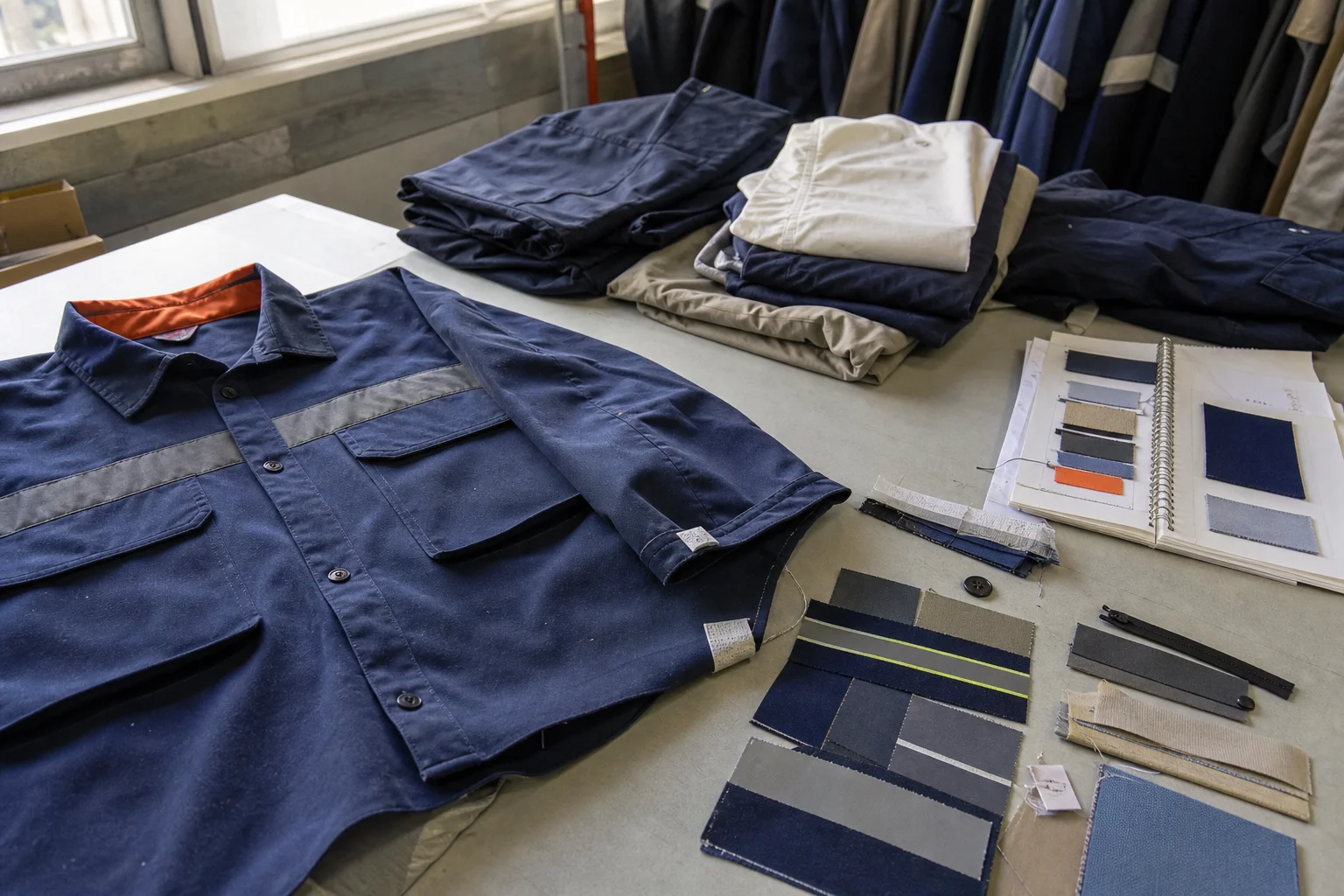
A buyer-focused review of wash testing for service uniforms, covering colorfastness, shrinkage, trim durability, decoration hold, and the pass-fail checks...
For distributor buyers, a service uniform wash test is not a cosmetic check. It is a practical verification step that shows whether a uniform program can survive repeated laundering, tumble drying, stain removal, and day-to-day handling without losing shape, color, or function. In category terms, this sits squarely in quality and inspection, because washing performance affects field appearance, replacement rates, customer satisfaction, and total landed cost.
When a buyer reviews service uniforms for wash performance, the goal is not to prove a fabric is perfect. The goal is to confirm whether the garment is fit for the intended end use, whether the supplier’s claims are realistic, and whether the approved sample can be repeated in bulk production. That distinction matters. A shirt that looks good out of the box can still be a poor choice if the collar twists, stitching puckers, logos crack, or shrinkage exceeds the agreed limit after five washes.
For sourcing teams that need a supplier baseline, Fabrikn’s services page is a useful starting point for understanding development and production support. Buyers evaluating vendor readiness can also review about us before shortlisting, then move to contact us when sample requests and testing requirements are ready.
Service Uniform Wash Test Review for Buyers - Quality & Inspection manufacturing guide
Distributor buyers sit in a difficult position. They are rarely buying one uniform style for one wearer. They are buying programs that may include multiple end users, multiple wash routines, and different compliance expectations. A hospital service shirt, a food service apron, a housekeeping tunic, and a mechanic’s work shirt all face different failure modes. Wash testing helps separate appearance claims from actual durability.
Wash performance directly affects resale and customer retention. A uniform that fades unevenly, shrinks after the first wash, or develops seam twist causes avoidable complaints. It also creates hidden cost. Buyers may need to replace entire size runs, manage returns, or renegotiate claims when the product fails sooner than expected. In a distributor model, those costs are rarely isolated to one order. They can damage a product line over time.
Wash review also protects the approval sample. The first sample often represents the best possible version of the garment, built with close attention and extra oversight. Bulk production is less forgiving. Thread type, dye lot, fabric finishing, seam tension, and trim quality can all drift. A wash test creates a checkpoint before that drift becomes a shipment problem.
A uniform that passes visual inspection but fails after laundering is not a strong product. It is a deferred complaint.
A useful wash review looks at the full garment, not just the fabric swatch. The buyer should assess appearance, dimensions, construction, and functional details after repeated wash cycles. The priority items depend on the end use, but the following checks are standard across most service uniforms.
Measure length, width, sleeve opening, collar width, and other critical dimensions before and after wash cycles. Shrinkage that looks small on paper can create fit issues in service. A 2 percent length loss may be acceptable in one program and unacceptable in another if the garment already fits close to body.
Color loss, crocking, and shade change matter for branded uniforms and multi-piece sets. A black trouser that grays out after a few washes or a navy polo that shifts noticeably creates inconsistent presentation across a team. Dark shades deserve particular attention because they often reveal laundering weakness faster than lighter colors.
Seams should remain straight, stable, and intact. Look for thread breakage, seam grin, skipped stitches, seam puckering, and twisting after laundering. Stress points at armholes, crotch seams, pocket openings, side vents, and button plackets deserve extra scrutiny.
Washing can alter softness, stiffness, and drape. Some buyers want a firm hand for professional appearance. Others need a softer feel for all-day wear. The issue is not whether the hand changes. The issue is whether the change is acceptable and consistent across lots.
Buttons, snaps, zippers, hook-and-loop tape, heat transfer logos, reflective tape, labels, and embroidered patches can fail before the base fabric does. Trims should be tested under the same laundering conditions as the garment, not treated as separate parts with separate assumptions.
Creasing, wrinkling, collar roll, distortion, gloss change, and surface pilling all affect uniform presentation. Buyers in front-facing service categories usually care about this as much as physical durability. A garment may technically pass washing yet still look tired too early.
Wash testing can be done in a lab, by a supplier, or through a third-party inspection path. The method should match the risk level and commercial stage. A preliminary sample review does not need the same depth as final production verification, but the test logic should stay consistent.
This is the most relevant test for many service uniform programs. Garments are washed under a controlled cycle that reflects normal use, then dried according to the target care method. The buyer evaluates results after each cycle or after set intervals such as five, ten, or twenty washes. This method is useful when the end user will wash uniforms in standard commercial or domestic machines.
Workwear and institutional uniforms often face harsher laundering than home laundry. Higher temperatures, stronger chemistry, and more aggressive drying can accelerate shrinkage and color loss. If the end user launders uniforms in a commercial setting, the garment must be tested against that condition rather than a gentler domestic standard.
Accelerated tests are useful when buyers need early warning before committing to a full order. These tests can reveal obvious failures in dye stability, finish retention, or trim performance. They do not replace real-use validation, but they help shortlist better options quickly.
Some failure modes only appear after washing and recovering from the dryer. Collar distortion, pocket wrinkling, logo cracking, and seam torque may not be obvious until the garment has rested. Buyers should inspect both immediately after drying and after stabilization.
Test Area What Buyers Look For Typical Risk if Weak Shrinkage Dimensional change across length and width Poor fit, rejected size run Colorfastness Shade retention, bleed, crocking Appearance complaints, brand inconsistency Seams Thread breakage, puckering, torque Premature failure in wear Trims Buttons, zippers, labels, transfers Functional defects and returns Pilling and hand feel Surface wear, roughness, fuzzing Shortened retail or contract lifeWash test results are only useful when the buyer has defined pass-fail thresholds in advance. A vague instruction such as “should hold up well” creates disputes later. A stronger approach is to define measurable limits tied to the product’s end use.
Common criteria include maximum shrinkage, acceptable shade variation, limited pilling, no seam failure, no button loss, and no logo cracking. The right threshold depends on fiber content, garment construction, and customer expectations. A cotton-rich knit behaves differently from a polyester blend. A premium corporate shirt has tighter appearance tolerances than a basic back-of-house apron.
Buyers should align the wash standard with the user environment. If the uniform will be cleaned frequently, a looser appearance threshold may be acceptable if the program values cost and replenishment speed. If the garment is tied to customer-facing brand presentation, appearance retention should be tighter, even if unit cost is higher.
Acceptance criteria should also account for component behavior. A garment can meet shrinkage targets and still fail because reflective tape peels, embroidery distorts, or fusible interfacing bubbles after washing. Those are not minor defects in a service uniform program. They are commercial defects.
Service uniform wash testing should be built into the development calendar, not treated as a late-stage check. The sample approval step matters because fabric, trim, and construction details affect wash results. If the buyer changes a yarn count, a zipper type, a heat transfer logo, or a collar insert after approval, the original wash result no longer applies.
Typical MOQ ranges vary by style, fabric, and decoration complexity. For standard service uniforms, buyers often see MOQs in the low hundreds per color or style. More technical garments, custom-dyed fabrics, or specialized trims can push the minimum upward. The buyer should confirm the MOQ before investing in wash testing, because a style that passes a sample test may still be commercially unattractive if the minimum order is too high for the channel.
Lead time also depends on testing scope. A basic sample round may take a short period, but full wash verification can add calendar time when third-party labs, fabric mills, or decoration vendors are involved. Buyers should plan for extra time if the garment includes:
A practical sourcing mistake is assuming the wash result from one sample automatically transfers to bulk production. That is only reliable when the supplier controls the same fabric, trims, machinery, and finishing route. A different batch of interlining or a changed thread specification can shift the result enough to matter.
Wash behavior begins with the material spec. Buyers often focus on visible style details, but the hidden drivers of performance are fabric composition, yarn quality, construction density, finishing chemistry, and trim compatibility. These should be locked down early.
Natural fibers usually offer comfort and breathability, but they can shrink or wrinkle more than synthetics if not engineered carefully. Polyester blends generally improve dimensional stability and drying speed. Cotton-poly blends are common in service uniforms because they balance comfort with easier care. The blend ratio matters, and so does the fabric construction.
Heavier fabrics often hold shape better, but they may feel warmer and cost more to launder. Light fabrics can be comfortable, yet they may show wear or distortion sooner. Jersey knits, twills, poplins, and dobby weaves all react differently to repeated washing. Buyers should not assume one construction can be swapped for another without changing the wash outcome.
Wrinkle resistance, soil release, anti-microbial claims, and water-repellent finishes can improve service performance, but they also add risk. Some finishes degrade after repeated laundering, while others interact poorly with heat or chemicals. The buyer should ask what finish is used, how long it is expected to last, and whether it has been tested under the intended wash conditions.
Thread type affects both strength and wash appearance. Polyester core-spun threads are often used where durability matters. Stitch density should balance strength and flexibility. Overly tight stitching can cause puckering after wash. Too loose, and the seam may not hold under repeated laundering.
Logos and name applications are common failure points. Embroidery can distort if the base fabric shrinks. Heat transfers can crack or lift. Screen prints can fade if curing or ink selection is weak. Buyers should confirm wash compatibility for every decoration method, not just the garment shell.
A wash test review should include risk thinking, not just pass-fail scoring. The same garment can pass a single test and still be risky if the production environment is unstable. Buyers should look for the signals that point to future complaints.
If the supplier cannot show stable fabric shade across lots, the wash result may vary by batch. This is especially important for multi-piece uniform programs where shirts, trousers, and outer layers must visually align.
Substituting a zipper tape, button material, label stock, or fusible insert can change wash performance. Buyers should require approval for substitutions, not just ask for a general “equivalent” promise.
Garments that are not properly pre-shrunk can pass initial checks and then fail after consumer washing. This is one of the most common avoidable issues in service uniforms because size consistency is central to repeat ordering.
Cracking at transfer edges, embroidery tunneling, and print adhesion loss are common after laundering. These defects may not affect wear safety, but they do affect uniform acceptance and brand image.
If the label care method is too optimistic, buyers inherit the risk. A garment marked for gentle washing may be used in harsher commercial conditions. Labeling should match actual end use, not ideal use.
Inspection teams should also watch for workmanship issues that become more visible after wash: loose threads, uneven hems, collapsed collars, twisted side seams, and bubbling around fused areas. These are often early signs that the bulk run will not match the sample standard.
A simple scorecard helps distributor buyers compare suppliers consistently. It prevents a situation where one supplier is chosen because the sample “looks good” while another is rejected for minor issues that might not matter commercially.
Category Weight What to Record Shrinkage High Measurement change by size point and garment zone Color retention High Shade change, bleed, crocking, visual consistency Construction integrity High Seam strength, puckering, thread condition, torque Trim performance Medium Button loss, zipper function, transfer or print damage Appearance retention Medium Wrinkle recovery, surface change, collar shape Commercial fit High MOQ, lead time, repeatability, risk of claimsThis kind of scorecard is useful because it separates technical performance from buying reality. A slightly more expensive garment may be the better choice if it reduces returns, extends replacement cycles, and protects the distributor’s margin. A low-cost garment that fails after a short wash cycle is not low cost in practice.
Buyers often face a familiar tradeoff: stronger wash performance usually means higher fabric cost, stricter process control, or more limited styling options. That does not automatically make the better-performing garment the correct choice. The right answer depends on the program.
For high-visibility service roles, appearance retention may justify a tighter spec and a higher unit price. For back-of-house or high-loss environments, a more durable but simpler construction may be the smarter purchase if it keeps replacement cycles manageable. The key is to make that decision deliberately, using wash evidence rather than assumptions.
Supplier credibility should also be judged on how they handle deviations. A good supplier does not just provide a sample and a promise. They should explain which component drives wash stability, what can be controlled in production, and where the known weak points are. Buyers should value that transparency because it reduces later disputes.
One practical approach is to request a pre-production sample, run it through the intended wash process, and compare it against the approved spec and measurement sheet. If the garment changes materially before bulk production starts, the buyer still has time to adjust construction, reject a weak trim, or tighten the spec. After shipment, options are much narrower.
A service uniform wash test review is a control point that protects both product performance and commercial margin. For distributor buyers, it should answer one question clearly: will this uniform still look and function acceptably after repeated laundering in the real use environment?
The best reviews are specific. They measure shrinkage, check colorfastness, inspect seams, verify trims, and compare results against agreed thresholds. They also connect the technical result to sourcing realities such as MOQ, sample timing, decoration method, and reorder consistency. That combination is what makes the test useful.
When buying service uniforms, the goal is not the cheapest sample. The goal is the least risky repeatable program. A disciplined wash test review gives buyers the evidence needed to make that call.
Get a free quote from Fabrikn — your trusted B2B clothing manufacturer with 10+ years of experience. MOQ as low as 200 pieces.
Get a Free Quote →It is a controlled review of how a uniform performs after washing and drying cycles. Buyers use it to check shrinkage, color retention, seam strength, trim durability, and overall appearance before approving production.
That depends on the end use and buyer standard. Many programs review early failure after a few cycles, then check longer-term performance at additional intervals. High-use uniforms usually need more than a single wash pass to be meaningful.
MOQs often start in the low hundreds per style or color, but they can rise with custom fabric, specialty finishing, or complex decoration. The exact minimum should be confirmed before the buyer commits to testing or approval.
There is no universal best fabric. Polyester-rich blends often provide better dimensional stability, while cotton-rich fabrics may offer better comfort. The right choice depends on the laundering method, appearance target, and wear environment.
Common early failures include shrinkage, seam puckering, print cracking, color loss, and trim damage. Collars and cuffs also show distortion quickly if the fabric or interfacing is not stable.
Yes. Embroidery, print, heat transfer, and reflective details can fail even when the base fabric performs well. Decoration should be tested under the same wash conditions as the garment itself.
Wash testing adds calendar time because samples must be produced, washed, evaluated, and sometimes corrected. Lead time increases further when third-party lab work, special finishes, or custom trims are involved.
A practical start is to align the service requirement, laundering method, and acceptance criteria before requesting samples. From there, buyers can review supplier capabilities on services, check background on about us, and submit technical questions through contact us.