
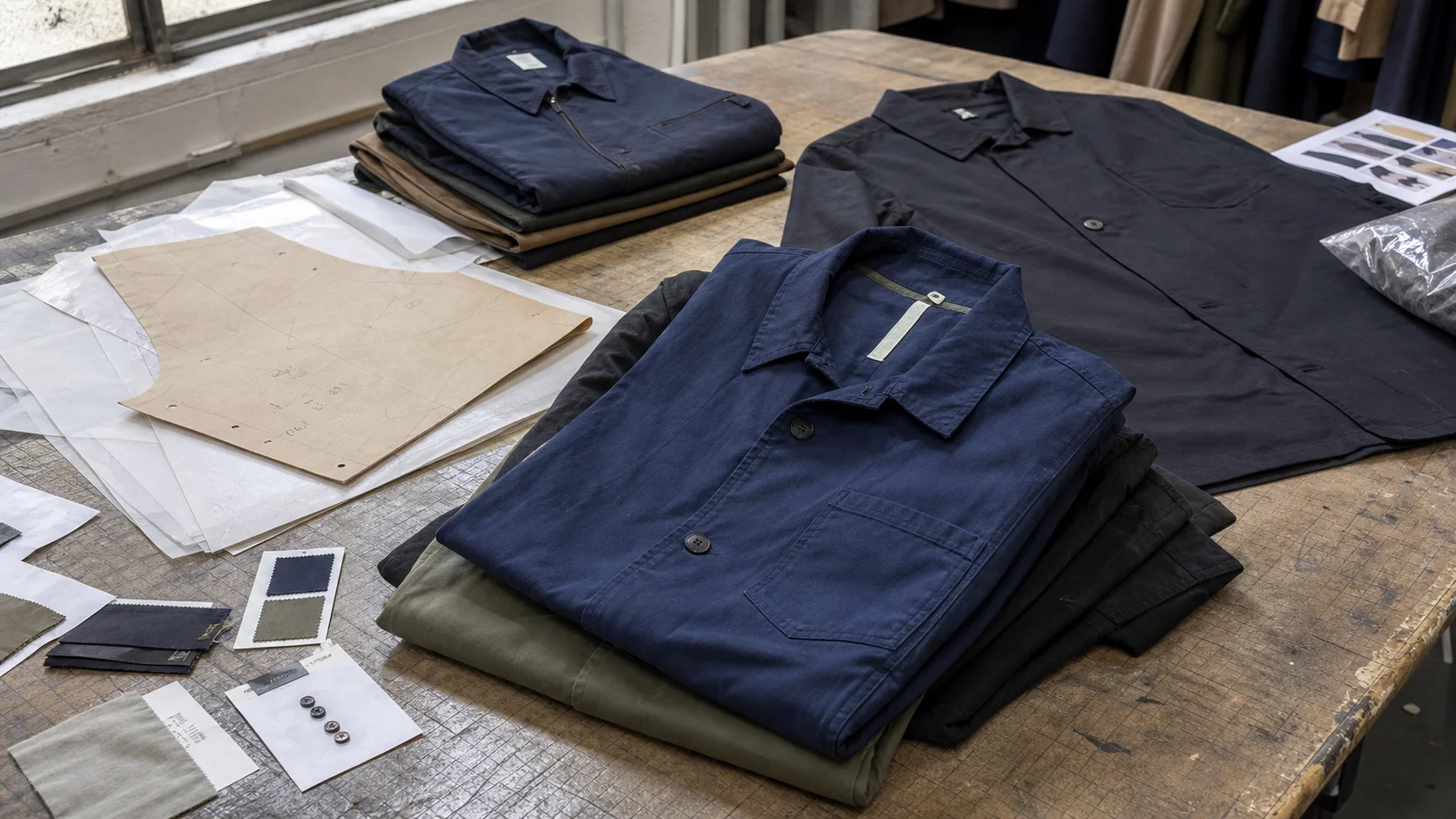
A product-specific outline for resort uniform buyers evaluating shop coat supplier size grading, fit consistency, spec sheets, samples, and production...
Shop Coat Size Grading Review for Resort Buyers - Outerwear & Jackets manufacturing guide
Resort uniform buyers source shop coats for more than back-of-house utility. A well-graded shop coat supports daily presentation, staff movement, laundry performance, and reorder consistency across departments. In resort environments, the same garment may be worn by engineering teams, spa maintenance staff, housekeeping supervisors, kitchen support crews, valet service teams, retail workshop staff, or activity attendants. Each group has different movement needs, body-size distribution, layering habits, and appearance standards.
This shop coat supplier size grading review is written for resort uniform buyers who need a practical way to evaluate fit before bulk production. The focus is not only on whether a supplier can make a shop coat, but whether they can grade it correctly across sizes, document the specification, control tolerance, and deliver repeatable sizing through future replenishment orders.
Size grading is the controlled adjustment of garment measurements from one size to the next. In a shop coat, grading affects chest width, sweep, sleeve length, shoulder width, armhole depth, across-back width, body length, pocket placement, and closure spacing. Resort buyers often focus first on fabric color, logo placement, and general styling. Fit sometimes gets checked late, usually after the first sample arrives. That timing creates risk.
A shop coat that fits only the medium sample size can fail badly once produced in XS, 2XL, or 4XL. Smaller sizes may have pockets that sit too low, sleeves that are too long, or shoulders that still feel broad. Larger sizes may pull across the back, restrict arm movement, gape at the front closure, or ride up when staff reach forward. These problems do not always show up in a flat measurement review. They appear during wear trials, especially in active resort roles.
Resort buyers should treat grading as a commercial issue, not a technical afterthought. Poor grading increases exchanges, emergency reorders, staff dissatisfaction, and inconsistent appearance across departments. It also complicates inventory planning because buyers cannot rely on the stated size curve. If a supplier’s large fits like a medium and the 2XL has narrow sleeves, the purchasing team ends up adjusting order ratios manually, often after the first delivery has already been issued to staff.
Purchasing judgment: a supplier with a slightly higher unit cost but stronger grading documentation is often safer than a lower-cost supplier that only confirms the base sample. Resort uniform programs depend on repeatable sizing, not just a good-looking first prototype.
The term “shop coat” can mean different things across resort operations. Before approving a size chart, buyers should define how the garment will be used. A light retail workshop coat has different grading requirements from a coat worn by engineering staff carrying tools or working outdoors in shoulder seasons.
Engineering staff need room through the chest, back, elbow, and bicep. They may reach overhead, kneel, bend, lift equipment, or wear the coat over a polo, work shirt, or light fleece. For this group, buyers should avoid overly slim grading. The coat should allow functional movement while still looking neat when staff are visible to guests.
Supervisory roles may need a cleaner silhouette because staff move between back-of-house and guest-facing areas. The coat may be worn over a blouse, shirt, or tunic. Sleeve length and pocket height matter because staff may carry keys, room lists, pens, or small devices.
These roles often require a softer appearance, lighter fabric, and more refined fit. A unisex shop coat may still work, but buyers should check whether the supplier can support women’s grading or at least a better unisex size curve. Poor shoulder grading is especially visible in wellness and retail settings where the uniform is part of the guest experience.
For kitchen-adjacent or service-support staff, laundering frequency, stain resistance, sleeve function, and closure security become more important. A coat used near food preparation may need specific fabric compliance or color separation by department. Buyers should confirm whether snaps, buttons, or concealed plackets are appropriate for the operating environment.
A size grading review starts with the intended fit profile. “Regular fit” is not enough. Resort buyers should ask suppliers to define the silhouette in measurable terms. Is the garment designed to fit over a T-shirt, polo, woven shirt, or mid-layer? Is the coat meant to close fully while staff are working, or is it often worn open? Is the hem intended to sit at the upper thigh, mid-thigh, or knee?
Most resort shop coats fall into one of three fit directions:
For unisex shop coats, buyers should be cautious with overly broad grading. A unisex medium often starts from a men’s block. That may work for some teams, but it can create long sleeves, wide shoulders, and boxy waist shaping for many female staff. One practical solution is to request two blocks: a unisex/men’s block and a women’s block. If budget or MOQ does not allow separate blocks, the supplier should at least provide a size set for fitting on different body types before approval.
The strongest uniform programs usually define fit by role. A resort may choose a more relaxed shop coat for engineering and a cleaner graded version for spa maintenance or retail workshop teams. Trying to force one fit across all departments can reduce purchasing complexity, but it often creates fit compromises that staff notice quickly.
A reliable shop coat size chart should include more than chest and length. Buyers should ask for a complete garment measurement specification with clear tolerance. Measurements should be taken on the finished garment, not body measurements, unless the supplier clearly separates body size guidance from garment specs.
Measurement Point Why It Matters Typical Review Concern Chest width Controls overall comfort and closure fit Too tight over polos or layers; too boxy in small sizes Shoulder width Affects appearance and arm mobility Over-graded shoulders in larger sizes or drooping shoulders in smaller sizes Across back Supports reaching and bending movement Pulling across shoulder blades during active tasks Armhole depth Controls sleeve mobility and comfort Armholes too low, causing body lift when arms are raised Bicep width Important for layered wear and active roles Narrow sleeves in XL and above Sleeve length Impacts professional appearance and safety Long sleeves in smaller sizes; short sleeves in tall wearers Body length Controls coverage and visual proportion Coats becoming too long in larger sizes if length grade is excessive Sweep Supports sitting, walking, and hip comfort Hem pulling across hips, especially in straight unisex blocks Pocket position Affects usability and size consistency Pockets not graded correctly across sizes Closure spacing Controls front appearance and gaping Top or waist closures placed poorly after gradingMeasurement tolerance should be realistic. For woven shop coats, common finished-garment tolerance may be around plus or minus 1 cm for smaller points and plus or minus 1.5 cm to 2 cm for larger circumference measurements, depending on fabric, construction, and production method. Tighter tolerance can be requested, but buyers should understand that it may increase inspection failure rates or cost if the garment is difficult to control in bulk production.
Grading rules vary by supplier, target market, and garment block. For resort buyers, the main goal is to confirm that the grade is logical across the full size range. A common problem is linear grading that works from S to XL but becomes awkward at 2XL, 3XL, and 4XL. Larger sizes often need more thoughtful distribution across chest, bicep, sweep, and back width, not just a wider body.
Typical adult shop coat programs may cover XS to 3XL, with some resort buyers requesting XXS or 4XL depending on workforce needs. Inclusive sizing is easier to manage when discussed before sampling. Adding extended sizes after production approval can require new pattern work, new fit checks, and sometimes higher MOQ by size.
Area Common Grade Direction Buyer Review Note Chest circumference Often 4 cm to 6 cm per size Check whether enough ease remains over base uniform layers Waist or mid-body Often follows chest or slightly less Avoid excessive boxiness if a cleaner resort look is required Sweep Often equal to or slightly greater than chest grade Important for hip comfort, walking, and seated tasks Shoulder width Usually smaller increments than chest Over-grading creates sloppy shoulders, especially in larger sizes Sleeve length Often 1 cm to 1.5 cm per size or grouped Consider short, regular, and tall needs if staff population requires it Body length Often 1 cm to 2 cm per size, sometimes grouped Large sizes should not automatically become excessively long Bicep circumference Often 1.5 cm to 3 cm per size Critical for maintenance and engineering rolesBuyers should request the supplier’s proposed grading rule before approving the full size chart. If the supplier only provides finished specs without explaining the grade logic, ask for clarification. A good supplier should be able to show how the base size expands into smaller and larger sizes, and where grade increments change for extended sizing.
One direct purchasing tradeoff is simplicity versus fit accuracy. A single unisex size run reduces SKU count and may lower MOQ pressure. Separate men’s and women’s grading improves fit but increases sampling, inventory, and forecasting complexity. For smaller resort programs, a well-tested unisex block may be acceptable. For larger properties, luxury positioning, or high staff visibility, the extra work of separate blocks often pays back through better appearance and fewer exchange issues.
Size grading cannot be reviewed in isolation from fabric and trim. A shop coat made in a stiff canvas will not fit or move like one made in a lighter poly-cotton twill. Fabric shrinkage, stretch, recovery, and laundering behavior affect final fit. Resort buyers should confirm fabric before locking size specs.
For resort use, fabric weight commonly falls somewhere around 160 gsm to 280 gsm depending on climate, department, and durability needs. A spa workshop coat may sit at the lighter end. An engineering shop coat may need midweight or heavier fabric. In hot-weather properties, breathability matters. In cooler destinations, buyers may choose a heavier fabric or allow enough grading ease for layering.
Trim choices affect both appearance and usability. Buttons look classic but can detach if construction is weak. Snaps are faster and practical for workwear, but poor-quality snaps can rust, pull out, or create puckering. Zippers are less common for traditional shop coats but may be suitable for modern utility jackets. Thread, interlining, pocket reinforcement, bar tacks, labels, and embroidery backing should all be included in the tech pack.
Practical trim specifications to confirm include:
Fabric shrinkage deserves special attention. If a coat shrinks 2% to 4% after industrial laundering, the approved measurements may not represent the worn garment after several wash cycles. Buyers should ask whether the supplier’s specs are before wash, after wash, or finished-garment measurements with expected shrinkage already considered. For resort laundries that use high heat or aggressive wash chemistry, a pre-production wash test is worth the time.
A disciplined sample process reduces risk before bulk production. Resort buyers should avoid approving a shop coat from a single photo or only one base-size sample unless the order is very small and the supplier has proven consistency. Fit samples, size sets, wash tests, and pre-production samples each serve a different purpose.
Not every order justifies every sample stage. A small reorder of an existing approved coat may only need a pre-production confirmation. A new resort-wide program should go through a more complete process. The cost of extra samples is usually lower than the cost of replacing ill-fitting stock across multiple departments.
Buyers should keep written approval records. Fit comments should be specific: “increase bicep by 2 cm in L to 3XL” is useful; “make sleeve more comfortable” is not. Comments should also specify whether changes apply only to one size, the base pattern, or the full grade rule. This is where many sourcing mistakes happen. A supplier may correct the sample size but fail to apply the adjustment across the complete size range.
Fabrikn’s apparel development and sourcing support can be reviewed through the services page for buyers who need help turning uniform requirements into production-ready specifications.
MOQ depends on fabric availability, trim customization, color, size range, branding method, and factory production setup. For standard fabric and simple branding, typical shop coat MOQs may start around 100 to 300 pieces per color. For custom-dyed fabric, special trims, extended size ranges, or multiple body blocks, MOQ may move closer to 500 to 1,000 pieces or more per color or style. These are typical sourcing ranges, not guarantees. A supplier may accept lower quantities at a higher unit price or with limited customization.
Resort buyers should ask whether MOQ applies per style, per color, per fabric, per size, or per purchase order. This distinction matters. A quoted MOQ of 300 pieces may sound manageable until the buyer learns that it applies per color and does not include separate women’s grading. Size distribution can also affect production planning. Suppliers may resist very small quantities in fringe sizes because cutting and bundling become less efficient.
Lead time for shop coats commonly depends on several moving parts:
For basic programs using available fabric, a development-to-delivery timeline might run around 8 to 12 weeks after confirmed specifications and sample approval. More customized programs can take 12 to 20 weeks or longer, especially if custom fabric, multiple approval rounds, or sea freight are involved. Buyers planning a resort opening, seasonal relaunch, or brand refresh should work backward from the staff issue date, not the guest launch date. Uniforms need time for receiving, inspection, allocation, alterations if allowed, and exchange handling.
Purchasing judgment: if the launch date is fixed, reduce complexity. Choose stock fabric, limit colorways, approve a proven fit block, and avoid late changes to logo placement. Custom details are valuable only if the timeline can absorb the sampling and production risk.
Inspection should check more than workmanship. For shop coats, the most serious bulk-production risks usually involve measurement drift, shrinkage, shade variation, weak seams, pocket placement inconsistency, and trim failure. These issues can pass a casual visual check but become obvious once uniforms are issued.
Bulk garments should be measured across sizes, not only in the base size. Inspectors should pull samples from different cartons and different size labels. If only medium is checked, a grading issue in 2XL or XS may go unnoticed. Buyers should agree on acceptable tolerance before production begins. Rejecting goods after delivery is harder if tolerance was never documented.
Resort uniforms are often seen in groups. Shade variation between fabric lots can make the program look inconsistent, especially in navy, charcoal, khaki, olive, white, and resort-specific brand colors. Buyers should request shade band approval when color consistency is important. If reorders are expected, it is wise to discuss fabric lot continuity or acceptable shade variation in advance.
A coat that measures correctly before wash may fail after laundering. Industrial wash conditions can reduce body length, sleeve length, and chest width. Shrinkage can also twist seams or distort pockets. Buyers should request wash test results or conduct internal laundering trials using the resort’s actual laundry process where possible.
Shop coats take repeated stress at pockets, side seams, underarms, cuffs, and closure points. Inspection should check stitch density, seam allowance, bar tack placement, loose threads, broken stitches, collar shape, sleeve setting, hem alignment, and snap/button security. For maintenance teams, pocket stress is a real issue because staff may carry tools, radios, pens, gloves, or small parts.
Logo placement should be graded intelligently. A chest logo that looks right on medium may sit too far toward the armhole in smaller sizes or too close to center in larger sizes if placement is not controlled. Buyers should specify logo position from clear reference points, usually center front, shoulder seam, or pocket edge, depending on design.
A capable shop coat supplier should be able to discuss sizing in practical terms. Buyers do not need a factory that overcomplicates the process, but they do need one that understands pattern grading, production tolerance, fabric behavior, and uniform end use. A supplier that only asks for a logo file and quantity is not asking enough questions for a serious resort program.
The answers should be clear and documented. Vague reassurance is not enough. If a supplier cannot explain sleeve grading, sweep measurement, or shrinkage allowance, the buyer should slow down before approving bulk production.
Buyers can learn more about Fabrikn’s background and operating focus through the about page. For resort buyers preparing a new uniform brief, the contact page is the right place to start a sourcing discussion.
A size curve is the planned quantity distribution by size. Resort buyers should not rely only on generic retail ratios. Staff demographics, department roles, regional body-size patterns, gender mix, and layering needs all affect the final curve. Engineering teams may require more L to 3XL stock. Spa or retail workshop teams may need more XS to M. A property with international seasonal staff may have a different distribution from a resort with long-term local teams.
For first orders, buyers can use current uniform issue data if available. If historical data is poor, a fitting session before bulk order can reduce risk. Staff can try size-set samples and the buyer can record preferred size by department. This also helps identify whether the garment block is wrong before production. If many staff size up because sleeves are tight or shoulders restrict movement, the pattern needs adjustment rather than a larger order in bigger sizes.
Resorts should also hold a small buffer for new hires, damaged garments, and seasonal staff changes. A common buffer may be 3% to 10%, depending on staff turnover and reorder lead time. High-turnover departments or remote resorts may need more. The buffer should not be made only in medium and large. It should reflect actual issue patterns.
Although shop coats are often lighter than jackets, they sit within the broader outerwear and jacket sourcing category because they cover the upper body, involve structured fit, and often serve a protective or professional function. Buyers who normally purchase jackets should not assume the same grading logic applies without adjustment. Shop coats may be longer, straighter, and more pocket-driven. They may also be worn indoors for long periods, making heat comfort and sleeve mobility more important than weather protection.
If the shop coat needs to coordinate with other outerwear, such as softshell jackets, rain jackets, or utility vests, buyers should align the size naming. Staff should not wear medium in one garment and XL in another unless the fit purpose is clearly communicated. Inconsistent size naming creates avoidable exchange volume and staff frustration.
Layering is another issue. A shop coat worn under a jacket needs a different sleeve and body length strategy from a shop coat worn as the outermost layer. If staff will wear the coat over a polo and under a resort-branded jacket, buyers should test the full system, not each garment separately.
Better grading can add cost through pattern work, size-set sampling, extended-size development, separate men’s and women’s blocks, or extra inspection. These costs are not wasteful if the program is large or visible. The question is where the added spend reduces risk.
For small internal teams, a stock shop coat with minor branding may be enough. Buyers should still check measurements and shrinkage, but a full custom block may not be necessary. For larger resort groups, luxury properties, or programs where the coat is part of the brand presentation, custom grading becomes more defensible. Better fit improves staff confidence and reduces the visual mismatch that occurs when garments are oversized to compensate for poor movement.
Extended sizes also need a clear purchasing decision. Offering 4XL or 5XL supports inclusivity and may be necessary for workforce needs. The buyer should confirm whether those sizes are graded from the same block or specially adjusted. Simply scaling up the pattern can create poor armhole shape, excessive length, or weak pocket proportion. Extended sizing should be treated as pattern work, not just extra fabric.
Before confirming a shop coat order, resort buyers should move through a practical checklist. This keeps the conversation with suppliers focused and reduces the chance of approving an attractive sample that fails in operational use.
A shop coat supplier size grading review should give resort buyers confidence that the garment will work across the real staff population, not just in a sample room. The strongest buying approach combines a clear fit profile, complete measurements, fabric testing, size-set review, and inspection discipline. This is especially important when the shop coat supports both operational performance and resort presentation.
The key decision is not whether the cheapest supplier can make a coat that looks close to the reference. The key decision is whether the supplier can control fit, grading, shrinkage, trims, and repeat orders with enough consistency for a uniform program. Resort buyers should reward suppliers that ask detailed questions, provide transparent specifications, and support practical sample approvals.
Good size grading protects the buyer from avoidable exchanges and protects staff from uniforms that restrict their work. It also protects the resort brand. When shop coats fit properly across departments and sizes, they look intentional rather than improvised.
Get a free quote from Fabrikn — your trusted B2B clothing manufacturer with 10+ years of experience. MOQ as low as 200 pieces.
Get a Free Quote →Size grading is the process of increasing or decreasing garment measurements across a size range. For shop coats, this includes chest, shoulder, sleeve, body length, sweep, armhole, bicep, and pocket placement. Good grading keeps the garment functional and proportional from smaller sizes through extended sizes.
Many resort programs use XS to 3XL, with XXS or 4XL added depending on staff needs. Buyers should confirm extended sizing before sampling because larger sizes may require adjusted pattern work rather than simple scaling.
Typical MOQs may range from 100 to 300 pieces for simpler programs using available fabrics, while custom colors, special trims, or separate fit blocks may require 500 to 1,000 pieces or more. Exact MOQ depends on the supplier, fabric source, and customization level.
Unisex sizing reduces SKU complexity and can work for smaller or back-of-house teams. Separate men’s and women’s blocks usually improve fit and presentation, especially for guest-visible departments. The tradeoff is higher sampling, inventory, and MOQ complexity.
For a new resort uniform program, buyers should approve fabric and trims, a base-size fit sample, selected size-set samples, and a pre-production sample. A wear trial is strongly recommended when staff movement is active or the order quantity is significant.
The main risks are measurement drift, shrinkage, shade variation, weak pocket reinforcement, poor sleeve mobility, inconsistent logo placement, and trim failure. Bulk inspection should include multiple sizes, not only the base size.
A basic program using available fabric may take around 8 to 12 weeks after confirmed specs and approvals. More customized programs can take 12 to 20 weeks or longer, especially when custom fabric, size-set sampling, lab dips, and sea freight are involved.
Many shop coats fall around 160 gsm to 280 gsm depending on climate and department use. Lighter fabrics suit warm resorts and spa or retail teams. Midweight or heavier fabrics may be better for engineering, maintenance, or cooler environments.