
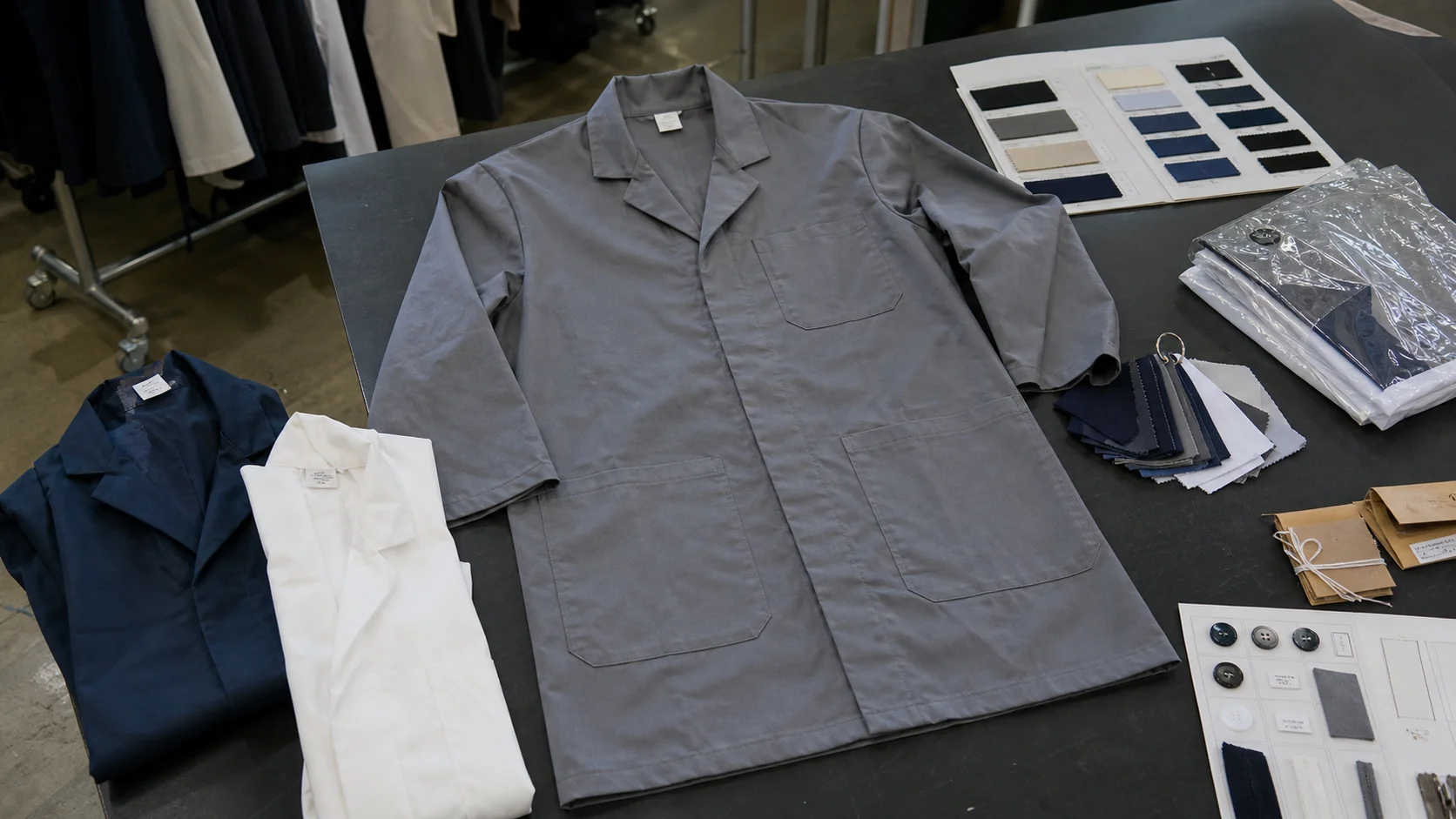
A product-specific audit outline for corporate uniform buyers evaluating shop coat vendors, covering fabric durability, pocket construction, closure...
Shop Coat Audit Brief for Uniform Buyers - Outerwear & Jackets manufacturing guide
Shop coats sit in a practical category between light outerwear, workplace jackets, and protective uniform layers. For corporate uniform buyers, they are not just “white coats with buttons.” A shop coat program has to survive daily wear, repeated industrial laundering, department-level size distribution, brand approval, and compliance checks across multiple work sites.
This audit brief is built for buyers sourcing shop coats for maintenance teams, automotive service departments, engineering staff, lab-adjacent work areas, facilities teams, production supervisors, and technical service crews. It focuses on vendor evaluation, garment specifications, sampling, MOQ planning, production controls, and inspection risks.
The goal is simple: reduce rework, avoid inconsistent bulk quality, and make sure the supplier can support a repeatable corporate uniform program rather than a one-off garment order.
A shop coat vendor audit is not only about checking whether a supplier can sew a coat. It is about confirming whether the supplier can maintain the same garment standard across sizes, production lots, fabric deliveries, logo applications, and repeat orders.
Uniform buyers usually face different pressures from retail apparel buyers. The garment has to fit a mixed workforce, hold a professional appearance, and remain available for replenishment. A poorly controlled shop coat program can create operational problems: mismatched colors between departments, inconsistent sleeve lengths, weak snaps, failed embroidery, and shrinkage complaints after the first wash cycle.
For corporate buyers, the audit should answer five commercial questions:
Shop coats often look simple on a quotation sheet, but failures tend to show up in daily use. Pockets pull out when overloaded. Cuffs fray. White or light-colored fabric yellows. Snap tape twists. Embroidery puckers on thin twill. Button placement shifts from size to size. These are not exotic problems; they are normal production risks when specifications and vendor controls are weak.
A good vendor audit does not try to find a perfect supplier. It identifies whether the supplier’s strengths match the uniform program’s real usage, budget, and replenishment requirements.
Before auditing a vendor, define the intended use. A maintenance shop coat, a service advisor coat, and a lab-style coat may share a similar silhouette but require different fabric weights, pocket structures, closure types, and appearance standards.
Maintenance teams need durable fabric, practical pockets, and easy movement. A mid-weight poly-cotton twill is common because it balances durability, cost, and laundering stability. Buyers should pay close attention to shoulder mobility, sleeve length, pocket bar tacks, and closure strength.
Automotive shop coats often require soil resistance, darker colors, concealed closures, and reinforced pockets. Loose buttons can be a concern around vehicles or equipment. Covered snaps or hidden plackets may reduce surface contact risks. Branding is usually visible, so embroidery quality and logo placement need firm approval standards.
These users may need a cleaner appearance rather than heavy-duty protection. Lightweight twill, poplin, or blended fabrics may be suitable. The tradeoff is durability. If supervisors move between offices and production floors, the coat should look neat while still resisting snagging and regular washing.
Not all shop coats are certified lab coats. If the garment is used in environments requiring flame resistance, chemical resistance, antistatic properties, or other protective claims, the buyer must request supporting test reports and confirm the intended standard. A basic uniform shop coat should not be represented as protective PPE unless the product and documentation support that claim.
A shop coat vendor audit should start with capability, not price. Low unit cost has limited value if the supplier cannot handle your size range, fabric testing requirements, branding standards, or replenishment plan.
Review the vendor’s experience with uniform outerwear and work jackets. A supplier focused only on fashion coats may not understand industrial laundering, pocket loading, or repeat-order shade control. A supplier focused only on basic workwear may struggle with premium corporate branding or strict presentation standards.
Buyers comparing vendor options can review broader sourcing and production support through Fabrikn’s services. For uniform programs with multiple garment categories, it is usually better to assess shop coats as part of a wider apparel sourcing plan rather than as an isolated SKU.
Fabric selection is the core of shop coat performance. Most corporate uniform buyers consider fabric based on appearance, durability, wash behavior, comfort, and price. The right choice depends on the workplace and laundering method.
For many corporate programs, a 65/35 polyester-cotton twill or similar blend is a practical starting point. It usually offers better wash stability than pure cotton and better comfort than polyester-heavy fabric. Buyers should still test actual fabric rather than relying on composition alone. Two fabrics with the same blend can perform differently because yarn count, weave density, dyeing, and finishing all matter.
Light colors show oil, ink, and shop soil quickly. Dark colors hide stains but may show lint, fading, and shade variation. White shop coats can look professional, but they require stronger laundering discipline and better fabric quality to avoid a worn appearance after repeated use.
Shop coats are often judged by fabric first, but construction determines how the garment survives real use. The audit should inspect seam strength, pocket attachment, closure alignment, collar shaping, and finishing consistency.
Uniform buyers should request seam type details. Basic overlock construction may be acceptable for some light-duty coats, but higher-stress areas benefit from stronger stitching and reinforcement. Bar tacks at pocket corners are not optional for most shop environments. If workers carry tools, pens, gauges, scanners, or notebooks, pocket stress becomes a predictable failure point.
Buttons, snaps, concealed snaps, zippers, and hook-and-loop closures all have tradeoffs.
Closure Advantage Risk Buttons Classic appearance, low cost, easy replacement Can detach; less suitable around scratch-sensitive surfaces Snaps Fast use, clean uniform look Poor setting can cause pull-out or cracking Concealed snaps Reduces contact with surfaces, neat appearance Higher sewing complexity and cost Zipper Secure closure, modern look More expensive and can fail if low quality Hook-and-loop Easy access, adjustable Collects lint and may look worn quicklyFor automotive, machinery, and equipment-adjacent users, concealed closures are worth considering. They add cost but reduce the chance of exposed hardware scratching work surfaces.
Fit problems are common in shop coat programs because one garment must cover many body types and job movements. The coat should allow layering over shirts or polos without looking oversized. It should also allow reaching, bending, and sitting.
The audit should review the vendor’s measurement chart, grading rules, tolerance table, and size-set samples. Buyers should not approve production from only one medium sample unless the order is very small and low risk.
Typical uniform size ranges may run from XS to 5XL, with some programs needing tall sizes or women’s-specific blocks. Extended sizes often affect MOQ and production planning. A vendor that can technically produce 5XL but has no proven grading discipline may create coats that are larger in chest but poorly balanced in shoulder, sleeve, and length.
For mixed-gender teams, buyers should decide whether to use a unisex block, separate men’s and women’s fits, or a relaxed fit with adjusted size guidance. A unisex coat simplifies ordering and inventory. Separate fits usually improve wearer satisfaction but increase SKUs, MOQ pressure, and stock complexity.
Corporate shop coats often carry a logo, name patch, department label, or color-coded trim. Branding is highly visible, so the audit should include decoration capability and trim consistency.
Embroidery should be tested on actual bulk fabric, not only on a generic swatch. Dense logos can distort thin fabric. Small text may become unreadable. Buyers should approve thread colors under normal workplace lighting, not only on a digital mockup.
Trim substitution is a common sourcing risk. If the approved snap or button is unavailable, the vendor may suggest an alternative. Buyers should require written approval before any trim change. Small substitutions can affect appearance, laundering performance, and long-term reorder consistency.
Typical MOQ ranges for custom shop coats vary by vendor, fabric availability, decoration method, and size distribution. For stock fabric with standard colors, practical MOQs may start around 100–300 pieces. For custom-dyed fabric, special trims, or private-label production, MOQs often move into the 500–1,000 piece range or higher. Very low MOQ custom orders may be possible, but unit cost and consistency can suffer.
Buyers should separate three MOQ questions:
A 500-piece MOQ sounds manageable until it becomes 500 pieces per color and per gender fit. If the program has five departments, four colors, and extended sizing, SKU count grows quickly. The audit should include a clear discussion of size breakdown, reorder MOQ, and overage policy.
The lowest quote may remove cost from areas the workforce will notice: fabric hand feel, pocket strength, closure quality, or shrinkage control. A small unit saving can become expensive when coats fail early or need emergency replacement.
Uniform buyers planning broader corporate apparel sourcing can speak with a production specialist through Fabrikn’s contact page to align MOQ, specification, and delivery needs before locking a vendor brief.
Sampling should be treated as a controlled approval process, not a casual preview. Each sample stage should answer a specific question. Skipping stages may save time early but create expensive problems once bulk fabric is cut.
The pre-production sample should use actual or production-intent fabric, trims, labels, and branding. If the vendor submits a sample with substitute fabric or temporary trims, the buyer should treat it as conditional only. Bulk approval requires confirmation that all final components are locked.
Buyers should avoid vague comments such as “make better” or “improve fit.” A vendor needs measurable direction: reduce sleeve length by 2 cm, raise pocket by 1.5 cm, increase back width by 2 cm, or change snap spacing to match the approved sample.
Shop coat lead times depend on fabric availability, trim sourcing, sample approvals, production capacity, decoration, inspection, and shipping method. A basic stock-fabric order may move faster than a fully custom uniform program. A realistic schedule should include decision time on the buyer’s side, not only factory production time.
These ranges are general. Actual timing depends on order quantity, vendor capacity, fabric mill schedule, holiday periods, approval speed, and shipping route. Buyers should build a buffer for sample revisions, lab dip rejections, and inspection corrections.
A vendor that promises unusually short lead times should explain exactly how they will achieve them. Fast production is useful only if fabric, trims, and labor capacity are already secured. A rushed program with unresolved specifications usually produces higher defect rates.
Inspection planning should start before production, not when cartons are ready to ship. Shop coats have predictable risk areas, and buyers should define acceptable quality limits, measurement tolerances, and defect classifications in advance.
Measurement tolerances should be realistic. A tolerance of plus or minus 1 cm may be reasonable for some key points, while larger garments and less critical points may allow slightly more. Tight tolerances increase inspection failures if the vendor’s pattern and cutting controls are not strong.
Important points of measurement usually include chest, shoulder, sleeve length, center back length, pocket placement, sweep, collar, and cuff opening. Buyers should specify whether measurements are taken flat, buttoned or snapped, and after pressing.
Inline inspection helps catch issues while production can still be corrected. It is useful for checking stitch quality, pocket reinforcement, placket alignment, logo placement, and size consistency. If the first 20–30% of production shows repeated problems, the vendor should stop and correct the process before completing the full run.
Final inspection should verify finished goods against approved samples and purchase requirements. For corporate uniform buyers, carton accuracy matters as much as garment quality. A shipment with mixed sizes, wrong department labels, or missing logo placements can disrupt distribution even if the sewing is acceptable.
The approved pre-production sample should be the inspection standard. If the vendor and buyer are judging against different references, disputes become likely.
A disciplined shop coat vendor should be able to provide the basic documents needed for quotation, production, and inspection. The level of documentation may vary by order size, but corporate buyers should not rely on verbal agreements.
Testing requirements depend on use. For a standard uniform coat, buyers may request basic fabric performance testing. For any protective claim, stronger documentation is needed.
Buyers should be cautious with generic test reports. A valid report should relate to the actual fabric or garment being ordered, not only a similar product. If the report is old, incomplete, or issued for another material, it may have limited value.
A scorecard helps buyers compare vendors consistently. It does not replace judgment, but it reduces the chance that a low price distracts from operational risk.
Audit Area What to Review Risk if Weak Fabric capability Composition, weight, shrinkage, color control Poor wash performance or shade mismatch Construction quality Seams, pockets, closures, reinforcements Early garment failure Fit control Pattern, grading, size set, tolerance High wearer complaints and size exchanges Branding execution Embroidery, patches, placement, color match Corporate appearance inconsistency MOQ flexibility Initial order, color MOQ, reorder MOQ Inventory overbuy or stock gaps Lead-time reliability Sample schedule, production capacity, trim availability Late rollout Documentation Spec sheet, BOM, approvals, test reports Disputes and unclear accountability Inspection readiness Inline checks, final QC, packing accuracy Defective or mispacked shipmentScore each area from 1 to 5, then apply weighting based on program needs. A shop coat used in a high-soil maintenance environment should weight fabric and construction more heavily. A customer-facing technical service program may weight branding and appearance more heavily. A national rollout should weight replenishment and packing control heavily.
Uniform buyers often face pressure to secure a low unit price, but shop coats reward practical specification choices. Overbuilding the garment can inflate cost and reduce comfort. Underbuilding it can shorten service life and damage wearer acceptance.
There is no universal best shop coat specification. A 240 gsm twill may be right for durability but too warm for some indoor facilities. A lightweight poplin may look clean and feel comfortable but fail faster in a tool-heavy setting. Concealed snaps may improve function around equipment but raise cost and require better production control.
The strongest purchasing decision is usually a balanced one: enough durability for the role, enough comfort for daily wear, enough branding control for corporate standards, and enough vendor discipline for reorders.
A clear audit brief makes vendor comparison easier. It also signals to suppliers that the buyer is serious about specifications and accountability.
Companies evaluating broader apparel supply partners can learn more about sourcing philosophy and supplier coordination through Fabrikn’s about page. For shop coat programs, this kind of structure helps connect design intent with production execution.
Some supplier responses should trigger extra caution. A red flag does not always mean the vendor is unusable, but it does mean the buyer should ask for proof, samples, or written clarification before moving forward.
Buyers should also watch for overconfidence. A vendor that says every requirement is easy may not have understood the program. Good suppliers ask practical questions about laundering, usage, fit, size ratios, and delivery priorities.
A shop coat vendor audit should focus on repeatable execution. The best supplier is not simply the one with the lowest price or the nicest first sample. It is the one that can lock the specification, control fabric and trims, manage sizing, produce consistent branding, and deliver accurate cartons on schedule.
For most corporate uniform buyers, the safest path is to define the use case first, approve real samples, verify fabric and trim details, and inspect production against a written standard. That approach reduces surprises and gives both buyer and vendor a fair reference point.
Shop coats are practical garments. The audit should be practical too: clear specifications, realistic tolerances, honest tradeoffs, and enough documentation to protect the program when production moves from sample table to bulk order.
Get a free quote from Fabrikn — your trusted B2B clothing manufacturer with 10+ years of experience. MOQ as low as 200 pieces.
Get a Free Quote →A shop coat vendor audit is a structured review of a supplier’s ability to produce shop coats for a corporate uniform program. It usually covers fabric, construction, sizing, branding, MOQ, lead time, documentation, and inspection controls.
Typical MOQs may start around 100–300 pieces for stock fabrics and standard colors. Custom fabric colors, special trims, private labels, or complex branding often require 500–1,000 pieces or more. Buyers should confirm MOQ per style, color, size, and decoration type.
Poly-cotton twill is a common practical choice because it balances durability, wash stability, comfort, and cost. Pure cotton may feel more natural but can shrink more and require more maintenance. Polyester-rich blends improve wash stability but may be less breathable.
Buttons are low cost and easy to replace, while snaps provide faster closure and a cleaner uniform appearance. Concealed snaps are useful around equipment or vehicles because they reduce exposed hardware. Poor-quality snaps can pull out, so they must be tested during sampling.
Most corporate programs should review at least a fit sample, fabric approval, logo strike-off, size set, and pre-production sample. Smaller or lower-risk programs may reduce stages, but bulk production should not start until final fabric, trims, sizing, and branding are approved.
Common problems include shrinkage, shade variation, weak pocket stitching, snap failure, embroidery puckering, incorrect logo placement, sleeve length inconsistency, wrong size labels, and poor packing accuracy.
Stock-fabric orders may take around 4–8 weeks after final approval. Custom fabric, special trims, extended sizes, or complex branding may take 8–14 weeks or more. Lead time depends on approvals, fabric availability, production capacity, inspection, and shipping.
Basic shop coats are usually uniform garments, not PPE. If the coat is intended to provide flame resistance, chemical resistance, antistatic protection, or another safety function, the buyer should request valid test reports and confirm the garment meets the required standard.
Buyers should inspect fabric quality, measurements, seam strength, pocket reinforcement, closure function, logo placement, size labels, care labels, shade consistency, pressing, cleanliness, and carton packing accuracy. The approved pre-production sample should be used as the main reference.
Keep a complete approved specification package, including fabric details, trims, measurements, logo placement, sample records, and inspection criteria. Confirm fabric availability before reorders and require written approval for any material, trim, or construction substitution.