
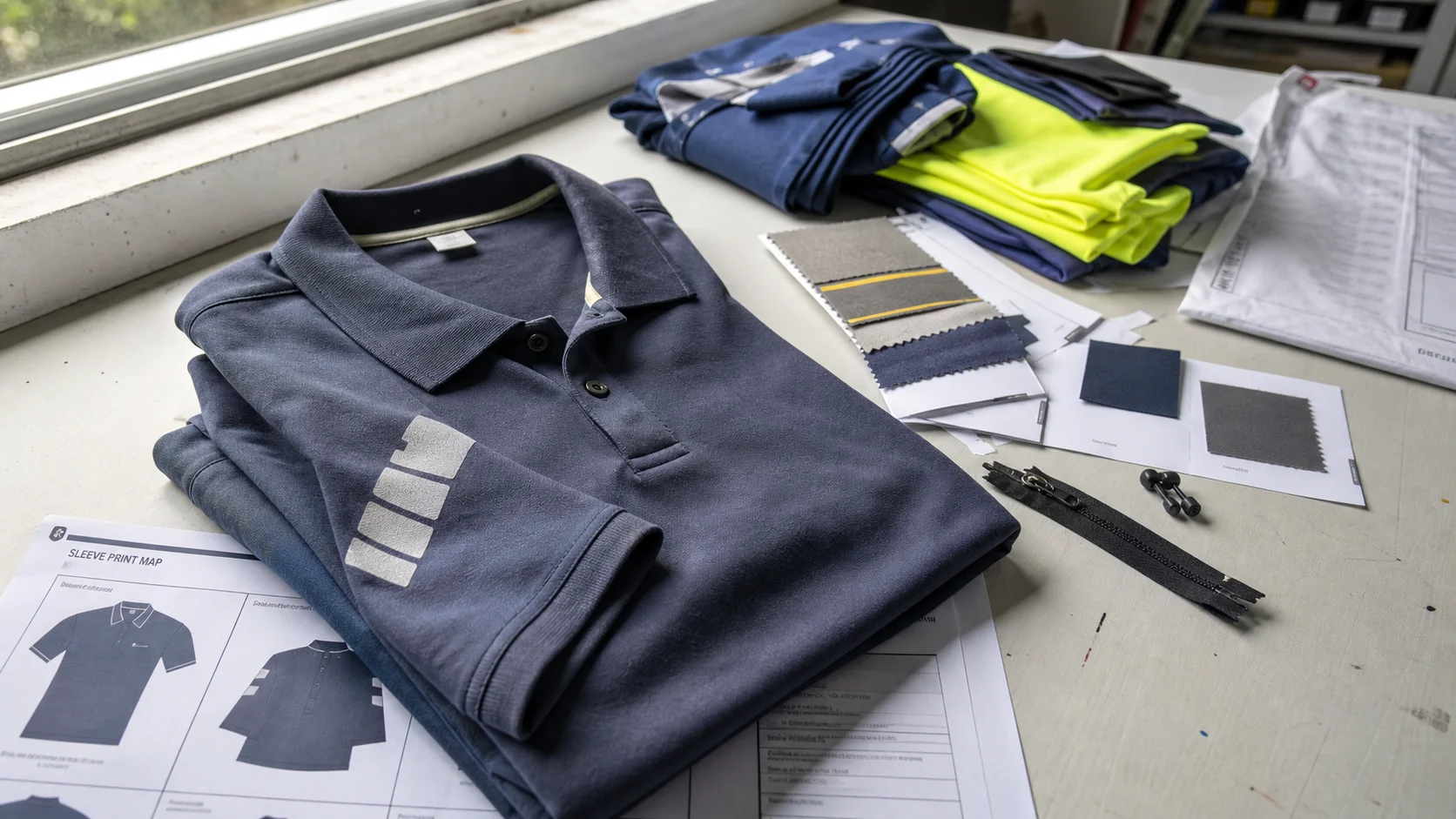
A sourcing-focused outline for buyers evaluating sleeve print maps, trim details, and decoration supplier readiness for cleaning crew uniforms.
Sleeve Print Maps for Cleaning Crews: Sourcing Review - Decoration & Printing manufacturing guide
For cleaning crew uniforms, sleeve print maps are not a minor artwork detail. They control where a logo, department label, certification mark, safety message, or color-coded role identifier sits on the sleeve after cutting, sewing, washing, and daily movement. A poor sleeve map can make a professional uniform look inconsistent across staff, especially when crews work in hotels, hospitals, offices, schools, industrial sites, and public buildings where branding and quick identification matter.
This sourcing review covers sleeve print map supplier selection, trim coordination, artwork approval, production risks, and purchasing tradeoffs for cleaning crew apparel. The focus is practical: what to request from suppliers, what to check before bulk production, and where buyers often lose control between decoration, trims, and garment assembly.
A sleeve print map is the placement guide that tells the factory exactly where sleeve decoration should appear on a garment. It usually includes artwork dimensions, distance from the shoulder seam, distance from cuff edge, orientation, print angle, sleeve panel position, size grading instructions, and tolerance allowance. For cleaning crew uniforms, the map may apply to short-sleeve polos, long-sleeve work shirts, scrub-style tops, jackets, coveralls, aprons with sleeve attachments, or high-visibility outerwear.
The map is not the same as the logo file. A logo file shows the design. A sleeve print map explains how that design should sit on the finished garment. Without it, the supplier may position artwork based on operator judgment, template availability, or a generic placement chart. That can work for low-risk promotional apparel, but it is weak for uniform programs where repeat orders must match previous deliveries.
Common sleeve print map elements include:
For cleaning crews, sleeve print maps often support functional identification. A sleeve may show “Supervisor,” “Sanitation,” “Floor Care,” “Housekeeping,” “Maintenance Support,” or a client-facing service logo. In some programs, color coding is combined with printed text or a patch to separate teams by shift, building area, or chemical-handling authorization.
Cleaning crew apparel has a different wear profile from standard office uniforms. Workers bend, lift, wipe, carry equipment, push carts, handle chemicals, and move through both public and back-of-house areas. Sleeve decoration needs to remain visible, durable, and consistent after repeated laundering. It also must avoid areas that rub heavily against carts, buckets, straps, and gloves.
For a buyer, sleeve placement control matters for three reasons: branding, function, and repeatability. Branding is the visible part. If one cleaner has a sleeve logo near the shoulder and another has it near the elbow, the uniform program looks poorly managed. Function is more direct. If a supervisor marker is hidden under a jacket cuff or placed too far inside the arm, it fails its purpose. Repeatability is the sourcing issue. A program may reorder the same uniform every quarter, and the supplier must reproduce the same position without renegotiating artwork each time.
Purchasing judgment: if sleeve decoration is part of staff identification, treat the sleeve print map as a controlled production document, not as a design suggestion.
Cleaning crew uniforms also pass through frequent wash cycles. The sleeve zone may experience more twisting and abrasion than the front chest. Poorly selected transfer films can crack. Thick prints can feel uncomfortable when the arm bends. Embroidery on lightweight sleeves can pucker if backing, stitch density, and fabric weight are not balanced. Reflective print may lose performance if the supplier uses low-grade film or incorrect curing.
A sleeve print map supplier should therefore understand both decoration and garment construction. The best quoting package is not only a logo file. It should include garment spec, fabric composition, trim list, sleeve pattern information if available, size range, wash requirement, packing format, and target order quantity. Buyers who only ask for “logo on sleeve” usually receive wider variance in bulk.
A reliable sleeve print map supplier for cleaning crew apparel should be able to manage three linked areas: artwork engineering, decoration execution, and production documentation. Some apparel factories handle all three internally. Others subcontract printing or embroidery to a decoration partner. Both models can work, but the buyer needs to know who controls the final placement and who signs off before bulk production.
When reviewing suppliers, ask for evidence of process rather than broad promises. Useful questions include:
Decoration timing is a major sourcing decision. Printing on flat sleeve panels before sewing can improve registration and reduce handling difficulty. It is often suitable for screen printing, sublimation, and some heat transfer applications. Printing after garment assembly can help align decoration to the finished sleeve, especially where sleeve length or seam position varies. It can be slower and may require sleeve platens or specialized equipment.
The right choice depends on garment design. A simple short-sleeve polo with a small logo may work well with post-assembly heat transfer. A long-sleeve woven shirt with a large wrap-style graphic may need panel printing before sewing. A reflective strip on a work jacket sleeve may require strict alignment with seam lines and safety standards.
Suppliers should also understand cleaning crew use conditions. Garments may require industrial laundry compatibility, bleach resistance, low-lint fabric, antibacterial finish, fluid-repellent treatment, or high-visibility trim. A supplier focused only on fashion decoration may not question whether the print can survive alkaline detergent, heat drying, or disinfectant exposure.
For broader manufacturing support, buyers can review apparel development and production options through Fabrikn services. The key is to connect decoration planning with the full garment specification before the purchase order is placed.
The phrase “sleeve print map supplier trim sourcing review for cleaning crews” points to an important reality: sleeve decoration does not stand alone. Trims affect placement, comfort, durability, and final appearance. A sleeve logo can be technically correct on the map but visually wrong if it conflicts with reflective tape, cuff binding, pen pockets, rib cuffs, seam tape, woven labels, or badges.
Cleaning crew uniforms may include the following sleeve-related trims:
Trim sourcing must be reviewed before print map approval. If reflective tape is later added to the sleeve, the logo may need to move. If the cuff changes from a plain hem to rib, the sleeve length and visual balance may shift. If a pen pocket is included, it can block the preferred print zone. If a woven patch replaces a printed logo, stitch margin and backing requirements change the placement tolerance.
Buyers should request a trim card with physical references or approved digital specifications. For sleeve-sensitive items, the trim card should include width, color, material composition, supplier code if available, finish, wash rating, and application method. Reflective trims should include brightness performance claims supported by supplier documentation where relevant. Hook-and-loop should specify nylon or polyester, color, width, stitch margin, and cycle durability expectation.
Trim Type Sourcing Concern Sleeve Print Map Impact Reflective Tape Brightness, wash durability, heat resistance May require minimum clearance from printed logos and seams Rib Cuff Stretch recovery, color match, shrinkage Changes distance from cuff edge and sleeve visual balance Pen Pocket Position, reinforcement, bartack quality May block left or right sleeve decoration area Woven Patch Edge finish, backing, color accuracy Requires stitch allowance and flat sleeve surface Seam Tape Adhesion, waterproof rating, heat setting Limits print placement near sealed seamsPurchasing judgment: trim changes after sample approval are one of the fastest ways to create sleeve placement problems. Lock trims and print maps together, then approve them as one production package.
Cleaning crew uniforms commonly use cotton-poly blends, polyester pique, interlock knit, twill, poplin, softshell, fleece, ripstop, and sometimes protective fabrics depending on the working environment. Sleeve print performance changes by fabric type. Polyester can dye-migrate into light-colored heat transfers. Cotton-rich fabrics may shrink more, shifting print position after washing. Stretch fabrics need flexible inks or transfer films. Coated fabrics may resist adhesion unless the decoration method is tested.
Typical fabric specifications to confirm include:
Print method should be selected based on fabric, order quantity, artwork complexity, durability requirement, and hand feel. Screen printing can be cost-effective for larger runs and simple colors. Heat transfer is flexible for smaller batches, multi-color logos, and repeat programs with variable names or departments. Embroidery offers a professional look but can pucker on lightweight sleeves and may feel bulky. Reflective transfer adds visibility but needs careful wash and heat testing. Silicone and high-density prints can provide a premium tactile effect, though they may be unnecessary for cleaning crew uniforms unless the brand requires it.
Decoration Method Best Use Main Risk Purchasing View Screen Print Medium to large runs with simple artwork Cracking, color variation, poor curing Good value when artwork and quantities are stable Heat Transfer Small to medium runs, complex logos, variable departments Peeling, dye migration, heat marks Flexible, but film quality must be specified Embroidery Premium logos, badges, supervisor identifiers Puckering, stiffness, thread snagging Strong appearance, less ideal for large sleeve graphics Reflective Transfer Visibility and safety markings Reduced reflectivity after washing Useful where visibility matters, not just decoration Woven Patch Removable or structured identification Edge fray, poor stitching, discomfort Good for role labels if placement is testedArtwork files should be supplied in vector format when possible. Buyers should provide AI, EPS, SVG, or production-ready PDF files, plus Pantone references. For embroidery, DST or equivalent stitch files may be created by the supplier after digitizing. For heat transfer, the supplier may need cut lines, bleed areas, and film references. For screen print, buyers should confirm color separations, mesh suitability, ink type, and curing requirements.
Do not rely on screen appearance for color approval. Sleeve logos on navy, charcoal, royal blue, white, and safety yellow fabrics can look different under factory lighting and workplace lighting. Lab dips, strike-offs, or print swatches are useful where color control is important.
A disciplined sample approval process prevents most sleeve print map problems. The process should start before the salesman sample or pre-production sample is made. If the buyer waits until bulk production to question sleeve placement, the supplier may already have cut panels, prepared transfers, or set screens.
A practical approval sequence looks like this:
For sleeve placement, the pre-production sample is more important than a standalone print swatch. A swatch shows print quality. It does not prove that the logo sits correctly on the sleeve after sewing. The sealed sample should show the exact placement on the correct size, often medium or large. For wide size ranges, buyers should request graded placement guidance for small and extended sizes.
Size grading is often overlooked. If the logo is placed 8 cm below the shoulder seam on all sizes, it may look acceptable on medium but too high on 4XL or too low on XS depending on sleeve length and armhole shape. Some programs use a fixed distance from the sleeve hem. Others use proportional placement based on sleeve length. The best rule depends on which visual reference matters more when worn.
Cleaning crew uniforms often include both men’s and women’s fits. A sleeve print map approved on a unisex size large may not transfer cleanly to a women’s fitted polo with shorter sleeves. Buyers should avoid assuming one placement rule works across all patterns. If the program includes multiple garment bodies, each body needs its own print map or a clearly approved exception.
For help discussing development steps and production documentation, buyers can contact the team through Fabrikn contact. Early clarification is usually cheaper than correcting bulk decoration.
Minimum order quantity depends on garment type, fabric sourcing, trim availability, decoration method, and supplier setup. Sleeve print map work itself may not have a large MOQ, but the garment and decoration inputs usually do. Buyers should separate garment MOQ from decoration MOQ in supplier quotes.
Typical MOQ ranges for cleaning crew uniform sourcing are:
These ranges are not universal. They are planning ranges for buyers preparing RFQs. A supplier may accept lower quantities using available blank garments and digital transfer decoration. A fully custom uniform with dyed fabric, custom rib, printed sleeves, and private labels will usually require higher MOQ.
Price should be reviewed in layers. The garment unit cost is only one part. Buyers should ask suppliers to break out artwork setup, screen charges, embroidery digitizing, transfer mold or cutting setup, patch development, trim surcharge, sample fee, courier fee, testing fee, and packing cost. A low unit price can become less attractive if every reorder carries repeated setup charges.
Cost Item What to Check Buyer Risk Artwork Setup One-time or repeated per order Unexpected reorder charges Screen Charge Number of colors and screens Higher cost for small runs Embroidery Digitizing Stitch count and file ownership Inconsistent logo if re-digitized later Transfer Film Film grade, wash rating, color stability Peeling or dye migration Trim Development Patch, tape, cuff, label MOQ Delays and shade mismatch Inspection Inline and final inspection scope Placement defects found too latePurchasing judgment: for cleaning crew programs with frequent reorders, a slightly higher first order cost may be acceptable if the supplier maintains controlled print maps, trim records, and repeatable production settings. The cheapest quote is often weak when the buyer needs consistency across months or locations.
Lead time for sleeve print map production depends on the number of approvals and whether the buyer uses stock blanks or custom manufacturing. A simple stock polo with a sleeve heat transfer can sometimes be completed in a few weeks after artwork approval. A custom cut-and-sew uniform with special trims, fabric testing, and decorated sleeves can take much longer.
Typical lead-time planning ranges are:
The biggest delays usually come from incomplete artwork, late trim changes, fabric shade approvals, failed wash tests, unclear placement tolerance, and buyer-side approval gaps. Sleeve print map sourcing is faster when the buyer provides a complete brief at the start.
A good RFQ package should include:
Buyers should also decide who approves what. If procurement approves cost, marketing approves logo color, operations approves sleeve role labels, and compliance approves reflective trim, the timeline can stretch unless responsibilities are assigned early.
Inspection for sleeve print maps must cover both measurement and appearance. A logo can be within measurement tolerance but still look tilted, distorted, puckered, cracked, or visually inconsistent from one sleeve to another. Cleaning crew uniforms are usually worn in groups, so small inconsistencies become more visible.
Key inspection checkpoints include:
Inspection risk is higher when the supplier decorates sleeves manually without jigs, templates, or clear measurement points. Heat transfer placement can drift if operators align by eye. Screen printing can shift if sleeve panels are not loaded consistently. Embroidery can rotate slightly if the sleeve is not hooped correctly. Reflective tape can wrinkle if applied over curved seams or stretch zones.
Buyers should require inline inspection for larger orders. Waiting until final inspection may be too late, especially if all sleeves have already been decorated and assembled. Inline checks can catch template errors after the first production batch. Final inspection should compare bulk garments against the sealed sample and approved print map.
Defect Likely Cause Prevention Logo too low or too high Unclear reference point or operator drift Approved map with fixed measurement and tolerance Logo tilted Sleeve not loaded squarely Use placement jig and inline checks Transfer peeling Incorrect heat, pressure, film, or fabric finish Test bulk fabric and lock application settings Embroidery puckering High stitch density or weak backing Adjust digitizing, backing, and thread tension Reflective trim conflict Trim added after map approval Approve trim card and sleeve map together Shade mismatch Uncontrolled ink, thread, or transfer color Use Pantone, thread codes, and approved strike-offsFor cleaning crew uniforms, reject criteria should be realistic. A 1 mm tolerance may be unrealistic for many bulk garment operations. A 0.5 cm to 1.0 cm placement tolerance is more practical for many sleeve decorations, though high-end programs or safety-critical markings may need tighter control. The tolerance must match the decoration method and garment construction.
Buyers sourcing sleeve print maps for cleaning crews should approach the project as a uniform system. The garment, sleeve artwork, trims, wash requirements, and inspection plan all affect each other. A supplier that can print a logo is not always the right supplier for a repeat uniform program.
The strongest buying approach is to start with the operational use case. A hotel housekeeping team may need a refined logo and supervisor identifier. A hospital cleaning team may need industrial laundry durability and low-lint fabric. A school janitorial team may need role labels and easy reorder capability. A warehouse cleaning crew may need reflective sleeve elements and abrasion-resistant fabric. Each case points to different fabric, trim, and decoration choices.
Recommended sourcing actions:
There are tradeoffs. Heat transfer is flexible and often efficient for smaller runs, but cheap film can fail quickly. Screen print can be economical for larger orders, but color changes and setup costs reduce flexibility. Embroidery looks durable and professional, but it can be uncomfortable or puckered on lightweight sleeves. Reflective trims support visibility, but they add sourcing complexity and may affect wash care. Woven patches allow role changes, especially with hook-and-loop bases, but they can catch lint and edges may fray if poorly made.
For buyers comparing suppliers, the best quote is not always the lowest unit price. The best quote is the one that makes placement, trim quality, wash durability, and repeat order control clear. Cleaning crew uniforms are workwear. They need to survive movement, laundering, and public-facing use. Sleeve print maps should be specified with the same discipline as fabric weight, size specs, and carton packing.
Buyers who want to understand production capability, sourcing approach, and company background can review Fabrikn about us. For decoration and uniform sourcing, the priority is to define the technical package before chasing final price.
Sleeve print map sourcing for cleaning crews sits at the intersection of decoration, trim sourcing, and uniform production control. The sleeve is a small area, but it carries visible brand and role information. If the map is vague, the risk moves into bulk production, where correction is expensive.
A buyer should approve four things together: artwork, placement, trims, and wash performance. If one changes, the others may need review. A sleeve logo that looks fine on a sample can fail if the cuff trim changes, the supplier switches transfer film, or the production team applies the mark to all sizes using the wrong reference point.
The practical recommendation is straightforward. Use a controlled sleeve print map, request production-fabric samples, define tolerances, confirm trim interactions, and inspect early. That approach reduces avoidable disputes and gives cleaning crews a consistent uniform appearance across sites, teams, and reorders.
Get a free quote from Fabrikn — your trusted B2B clothing manufacturer with 10+ years of experience. MOQ as low as 200 pieces.
Get a Free Quote →A sleeve print map is a technical placement guide for sleeve decoration. It shows the artwork size, sleeve side, measurement points, print angle, tolerance, and grading rules across sizes.
Cleaning crew uniforms are often worn in groups and used in public-facing environments. Consistent sleeve placement supports branding, role identification, and a more professional appearance across staff.
For stock garments with heat transfer or embroidery, typical MOQs may start around 50-200 pieces. Custom cut-and-sew uniforms often start around 300-800 pieces per style and color, while special fabric or trim programs may require higher quantities.
There is no single best method. Heat transfer works well for flexible smaller runs, screen print suits larger stable artwork, embroidery gives a premium look, and reflective transfer is useful for visibility. The right choice depends on fabric, wash requirements, artwork, and budget.
Both options can work. Panel printing before sewing can improve flat registration for certain graphics. Post-assembly decoration can align better to the finished garment but may require special equipment and closer operator control.
Reflective tape, rib cuffs, elastic cuffs, pen pockets, woven labels, hook-and-loop patch bases, seam tape, and sleeve binding can all affect where artwork should be placed.
Many uniform programs use a tolerance around 0.5 cm to 1.0 cm, depending on garment construction and decoration method. Tighter tolerance may be possible but should be confirmed with the supplier before production.
Buyers should approve artwork, sleeve print map, fabric, trims, decorated sample, wash performance if required, and final tolerance. A sealed pre-production sample should be kept as the reference for inspection.
Common risks include wrong sleeve side, crooked artwork, inconsistent placement, transfer peeling, dye migration, embroidery puckering, shade mismatch, and conflicts with cuffs, pockets, or reflective trims.
Buyers should require the supplier to maintain approved artwork files, print maps, trim cards, application settings, and sealed samples. Repeat orders should reference the same controlled documents rather than starting from a new verbal instruction.