
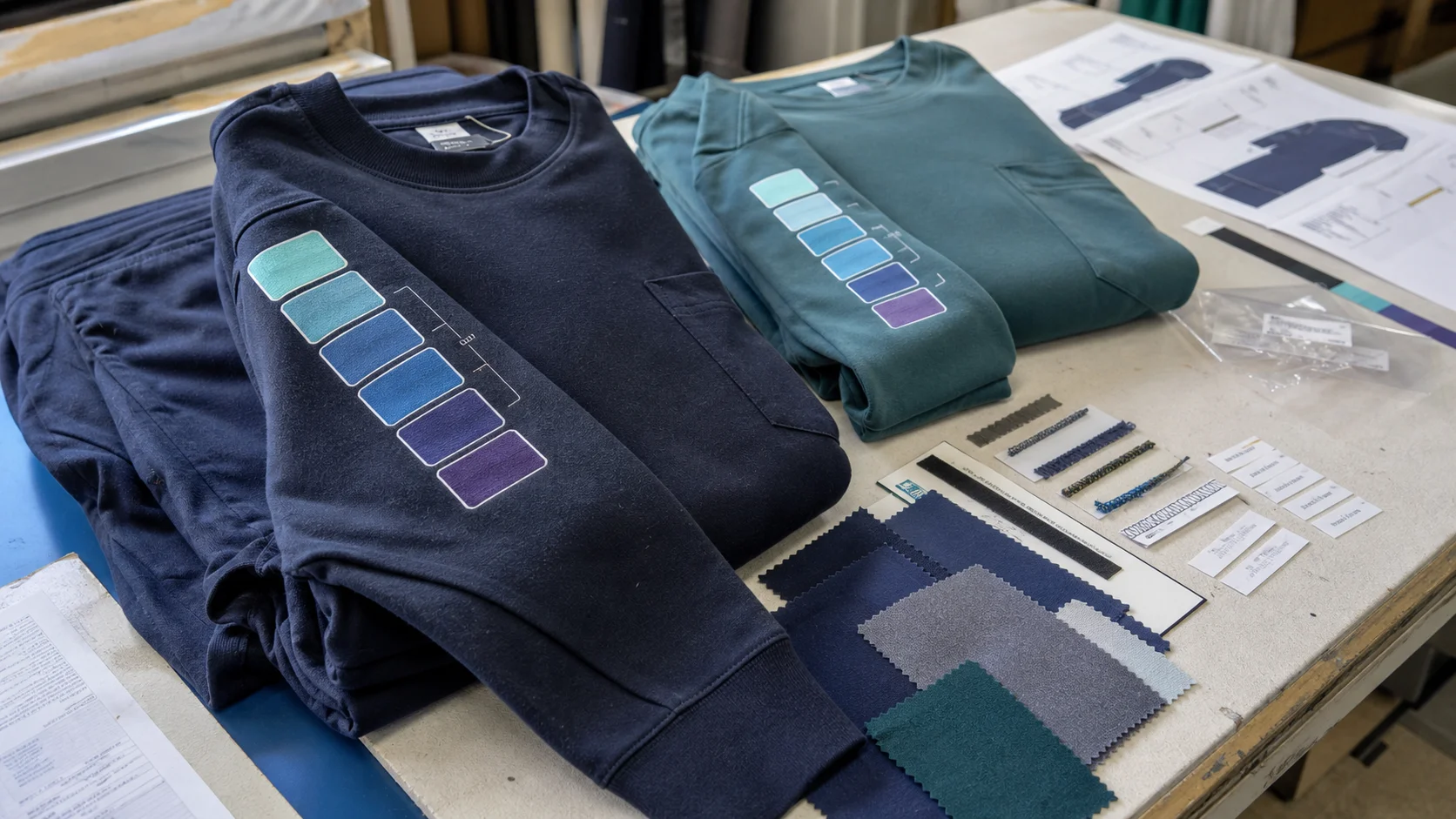
A practical SEO outline for pharmacy operations teams auditing sleeve print maps for colorfastness, wash durability, placement accuracy, and production...
Sleeve Print Map Audit for Pharmacy Teams - Decoration & Printing manufacturing guide
Pharmacy operations teams do not usually buy decorated apparel for fashion reasons. They buy it because uniforms, campaign shirts, vaccination event tops, delivery polos, and branded pharmacy jackets need to identify staff clearly, hold up through repeated laundering, and avoid creating avoidable compliance or presentation issues. A sleeve print may look like a small decoration decision, but once it sits next to sanitizer, prescription bags, counters, carts, heat, sweat, and frequent washing, the print becomes an operational risk point.
A sleeve print map colorfastness audit is a structured review of where sleeve artwork is placed, which decoration method is used, how the color behaves under use, and whether the finished garment can survive pharmacy conditions without dye transfer, cracking, smearing, staining, or brand inconsistency. It connects design, production, quality control, and store operations into one practical checklist.
For pharmacy teams managing multi-location rollouts, seasonal health campaigns, or staff uniform programs, this audit helps prevent expensive reorders and embarrassing field complaints. It also gives buyers clearer language when speaking with apparel manufacturers, decorators, and sourcing partners.
A sleeve print map audit is a documented check of all print positions, dimensions, colors, tolerances, and performance requirements on the sleeve area of a garment. It is more specific than a general artwork approval because sleeves are curved, narrow, and highly mobile. A design that appears clean on a flat digital mockup may distort once placed on a rib cuff, a tapered polo sleeve, or a stretch scrub top.
The “print map” shows exactly where the decoration sits. It should include distance from shoulder seam, distance from sleeve hem, print width, print height, rotation angle, logo orientation, left or right sleeve placement, and any restrictions around seams or cuffs. For pharmacy teams, the map may also need to specify whether the print must remain visible under a lab coat, vest, or outer layer.
The “colorfastness audit” checks whether the printed colors and garment base colors remain stable during wear, washing, rubbing, exposure to moisture, and contact with other materials. This matters because pharmacy uniforms often come in contact with white coats, disposable PPE, branded lanyards, counters, stock totes, and patient-facing materials.
Purchasing judgment: if sleeve print placement is not locked before bulk production, the buyer is effectively approving variation. For pharmacy rollouts, that usually creates avoidable store-to-store inconsistency.
Pharmacy apparel has a different risk profile from promotional giveaways. Staff may wear the same garments weekly or daily. Items are often washed at home, sometimes with warm water, detergent boosters, stain removers, or disinfecting laundry additives. Staff also work in environments where cleanliness and visual trust are important.
Colorfastness problems can show up in several ways. A dark navy sleeve may bleed onto a white underlayer. A red printed campaign logo may turn pink after repeated washing. A plastisol print may crack across the elbow area. A water-based print may fade too quickly on a polyester-rich fabric. A heat transfer may lift at the edge after exposure to dryer heat.
For pharmacy operations, these are not just decoration defects. They can become labor issues, brand issues, and replacement-cost issues. A team member may reject a uniform because it looks worn after two washes. A regional manager may notice that campaign shirts across stores do not match. A customer may see a peeling sleeve logo and question the professionalism of the environment.
Colorfastness control also matters when apparel is used for vaccination clinics, wellness events, delivery services, or temporary pharmacy programs. These garments are often ordered under deadline pressure. Fast production increases the chance that shortcuts are taken in curing, drying, color matching, or inspection.
Pharmacy teams use sleeve printing across several garment categories. Each category needs a different approach to print mapping and colorfastness review.
Polos are common for retail pharmacy staff because they balance professional appearance and comfort. Sleeve prints on polos are often used for department identifiers, campaign marks, or small corporate logos. The main audit issue is sleeve taper. A logo that is too wide may wrap toward the underarm and become unreadable.
Scrub tops may be used in clinical pharmacy settings, vaccination clinics, compounding environments, or health service areas. Sleeve prints must be checked against sleeve mobility, fabric stretch, and laundering frequency. Stretch fabrics need decoration methods that move without cracking.
Flu shot campaigns, health screening days, recruitment events, and community outreach programs often use T-shirts. Sleeve prints can carry sponsor marks, program names, or store identifiers. The risk is usually production speed: short timelines can lead to insufficient strike-off review or rushed curing.
Outerwear is common for staff working near entrances, drive-through windows, delivery staging areas, or cooler store zones. Sleeve decoration on fleece or performance knits requires careful heat testing because pile, stretch, and synthetic fibers can react poorly to transfers or high-temperature curing.
When sleeve prints are used on coats, the map must account for professional appearance and print visibility. Embroidery may be preferred for durability, but printed sleeve identifiers may be selected for lighter weight or lower cost. White fabrics also increase the risk of dye migration and visible staining.
The print map should be treated as a technical document, not a rough design suggestion. A good print map protects the buyer and gives the decorator measurable targets.
At minimum, specify the sleeve side, distance from the shoulder seam, distance from sleeve opening, artwork size, and acceptable tolerance. A typical sleeve print tolerance may be plus or minus 0.25 inch for simple T-shirts and polos, though tighter tolerances may raise cost or slow production. For small logos, even 0.25 inch can look noticeable, so the tolerance should match the visibility risk.
Sleeve artwork can be vertical, horizontal, or angled. Pharmacy buyers should decide whether the logo must read when the arm is relaxed at the side or when the arm is extended at counter height. This is especially important for vaccination event shirts where staff interact with patients across tables or counters.
A safe sleeve print width often falls between 2.0 and 3.5 inches for adult polos and T-shirts, depending on garment size range. Larger artwork can work, but it needs a size-run review. A print that fits an adult XL sleeve may overwhelm an adult XS sleeve. If the same artwork is used across all sizes, the buyer should approve how it looks on the smallest and largest sizes.
Prints should not cross sleeve seams unless the production method is specifically built for that effect. Standard screen printing, heat transfer, and digital transfer methods may distort or fail near seam bulk. Rib cuffs also complicate adhesion and stretch recovery. A practical print map keeps the decoration on a smooth, stable panel wherever possible.
Map Element What to Specify Why It Matters Sleeve side Left sleeve, right sleeve, or both Prevents mixed placement during production Distance from seam Measurement from shoulder seam or sleeve hem Controls visual consistency across stores Artwork size Width and height in inches or centimeters Reduces scaling errors Print tolerance Acceptable placement variation Defines pass/fail inspection criteria Color standard Pantone, brand guide reference, or approved lab dip Controls shade variationNo decoration method is universally best for pharmacy sleeve prints. The right choice depends on fabric, order quantity, artwork detail, budget, wash expectations, and lead time.
Screen printing is common for cotton and cotton-blend T-shirts. It works well for larger quantities and simple spot-color logos. For sleeve prints, it can be cost-effective once screens are set up. Typical MOQs may start around 100 to 300 pieces per design, though some suppliers accept lower quantities with higher setup charges.
The tradeoff is flexibility. Each color usually requires a separate screen, and color changes can add cost. Curing must be controlled carefully. Under-cured ink can wash out or crack, while over-curing can scorch some fabrics or affect hand feel.
Heat transfers can be useful for smaller pharmacy orders, personalization, store codes, or multi-color sleeve graphics. Typical MOQs can be as low as 25 to 100 pieces, depending on supplier and transfer type. They are often attractive when the artwork includes gradients or many colors.
The risk is edge lifting, dye migration, and poor stretch recovery. Transfers on polyester, fleece, or stretch knits need testing under wash and dryer conditions. Buyers should ask for the exact transfer type, application temperature, pressure, dwell time, and wash rating.
Direct-to-film, often called DTF, is widely used for detailed decoration and short runs. It can reproduce complex graphics without traditional screen setup. For pharmacy campaigns with changing artwork, it can reduce preproduction complexity.
DTF quality varies significantly by film, adhesive powder, curing, and application control. A low-cost DTF print may feel heavy on a small sleeve and may not meet repeated wash expectations. For staff uniforms, buyers should request wash test samples rather than approving only a fresh press sample.
Embroidery is not a print method, but it is often considered for sleeve branding. It offers strong durability and a professional look, especially on polos, fleece, and coats. Typical MOQs may begin around 24 to 72 pieces for domestic decoration and 100 to 300 pieces for factory-direct production.
The tradeoff is weight and detail. Small text can become illegible, and dense embroidery can pucker lightweight sleeves. Embroidery also requires thread color approval and stitch-density review.
Sublimation works best on white or light polyester fabrics. It can produce strong color penetration and soft hand feel. It is less suitable for dark garments and may not be appropriate for conservative pharmacy uniform programs unless the design is built around sublimated panels.
The main risk is shade variation and print placement drift during cut-and-sew production. For sleeve maps, sublimation requires careful panel alignment and size grading.
Method Best Use Main Risk Typical MOQ Range Screen printing Simple spot-color sleeve logos Under-curing, cracking, setup cost 100-300+ pieces Heat transfer Short runs, multi-color graphics Edge lift, dye migration 25-100+ pieces DTF transfer Detailed artwork and campaign runs Hand feel, wash durability variation 25-100+ pieces Embroidery Polos, jackets, coats Puckering, poor small text clarity 24-300+ pieces Sublimation Polyester performance styles Placement drift, shade variation 100-500+ piecesColorfastness cannot be separated from fabric. A print that performs well on a 100% cotton T-shirt may fail on a recycled polyester polo. A transfer that bonds cleanly to smooth jersey may lift from textured fleece. Pharmacy buyers should define fabric and trim requirements before approving sleeve decoration.
Common pharmacy apparel fabrics include 100% cotton jersey, cotton-poly jersey, polyester pique, performance interlock, poly-spandex blends, fleece, and woven coat fabrics. Each has different absorption, heat sensitivity, and stretch behavior.
For screen printing, cotton-rich fabrics usually provide a more forgiving surface. For polyester-rich fabrics, dye migration becomes a larger risk, especially with red, navy, black, royal blue, and bright synthetic colors. For stretch fabrics, the print must stretch and recover without cracking.
Fabric weight affects print stability and hand feel. Lightweight sleeves can show print strike-through, puckering, or stiffness. Heavy fleece may require higher pressure or a different transfer adhesive. A practical specification should state fabric weight, such as 160-200 gsm for T-shirts, 180-240 gsm for polos, or 240-320 gsm for fleece, depending on the intended garment.
Brand colors should be linked to a recognized standard. Pantone references are useful, but buyers should still approve physical strike-offs because ink color shifts on different base fabrics. A white print on navy polyester may not look as crisp as the same white print on cotton. A red print on heather gray may appear muted.
Trims can affect sleeve print quality indirectly. Rib cuffs, seam tapes, reflective trims, pocket edges, and badge loops may restrict decoration space. Care labels also need to support the decoration method. If a heat transfer cannot tolerate high dryer temperatures, the care label should not encourage high-heat drying.
Operations teams should also think about staff comfort. A heavy sleeve print on a short sleeve can feel stiff. A rough transfer edge can irritate skin during long shifts. Decoration should support the uniform, not make it harder to wear.
A pharmacy sleeve print map audit should include practical colorfastness tests. Formal lab testing may be appropriate for larger programs, but even smaller orders benefit from structured sample checks.
Wash fastness checks whether the print and garment color change after laundering. For pharmacy staff apparel, request testing after at least five wash cycles for basic promotional orders and ten or more cycles for core uniform programs. The wash method should match expected staff behavior as closely as possible.
Ask whether the test uses cold, warm, or hot water; mild detergent or standard detergent; tumble dry or line dry; and whether garments are washed inside out. If the supplier’s wash claim only applies to cold wash and line dry, it may not reflect real staff habits.
Crocking tests check whether color transfers when rubbed dry or wet. Sleeve areas are especially exposed to rubbing against counters, bags, carts, and outerwear. Dark base fabrics and heavily pigmented prints should be checked carefully. Wet crocking is important because pharmacy staff frequently wash hands and may work near moisture, sanitizer, or spills.
Perspiration can affect print and dye stability. Staff working long shifts, moving stock, or supporting busy vaccine clinics may generate heat and moisture around sleeves. Perspiration testing is especially useful for synthetic performance fabrics and dark colors.
Pharmacy environments include alcohol-based sanitizer, disinfectant wipes, cleaning sprays, and other mild chemical exposure. Garments should not be expected to resist every chemical, but a basic spot exposure review is sensible. A sleeve print that smears after incidental sanitizer contact is a poor choice for pharmacy use.
Light fastness may matter for staff working near windows, drive-through areas, or outdoor community health events. Some neon or bright campaign colors fade faster than standard corporate colors. If the garment is used for a short event, this may be acceptable. For a long-term uniform, it is not.
Test Area Practical Audit Question Buyer Action Wash fastness Does the print fade, crack, or peel after repeated wash? Approve washed samples, not only fresh samples Crocking Does color transfer when rubbed dry or wet? Check dark fabrics and strong print colors Perspiration Does moisture affect color or adhesion? Test performance and stretch fabrics Sanitizer contact Does incidental alcohol exposure damage print? Run a controlled spot check on samples Heat exposure Does dryer heat cause lift, shrinkage, or gloss change? Review care label and staff use expectationsA disciplined sample process is the simplest way to reduce sleeve print failures. Skipping samples may save a week at the front end and cost a month after delivery.
The first step is to review the logo file, brand color references, sleeve map, garment specification, size range, and decoration method. Vector artwork is preferred for clean edges and accurate scaling. If raster artwork is used, the resolution must be high enough for the final print size.
The tech pack should show the sleeve print on a flat sketch and include measurements. If the garment has multiple colors, each body color should be reviewed against the print color. White ink on black fabric and white ink on royal blue fabric may require different underbase or curing control.
A strike-off is a sample of the print on the intended fabric or a close substitute. It is used to review color, opacity, hand feel, line sharpness, and adhesion. For sleeve programs, the strike-off should not be approved only as a loose swatch if placement is critical. A garment sample is better when the sleeve is narrow or curved.
The pre-production sample should represent the approved garment, decoration method, print location, and care label. Pharmacy operations teams should review the sample on a person or fit form, not only on a table. Sleeve placement changes visually when the arm bends.
At least one approved sample should be washed before bulk approval. For core uniform programs, multiple wash cycles are strongly recommended. If timing is tight, run accelerated internal checks, but do not confuse a one-cycle wash with proof of durability.
Bulk production should begin only after written approval of artwork, placement, print color, garment color, sample condition, and test expectations. Approvals should be stored centrally so regional teams, procurement, and suppliers are working from the same version.
Purchasing judgment: for pharmacy uniforms expected to last several months, a fresh unwashed print sample is not enough. Approval should include at least a basic wash and rub review.
Minimum order quantity and lead time depend on garment availability, decoration method, artwork complexity, packaging requirements, and inspection level. Pharmacy buyers often face two conflicting pressures: keep inventory lean and distribute consistent apparel across many locations. The sleeve print map audit helps control that tension by reducing rework.
For domestic decoration on stock blanks, buyers may find MOQs around 24 to 100 pieces for embroidery or transfers, and 100 to 300 pieces for screen printing. For custom garment production, MOQs may range from 300 to 1,000 pieces per style and color, sometimes higher for custom-dyed fabric, specialty trims, or factory-direct decoration.
Small quantities are possible, but the unit price usually rises. Large quantities improve cost efficiency but increase exposure if the print map or colorfastness approval is weak. A staged rollout can reduce risk: approve one pilot batch, inspect performance, then release the larger order.
Lead time is affected by blank garment stock, sample queue, print method, color approvals, testing, production capacity, and shipping. A simple domestic sleeve transfer order on available blanks may take one to three weeks after approval. Screen printing may take two to four weeks depending on queue and complexity. Custom production can take six to twelve weeks or more, especially if fabric dyeing, lab dips, and international freight are involved.
Testing adds time. Wash testing, crocking review, and pre-production sample approval may add several days to several weeks. This time is worthwhile for programs that will be repeated, photographed, used across stores, or worn by patient-facing staff.
The cheapest sleeve print is rarely the safest option for pharmacy operations. A low-cost transfer can be acceptable for a one-day community event. It may be a poor choice for a six-month uniform program. Screen printing can lower unit cost at volume, but setup fees make it less attractive for small store-specific runs. Embroidery costs more per piece but may reduce replacement complaints on jackets and polos.
Buyers should evaluate total cost, not just decoration cost. Include sample fees, setup fees, color changes, spoilage allowance, testing, shipping, repacking by location, and replacement reserves.
Teams sourcing a broader apparel program can review service capabilities through Fabrikn’s services page. For buyers still defining supplier responsibilities, the about page can help frame what to ask from a manufacturing partner before committing to bulk orders.
Inspection should verify both appearance and function. Sleeve print issues are easy to miss when inspectors only check folded garments in polybags. The sleeve needs to be opened, measured, rubbed, and compared against the approved sample.
The most common issue is inconsistent placement. Prints may sit too close to the cuff, rotate toward the back arm, or vary by size. For pharmacy teams, this becomes obvious when staff stand together. Inspection should use a ruler or template, not visual judgment alone.
Print color can vary between production days, garment colors, or curing conditions. A controlled inspection should compare bulk pieces against the approved strike-off under consistent lighting. Store lighting and daylight can show differences that warehouse lighting hides.
Look for pinholes, poor opacity, edge lift, scorching, gloss changes, adhesive residue, cracking, and misregistration. Small sleeve logos often contain fine text, and fine text is where weak decoration methods reveal themselves first.
Heat application can leave press marks, shine, indentation, or fabric discoloration. This is common on polyester and fleece if temperature, pressure, or dwell time is not controlled. On pharmacy apparel, visible press marks can make a new garment look used.
Multi-location pharmacy orders often require size sorting, store-level packing, employee allocation, or campaign kits. A perfect print still creates problems if cartons are mislabeled or store packs are mixed. Inspection should include carton marks, size ratios, and packing lists.
Inspection Point Common Defect Recommended Check Print placement Logo too low, too high, or rotated Measure against approved sleeve map Print color Shade mismatch or low opacity Compare to approved sample under stable light Adhesion Peeling or cracking Stretch, rub, and wash sample pieces Fabric surface Scorching, shine, press box Inspect sleeves flat and worn if possible Packing Wrong size or store allocation Audit cartons against distribution listA sleeve print map colorfastness audit works best when it is built into the buying process early. Pharmacy teams can use the following checklist before releasing a purchase order.
Clear supplier questions prevent vague answers. Pharmacy buyers should ask for specifics, especially when the order is time-sensitive or distributed across many locations.
If the supplier cannot answer these questions clearly, the risk is not necessarily that they are incapable. The risk is that the order may be managed as a basic print job rather than as an operational uniform program. That distinction matters.
A pilot run is useful when a sleeve print is new, the garment fabric has changed, the order will be repeated, or the apparel will be worn heavily. It is also useful when multiple pharmacy locations will receive the same garment and leadership expects visual consistency.
A pilot does not need to be large. Depending on the supplier, 25 to 100 pieces may be enough to test production handling, staff acceptance, laundering, and distribution. For custom factory production, a pilot may require a higher MOQ, but the same principle applies: test before committing to a large rollout.
For urgent campaigns, a pilot may not fit the timeline. In that case, reduce complexity. Use a known garment, a proven decoration method, fewer colors, and a conservative sleeve placement. Avoid testing a new fabric, new supplier, and new print method at the same time.
Pharmacy operations teams should keep a record of every approved item. This protects future reorders and helps resolve disputes if field complaints occur.
This documentation also supports future sourcing decisions. If a print performed well, the team can repeat the same method with confidence. If it failed, the team can identify whether the issue came from fabric, ink, curing, transfer adhesion, washing, or placement.
For pharmacy operations teams, sleeve printing should be treated as a controlled uniform detail, not a last-minute branding add-on. The best buying path is usually conservative: stable fabric, proven decoration method, documented sleeve map, physical sample approval, and realistic wash testing.
Use low-MOQ transfer methods for short campaigns when speed and artwork flexibility matter more than long-term durability. Use screen printing for larger runs with simple artwork and controlled curing. Use embroidery for jackets, polos, and coats when durability and professional appearance outweigh fine graphic detail. For stretch and polyester fabrics, demand more testing because dye migration, heat marks, and cracking risks are higher.
A sleeve print map colorfastness audit will not eliminate every issue, but it will catch the common ones before they reach staff. It gives procurement, brand teams, store operations, and suppliers the same standard to work from. That is the difference between buying decorated apparel and managing a uniform program.
For pharmacy teams preparing a new decorated apparel order, a sourcing discussion before artwork release can save time later. Use Fabrikn’s contact page to start that conversation with clear garment, print, and rollout requirements.
Get a free quote from Fabrikn — your trusted B2B clothing manufacturer with 10+ years of experience. MOQ as low as 200 pieces.
Get a Free Quote →It is a structured review of sleeve print placement, artwork size, print method, color stability, wash durability, and inspection requirements. For pharmacy teams, it helps ensure decorated apparel remains professional and consistent during repeated use.
Pharmacy uniforms are worn in clean, patient-facing environments and often washed frequently. Sleeve prints are exposed to rubbing, moisture, sanitizer, counters, and movement, so weak decoration can fade, crack, peel, or transfer color.
Domestic decoration on stock garments may start around 24 to 100 pieces for transfers or embroidery and 100 to 300 pieces for screen printing. Custom garment production often starts around 300 to 1,000 pieces per style and color, depending on fabric and supplier requirements.
Simple stock garment orders may move through sampling in a few days to two weeks. Orders requiring lab dips, pre-production samples, wash testing, custom fabric, or international production may need several additional weeks before bulk production starts.
There is no single best method. Screen printing suits larger runs with simple artwork. Transfers and DTF work for short runs or detailed graphics. Embroidery is strong for polos, jackets, and coats. The fabric, wash expectations, and program duration should drive the choice.
Useful checks include wash fastness, dry and wet crocking, perspiration exposure, heat exposure, and a controlled sanitizer contact review. Larger or long-term uniform programs may justify third-party lab testing.
It is usually safer to avoid seams and cuffs unless the supplier has a proven method for that construction. Seam bulk and rib stretch can cause distortion, poor adhesion, or inconsistent print appearance.
The map should include sleeve side, artwork dimensions, distance from shoulder seam or sleeve hem, orientation, color reference, placement tolerance, and any seam or cuff restrictions. It should also identify whether the measurement applies across all sizes or changes by size.
Yes. A physical pre-production sample is strongly recommended. For core uniform programs, the sample should be washed and checked for rubbing, cracking, fading, and placement before bulk approval.
Use proven garments, avoid untested decoration methods, document placement tolerances, approve washed samples, inspect bulk production, and provide care instructions to staff. A small pilot run can also reduce risk before a full rollout.