
A production-focused guide for security contractors buying sleeve print maps, covering fabric tests, print placement, durability checks, compliance...
Security contractor uniforms have a simple job on paper: identify the wearer quickly, hold up to frequent use, and stay presentable in difficult conditions. In practice, sleeve print maps, logos, rank markers, and service identifiers can fail for very ordinary reasons. The print method is wrong for the fabric. The garment construction fights the decoration. The wash standard is not aligned with the contract cycle. A sourcing decision that looks small at the sample stage can turn into repeat reorders, color drift, or cracking after a few wash rounds.
This guide is written for buyers who need a practical framework for working with a sleeve print map manufacturer and for checking fabric testing before production starts. The focus is not on design trends. It is on durability, readability, compliance-minded buying, and the tradeoffs that matter when uniforms are issued in volume.
Sleeve Print Maps for Security Contractor Buying - Fabrikn production reference
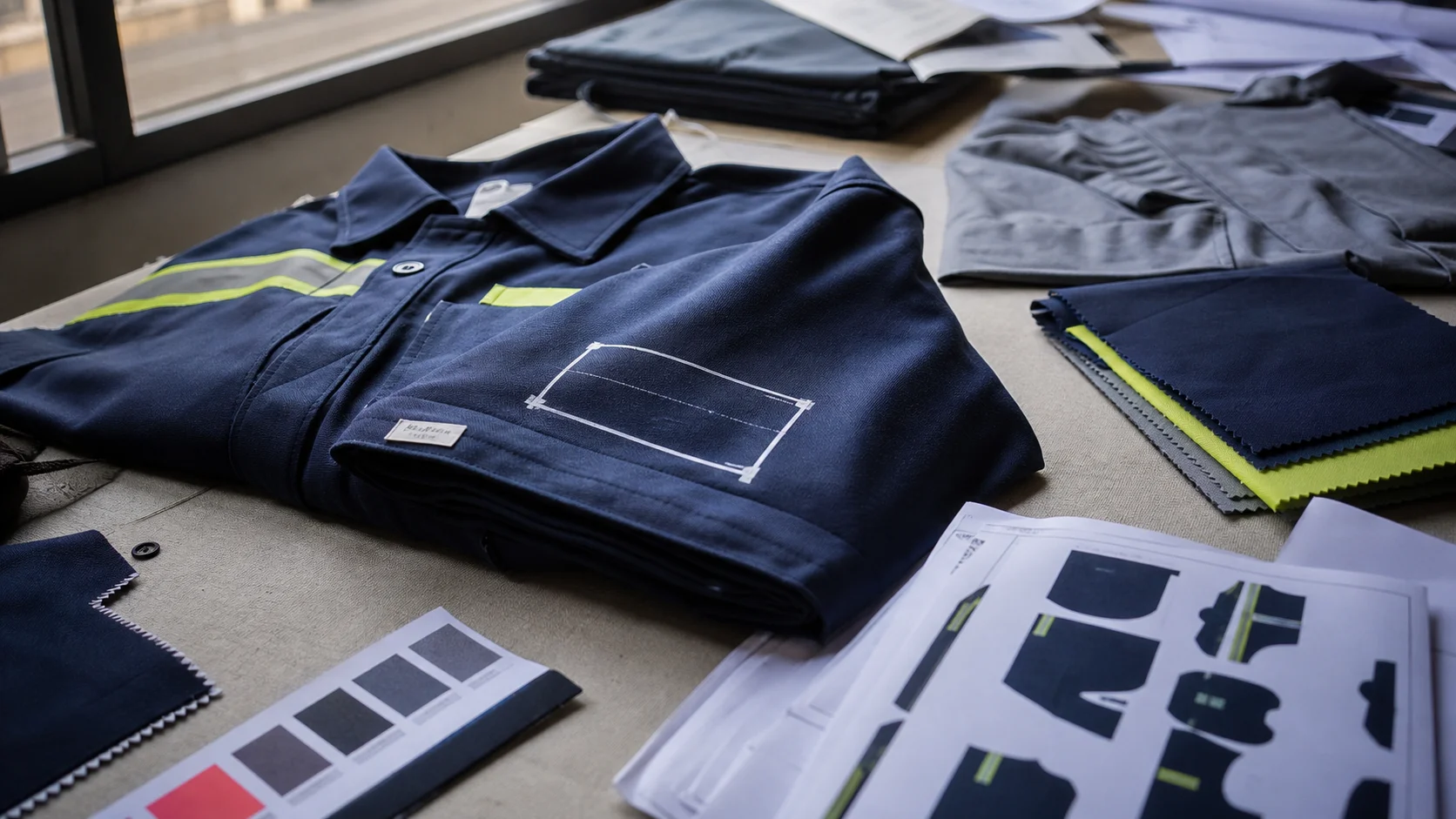
In apparel sourcing, “sleeve print maps” usually refers to the defined placement plan for printed information on the sleeve area. For security contractor garments, that may include company names, patrol identifiers, role labels, logo lockups, department marks, or reflective print elements positioned for visibility. The term “map” matters because the buyer is not only approving artwork. The buyer is approving placement, size, proportions, and the relationship between print and garment pattern.
That distinction matters on finished uniforms. A sleeve panel can narrow at the elbow, twist during motion, or stretch over layered wear. A print that looks centered on a flat spec sheet may look off-center on the worn garment. For security workwear, that is not just a visual issue. It affects legibility, professionalism, and consistency across the issued set.
A strong sleeve print map should define:
If the artwork team and the garment factory are not aligned on these points, approval will be delayed. The common buyer mistake is treating sleeve decoration as a last-step branding task. In uniforms, it is a construction decision as much as a print decision.
For buyers comparing service options, it is worth reviewing the manufacturer’s broader capability set before requesting quotes. See services for a sense of how end-to-end development, printing, and production support are typically structured. Company background is useful too, so a quick look at about us can help when screening whether the supplier operates as a cut-and-sew partner, a decoration house, or a trading layer.
Printing on sleeve panels is only as reliable as the fabric beneath it. Security contractor uniforms often use polyester-cotton blends, polyester twill, ripstop, heavy jersey, brushed knit, or softshell layers depending on role and climate. Each substrate behaves differently under heat, pressure, ink bonding, and washing.
Fabric testing gives the buyer a practical answer to a simple question: will the print stay readable and intact through the intended use cycle? If the answer is uncertain, the product is not ready for bulk production.
The biggest issues arise when the fabric is not stable enough for the selected decoration method. For example:
Buyers should expect the supplier to test the actual production fabric, not a generic swatch that “should be similar.” That point is important. Fabric composition alone does not guarantee the same finishing behavior. Dye lot variation, surface texture, and chemical finishing can all affect print adhesion and color.
For security contractor apparel, the lowest-risk approach is to lock fabric, print method, and wash standard together before bulk approval. Changing one element after sampling often creates a chain reaction of quality issues.
Different decoration methods suit different uniform uses. The right choice depends on wash frequency, visibility requirements, garment fabric, and the size of the branding area. Buyers should not default to the cheapest print. They should choose the method that matches service conditions.
Screen printing remains a common option for sleeve marks, ranks, and logos on stable fabrics. It offers strong opacity, especially on darker garments, and can be cost-effective in volume. The tradeoff is hand feel and possible cracking if the print layer is too heavy or if the garment is highly flexible.
Good for: simple logos, large-volume orders, cotton or poly-cotton sleeves, moderate wash expectations.
Watch for: registration drift on small lettering, print thickness, and cure consistency.
Heat transfer can support finer detail and more complex artwork. It is useful when the sleeve area is limited or when the buyer wants multiple design variants. The risk is long-term edge lifting, especially if the garment flexes heavily or if the transfer is applied without enough pressure and temperature control.
Good for: short production runs, detailed graphics, variable names or IDs.
Watch for: adhesion on textured fabrics, wash durability, and sensitivity to temperature settings.
Sublimation works best on light-colored polyester fabrics. The image becomes part of the fiber structure rather than sitting on top of it. The finish is light and breathable, and durability is strong when the substrate is right.
Good for: full-color logos on polyester-based sleeve panels.
Watch for: incompatibility with cotton-rich fabrics and limitations on dark garments.
For security contractors working in low light, reflective elements can improve visibility and identification. These films or prints add value, but they also bring testing requirements. Adhesion, wash performance, and flexibility can vary widely between suppliers.
Good for: safety-focused garments, high-visibility identifiers, low-light environments.
Watch for: stiffness, edge lifting, and compliance requirements if the garment is part of a broader safety program.
A good sleeve print map manufacturer will ask for a complete spec package. Buyers should be ready with more than artwork. The garment base should be defined clearly enough that the supplier can test and quote correctly.
Specification Area Buyer Should Confirm Why It Matters Fabric composition Cotton, polyester, blend ratio, spandex content Affects print adhesion, shrinkage, and feel Fabric weight GSM or oz/yd² Influences opacity, durability, and hand feel Weave or knit structure Twill, ripstop, jersey, interlock, softshell Controls stretch and surface behavior Finishing treatment Wicking, water resistance, anti-pilling, brushing Can help or hurt print performance Trim spec Thread type, zippers, hook-and-loop, reflective trim Some trims affect heat transfer or placement Color standard Approved Pantone or lab dip reference Prevents shade mismatch across reorders Care standard Wash temperature, drying method, expected cycle count Determines required print durabilityOne practical rule helps here: if the uniform will be issued repeatedly and washed frequently, ask the supplier to prioritize print adhesion and dimensional stability over the absolute lowest cost. A cheaper print can become expensive if it fails early and triggers replacement claims.
Fabric testing does not need to be complicated to be useful. It does need to be consistent. The goal is to confirm that the chosen fabric can accept the decoration method and survive the intended wear cycle.
Request a full fabric spec sheet and ask for the production-ready material, not a substitute. Check fiber content, yarn count or knit gauge where available, GSM, finishing treatment, and whether the fabric has been pre-shrunk or heat-set.
Why this matters: shrinkage and surface finish can change print position and wash behavior after the first cycle.
Do not approve decoration based only on digital mockups. Ask for a strike-off or sample print on the exact production fabric. Review edge sharpness, color density, opacity, and whether the print cracks under flexing.
For sleeve placements, bend the garment at the elbow and shoulder area during inspection. Small print defects can become larger once the sleeve is in motion.
Security uniforms often face regular laundering. Ask the supplier what wash test standard is being used and how many cycles the print should survive without visible loss of legibility. If the supplier cannot state a target, that is a warning sign.
A basic review should include:
Fabric that shrinks unevenly can move the print off its intended position. That is a common problem on sleeve graphics because the sleeve has less forgiving visual tolerance than a chest print. Ask for shrinkage data after washing, especially if the garment uses a cotton-rich construction.
If the decoration method uses heat, the garment and trims must tolerate the process. Some adhesive labels, reflective films, and synthetic blends can deform or discolor under pressure and temperature. Testing should include the full assembly, not only the fabric panel.
A low-volume issue order for a controlled site may not require the same standards as a multi-site security contract with frequent laundering. Buyers should match test intensity to the real operating environment. It is better to define a realistic wear cycle than to overpromise a performance spec no supplier can hold consistently at scale.
Strong sample control is one of the fastest ways to avoid production disputes. The approval sequence should separate design approval from technical approval. Many buyers merge the two and lose clarity.
A practical process looks like this:
Buyers should insist on documented approval marks. A verbal “okay to proceed” is weak evidence if the bulk result drifts. If the factory proposes a different ink, transfer film, or fabric shade after approval, the sample status should be reopened.
For buyers who need development support, it can help to speak directly with the supplier’s production team rather than routing every question through sales. A direct contact path is available at contact us, which is usually the fastest way to confirm sampling, artwork, and production questions.
Typical MOQ ranges vary by garment type, decoration method, and fabric. For sleeve-printed security contractor apparel, buyers often see the following broad patterns:
These are not universal minimums. They are planning ranges. A supplier with existing fabric inventory may accept a smaller order, while a fully custom program with special trims may require a much larger commitment.
Lead time depends on the slowest step, not the fastest one. Buyers should map the timeline as follows:
A straightforward order with approved fabric may move relatively quickly. A new fabric, new print method, or new trim package adds time. Buyers should not compress sample approval just to save a week. That often costs more in bulk corrections later.
Inspection on printed sleeves should not stop at “does it look right from a distance.” The problem areas are usually technical and small:
Buyers should also check carton packing. Printed sleeves can pick up scuffing if garments are folded with print-to-print contact or packed under compression. This is a small detail that can affect first impression on receipt. If the uniform is handed directly to staff, presentation matters almost as much as durability.
A sensible inspection plan includes random garment opening, flat measurement, print count verification, and visual review under decent light. If the garment will be used in low-light environments, readability under poor lighting should also be checked during approval.
Procurement teams get better results when the supplier answers technical questions clearly. The purpose is not to create friction. It is to find out whether the supplier understands the risks.
The quality of the answers matters more than the promise itself. A practical supplier should be able to explain testing limits, lead-time drivers, and where durability tradeoffs appear. If the response is vague, the buyer should slow the process and ask for a sample on the final fabric.
In security contractor apparel, the best buying decisions usually come from knowing where risk is concentrated. Buyers can often save money on simple artwork complexity, but they should be cautious about reducing fabric quality, print testing, or sample approval time.
Good places to control cost include:
Places where saving money can backfire include:
For buyers who need broader support beyond the print step, it can be useful to review how the supplier structures development and production. A clear process page such as services can help identify whether the partner is set up for sampling, decoration, and bulk coordination in a disciplined way.
The cheapest sleeve print is not the cheapest uniform if it fails on appearance after a few wash cycles. For security contractors, durability and readability usually carry more value than an aggressive unit-cost cut.
Sleeve print maps are a small component of a security uniform program, but they carry outsized importance. They affect identification, consistency, and the life-cycle cost of the garment. A good buying process does not stop at approving artwork. It tests the fabric, confirms the print method, checks sleeve placement on the real garment, and sets a realistic standard for wash and wear.
For procurement teams, the safest path is straightforward: define the substrate, approve the print on actual fabric, verify sample performance, and only then move into bulk. That approach may feel slower at the start, but it usually prevents the type of rework that causes real delay later.
Get a free quote from Fabrikn — your trusted B2B clothing manufacturer with 10+ years of experience. MOQ as low as 200 pieces.
Get a Free Quote →It is the defined plan for what gets printed on the sleeve, where it sits, how large it is, and how it should appear on the finished garment. It is both a branding and a construction spec.
There is no single best fabric. Poly-cotton and stable polyester blends are common because they balance durability and print performance. The right choice depends on wash frequency, climate, and the print method.
Many buyers see ranges from 100 to 300 pieces for simpler programs and 300 to 1,000 plus for fully custom garment packages. Actual MOQ depends on fabric sourcing, print setup, and trim complexity.
Approve the artwork concept first, but do not give final production approval until the print has been tested on the actual fabric. Placement can look different once the garment is cut and sewn.
That depends on the fabric and use cycle. Screen printing can be durable on stable fabrics, sublimation works well on polyester, and heat transfers can suit detailed artwork if the application is controlled carefully.
Check placement, legibility, color match, edge quality, print feel, flexibility, and wash durability if available. Bend the sleeve and review it under normal lighting, not just on a flat table.
You can use the manufacturer’s contact page here: contact us. That is usually the right place to ask about sampling, fabric testing, and production timing.