
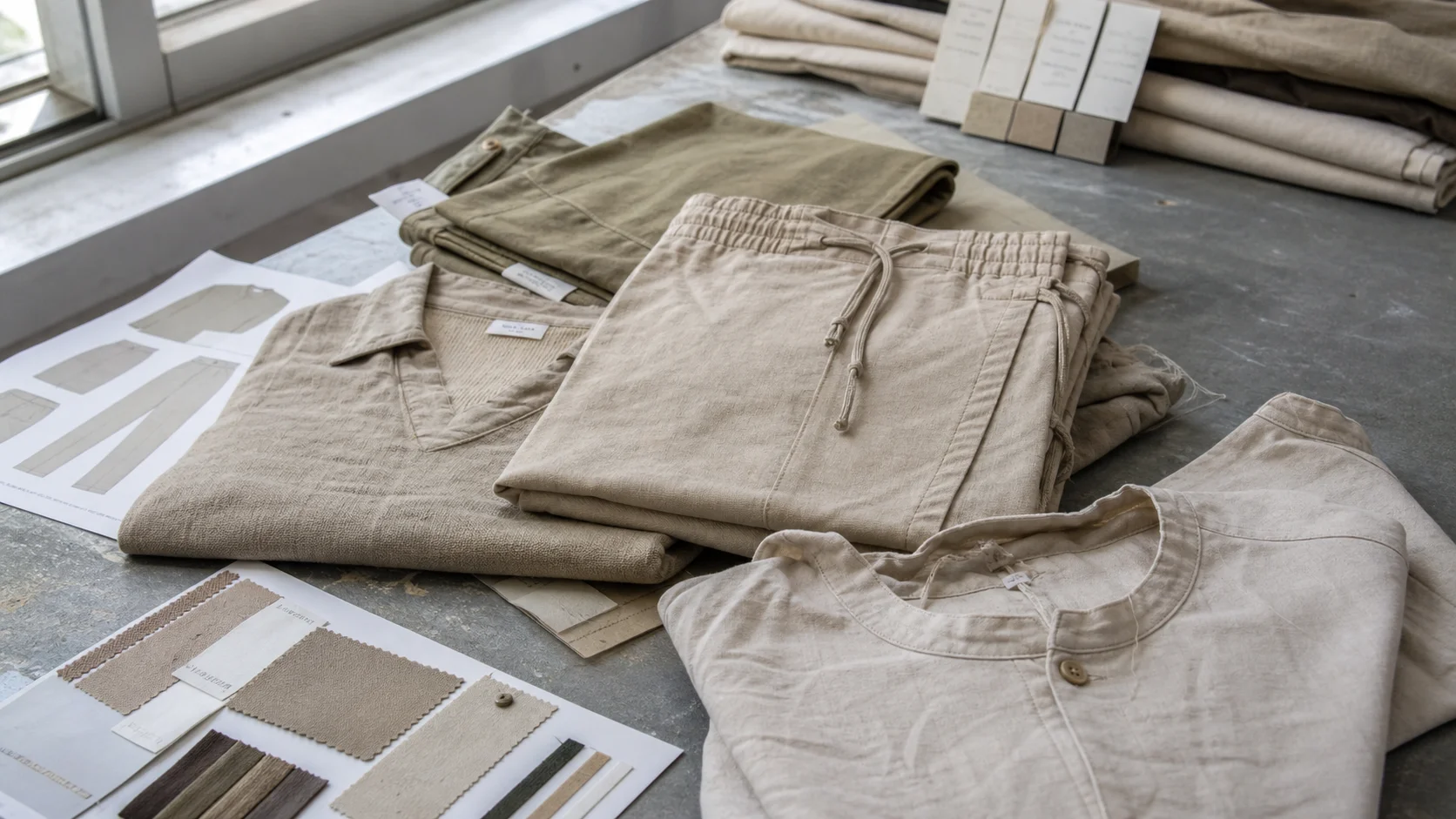
A production-focused outline for food hall operators evaluating sleeve print maps, seam strength risks, placement tolerances, and decoration choices for...
Sleeve Print Map Review for Food Hall Uniforms - Fabrikn production reference
Food hall uniforms carry more operational pressure than many standard hospitality garments. A single venue may include ramen counters, coffee bars, bakeries, burger stalls, dessert kiosks, cleaning teams, event staff, and managers. Each group may need a slightly different uniform identity while still looking part of the same property. Sleeve printing is often used to solve that problem because it keeps the front of the garment clean while adding department names, stall logos, sponsor marks, QR codes, or service role identifiers.
The problem is not the idea of sleeve printing. The problem is execution. A sleeve is not a flat poster. It curves around the arm, stretches during service, rubs against counters, passes through repeated laundering, and sits close to seams that carry stress. If the print map is loose or the seam strength review is skipped, the result can be crooked logos, cracked ink, distorted lettering, uncomfortable sleeve interiors, and seam failures after only a short period of use.
A sleeve print map seam strength review is the buying checkpoint that connects decoration artwork with garment construction. It answers practical questions before bulk production starts. Where exactly does the print sit? How far is it from the sleeve seam? Does the decoration cross a high-tension area? Will the print survive repeated washing? Can the seam tolerate the added heat, pressure, needle penetration, or film edge associated with the decoration method?
For food hall operators, this review is not a design luxury. It is a cost-control tool. Uniforms that fail early create replacement orders, inconsistent staff appearance, and avoidable complaints. If the venue has many vendors sharing one uniform program, small errors multiply quickly. A logo placed too close to the underarm seam may look acceptable on one sample but become a problem across hundreds of garments in different sizes.
Operators sourcing uniforms at scale should treat sleeve maps as production documents, not visual suggestions. The map should be approved together with fabric specifications, size grading, seam construction, decoration method, wash testing, and final inspection criteria. For support with apparel production planning, buyers can review manufacturing and decoration capabilities through Fabrikn’s services page.
A sleeve print map is a technical placement guide. It should show the decoration position on the sleeve in measurable terms, not just “print logo on left sleeve.” Food hall operators often approve artwork visually, then discover too late that the factory interpreted placement differently across sizes or sleeve types.
A useful sleeve print map should include the following details:
The most common sleeve placement mistake is approving one medium-size sample and applying the same measurement blindly across all sizes. A print that looks balanced on a size M may sit too close to the hem on XS or too high on 3XL. Food hall uniforms often cover a wide size range because teams include different roles, body shapes, and shift requirements. The sleeve map should define whether the placement is fixed from the sleeve hem, fixed from the shoulder seam, or adjusted by size.
There is no universal answer. If the print is a role identifier that must be visible above an apron or service counter, measuring from the shoulder seam may be better. If it is a small brand mark near the cuff, measuring from the sleeve opening can maintain a consistent visual relationship. For short-sleeve kitchen T-shirts, the safest approach is often a centered position on the outer sleeve panel, with enough clearance from both the hem and underarm seam.
Artwork orientation also needs attention. Staff do not stand like technical drawings. Arms rotate, bend, and reach. A sleeve logo that appears straight on a flat garment may tilt backward when worn. During sample review, the buyer should check the print on a person or mannequin in typical service positions: arm relaxed, arm reaching forward, and arm bent at the elbow.
Seam strength is often treated as a garment construction topic, while sleeve printing is treated as a decoration topic. In production, they are connected. The sleeve seam must carry movement and stress. Decoration can change how that seam behaves, especially when print placement sits near the underarm, sleeve cap, or cuff.
Food hall uniforms are exposed to frequent arm movement. Staff lift trays, wipe counters, restock refrigerators, pass plates, use POS systems, and handle cleaning tasks. The underarm and sleeve side seam are high-stress zones. If decoration is applied too close to those seams, several problems can occur:
For most sleeve prints, keeping decoration away from the underarm seam is sensible. A practical clearance range is usually 2.5 cm to 5 cm, depending on garment size, sleeve width, fabric stretch, and decoration thickness. For embroidery or heavy patches, a larger clearance may be needed. For light screen printing on stable cotton-poly fabric, closer placement may be possible, but it still requires testing.
Seam type matters. A basic overlock seam may be acceptable for standard T-shirts, but it may not provide enough durability for tight sleeves, stretch fabrics, or heavy laundering. Coverstitching, reinforced seams, bartacks, or improved stitch density may be needed in areas that carry repeated stress. If sleeve branding is critical and the print sits near construction lines, seam strength should be reviewed before bulk cutting.
Buyers should ask for seam strength expectations in practical terms. Laboratory testing may include seam slippage, seam bursting strength, or tensile strength, depending on fabric and garment type. For many uniform orders, a simpler but still useful check includes stretch recovery, pull testing at sleeve seams, wash testing, and visual inspection after wear simulation. The key is to agree on the inspection method before production begins.
Purchasing judgment: if the sleeve print must sit close to the underarm seam for design reasons, choose a lighter decoration method and strengthen the seam construction. If the logo can move outward by a few centimeters, that is usually the lower-risk option.
The sleeve print map should be reviewed alongside the decoration method. A placement that works for screen printing may not work for embroidery. A design that looks sharp as a heat transfer may fail if the film is too thick for a stretchy sleeve.
Screen printing is commonly used for cotton and cotton-poly food hall T-shirts, polos, and casual service tops. It works well for simple logos, role labels, and repeated orders. It is cost-effective at scale, especially when artwork uses limited colors.
The tradeoff is that sleeve printing can be harder to control than front chest printing. Sleeve panels are smaller and curved. If the print is applied after garment assembly, the operator needs proper sleeve pallets and alignment control. If printed before assembly, placement can be more accurate, but the production sequence must protect the artwork during sewing.
Screen print ink should be reviewed for hand feel, stretch, wash durability, and opacity. Plastisol can provide strong opacity but may feel heavier. Water-based ink can feel softer but may require careful curing and may not achieve the same brightness on dark fabrics without additional steps. For food hall uniforms, soft hand feel and wash resistance usually matter more than oversized decoration impact.
Heat transfers are useful for smaller runs, multi-color logos, staff role names, and programs where different food stalls need different sleeve marks. They can reduce setup cost and allow more variation than traditional screen printing.
The main risk is film durability. Low-quality transfer film may crack, peel, or wrinkle after commercial laundering. Edges can lift if heat, pressure, and dwell time are not controlled. Stretch fabrics require stretch-compatible transfer material. A transfer that performs well on a flat cotton shirt may fail on a fitted polyester-spandex sleeve.
Heat transfer placement should avoid thick seam junctions. Heat press pressure becomes uneven near raised seams, which can cause poor bonding. The sleeve map should maintain enough distance from seams and cuffs so the press can sit flat.
Embroidery gives a premium look and works well for managers, host teams, or higher-end food hall concepts. It is less ideal for large sleeve graphics or fine text. Dense embroidery can make sleeves stiff and may irritate the wearer if backing is rough.
For sleeve embroidery, buyers should check stitch count, backing type, thread colorfastness, and puckering risk. Lightweight jersey sleeves are often poor candidates for dense embroidery unless stabilizers are carefully selected. Pique polo sleeves, twill overshirts, chef jackets, and structured work shirts are usually more forgiving.
Embroidery near a sleeve seam can weaken fabric if stitch density is excessive. It also creates more needle penetration. For uniforms that will be laundered heavily, embroidery should be compact, not overly dense, and placed where fabric can support it.
Patches allow brand systems to be updated without changing the full garment print. They are useful when a food hall needs vendor-specific identities or seasonal branding. Sewn patches are more durable than many adhesive options, but they add seam operations and can create stiffness.
Patch placement requires edge clearance and stitch review. A sleeve patch that is too large may not wrap cleanly around the arm. If the patch edge lands near a seam, it may curl or distort. Patch stitching should be even, secure, and comfortable on the inside of the sleeve.
Some food halls include back-of-house receiving teams, waste management teams, or late-night event staff who may require reflective sleeve details. Reflective transfers can be useful, but they must be tested for wash durability and flexibility. Reflective films can be less breathable and may crack if placed across high-stretch areas.
Fabric choice determines how well the sleeve print performs. Food hall uniforms are often selected for price, color, comfort, and availability, but decoration compatibility should be part of the buying decision from the start.
Fabric Type Benefits Sleeve Print Risks Buying Recommendation 100% Cotton Jersey Comfortable, breathable, familiar hand feel Shrinkage, twisting, fading, print distortion after washing Require shrinkage testing and check sleeve rotation after wash Cotton-Poly Jersey Better stability, faster drying, good for casual uniforms Dye migration risk on some dark polyester blends Use compatible inks or transfers and test colorfastness Polyester Performance Knit Moisture management, quick drying, useful for busy service teams Heat sensitivity, sublimation migration, transfer adhesion issues Confirm low-temperature transfer options and wash durability Pique Polo Fabric Structured, presentable, suitable for front-of-house Uneven print surface, embroidery puckering Keep sleeve logos compact and test decoration on actual fabric Twill or Poplin Shirting Professional appearance, stable for embroidery and patches Creasing and seam bulk near cuffs Use measured placement away from cuff plackets and seamsFabric GSM is also important. Lightweight T-shirts in the 140 to 160 GSM range may be comfortable but less stable for heavy decoration. Midweight cotton-poly knits around 170 to 220 GSM are often more reliable for printed food hall uniforms. Polos may range from 180 to 240 GSM or more, depending on the desired structure and climate.
Stretch content needs special care. A small amount of elastane can improve comfort, but it complicates decoration. Standard heat transfers and thick prints may restrict stretch, causing cracking or pulling. If a sleeve has 3% to 8% spandex or elastane, the decoration should be stretch-compatible and wash-tested.
Trim details can interfere with sleeve decoration. Cuffs, rib bands, sleeve tabs, pen pockets, reflective tape, and patch pockets all reduce available print space. On chef coats or utility shirts, the sleeve may include a thermometer pocket. That pocket may be more operationally useful than a large print, so buyers should avoid forcing decoration into a congested area.
Thread quality also matters. Sleeve seams on food hall uniforms should use suitable polyester thread for durability and wash resistance. Stitch density should be consistent, with no skipped stitches or loose tension. If the garment is garment-dyed or enzyme-washed, decoration and seam performance must be checked after those processes, not before.
A disciplined sample process prevents most sleeve print failures. Food hall operators often rush this step because opening dates, vendor onboarding, or seasonal events create time pressure. That is understandable, but approving bulk production from an untested digital mockup is a poor tradeoff.
Start with clean vector artwork, confirmed colors, and a sleeve print map with exact measurements. The buyer should confirm whether the logo is for the left sleeve, right sleeve, or both. If multiple departments or vendors use different sleeve marks, each version should be listed in a decoration matrix.
The supplier should test the decoration method on actual bulk fabric or a confirmed production-equivalent fabric. Lab dips and strike-offs should be reviewed under consistent lighting. For dark fabrics, check opacity and dye migration. For performance fabrics, check heat sensitivity and bonding.
A decoration strike-off shows the print quality, color, edge sharpness, and hand feel. It may not show full garment fit. A proto sample shows print placement on an actual garment, but early proto samples may use substitute fabric. Buyers should be clear about what each sample is proving.
For sleeve maps, a size set is especially useful. At minimum, review one small size, one middle size, and one large size. If the order includes extended sizes, include the largest size in the review. Check whether the print remains visually balanced across the range.
Wash testing should reflect actual uniform care. If staff uniforms are commercially laundered, home-wash testing alone may not be enough. Common checks include five wash cycles for early warning and more cycles for higher-confidence programs. Review shrinkage, print cracking, edge lifting, seam twisting, and color change.
The pre-production sample should represent the final garment: correct fabric, correct color, correct trims, approved decoration, final seam construction, and final labels. Bulk cutting should not begin until this sample is approved in writing.
When coordinating specifications and approvals, operators can use the Fabrikn contact page to discuss production requirements, decoration planning, and sourcing timelines.
MOQ depends on garment type, fabric availability, decoration method, color count, and customization level. Food hall operators should separate garment MOQ from decoration MOQ. A blank garment program may have one minimum, while a sleeve print version matrix may create additional minimums by logo, color, or size.
Uniform Type Typical MOQ Range Notes Stock T-shirt with sleeve print 50 to 300 pieces per artwork Good for small vendor groups or launch teams Custom cut-and-sew T-shirt 300 to 1,000 pieces per color/style Better control over fabric and fit, higher planning requirement Stock polo with sleeve embroidery 50 to 200 pieces per artwork Suitable for managers and front-of-house teams Custom polo or overshirt 300 to 800 pieces per style/color Lead time increases with custom dyeing and trims Chef coat or utility shirt with sleeve patch 100 to 500 pieces per style Patch MOQ may be separate from garment MOQThese ranges are typical planning references, not fixed promises. A supplier with available blank stock may accept lower quantities. Custom fabric, special colors, private labels, or multiple sleeve logos can raise the minimum. Buyers should ask for MOQ by style, color, size range, and artwork version before finalizing the uniform program.
Lead times also vary. A simple stock garment with one-color sleeve print may be completed in two to four weeks after artwork approval, depending on capacity and order size. Custom cut-and-sew uniforms may require six to twelve weeks after approvals. More complex programs can take longer when fabric dyeing, lab dips, trim development, strike-offs, size sets, and wash testing are included.
Several factors can extend the calendar:
The safest purchasing schedule includes a buffer between final inspection and launch date. Food halls opening with many vendors should avoid receiving uniforms only a few days before staff training. If replacements or corrections are needed, there will be no practical time to react.
Final inspection should verify both the garment and the decoration. Sleeve prints create specific risks because small placement errors are easy to miss in folded cartons. Inspectors should open garments, lay sleeves flat, measure placement, and check consistency across sizes.
Important inspection points include:
Measurement tolerance should be realistic. For sleeve prints, a tolerance of plus or minus 0.5 cm to 1 cm is common for many casual garments, but it depends on the decoration process and sleeve shape. Very tight tolerances may increase rejection rates and cost. Very loose tolerances may create visible inconsistency among staff standing together.
AQL inspection can be used for larger orders, but the defect classification should be agreed in advance. A sleeve logo printed on the wrong arm should usually be treated as a major defect. Minor placement variation within tolerance may be acceptable. Peeling transfers, open sleeve seams, and incorrect artwork should not be dismissed as minor issues if the uniforms are customer-facing.
Carton mixing is another common problem. Food halls often require separate packing by vendor, department, or size. If printed sleeve versions are mixed incorrectly, distribution becomes slow and error-prone. The packing list should identify style, color, size, artwork version, and quantity per carton.
The best sleeve print strategy depends on the role of the uniform. A high-volume food hall T-shirt for line staff should prioritize durability, comfort, easy replenishment, and low decoration risk. A manager polo or overshirt can carry a more premium sleeve detail. A chef coat may be better served by a compact patch or embroidery rather than a large print.
For new food hall launches, stock garments with controlled sleeve decoration may be the most practical first purchase. This approach keeps MOQ lower and reduces development risk. Once headcount, turnover, and laundering patterns are clear, the operator can move into a more customized uniform program.
Custom cut-and-sew uniforms offer stronger brand control, but they require more discipline. Fabric specs, seam construction, size grading, decoration placement, and packaging all need approval. The cost per piece may improve at volume, yet the upfront sampling and planning burden is higher.
Operators managing multiple food vendors should limit the number of sleeve artwork versions where possible. Every extra logo version adds risk: wrong print, wrong carton, wrong size allocation, and separate replenishment needs. If vendor differentiation is important, consider a standard base uniform with removable or sewn patches, or use a controlled placement system with a clear decoration matrix.
There is also a comfort tradeoff. Large sleeve graphics may look good in marketing images, but staff may dislike them if they feel stiff, hot, or scratchy during long shifts. Food hall uniforms are working garments. Decoration should support identification and brand consistency without reducing movement or comfort.
From a sourcing standpoint, the strongest option is usually a moderate-size sleeve mark placed away from the underarm seam, applied with a decoration method matched to the fabric, and validated through wash testing. That may sound less dramatic than a full wraparound sleeve graphic, but it is more likely to survive daily service.
Buyers who want to evaluate a manufacturing partner’s broader approach to apparel development can review company background and sourcing orientation on Fabrikn’s about page.
The following guidelines are useful starting points for food hall uniform development. They should still be adjusted for each garment style, fabric, and decoration method.
Review Area Practical Guideline Reason Underarm seam clearance Keep most prints 2.5 cm to 5 cm away Reduces cracking, seam distortion, and pressure issues Sleeve hem clearance Allow enough space for folding, stitching, and size variation Prevents print from looking crowded or being affected by hem bulk Print size Keep role marks and logos compact on short sleeves Improves comfort and consistency across sizes Stretch fabric Use stretch-compatible ink or transfer Reduces cracking and restriction during movement Embroidery Avoid dense designs on lightweight jersey Reduces puckering and wearer irritation Bulk approval Approve final pre-production sample before cutting Prevents expensive corrections after production startsOne useful rule is to treat the sleeve seam as both a construction line and a visual line. If the print is close to that line, every small placement error becomes obvious. If the print has breathing room, small production variation is less noticeable.
Another practical rule is to avoid placing critical text where the arm naturally curves away from view. A sleeve logo can wrap slightly, but staff role names, stall names, and QR codes need better visibility. QR codes on sleeves are usually risky unless they are large enough, flat enough, and tested on a worn garment. For most food hall operations, QR codes are better placed on signage, menus, badges, or hangtags rather than working sleeves.
Before issuing a purchase order, food hall operators should prepare a specification package that includes both garment and decoration details. A complete package reduces interpretation and gives the supplier a fair basis for pricing.
Spare stock deserves attention. Food hall teams change frequently, and uniforms are damaged in service. A reorder plan should include extra units in common sizes and a method for handling new vendor logos. Without spare stock, operators may place small emergency orders at higher cost and with weaker consistency.
A reasonable spare quantity might be 5% to 10% of the initial order for stable teams, with more for high-turnover operations or events. Size distribution should be based on expected staffing, not equal quantities across all sizes. Common middle sizes usually need more depth, while extended sizes should still be planned respectfully and realistically.
The most expensive mistakes usually happen before production begins. A food hall operator may approve attractive mockups without checking construction realities. The supplier may price based on an easy decoration assumption. The decoration team may receive artwork without placement tolerances. Each party thinks the other has solved the technical details.
The safer route is not complicated, but it requires discipline. Confirm the fabric. Confirm the seam. Confirm the decoration. Confirm the map. Wash the sample. Inspect the bulk goods against the approved standard. Those steps reduce arguments and protect the launch schedule.
For food hall operators, sleeve printing is most successful when it is restrained, measured, and tested. A sleeve print map seam strength review should be part of every uniform order that includes sleeve decoration, especially when the garments will be worn through long shifts and frequent washing.
The best-value specification is usually a stable cotton-poly or performance blend fabric, a compact sleeve logo or role mark, adequate clearance from seams, reinforced sleeve construction where needed, and a decoration method proven through wash testing. Screen printing is often cost-effective for larger consistent programs. Heat transfers suit smaller runs and artwork variation if the film quality is strong. Embroidery works best on structured garments and compact marks. Patches are useful when identity needs to change or when a more dimensional look is desired.
Large, complex, or wraparound sleeve graphics may be visually appealing, but they are higher risk for food hall uniforms. They create more placement variation, more comfort concerns, and more durability questions. If the uniform must work every day across many staff roles, a clean and durable sleeve mark is usually the smarter purchase.
Good uniform sourcing is not only about the lowest unit price. It is about reducing replacement cost, protecting brand consistency, and keeping staff comfortable. A clear sleeve print map and seam strength review help operators get there before bulk production money is committed.
Get a free quote from Fabrikn — your trusted B2B clothing manufacturer with 10+ years of experience. MOQ as low as 200 pieces.
Get a Free Quote →A sleeve print map is a technical placement guide showing exactly where sleeve decoration should be applied. It includes measurements from seams, hems, cuffs, or shoulder points, plus print size, artwork orientation, tolerance, and size grading rules.
Sleeve seams carry stress during reaching, lifting, and cleaning tasks. If decoration is placed too close to a high-stress seam, the print may crack, peel, distort, or restrict movement. Seam construction should be reviewed before bulk production.
A practical starting range is 2.5 cm to 5 cm away from the underarm seam. The final distance depends on sleeve size, fabric stretch, print thickness, and decoration method.
Screen printing is often best for larger consistent orders. Heat transfers work well for smaller runs or multiple logo versions if the film is durable. Embroidery suits structured garments and compact marks. Patches are useful for vendor-specific identity or premium uniform styles.
Stock garments with sleeve decoration may start around 50 to 300 pieces per artwork. Custom cut-and-sew programs often range from 300 to 1,000 pieces per style or color. Patch, embroidery, and transfer minimums may be separate from garment minimums.
Simple stock garment decoration may take two to four weeks after approvals. Custom uniform production commonly takes six to twelve weeks, depending on fabric sourcing, sampling, decoration testing, size sets, and factory capacity.
Yes. Wash testing helps identify shrinkage, cracking, peeling, dye migration, seam twisting, and color loss. Food hall uniforms face frequent laundering, so a print that looks good on day one still needs durability review.
Sometimes, but it should not be assumed. A placement that looks balanced on size M may look wrong on XS or 3XL. The sleeve print map should define grading rules or be checked through a size set sample review.
They are usually risky. Sleeves curve, wrinkle, and move, which can make QR codes hard to scan. If a QR code is required, it should be tested on a worn garment in real positions, not only on a flat sample.
Inspectors should check print position, correct sleeve side, artwork version, color, cracking, peeling, embroidery puckering, seam distortion, skipped stitches, open seams, size labels, and packing accuracy by department or vendor.