
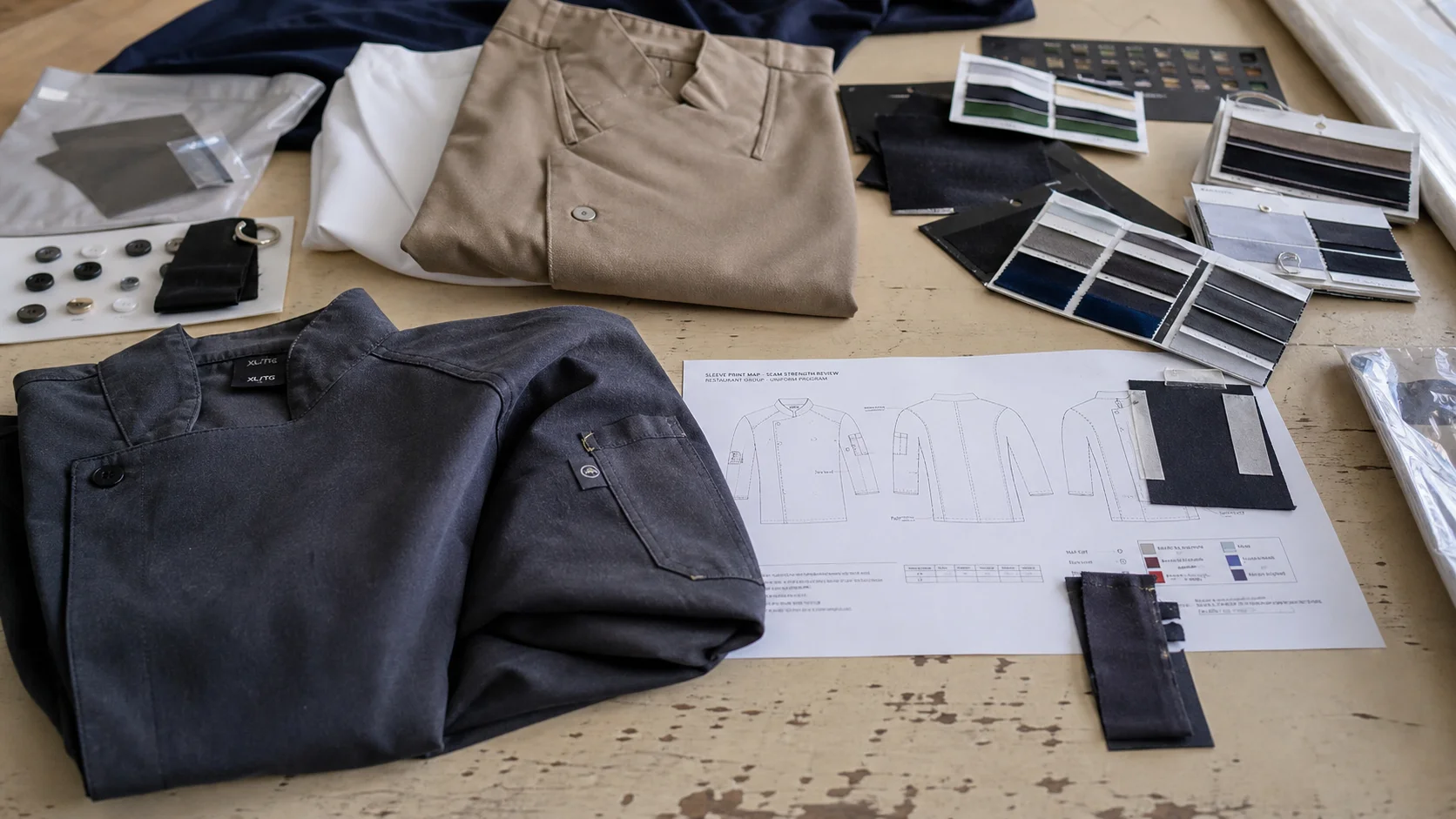
A production-focused outline for restaurant groups evaluating sleeve print maps, seam placement, and wash-ready seam strength before approving decorated...
Sleeve Print Map Review for Restaurant Uniform Buyers - Decoration & Printing manufacturing guide
Category: Decoration & Printing
Sleeve decoration looks simple on a purchase order. A buyer may write “logo on left sleeve” or “slogan on right sleeve” and assume the factory will understand the placement. In bulk restaurant uniform production, that assumption is risky. A sleeve print map turns a loose decoration request into a measurable production instruction.
For restaurant groups, sleeve prints often carry location identity, delivery platform marks, limited-time campaign graphics, crew role indicators, or brand slogans. These prints are small, but they sit on one of the most mobile parts of the garment. Arms bend, sleeves twist, seams stretch, and staff move through heat, steam, repeated washing, and high-friction service environments.
A practical sleeve print map review should answer three sourcing questions. First, will the artwork land in the correct visible position across all sizes? Second, will the decoration process weaken or distort the sleeve seam? Third, can the supplier repeat the placement accurately across hundreds or thousands of units?
Uniform buyers should not treat sleeve printing as a late-stage artwork task. It affects pattern engineering, seam construction, fabric selection, production flow, inspection criteria, and return risk. A poorly mapped sleeve print can make a clean brand design look cheap. A poorly reviewed seam area can create popped stitches after a few wash cycles, especially on knit polo shirts, chef jackets, and stretch work shirts.
Purchasing judgment: if the sleeve print crosses or sits too close to a high-stress seam, approve it only after testing on the real bulk fabric and the real sleeve construction. A digital mockup is not enough for restaurant uniform programs.
A sleeve print map is a technical placement guide. It should be clear enough that a production line, print room, quality inspector, and buyer can all measure the same result. The map should not rely only on a visual mockup because sleeve shape changes by size, cut, fabric behavior, and seam type.
A reliable print map normally includes sleeve view, print size, placement point, distance from seam, distance from sleeve hem, orientation, color standard, decoration method, and size grading rules. Restaurant groups with multiple concepts or store tiers should also specify whether the same placement applies to every uniform style or only to one SKU.
For most restaurant uniform programs, a reasonable placement tolerance is often around 3 mm to 5 mm for small logos and 5 mm to 8 mm for longer sleeve text. Tighter tolerance can increase rejection risk and slow production. Wider tolerance may be acceptable for casual staff T-shirts but usually looks inconsistent on premium shirts, outerwear, or front-of-house uniforms.
One common issue is grading. A sleeve print that looks centered on a medium size may drift too close to the hem on an extra-small size or too far down the arm on a 3XL. The buyer should ask whether placement is fixed from a single point or adjusted by size. Fixed placement is easier to control. Graded placement looks better across broad size ranges but requires stronger factory controls.
Buyers sourcing restaurant uniforms across multiple body fits should also confirm whether men’s, women’s, and unisex patterns share the same sleeve panel shape. The same 70 mm sleeve logo can behave differently on a fitted women’s polo than on a relaxed unisex kitchen shirt.
The phrase “sleeve print map seam strength review” should not be treated as technical overkill. It is the practical review that prevents decoration from damaging the garment’s weakest stress points. Sleeve seams carry repeated strain. When staff reach overhead, carry trays, wipe counters, bend elbows, or pull garments on and off quickly, the sleeve seam is tested.
Prints placed too close to the underarm seam, sleeve joining seam, cuff seam, or coverstitch line may cause several problems. Heat can flatten seam bulk. Ink can bridge over seam ridges and crack later. Embroidery can perforate fabric near the seam allowance. Heat transfer pressure can leave uneven adhesion where seam thickness changes. A print that overlaps a seam may pass a first visual check but fail during washing or wear.
A practical rule is to keep most flat prints away from heavy seam ridges unless the design intentionally uses the seam as a reference line and the factory has tested the method. For screen print or heat transfer on knit sleeves, many buyers specify a minimum clearance of roughly 10 mm to 15 mm from major seams. Embroidery may need more clearance depending on stitch density and fabric weight.
Seam strength should be reviewed after decoration, not only before decoration. A sleeve panel may pass normal seam testing in greige or finished fabric, then lose performance after heat, pressure, needle penetration, or handling. This is particularly relevant for polyester-rich uniforms, blended polos, and lightweight stretch fabrics used in quick-service restaurants.
Risk Area Typical Cause Buyer Action Print near underarm seam Stretch and friction during movement Request decorated sample and seam pull check after wash Print over coverstitch hem Uneven pressure and ink cracking Move artwork above hem or reduce print height Dense embroidery near seam Needle perforation and fabric distortion Lower stitch density or increase seam clearance Heat transfer on bulky seam Poor adhesion over uneven surface Use smaller transfer or apply before sewing if feasibleRestaurant groups should decide early whether brand accuracy or durability matters more in each sleeve location. A sleeve logo positioned high near the shoulder may be more visible on staff photos, but it can be closer to the armhole seam. A lower placement may last better but may be hidden by aprons, folded arms, or service posture.
Sleeve decoration cannot be separated from fabric specification. Restaurant uniforms often require comfort, wash durability, stain resistance, color consistency, and cost control. Each fabric reacts differently to ink, heat, embroidery, and seam stress.
Common restaurant uniform fabrics include cotton jersey, cotton-poly jersey, pique knit, interlock knit, woven poplin, twill, Oxford cloth, ripstop, and performance polyester. Apron straps, sleeve tabs, rib cuffs, contrast panels, and reflective trims may also affect where decoration can be placed.
Heat-sensitive fabrics need extra caution. Some polyester sleeves can show press marks, shine, dye migration, or scorching if heat transfer parameters are not controlled. Dark polyester can cause dye migration into light-colored prints, turning white sleeve logos gray, pink, or dull after curing or storage.
Cotton-rich fabrics are easier for many ink systems, but they may shrink more. If the sleeve shrinks after decoration, the print can look distorted or sit lower than intended. Pre-shrunk fabric helps, but buyers should still check final garment measurements after wash.
Stretch fabrics can improve staff comfort, but they complicate sleeve printing. Thick prints restrict stretch and may crack. Embroidery can create puckering. Heat transfers must stretch with the fabric or they will peel at the edges. On stretch sleeves, softer inks, stretch additives, or flexible transfers are often better than heavy, high-build prints.
Trim details also matter. Sleeve tabs, pen pockets, contrast bands, rib cuffs, snaps, and roll-up sleeve loops can interfere with print placement. If a restaurant group wants both sleeve functionality and sleeve branding, the technical pack should show both on the same sleeve map. Separate artwork and garment sketches often lead to conflicts during production.
The best decoration method depends on fabric, order quantity, logo complexity, wash expectations, hand feel, color count, and budget. Sleeve space is limited, so small artwork must stay readable. Fine text, thin lines, and small icons often fail when the wrong method is selected.
Screen printing is commonly used for T-shirts, casual polos, and larger restaurant staff programs. It can be cost-effective when the artwork repeats across many units. It is less efficient for many location-specific designs or short runs because each color and artwork variation adds setup cost.
Screen print works well for bold sleeve logos and simple one-color slogans. It becomes more difficult on seams, ribbed sleeves, high-stretch fabric, and small curved panels. Buyers should confirm ink type, curing temperature, wash durability, and whether stretch additive is needed.
Heat transfer is useful for smaller quantities, multi-color artwork, staff role identifiers, and franchise location customization. It gives clean edges and can handle detailed logos better than some direct print methods. The tradeoff is sensitivity to heat, pressure, fabric finish, and laundering conditions.
For restaurant uniforms that go through commercial laundry, buyers should be cautious with low-grade transfers. Edge lifting, cracking, and dye migration are common inspection and wear risks. A good transfer specification should include film type, adhesive type, application temperature, pressure, dwell time, peel method, and wash test requirement.
Embroidery gives a durable, premium look on chef coats, woven shirts, jackets, and some polos. It is not always the right choice for small sleeves. Dense embroidery can feel stiff, distort lightweight fabric, and weaken areas near seams. Small letters may lose clarity.
For restaurant groups, embroidery is often better for a chest logo than a tight sleeve placement. If the sleeve must be embroidered, the buyer should request a digitized stitch file review, stitch count, backing type, thread color standard, and actual sew-out sample on the bulk fabric.
Sublimation can be effective for polyester uniforms, especially when artwork is part of an all-over design or performance shirt. It creates a soft hand feel because the dye bonds with the fiber. It is less suitable for cotton fabrics and may not match brand colors perfectly on every polyester base.
Sublimation should be reviewed carefully when sleeve artwork needs exact color matching. Restaurant brands often have strict logo standards, and sublimation colors can shift with fabric tone, heat settings, and supplier profiles.
Method Good For Main Tradeoff Screen print Large runs, simple sleeve logos, casual staff tees Setup cost and cracking risk on stretch zones Heat transfer Short runs, multi-color logos, location customization Peeling and dye migration if poorly specified Embroidery Premium woven shirts, jackets, chef coats Puckering and stiffness on lightweight sleeves Sublimation Polyester performance uniforms Color control and fabric limitationBuyers comparing decoration options can review broader production capabilities through Fabrikn’s services page. The main point is to align the sleeve print method with the garment’s actual use, not just the artwork file.
A strong approval process prevents sleeve decoration problems from reaching bulk production. Restaurant groups should avoid approving sleeve placement from flat artwork alone. The approval should include garment sample, decoration sample, wash sample, and size-set review when the program covers a broad size range.
For sleeve print map seam strength review, the pre-production sample is the key checkpoint. It should show the final fabric, sleeve construction, seam type, thread, decoration method, and artwork position. If the supplier changes fabric weight, sleeve pattern, seam construction, or print vendor after approval, the buyer should require another review.
Wash testing does not need to be complicated for every order, but it should be realistic. A casual restaurant T-shirt may need several home laundry cycles before approval. A chef coat or back-of-house shirt may need harsher testing if commercial laundry is expected. Buyers should specify whether tumble drying, bleach exposure, high-temperature washing, or industrial detergent is part of the use case.
Approval photos are helpful but not a replacement for measurement. A sleeve can look acceptable in one photo angle and still be off spec. Buyers should request photos with a ruler or measurement tape from the hem, shoulder seam, and underarm seam. For critical programs, a physical sealed sample is more reliable.
Minimum order quantity depends on garment type, fabric availability, decoration method, artwork variations, and whether the order uses blank stock or custom production. Restaurant buyers often underestimate how much sleeve customization affects MOQ.
For blank stock uniforms with sleeve decoration, MOQs can sometimes start around 50 to 100 pieces per design, especially for heat transfer or embroidery. Screen printing may be practical at similar quantities for simple one-color artwork, but unit cost improves substantially at higher volume. For custom-made uniforms with private fabric, dyed-to-match trims, custom labels, and sleeve printing, MOQs often fall closer to 300 to 1,000 pieces per style or color. Some fabric mills and dye lots may require more.
These ranges are typical, not guaranteed. A simple black poly-cotton polo with a one-color sleeve logo is a different sourcing problem from a multi-panel performance shirt with graded sleeve graphics across eight sizes and three franchise regions.
For decorated blank garments, buyers may see lead times around 2 to 5 weeks after artwork and sample approval, depending on stock availability and decoration workload. For custom restaurant uniforms, a more realistic range is often 6 to 12 weeks after approvals. Complex fabric development, multiple logo placements, or large size ranges can extend the schedule.
The main cost tradeoff is standardization versus local customization. A restaurant group can reduce cost by using one sleeve logo across all stores. A franchise model may need location names, regional sponsors, or role labels, which increases handling and risk. Heat transfer can handle variation better than screen print, but durability requirements must be checked.
Buyers should also consider whether sleeve prints are worth the operational complexity. A chest logo plus apron branding may be enough for some groups. Sleeve branding makes sense when it supports brand visibility, staff hierarchy, delivery partnerships, or campaign identity. It is less useful when it creates too many SKUs or slows replenishment.
For buyers building a larger uniform program, Fabrikn’s about page can help frame supplier capability, and the contact page is the right route for discussing a project brief, style list, or production questions.
Sleeve decoration defects can be easy to miss during carton-level inspection. Inspectors may focus on chest logos, garment measurements, shade variation, and packing. Sleeve placement should be listed as a specific checkpoint in the inspection standard.
Inspection should include both visual checks and simple handling checks. Stretch the sleeve gently near the print. Bend the elbow zone on long sleeves. Check whether the print cracks immediately. Rub the print surface lightly to detect curing or adhesion problems. Review seam appearance from the inside and outside.
AQL inspection can catch recurring problems, but sleeve print defects may cluster by size, operator, or decoration batch. Sampling should include multiple sizes, not only medium or large. If the restaurant group uses several artwork versions, every version should be checked.
Packing also matters. Heat transfers can block, stick, or mark other garments if packed too soon after pressing or if the finish is unstable. Embroidered sleeves can leave impressions on adjacent garments if folded tightly. Buyers should specify folding method when sleeve decoration is raised, sensitive, or placed near visible panels.
A restaurant uniform buyer does not need to become a print technician, but the purchase file should be specific enough to prevent avoidable mistakes. The most effective checklist is short, measurable, and tied to approval samples.
The best purchasing decision is not always the most decorative sleeve. It is the sleeve treatment that can be repeated, washed, worn, and replenished without constant exception handling. Restaurant uniforms live in a harsher environment than promotional apparel. Sleeve print maps should reflect that reality.
For restaurant groups, sleeve branding is worth approving only when the placement, decoration method, fabric, and seam construction work together. If one of those four elements is uncertain, sample again before bulk production.
Get a free quote from Fabrikn — your trusted B2B clothing manufacturer with 10+ years of experience. MOQ as low as 200 pieces.
Get a Free Quote →A sleeve print map is a technical placement guide showing where artwork should sit on a sleeve. It includes measurements, artwork size, sleeve side, orientation, tolerance, decoration method, and any seam clearance rules. It helps the supplier repeat the same placement across sizes and production batches.
Sleeve seams are high-stress areas. Heat, pressure, ink thickness, or embroidery needles can weaken or distort fabric near seams. A seam strength review checks whether the decoration position creates risk during movement, washing, or long-term restaurant use.
Many buyers use a rough clearance of 10 mm to 15 mm from major seams for flat prints, but the right distance depends on fabric, seam bulk, print method, sleeve size, and artwork shape. Embroidery or bulky heat transfers may require more space.
There is no single best method. Screen print is efficient for larger runs with simple artwork. Heat transfer works well for smaller runs and multi-color customization. Embroidery gives a premium look but can pucker lightweight sleeves. Sublimation is useful for polyester performance garments.
For blank stock garments with sleeve decoration, typical MOQs may start around 50 to 100 pieces per design. For custom-made uniforms with fabric development, trims, labels, and decoration, MOQs often range from 300 to 1,000 pieces per style or color. Actual MOQ depends on supplier setup and material availability.
Decorated blank garments may take around 2 to 5 weeks after approvals if stock is available. Fully custom restaurant uniforms often take 6 to 12 weeks after sample and material approvals. Lead time changes with fabric sourcing, artwork revisions, decoration setup, and inspection requirements.
Size grading is useful when the size range is wide and the sleeve shape changes significantly. Fixed placement is easier to control, but it may look too high or too low on extreme sizes. Buyers should review a size set before approving bulk production.
The biggest risks are incorrect sleeve side, wrong rotation, inconsistent placement, poor adhesion, cracked ink, dye migration, embroidery puckering, and seam distortion. Inspection should include several sizes and all artwork versions, not only one sample garment.