
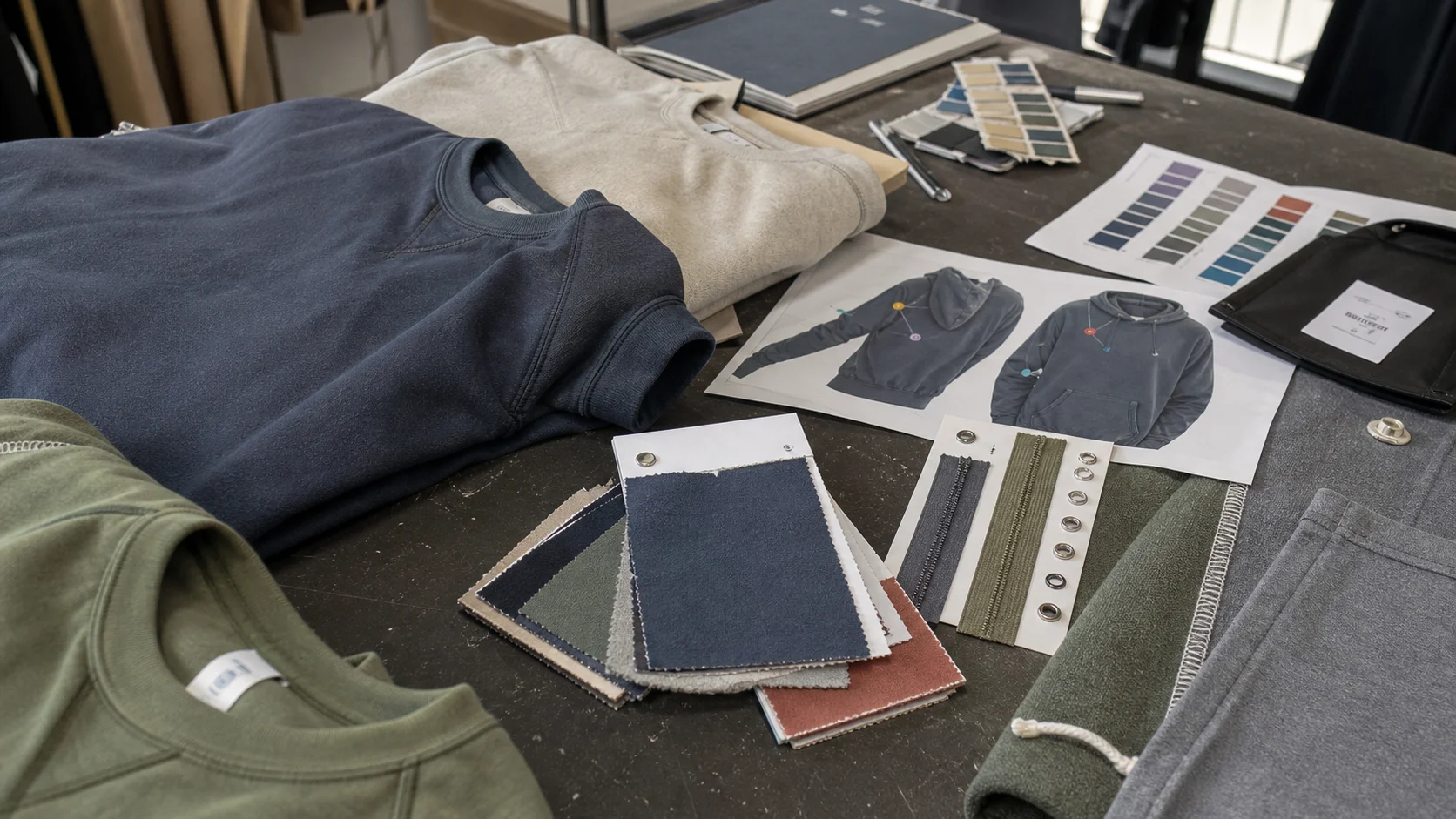
A buyer-focused outline for distributor teams managing sleeve print maps, with a practical shrinkage control plan, production checkpoints, and...
Sleeve Print Map Shrinkage Control Plan - Fabrikn production reference
For distributor buyers, sleeve decoration looks simple until garments hit washing, heat pressing, or repeat production. A sleeve print map can shift, distort, or crack if shrinkage is not controlled from the start. That is why a sleeve print map shrinkage control plan matters. It gives the manufacturer and buyer one shared method for managing garment movement, artwork placement, fabric behavior, and approval points before bulk production begins.
In decoration and printing, the main risk is not only poor print quality. The bigger problem is inconsistency. A sleeve graphic that lands correctly on one size can look off-center on another. A left sleeve and right sleeve can drift differently after washing. A cotton-rich fabric can shrink more than a polyester blend. Small changes in fabric lot, print method, or curing temperature can move the final placement enough to trigger claims from retail or downstream buyers.
This article is written for distributor buyers who need practical sourcing judgment, not theory. It explains how a sleeve print map shrinkage control plan should be built, what to ask a manufacturer, and which tradeoffs usually matter most when comparing suppliers. For buyers evaluating service capability, it is worth reviewing the manufacturer’s broader decoration support on fabrikn.com/services/ and confirming commercial contact paths through fabrikn.com/contact-us/.
A sleeve print map shrinkage control plan is a production system for keeping artwork aligned after fabric shrinkage, garment finishing, and decoration curing. It typically defines the exact placement of sleeve graphics across sizes, the allowable tolerance after wash testing, and the corrective method if the fabric shrinks more than expected.
In practice, the plan should cover four things:
For distributor buyers, the value of this plan is simple. It reduces the chance that a decorating issue becomes a commercial dispute. A good manufacturer does not just print to spec; it checks how the shirt behaves under heat, wash, and finishing. That is especially important for sleeves, where the eye notices alignment quickly and where even a few millimeters can look wrong.
Distributor buyers usually work with compressed timelines, multiple colorways, and repeat programs. That makes print consistency more important than a one-off fashion run. A sleeve decoration that shifts from lot to lot creates returns, chargebacks, and replacement cost. It also weakens trust with the customer who expects repeatability.
Shrinkage control matters even more when the program includes multiple fabric types. A 100% cotton tee may shrink differently from a ring-spun cotton/poly blend. Garment dyeing, enzyme washing, or heavy tumble drying can change the final sleeve dimensions again. If the supplier does not build the print map around these movements, the artwork can end up too close to the cuff, too far up the bicep, or visibly uneven between sizes.
There is a sourcing tradeoff here. Tighter control usually means more sampling, more measurement steps, and a longer approval cycle. That can increase upfront cost. The cost is usually justified when the product is branded, repeated across seasons, or sold to customers who inspect visual placement closely.
Most sleeve print issues are not caused by the artwork file alone. They come from the interaction between pattern, fabric, heat, and sewing. Buyers should watch for the following failure points.
The best manufacturers treat the sleeve as a moving surface, not a fixed panel. That means they should measure shrinkage on the actual garment, not only on fabric yardage. The print map should be tested on the finished shirt after the intended wash or finishing process whenever possible.
The manufacturer should start with a written product brief. This should include fabric composition, knit type, GSM, yarn count if relevant, sleeve length, cuff construction, and decoration method. Buyers should insist on clear definitions for whether the garment is pre-shrunk, garment washed, enzyme washed, silicone washed, or heat-set. Each of these changes the shrinkage profile.
Without a fixed product definition, the print map has no stable baseline. Buyers sometimes approve a graphic on an unwashed sample and then discover the bulk order is washed, soft-finished, or heat-cured differently. That is a common cause of placement disputes.
A reliable plan tracks both fabric shrinkage and garment shrinkage. Fabric alone can be misleading because sewing tension and seam construction affect the final sleeve shape. The supplier should measure before and after laundering, using the intended care process. Measurements should include sleeve width, sleeve length, armhole relationship, and graphic reference points.
For most distributor programs, a practical tolerance discussion is better than pretending every garment can be identical. A common target might be within a small millimeter range for placement after wash, but the exact tolerance should depend on garment type, decoration method, and customer expectation. Buyers should ask the supplier to state the tolerance in writing before sample approval.
The artwork should be positioned against the finished garment pattern, not a generic template. On sleeves, the key reference points are the top sleeve seam, the bottom seam or cuff line, and the centerline or rotation of the sleeve. The manufacturer should confirm where the graphic sits when the garment is worn, not only when it is laid flat.
For striped, raglan, or curved sleeve shapes, the map usually needs a special placement approach. A standard rectangular transfer location can look wrong once the sleeve bends. Buyers should not accept a one-size-fits-all sleeve map if the garment construction changes by style.
Some suppliers will pre-shrink fabric before cutting. Others will cut, sew, and then wash the garment to stabilize dimensions before printing. The right method depends on the decoration system and the production flow. A post-sew wash can improve realism for placement, but it may also increase lead time and cost.
Buyers should ask a direct question: is the artwork being mapped to the garment before or after the shrinkage-driving process? If the supplier cannot answer clearly, the risk is high. A manufacturer that knows its process should be able to explain where the stabilizing step sits and how it affects placement.
Base-size approval is not enough for sleeve print placement. The artwork can look correct on one size and drift on another because the grade rules change. A practical plan includes at least a small size run, usually covering a low, middle, and high size in the line.
This step adds time, but it is usually worth it for any promotional, retail, or private-label program. For simple repeat programs, buyers may approve one core size and require the supplier to prove the placement formula works across the grade.
If the sleeve print lands off spec, the supplier should already have a correction method. That might include adjusting print art coordinates, changing stencil or transfer placement, modifying pressing guides, or updating the shrinkage allowance. The plan should say who signs off on the correction and whether the revised map applies only to that order or to future repeat orders.
This is a sourcing point many buyers overlook. A corrected sample without a documented update can create the same problem on the next bulk run. The control plan should live with the style record, not only in one email thread.
Shrinkage control improves when the buyer specifies the right inputs from the beginning. The supplier needs more than an artwork file. It needs a technical pack that defines the substrate and the decoration method.
Spec Area What to Define Why It Matters Fabric content Cotton, polyester, blends, elastane percentage Controls shrinkage behavior and heat response Fabric construction Jersey, interlock, fleece, rib, brushed surface Affects stretch, recovery, and print distortion GSM / weight Target weight and acceptable range Heavier fabrics may behave differently during wash and press Decoration method Screen print, heat transfer, digital print, puff, reflective, plastisol Each method handles heat and wash differently Care process Wash type, drying method, finishing process Determines the final size and placement behavior Placement tolerance Allowed deviation after wash and cure Sets the quality benchmark for inspectionTrim specs matter too, even on a sleeve print program. Cuffs, binding, tapes, labels, and seams can change how the sleeve sits. A heavy rib cuff can pull the sleeve opening tighter after wash. A thick neck label can create a small twist in the garment body that makes the sleeve print appear off-center. Buyers should include all trims in the sample review, not only the printed area.
When a supplier proposes lower-cost trims or alternate fabrics, the first question should be whether the change affects shrinkage or sleeve rotation. Small material savings can become expensive if the decoration map has to be rebuilt.
A proper approval flow usually has several checkpoints. Buyers should not rush this part, especially for repeated orders.
Buyers should insist on before-and-after measurements in the sample report. That report should show where the graphic was placed, how much the garment changed, and whether the final result stayed within tolerance. If the supplier uses different test methods between sampling and bulk production, the report loses value.
Typical MOQ ranges depend on the decoration method and fabric. Screen-printed or transfer-decorated programs often start around 300 to 1,000 pieces per colorway or design, while more specialized runs can require more. Buyers should treat MOQs as a negotiation point, not a fixed rule. Smaller runs may be possible, but they often come with higher unit cost and less production flexibility.
Shrinkage control can extend lead time. That is not a problem if the buyer plans for it. The schedule usually depends on fabric sourcing, sampling rounds, wash testing, correction cycles, and bulk line availability. If any of those steps slip, the print map can become outdated before production starts.
A realistic lead-time structure might look like this:
Buyers should be cautious when a supplier promises a very short lead time without mentioning testing. That can mean the print map is being copied from a previous order without checking the new fabric lot. Repeat programs still need verification because shrinkage can change when mills, finishes, or decoration equipment change.
For more detail on manufacturing support and service scope, buyers can review fabrikn.com/services/ and use the brand information on fabrikn.com/about-us/ to evaluate whether the supplier’s process depth matches the order complexity.
Inspection for sleeve print programs should not stop at visual check. It should include placement measurement, wash stability, print integrity, and repeatability across the order. The highest-risk defects are often subtle and easy to miss in a quick final inspection.
Quality control should start in pre-production and continue through in-line checks. A good inspector will measure a sample of garments from each lot, compare them to the sealed sample, and verify that the sleeve print map still matches the approved reference after any finishing step. Buyers should ask whether the factory records these results by lot number. If it does, traceability becomes much easier when a claim appears later.
There is also a practical risk in using multiple decoration technologies on the same sleeve. A plastisol print, a heat transfer, and a reflective detail may not age the same way. If a supplier is combining methods, the buyer should request a test wash on the full decoration stack, not only on one element.
Distributor buyers should compare manufacturers on process control, not only price. A lower quote can be attractive, but it may hide loose placement tolerances, weak sampling discipline, or a lack of wash testing. The best supplier is the one that can explain how it prevents variation, not the one that simply says it can do the print.
Useful comparison questions include:
Buyers should also check whether the manufacturer is comfortable documenting decisions. A clear spec sheet, approval record, and correction log are signs of maturity. If a supplier cannot provide those documents, it usually means the process depends too much on individual judgment at the line. That may work for small custom jobs, but it is weaker for distributor business with repeat orders and multiple customers.
Before placing an order, buyers should clarify commercial and technical support through fabrikn.com/contact-us/. A well-run production partner should respond with specific questions about fabric, artwork size, wash process, and size range instead of offering a generic yes.
A sleeve print map shrinkage control plan is not an extra document. It is the working method that keeps decorated sleeves consistent from sample to bulk production. For distributor buyers, the plan reduces waste, protects customer relationships, and gives the supplier a clearer path to repeatable results.
The strongest programs start with fabric and finish definition, then move through measurable sample approval, wash testing, and documented correction. Buyers should be cautious of any supplier that skips measurement or treats the sleeve like a flat panel. Sleeve decoration is visible, and the market notices when it is off by even a small amount.
When the control plan is built properly, the tradeoff is usually worth it. You spend a little more time in sampling and review, but you get fewer claims, better repeatability, and a cleaner procurement record. In decoration and printing, that is often the difference between a one-time order and a reliable supply relationship.
Get a free quote from Fabrikn — your trusted B2B clothing manufacturer with 10+ years of experience. MOQ as low as 200 pieces.
Get a Free Quote →Its purpose is to keep sleeve artwork aligned after fabric shrinkage, washing, and curing so the final garment matches the approved placement across sizes and production lots.
There is no single rule that fits every garment. Cotton-heavy styles generally move more than polyester-rich styles, and the exact tolerance should be written into the approval process based on the fabric, decoration method, and wash treatment.
Most buyers should expect at least one decorated sample, one washed or cured sample, and a size-run check for any style where sleeve placement is critical. More complex programs may need additional revisions.
MOQs often start around 300 to 1,000 pieces per design or colorway for common print programs, though exact numbers depend on fabric, decoration method, and supplier setup. Smaller orders are sometimes possible at a higher unit cost.
Heat transfers, certain specialty inks, and mixed decoration stacks tend to need tighter control because heat, stretch, and wash movement can change appearance or placement more noticeably than simpler print methods.
It should be based on the finished garment whenever possible. Fabric-only mapping can miss seam tension, sleeve rotation, and post-sew behavior that affect the final look.
Ask how shrinkage is measured, how sample approval works, what placement tolerance is accepted, and what happens if the fabric lot or finishing process changes. Clear answers usually indicate a more controlled operation.