
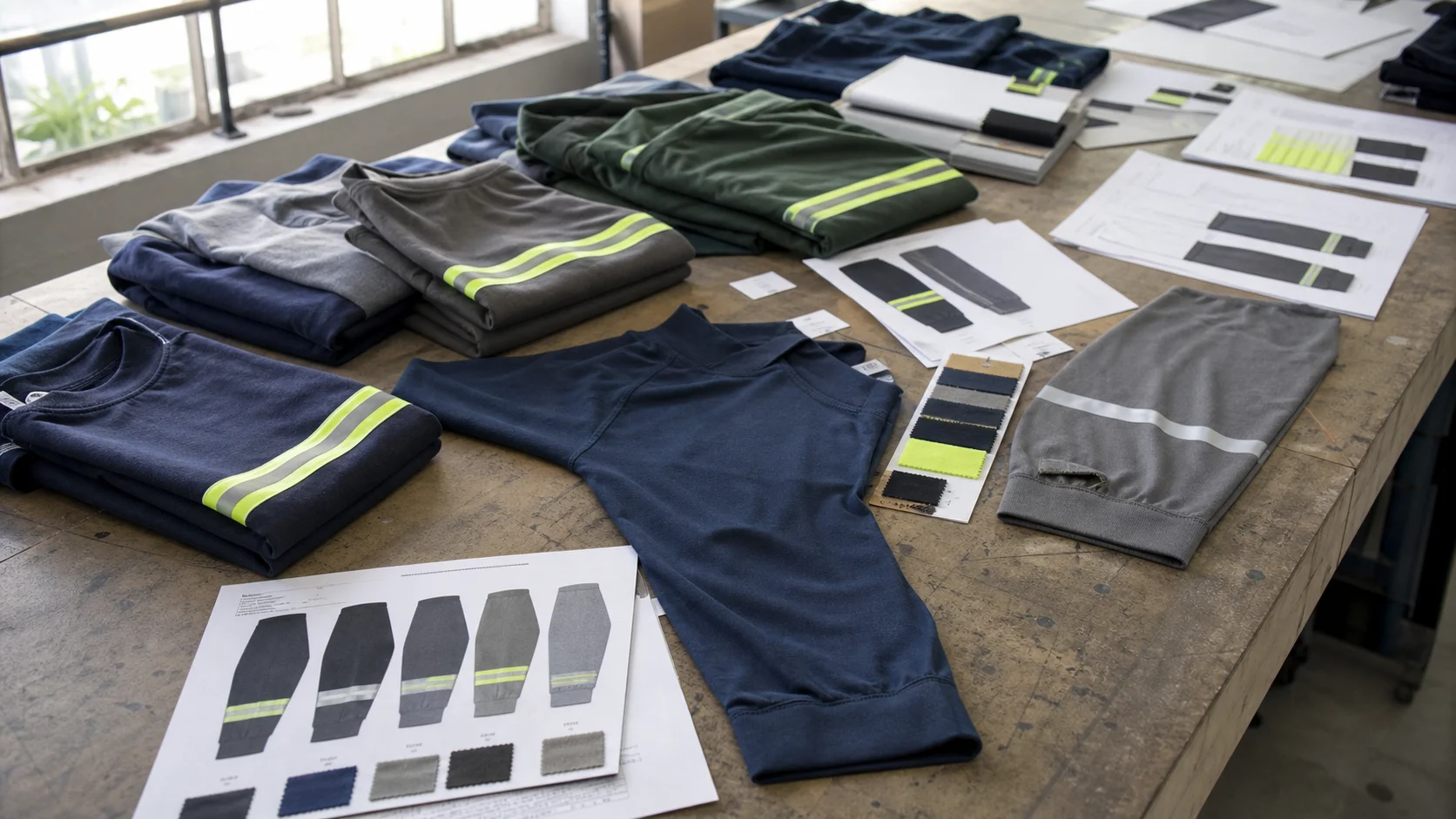
A 2500-word SEO outline for buyers auditing sleeve print maps, supplier colorfastness controls, and decoration durability for cleaning crew uniforms...
Sleeve Print Map Audit for Cleaning Crew Buyers - Decoration & Printing manufacturing guide
Buying uniforms for cleaning crews looks simple until the sleeve print starts cracking, fading, bleeding, or sitting in the wrong place across mixed sizes. A sleeve logo that looks acceptable on a medium sample can become too low on a 3XL, too close to the cuff on a small, or distorted across a ribbed long-sleeve polo. For cleaning companies, facility service contractors, janitorial teams, hotel housekeeping vendors, and commercial maintenance crews, the sleeve print is not only decoration. It is brand identification in motion.
A sleeve print map supplier colorfastness audit for cleaning crews is a practical control process that checks three things before bulk production: the print location map, the decoration method, and the colorfastness performance after washing, rubbing, sweat, and cleaning chemical exposure. The goal is not to create paperwork for its own sake. The goal is to stop the most common uniform problems before cartons leave the factory.
Cleaning crew uniforms face harder use than standard office apparel. Shirts are washed frequently. Sleeves rub against carts, counters, tile, equipment, gloves, and chemical bottles. Workers may handle diluted bleach, disinfectant, detergent, degreaser, ammonia-free glass cleaner, and floor-care products. If the sleeve print is poorly specified, even a decent garment can fail in the field.
A sleeve print map audit is the review of sleeve artwork placement, size grading, print direction, registration, and production tolerance before and during manufacturing. It confirms where the artwork should sit on each size, how it should align when the sleeve is laid flat, and how much variation is acceptable in bulk.
For cleaning crew buyers, the audit should be tied to colorfastness. A sleeve mark that is perfectly placed but loses color after ten industrial washes is still a failed uniform. The audit must connect the technical print map with the garment’s real operating conditions.
A complete sleeve print map audit normally checks:
The strongest buying teams treat the sleeve print map as a production document, not a marketing image. Mockups are useful for presentation, but factories need measurements, fabric behavior notes, and pass/fail criteria.
A sleeve print map should answer one simple production question: if 5,000 shirts are made in eight sizes, how does the supplier keep the sleeve logo consistent, washable, and readable on every unit?
Cleaning crew uniforms are exposed to more friction, moisture, and cleaning substances than many promotional garments. A sleeve print may touch sprayed surfaces, wet gloves, towel bundles, trash liners, mop handles, stainless steel edges, and laundry chemicals. These conditions increase the risk of print wear, dye migration, and discoloration.
Colorfastness is the ability of a fabric, dye, print, or decoration to retain color and resist staining other materials. For sleeve prints, colorfastness is not only about the ink. It also depends on fabric composition, surface texture, pretreatment, curing, storage, washing temperature, and the chemical environment.
Common sleeve print failures in cleaning uniforms include:
These failures are visible to end clients. A cleaning crew wearing faded sleeve prints can make a service provider look less controlled, even when the actual work is strong. For B2B uniform buyers, this creates replacement cost, complaint handling, and brand damage.
The audit starts before the supplier makes the first sample. A buyer brief should define the use case, washing conditions, print expectations, and inspection standard. If the brief only says “logo on sleeve,” the supplier will make assumptions. Some assumptions may be reasonable, but they may not match the needs of a cleaning crew uniform program.
Cleaning crew buyers should avoid approving a decoration based only on a digital rendering. A sleeve is curved, stretched, washed, and rubbed. Print performance must be tested on the exact garment fabric or a production-representative fabric.
Companies sourcing uniform programs can review broader manufacturing support options through Fabrikn services when they need structured sourcing, sampling, or production coordination. For sleeve print audits, the useful service is not generic decoration sourcing. It is the ability to translate buyer requirements into factory-ready specifications.
The print map is the main control document for sleeve decoration. It should be specific enough that a production line, sample room, and inspection team can all use the same reference. A vague position such as “centered on sleeve” is not enough for bulk apparel manufacturing.
Reference points must be stable and easy to measure. Sleeve seams, cuff edges, sleeve hem edges, shoulder seams, and bicep width points are common references. The right choice depends on the garment construction.
Garment Type Common Sleeve Print Reference Audit Risk Purchasing Note Short-sleeve T-shirt Distance from sleeve hem and sleeve center line Print may look too low on smaller sizes Request size-grade placement rules, not one fixed point for all sizes. Long-sleeve polo Distance from shoulder seam or cuff edge Logo may twist around the arm Check sleeve rotation and worn appearance, not only flat measurement. Sweatshirt Distance from cuff seam and outer sleeve fold Rib and fleece bulk can affect transfer pressure Use production fabric for sample approval. Work jacket Distance from armhole seam, sleeve seam, or cuff Seams and padding may interfere with heat press Confirm machine access before approving placement. High-visibility shirt Clearance from reflective tape and sleeve hem Decoration may violate visibility layout or wash performance Keep printed artwork away from reflective tape unless tested together.Reasonable sleeve print placement tolerances depend on fabric stretch, garment size, and decoration method. For many bulk uniform orders, a placement tolerance of about plus or minus 5 mm to 10 mm is common for simple sleeve prints. Wider tolerances may be needed for bulky jackets or highly elastic knitwear. Tight tolerances may increase production cost and rejection rates.
Artwork size tolerances are usually tighter. A logo that changes size by more than a few millimeters can look unprofessional when crew members stand together. Buyers should specify acceptable print width, print height, and position tolerance separately.
The audit must state whether the print belongs on the wearer’s left sleeve or the wearer’s right sleeve. Confusion between wearer’s side and viewer’s side is a common pre-production error. The safest wording is “wearer’s left sleeve” or “wearer’s right sleeve,” supported by a technical sketch.
If one sleeve carries the company logo and the other carries a safety message, department code, or client site name, each sleeve needs its own print map. The inspection team should not be asked to judge from a sales mockup alone.
Fabric is a major factor in sleeve print performance. Cleaning crew uniforms are often made from cotton-polyester blends, polyester pique, interlock knit, jersey, fleece, softshell, or woven workwear fabric. Each behaves differently under heat, pressure, ink, and washing.
Cotton-rich fabrics often accept screen printing well, but they may shrink more if not controlled. Polyester-rich fabrics can offer quick drying and durability, yet they raise the risk of dye migration into light prints. Blended fabrics need testing because the print must bond to both fiber behavior and surface texture.
Typical fabric options for cleaning crew shirts include:
Lightweight sleeve fabrics can scorch, shine, or distort under heat. Heavy fabrics may need more pressure or longer dwell time for transfers. Ribbed or textured fabrics can break up fine artwork details. A sleeve print map supplier audit should ask whether the artwork is suitable for the selected fabric surface.
Fine text, small icons, and thin lines are risky on textured sleeves. For cleaning crews, legibility at a practical distance is more important than reproducing every small brand detail. A simplified sleeve mark often performs better than a full corporate lockup.
Sleeve trims can interfere with decoration. Rib cuffs, reflective tape, contrast panels, sleeve pockets, pen slots, and seam tape may limit usable print area. Heat transfers placed too close to bulky seams may not bond evenly. Screen prints too close to seam ridges may show blurred edges or skipped ink.
Buyers should ask the supplier to confirm the sleeve print area after the garment pattern is finalized. A print map approved on a generic blank may not transfer cleanly to a custom uniform pattern.
No single sleeve decoration method is best for every cleaning crew program. The right choice depends on order size, fabric, artwork complexity, wash target, budget, and replacement schedule. Buyers should compare decoration methods based on performance, not only unit price.
Decoration Method Strengths Risks Best Use Screen Print Cost-effective for larger runs, good color opacity with correct ink Cracking, poor curing, dye migration on polyester Medium to large uniform orders with simple artwork Heat Transfer Clean detail, flexible for names or small batches Peeling, edge lift, shine marks, pressure inconsistency Smaller orders, multi-location branding, variable logos DTF Transfer Good detail and color range, suitable for varied artwork Hand feel, wash durability variation, adhesive quality risk Complex artwork when screen setup is not economical Embroidery Durable appearance, strong perceived quality Can pucker sleeves, uncomfortable on thin knits, not ideal for fine small text Polos, jackets, supervisory uniforms Reflective Transfer Improves visibility and role identification Wash degradation, cracking, compliance limitations Night cleaning teams, parking facilities, exterior maintenance Sublimation Excellent wash resistance on suitable polyester Limited to light polyester fabrics, color matching constraints All-over polyester designs, not standard dark uniform sleevesScreen printing remains a sensible choice for many cleaning crew uniforms when the logo is simple and the order quantity is high enough. It can be economical and durable if ink, mesh, curing, and fabric are controlled. On polyester garments, buyers should request low-bleed or migration-resistant ink systems when light prints sit on dark fabric.
The tradeoff is setup cost and less flexibility. If a buyer needs small site-specific sleeve changes, screen printing can become inefficient. It also needs strong curing control. Under-cured prints may pass a quick visual check and fail after washing.
Heat transfers are useful for smaller batches, complex artwork, or variable logos. They can deliver clean edges on sleeves where screen printing is difficult. The risk is adhesion. Cleaning uniforms are washed hard and used hard. Transfer film, adhesive, press pressure, dwell time, and temperature must be validated.
Buyers should request a wash-tested transfer sample on the exact sleeve fabric. Edge lift after washing or rubbing is a warning sign. A cheap transfer may save money at purchase and create a replacement problem within weeks.
Embroidery can look durable, especially on polos and jackets. It is less suitable for thin T-shirt sleeves because it can pucker the fabric, add bulk, and feel rough against the arm. Small sleeve text can also lose clarity in embroidery.
For cleaning supervisors or customer-facing managers, embroidery may be justified. For high-volume hourly crew T-shirts, it may be unnecessarily expensive or uncomfortable unless the garment is built for it.
A supplier audit for sleeve print map and colorfastness does not need to be complicated, but it must be specific. The buyer should confirm whether the supplier can control print mapping, decoration performance, and production consistency at the expected order volume.
Buyers should ask direct questions and expect clear answers. If the supplier cannot explain how sleeve placement is controlled, the risk moves to the buyer.
A supplier who gives practical numbers and process details is usually lower risk than one who only says the print is “good quality.” Buyers do not need every proprietary formula, but they do need enough information to judge control.
For buyers comparing sourcing partners, the Fabrikn about us page can help frame how a manufacturing partner positions its sourcing and production role. In any supplier conversation, the buyer should still ask for garment-specific evidence before committing to bulk.
Colorfastness testing should reflect the expected use of cleaning crew uniforms. A fashion T-shirt test plan may not be enough. The sleeve print has to survive repeated washing, rubbing, sweat, and incidental contact with diluted cleaning products.
Exact test standards vary by buyer, market, and garment type. Many buyers use recognized textile test methods through third-party labs, while others use supplier internal testing for lower-risk programs. For cleaning crew uniforms, a practical target is to validate the print after multiple home-laundry or commercial-laundry cycles before bulk approval.
A cautious starting point is to test at 5, 10, and 20 wash cycles for visible print change, cracking, peeling, and color loss. Programs that promise long service life may need higher wash-cycle validation. If uniforms are laundered weekly, 20 washes may represent only part of the expected wear period.
Buyers should not rely on a single unwashed salesman sample. A sleeve print can look excellent before laundering and still fail under regular use.
Cleaning chemicals create a difficult sourcing issue. No ordinary uniform decoration should be assumed resistant to every disinfectant, bleach solution, degreaser, or solvent. Buyers should identify the main chemical families used by their crews and test realistic exposure. A short contact with diluted chemical followed by laundering is more relevant than soaking a sleeve print in concentrated product, unless that reflects actual misuse risk.
Bleach is especially aggressive. If crews regularly handle bleach, buyers should consider darker design expectations carefully. Some fading or spotting may be unavoidable with repeated accidental contact. The purchasing decision then becomes a tradeoff between uniform cost, replacement cycle, and chemical-resistant performance.
Sample approval is where buyers catch problems cheaply. Once bulk sleeve printing starts, mistakes multiply quickly. The approval process should move from artwork confirmation to physical print testing before production release.
Size set review is often skipped to save time. That is a poor saving when the sleeve print is prominent. A logo that is correctly placed on size M may look off on XS or 4XL. For mixed cleaning crews, size range is not a detail. It is part of the uniform system.
Buyers should keep approved physical samples or clear approved sample photos with measurements. Written approval should state what is accepted and what remains conditional. If colorfastness testing is pending, bulk production should not start unless the buyer knowingly accepts that risk.
A useful approval record includes:
MOQ and lead time depend on garment type, fabric availability, decoration method, artwork complexity, and whether the buyer is using stock blanks or custom manufacturing. Buyers should treat any quoted timeline as conditional until fabric, trims, print method, and sample approval are locked.
Typical minimum order quantities vary widely. The ranges below are practical planning references, not guarantees.
Program Type Typical MOQ Range Cost Position Best Fit Stock blank with sleeve transfer 50 to 300 pieces Higher unit cost, lower setup burden Small cleaning teams, pilot programs, urgent orders Stock blank with screen print 100 to 500 pieces Better unit cost at higher volume Simple logo programs with stable artwork Custom polo or T-shirt with sleeve print 300 to 1,000 pieces per style/color Balanced cost and customization Regional cleaning companies and recurring uniform buys Custom fabric or dyed-to-match program 800 to 2,000+ pieces per color Lower unit cost at scale, higher development risk Larger service contractors with planned replenishment Multi-site variable sleeve logos Varies by decoration method Setup and handling costs can rise Franchise, facility-specific, or client-branded programsFor cleaning crews, buyers often underestimate replenishment. Staff turnover, damaged uniforms, site expansion, and seasonal contracts can require repeat orders. A slightly higher MOQ may be acceptable if the supplier can support consistent reorders. A low MOQ is attractive, but it may come with inconsistent fabric lots, changing blanks, or different print chemistry over time.
Lead times are not controlled by printing alone. The slowest dependency sets the schedule. A sleeve print audit should be built into the calendar rather than treated as an afterthought.
A rushed schedule usually removes testing first. That is risky for cleaning crew uniforms because the product must perform after laundering. If launch timing is tight, buyers may approve a smaller pilot batch first, then release full production after wash results are known.
Final inspection should check both the garment and the sleeve decoration. AQL inspection can be used, but the checklist must define sleeve-specific defects. Inspectors cannot make consistent decisions if defects are not classified.
Critical defects are generally safety, compliance, or severe brand errors. Major defects affect saleability, usability, or brand presentation. Minor defects are small issues unlikely to affect normal use, though they still matter when repeated.
Defect Likely Classification Why It Matters Inspection Method Wrong sleeve side Major or critical Brand layout or compliance marking is incorrect Compare to approved print map. Wrong artwork version Major or critical Client logo, site name, or role mark may be wrong Compare to approved artwork file. Placement outside tolerance Major Uniforms look inconsistent when worn together Measure from defined reference points. Cracked or peeling print Major Decoration may fail quickly in use Visual check, stretch check, tape or rub check where appropriate. Color noticeably off standard Major Brand color inconsistency is visible Compare under controlled light to approved sample. Ink stains or transfer marks Major or minor Garment may look dirty before use Visual inspection front, back, and sleeve panels. Heat press scorch or shine Major Fabric damage around sleeve print Angle-light visual check.In-line inspection is valuable for sleeve prints because placement and curing problems can be caught early. A first-piece check should happen before the print operator continues. For larger orders, inspections should repeat at intervals. If the first 50 pieces are acceptable but the jig shifts later, the order can still develop a consistency problem.
Buyers should ask for production photos that include a ruler or placement guide. Photos are not a substitute for full inspection, but they can catch obvious errors quickly when production is remote.
Sleeve print audits should also look at packing. Garments from different shade lots should not be mixed randomly if color variation is visible. Printed sleeves should be dry and fully cured before folding and packing. Fresh prints packed too soon may block, stick, or mark adjacent surfaces.
Size stickers, carton labels, and polybag labels matter for cleaning crew distribution. A uniform program often ships to multiple sites. If cartons are mislabeled, the buyer may face operational delays even when the garments themselves are acceptable.
Good sourcing is not the same as choosing the most expensive option. It is choosing the lowest-risk option that fits the intended service life and budget. For sleeve print map supplier colorfastness audit work, buyers should decide which risks are acceptable and which are not.
Spending more is justified when the sleeve print carries important brand, safety, or client identification. It is also justified when uniforms will be washed frequently, worn in high-visibility client environments, or issued across many sites where inconsistent branding creates complaints.
Higher spend may go toward better fabric, better print chemistry, more sampling, lab testing, size set approval, or stricter inspection. These controls add cost, but they can reduce replacement and dispute costs.
A simple one-color sleeve logo on a stable cotton-poly blend can be a strong choice for many cleaning companies. If the uniform is replaced often and the brand mark is not highly detailed, a basic screen print or reliable transfer may be enough.
The mistake is not simplicity. The mistake is untested simplicity. Even low-cost uniforms need a print map, a wash check, and a clear approved sample.
A sleeve print may not be the right choice if the sleeve is too narrow, too textured, heavily seamed, or frequently exposed to harsh chemical contact. In those cases, a chest logo, woven patch, label, or back print may perform better. If workers wear gloves and sleeves rub constantly against surfaces, a sleeve print will face more abrasion than a chest print.
Buyers should challenge the decoration location when the garment construction does not support it. Brand teams may prefer the sleeve visually, but production reality should lead the final decision.
A useful audit framework keeps the buyer focused on decisions that affect performance. The supplier does not need to produce excessive documents, but the buyer should not release bulk production without evidence.
Audit Stage Buyer Decision Evidence Needed Pass/Fail Trigger Design review Is the sleeve artwork suitable for the fabric and location? Vector art, mockup, garment construction details Reject if text is too small or location conflicts with seams. Print map review Can placement be measured and repeated? Technical sketch with reference points Reject vague placement instructions. Material review Will fabric support the decoration method? Fabric composition, weight, finish, color Hold if coating, dye migration, or stretch risk is unresolved. Sample review Does the print look correct on the actual garment? Physical sample or production-equivalent sample Reject if placement, color, opacity, or hand feel is unacceptable. Performance review Will it survive expected cleaning crew use? Wash, rub, stretch, and chemical spot checks Reject if fading, peeling, staining, or cracking appears early. Bulk release Can production maintain consistency? First-piece approval and inspection plan Stop production if first pieces do not match approved sample.This framework works for direct factory orders, distributor-managed programs, and custom sourcing projects. The point is to make the sleeve print measurable and testable.
Many sleeve print problems come from avoidable buying mistakes. The supplier may still share responsibility, but buyers can reduce risk by tightening the brief and approval process.
The highest-risk phrase in uniform sourcing is “same as sample” when the sample was never properly measured, washed, or tested. A good sample must become a controlled standard, not just a visual memory.
If a sleeve print fails during sample testing or early bulk inspection, corrective action should be specific. Telling the supplier to “improve quality” is not enough. The buyer should identify the failure mode and request a technical response.
Corrective action should be verified with a new sample or test piece. If a supplier changes the ink, film, thread, or process, the previous approval may no longer apply. Buyers should treat technical changes as new approval points.
A sourcing partner can be useful when the buyer is managing multiple sites, variable uniform needs, custom garment development, or quality disputes. The value is in specification control and supplier management, not simply finding a printer.
If a cleaning company needs help turning a sleeve branding idea into a manufacturable uniform program, it can start with a structured inquiry through Fabrikn contact. The useful starting information includes garment type, estimated quantity, artwork, fabric preference, wash expectations, delivery schedule, and any known chemical exposure.
Buyers should be realistic in the first discussion. A low MOQ, custom fabric, urgent delivery, multi-color sleeve print, and high wash resistance can conflict with each other. A good sourcing process will identify those conflicts early and recommend a workable path.
Before releasing a cleaning crew sleeve print order, buyers should confirm the essentials. This checklist is deliberately practical. It focuses on what reduces visible failures in bulk production.
A sleeve print map supplier colorfastness audit for cleaning crews is not only a quality control exercise. It is a purchasing discipline. It helps buyers avoid unclear instructions, weak decoration choices, and untested assumptions. The best result is not the most elaborate sleeve print. It is a sleeve print that looks correct, stays readable, survives the expected wash cycle, and supports the cleaning crew’s professional appearance at a controlled cost.
Get a free quote from Fabrikn — your trusted B2B clothing manufacturer with 10+ years of experience. MOQ as low as 200 pieces.
Get a Free Quote →A sleeve print map is a technical placement guide for sleeve decoration. It defines print size, sleeve side, reference points, distance from seams or cuff edges, placement tolerances, and size grading rules. For cleaning crew uniforms, it should also connect to wash and colorfastness requirements.
Cleaning uniforms are washed often and exposed to friction, moisture, and cleaning substances. Poor colorfastness can cause fading, bleeding, cracking, peeling, or staining. A sleeve print that fails early makes the uniform look worn and can create replacement costs.
Screen printing is often cost-effective for larger orders with simple artwork. Heat transfers or DTF transfers can work for smaller batches or detailed graphics, but adhesion must be tested. Embroidery can suit polos and jackets, though it may pucker thin sleeves. The best method depends on fabric, artwork, wash target, and order volume.
Stock blanks with sleeve transfers may start around 50 to 300 pieces. Stock blanks with screen print often sit around 100 to 500 pieces. Custom garments commonly require 300 to 1,000 pieces per style or color, while custom fabric programs may require 800 to 2,000 pieces or more. Actual MOQ depends on supplier capacity and specification.
Buyers should test washing, wet and dry rubbing, stretch behavior, and realistic chemical spot exposure. A practical approach is to check samples after 5, 10, and 20 wash cycles, then assess fading, cracking, peeling, staining, and print hand feel. Higher-use programs may need more wash cycles or third-party lab testing.
The most common risks are wrong sleeve side, incorrect placement, artwork version errors, color variation, cracking, peeling, dye migration, heat press marks, and ink stains. Inspection should compare bulk units against the approved print map and physical sample.
Not always. A single fixed placement may look unbalanced across a wide size range. Buyers should review at least the smallest, middle, and largest sizes. Size-specific or size-group placement rules are often safer for mixed crew uniforms.
Some decoration systems resist mild exposure better than others, but no standard sleeve print should be assumed resistant to all bleach, disinfectants, degreasers, or solvents. Buyers should identify the chemicals crews actually use and test realistic diluted exposure before bulk approval.
Buyers should approve the final artwork, print map, garment fabric, decoration method, color standard, pre-production sample, wash or colorfastness checks, size set placement, and first bulk piece procedure. Starting bulk production before these items are controlled increases the risk of costly rejects.
A sourcing partner is useful when the order involves custom garments, multiple sites, variable sleeve logos, strict wash performance, or supplier quality uncertainty. The key value is converting uniform requirements into clear specifications and managing sample approval before bulk production.