
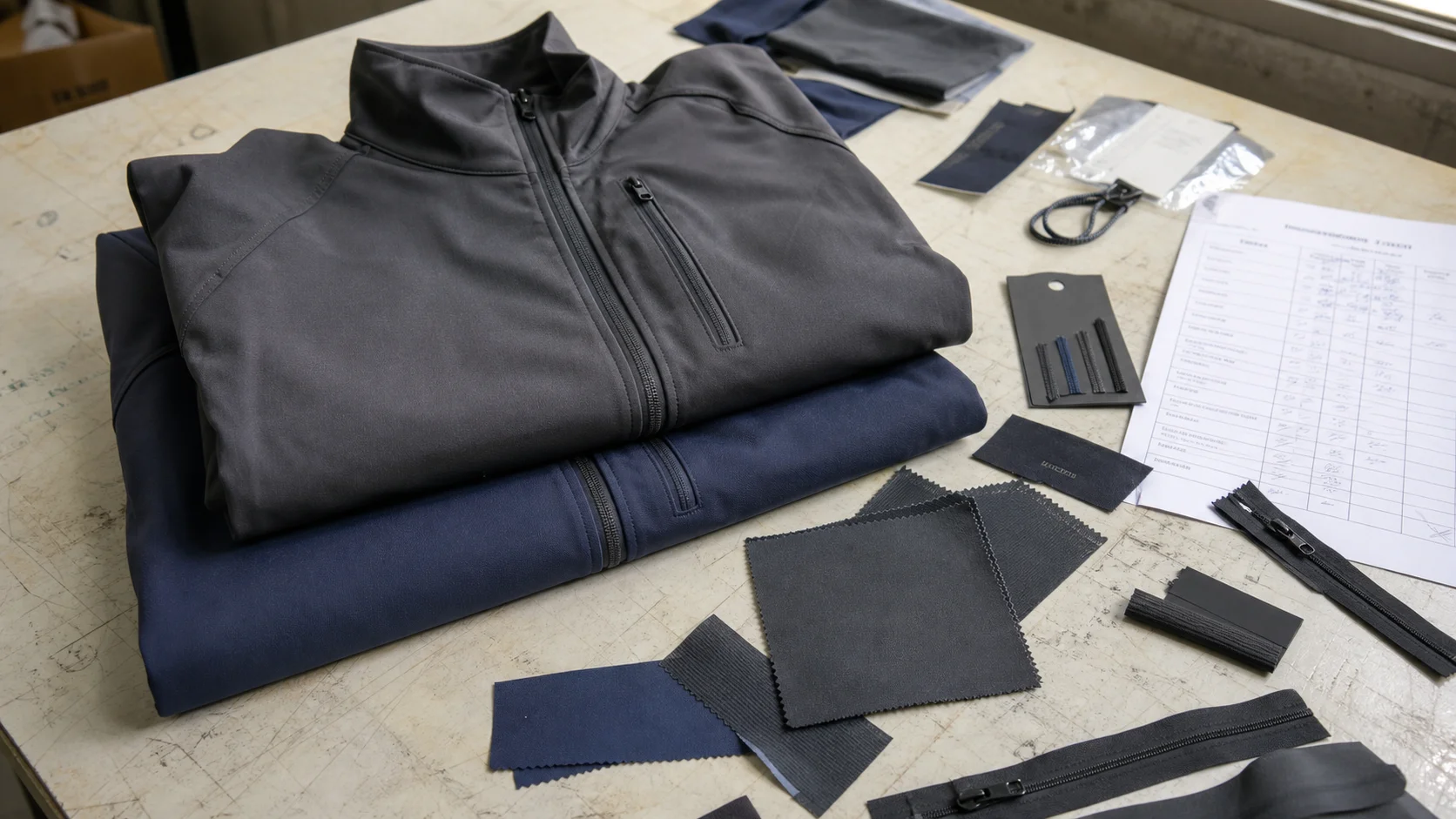
A product-specific AQL inspection outline for fitness club buyers sourcing branded softshell jackets, covering fabric performance, construction,...
Buying softshell jackets for fitness clubs looks straightforward until the order reaches production control. A logo can be approved, a fabric handfeel can feel right on a counter sample, and the bulk shipment can still miss the mark on sizing consistency, zipper performance, bonding quality, or print alignment. For fitness club buyers, the real goal is not just a decent-looking jacket. It is a repeatable garment that members can wear to and from training, staff can use as uniform outerwear, and the club can reorder without surprises.
This checklist is written for buyers who need a practical factory AQL inspection standard for softshell jacket orders. It focuses on what should be checked, where common failures appear, and how to use inspection results to make a shipment decision. The approach is cautious on purpose. AQL is a sampling tool, not a guarantee of perfection. It works best when paired with a clear tech pack, pre-production approval, and realistic quality tolerance for the product category.
Softshell Jacket AQL Checklist for Fitness Clubs - Quality & Inspection manufacturing guide
AQL, or Acceptable Quality Limit, is the inspection method many apparel buyers use to judge whether a lot is within tolerance. For softshell jackets, this matters because the product combines multiple risk areas in one garment: bonded or laminated fabric, zippers, trims, embroidery or printing, seam strength, water resistance expectations, and fit consistency across sizes.
Fitness clubs often place orders with mixed end uses. Some jackets are for front-desk staff. Some are for trainers, coaches, and outdoor bootcamp teams. Some are sold as branded merchandise. That means one defect can create more than a cosmetic issue. A broken zipper, bad color match, or peeling logo affects brand perception quickly.
AQL is useful because it forces discipline. The factory has to produce against measurable standards. The buyer has to decide what counts as a minor issue versus a major failure. The inspection team has to test actual garments instead of relying on packing list checks. For softshell jackets, a weak AQL plan can miss functional problems. A strong plan checks the product as a performance garment, not just as a logo carrier.
Fitness club orders tend to share a few commercial patterns. The jacket should look professional, move well, and carry branding cleanly. It should not feel too heavy for indoor-to-outdoor transitions. It should handle frequent wear, repeated washing, and casual use by staff or members. That changes the inspection priorities compared with a fashion outerwear order.
Typical buyer expectations include a clean silhouette, stretch comfort, a stable front zipper, secure pocket construction, and reliable logo placement. If the club uses the jacket as part of a staff uniform, color consistency matters more than trend detail. If it is a member retail item, packaging and presentation become more important. If it is meant for outdoor training, some attention should be paid to wind resistance, abrasion resistance, and basic weather protection claims.
Softshell jackets for fitness clubs are often made with polyester or polyester-spandex blends, usually with a brushed back, bonded fleece, or microfleece interior. Buyers should be cautious about assuming a fabric spec means the same thing across factories. One supplier’s “softshell” may be a stretch woven with light brushed back. Another may be a heavier three-layer laminate. The AQL checklist needs to match the actual construction.
Inspection should begin with documentation and end with product performance. A practical checklist covers the whole order flow, not only the final carton stage. The best results usually come from three control points: pre-production sample approval, inline process checks, and final random inspection before shipment.
For fitness club buyers, the final AQL inspection should review at least the following:
For more complete sourcing support, buyers often pair this with factory documentation and production controls from the supplier. If the internal process is not mature, final inspection becomes too late to correct avoidable problems. A solid factory profile helps. See the supplier overview at /about-us/ and the production support options at /services/.
Softshell quality starts with fabric integrity. Inspect shade consistency across panels and between size runs. Check for surface defects such as oil marks, scratches, pilling, delamination, or uneven brushing. If the jacket is water-resistant or uses a membrane, the buyer should confirm the exact performance claim before production. A visual inspection cannot prove waterproof performance, but it can catch construction issues that often lead to field failure.
Fabric weight should align with the target use. Lightweight jackets can be appropriate for indoor staff and mild weather. Heavier bonded constructions offer better structure but may feel bulky for active wear. A club-focused buyer should not overbuy on weight unless the garment is meant for colder outdoor activity. Comfort usually matters more than technical bragging rights.
Panel symmetry is a common overlook. Poor cutting shows up in uneven hems, mismatched sleeves, crooked yokes, and inconsistent zipper plackets. Inspect the first and last garments in the line if possible. When the fabric has stretch, cutting accuracy becomes even more important because small deviations can distort fit across size sets.
Pattern matching matters if the jacket includes color-blocking or panel seams intended to create a sharp club image. Misaligned panels look cheap even when the garment otherwise meets measurement tolerances. For a fitness club program, visual consistency is often as important as technical performance.
Examine stitch density, skipped stitches, broken threads, seam puckering, and seam opening under light tension. Softshell seams need to stay flat and durable. Weak topstitching near pockets, shoulders, and cuffs is a recurring issue. If the jacket includes elastic binding or cuff inserts, confirm that the attachment is secure and evenly stretched.
Any exposed seam inside a brushed or bonded fabric should be evaluated carefully. Rough seam work can damage the comfort perception immediately. Buyers should also inspect thread color against fabric shade. In some cases, contrast thread is intentional. In others, it is a sign that the factory substituted materials without approval.
Zippers are a major failure point in softshell jackets. The inspection should test every sampled garment through full open-and-close cycles. Check for smooth movement, proper alignment at the bottom stop, clean insertion, and secure stitching at the tape ends. If the design uses reverse coil, water-resistant, or auto-lock zippers, verify that the exact spec was used.
Pullers should feel secure and should not detach under normal handling. A loose zipper pull on a staff jacket creates avoidable service complaints. Pocket zippers need the same attention as the front zipper, since pocket failures often appear after repeated use rather than at initial inspection.
Fitness club logos are usually simple, but simple decoration still fails often. Inspect embroidery density, patch edge quality, print alignment, and color match. Check the left chest, sleeve, or back placement against the approved artwork and measurement point. Even a small placement shift becomes visible on a uniform garment.
Decoration method should fit the garment use. Embroidery adds durability and structure, but it can affect drape on lighter fabrics. Heat transfer or screen print may look cleaner on certain designs, yet those methods carry adhesion risk if the factory cuts corners on curing or press temperature. The buyer should choose the method based on wear conditions, not just unit price.
Measurement control is one of the most practical parts of AQL inspection. For club buyers, a jacket that fits too tight across the chest or too short in the sleeve damages the product’s usability. Check key points against the approved measurement chart: chest, body length, sleeve length, shoulder width, cuff opening, bottom hem, and collar height if relevant.
Size grading should be checked across the run, not only at one size. Many factories manage sample size well and drift on larger or smaller sizes in bulk. If the order includes both men’s and women’s fits, the differentiation should be obvious. A unisex garment that is only nominally graded often causes distribution problems later.
Care labels, size labels, country-of-origin markings, and brand labels should be checked for accuracy and legibility. Fitness club buyers often focus on the outside branding and neglect the legal and commercial details inside the garment. That is a mistake. Incorrect fiber content, missing origin details, or unreadable care instructions can create avoidable downstream issues.
If the order is going to multiple regions, label language and compliance requirements may need pre-approval. The buyer should confirm what the factory can print directly versus what must be applied as a separate label. Late label changes are a common source of delay.
Packaging affects presentation, damage risk, and fulfillment efficiency. Check folding consistency, polybag size, warning text where required, hangtag attachment, barcode accuracy, and carton count. If the jackets are for retail sale by the club, packaging should look deliberate and controlled. If the jackets are for internal staff use, the requirement may be simpler, but carton accuracy still matters.
Moisture risk should not be ignored. Softshell fabrics can trap odor or retain creasing if packed badly in humid transit conditions. Cartons should be dry, properly sealed, and stacked in a way that avoids crushing zippers or decoration.
The table below is not a universal standard. It is a practical starting point for fitness club buyers managing softshell jacket orders. The exact sampling plan, defect classification, and accept/reject threshold should be agreed with the factory and inspection agency before production.
Inspection Area What to Check Typical Risk Level Buyer Judgment Fabric Shade, handfeel, defects, delamination, weight High Reject visible defects or inconsistent shade across the lot Measurements Chest, length, sleeve, shoulder, grading High Hold shipment if key points drift outside tolerance Zippers Run smoothness, alignment, puller security High Repairable only if the issue is isolated and practical to rework Seams Skipped stitches, puckering, opening, reinforcement Medium to High Classify by function impact, not appearance alone Logo Placement, color, density, edge finish, adhesion Medium Accept only when brand presentation stays consistent across the lot Labels Content accuracy, language, legibility, attachment Medium Do not treat label errors as minor if they affect compliance or retail use Packaging Folding, barcode, carton counts, damage risk Medium Accept minor cosmetic pack issues only if they do not affect distributionFinal inspection works better when the sample stage is disciplined. A softshell jacket order usually needs more than one approval point. A fit sample confirms shape and sizing. A fabric swatch or lab dip confirms color direction. A pre-production sample confirms the final combination of fabric, trim, labeling, and decoration. The buyer should not skip any of these if the order is important.
For fitness clubs, the approval process often breaks down when branding is rushed. A logo may be approved on a screen but not checked at full size on the garment. That creates scale and placement errors. The safest process is to approve the decoration on an actual garment sample, not on artwork alone.
Factories that support structured sampling and production control are easier to work with on repeat programs. Buyers can review the supplier’s service structure at /services/ and use the contact page at /contact-us/ to clarify measurement charts, decoration methods, or inspection expectations before bulk production begins.
A practical approval sequence looks like this:
Skipping one step can create false confidence. The cheapest mistake is usually a delay at sample stage. The most expensive mistake is discovering bulk defects after cartons are sealed.
Softshell jacket lead time depends on more than stitching time. Fabric sourcing, lab dips, zipper procurement, logo approval, and seasonal factory loading all affect the calendar. If the jacket uses a custom fabric or special trim, the lead time can extend quickly. Buyers planning for club launches, member promotions, or seasonal staff uniforms should build margin into the schedule.
Typical MOQ ranges vary by factory, construction, and decoration method. For a standard softshell jacket with straightforward branding, many suppliers prefer quantities in the low hundreds per color or style. Some will accept smaller runs, but pricing tends to rise because cutting, trimming, and decoration are less efficient at low volume. A club buyer should ask whether the MOQ applies per color, per size ratio, or per fabric type. That detail matters more than the headline number.
Lead-time dependencies often include:
There is a direct tradeoff between speed and control. A very fast program can work if the fabric and trims are standard, the artwork is simple, and the buyer has already approved the fit. Once the order includes custom color, special zipper tape, or multiple size splits, speed becomes risky. Buyers should choose the timeline that allows for corrections before bulk completion.
Some factories may try to substitute a similar-looking fabric when the approved base is delayed. That can change stretch, surface finish, or water resistance. The buyer should lock fabric composition, weight, and approved swatch reference in writing.
Logo size, placement, or color can shift during bulk production. This often happens when approval files are not marked with exact measurement points. A clear placement diagram reduces the risk. A full-size sample is still better than a flat artwork file.
Factories sometimes hold sample size well and miss the grade in production. The answer is not just a final check. Early-line measurement audits catch drift before it spreads through the order.
Low-cost trims save a little on unit price and create problems later. For club uniforms, a zipper failure is more visible than a slight fabric imperfection. Buyers should specify trim quality clearly instead of allowing the factory to choose by default.
Softshell jackets are often marketed as weather resistant, but not all are built to the same standard. If the club expects outdoor use in harsh conditions, the buyer should not rely on vague performance language. Ask the factory to define the fabric construction and any test reports that support the claim.
The practical buying rule is simple: pay for the quality that members and staff will notice in daily use, not for features that sound impressive on paper but do not affect real wear. For many fitness clubs, a clean fit, durable zipper, stable branding, and consistent sizing matter more than advanced technical claims.
AQL results should lead to a clear commercial decision. Accepting a shipment with repeatable major defects is usually a false economy. Rejecting a shipment for minor cosmetic issues can also be wasteful if the problems are isolated and reworkable. The right response depends on the defect type, quantity, and end use.
Accept when the lot meets the agreed sampling plan and the issues found are cosmetic, isolated, and do not affect fit, function, safety, or brand presentation. Rework when defects are limited and the factory can correct them quickly without creating new damage. Reject or hold the shipment when there are recurring failures in measurements, zippers, labels, or branding placement, or when fabric quality is inconsistent across the lot.
For fitness club buyers, the most expensive defect is usually not a visible flaw. It is the one that hits daily wear, staff confidence, or the club’s image on first use.
If a supplier can respond clearly to inspection findings and correct the issue without argument, that is often more valuable than a slightly lower unit price. A well-run production partner will understand what the inspection is trying to protect: repeatable quality, manageable lead time, and a usable garment at delivery.
Choosing the right factory matters as much as choosing the right checklist. A factory that understands softshell construction should be able to explain how it handles bonding, zipper sourcing, size grading, and decoration placement. The buyer does not need theatrical promises. Clear answers are more useful than sales language.
When evaluating a supplier, ask for the measurement tolerance, trim sources, sample timeline, and inspection process. Ask what happens if the approved fabric is unavailable. Ask how the factory controls logo placement across size runs. Ask whether final inspection happens in-house or through a third party. Those questions reveal much more than a generic capability statement.
For buyers building a repeat program, supplier transparency is a quality control tool. The more the factory can document, the easier it is to reduce avoidable defects and shorten future approvals. If the buyer needs to start that discussion, the contact page at /contact-us/ is the most direct place to begin.
Get a free quote from Fabrikn — your trusted B2B clothing manufacturer with 10+ years of experience. MOQ as low as 200 pieces.
Get a Free Quote →Many apparel buyers use a standard final inspection sampling plan with separate treatment for major and minor defects. The exact acceptance number depends on the order size and the buyer’s risk tolerance. Softshell jackets with branding, zippers, and measurement sensitivity usually deserve stricter scrutiny than basic knitwear.
The most common issues are measurement drift, zipper problems, fabric shade variation, logo placement errors, seam puckering, and label mistakes. Fabric delamination and poor bonding are less common but more serious when they occur.
At minimum, a buyer should approve the fit sample and the pre-production sample. If the jacket uses a custom fabric, custom color, or special branding, a fabric swatch or lab dip approval should also be part of the process.
MOQ depends on the factory, color count, decoration type, and fabric choice. A common range is a few hundred pieces per style or color, but smaller runs may be possible at a higher unit cost. The key question is whether the MOQ applies per size run, per color, or per logo version.
No. AQL is a sampling method, not a perfect guarantee. It can miss hidden or rare defects. It works best when combined with sample approval, inline checks, and a clear technical specification.
Embroidery usually lasts longer and looks more substantial on outerwear. Print can be cleaner on some lighter constructions and may suit smaller logos or lower budgets. The better choice depends on jacket fabric, intended use, and the club’s brand style.
The shipment should be held until the cause is understood. Repeated zipper failure suggests a material or assembly issue, not a random defect. If the factory cannot explain the root cause and prove correction, the buyer should not release the lot.
Softshell jacket sourcing for fitness clubs is not complicated, but it does reward discipline. The best orders come from tight control over fabric, trims, branding, and fit, followed by an inspection plan that matches the product’s real risks. AQL is only useful when it is treated as part of a production system, not a box-ticking exercise. That is the difference between a jacket that arrives on time and one that becomes a service problem after delivery.