
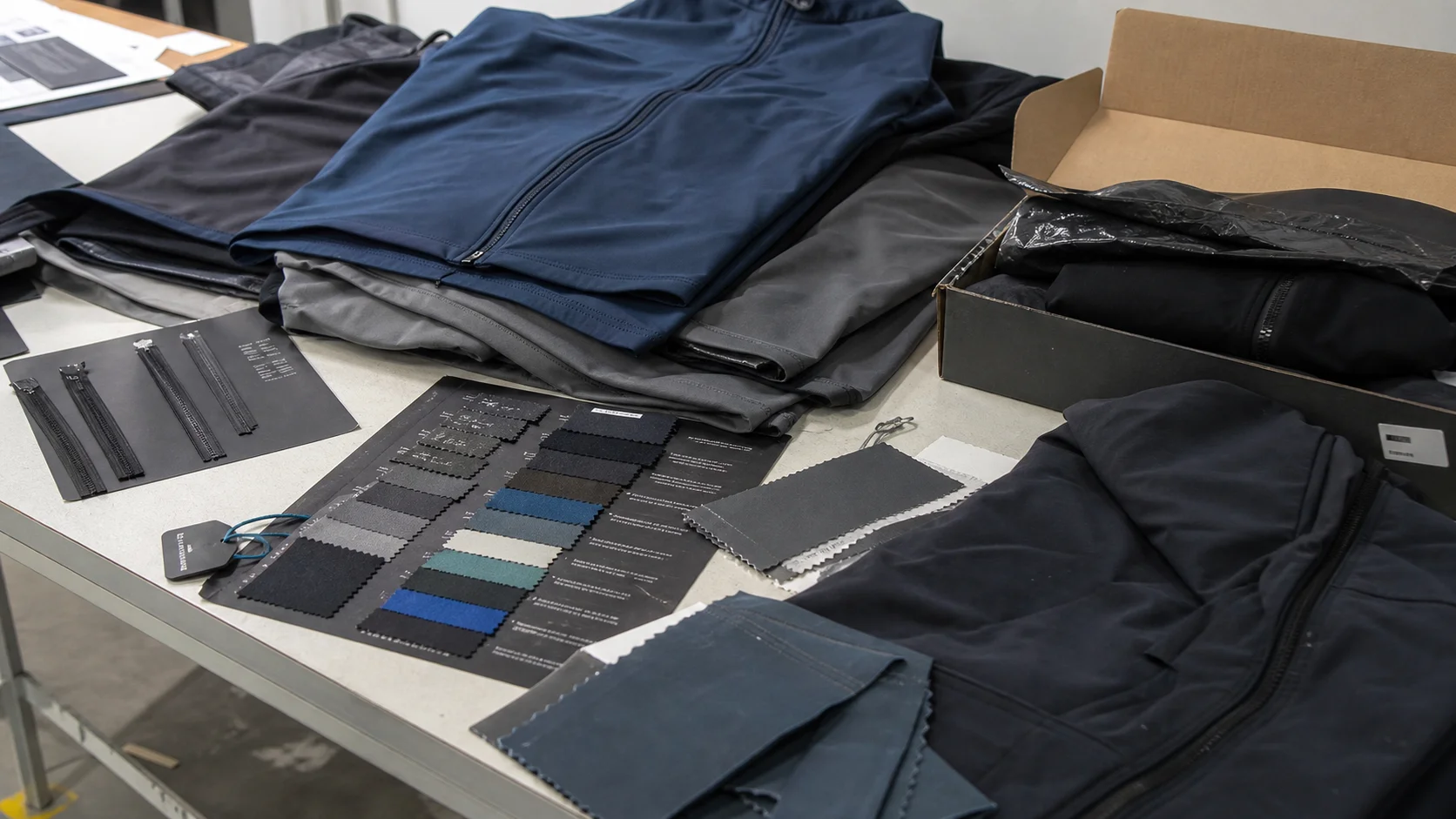
A quality and inspection outline for auditing softshell jacket colorfastness in fitness club orders, covering fabric panels, trims, logos, wear tests,...
Softshell Jacket Colorfastness Audit for Fitness Clubs - Quality & Inspection manufacturing guide
Softshell jacket orders for fitness clubs carry a different color risk than many general outerwear programs. The jackets are often worn over light-colored training tops, packed into gym bags while damp, washed frequently, and exposed to sweat, rain, friction, and branded embroidery or heat-transfer logos. A colorfastness issue does not stay hidden for long. It becomes a member complaint, a staff uniform problem, or a visible brand inconsistency across branches.
For fitness club buyers, a softshell jacket colorfastness audit should be treated as a practical pre-shipment control, not a laboratory formality. The goal is simple: confirm that shell fabric, bonded fleece, contrast panels, zipper tapes, trims, labels, prints, and club branding will hold color under realistic use and care conditions.
This guide explains how to structure a colorfastness audit for softshell jacket orders, what to test, where failures usually appear, and how buyers can make better purchasing decisions before approving bulk production or shipment.
Fitness club apparel sits between uniform, merchandise, and performance wear. A jacket may be issued to trainers, sold to members, used by front-desk staff, worn by outdoor bootcamp coaches, or included in a corporate wellness program. That makes color consistency and color durability commercially important.
A softshell jacket that looks acceptable in a factory showroom can still fail in club use. Sweat can lift dye from collar edges. Backpack straps can cause crocking across shoulders. Damp storage can transfer dark dye onto white towels or pale leggings. Repeated laundering can dull a brand color until the jacket no longer matches the approved club identity.
Colorfastness is especially important when the order includes dark shades such as black, navy, charcoal, burgundy, forest green, royal blue, or deep red. Bright colors and fluorescent accents also require attention because they may fade under washing, rubbing, or light exposure. Contrast trims create another layer of risk: a black body with white zipper tape, a red lining against a pale membrane, or a colored logo print on a dark shell can all produce visible staining if the dye system is weak.
For fitness club buyers, the question is not only “does the jacket pass a standard?” The better question is “will this jacket still look brand-correct after sweat, rain, washing, and daily staff wear?”
A proper colorfastness audit gives the buyer leverage before goods leave the factory. It helps identify whether the issue is a fabric batch problem, a dyeing process weakness, a trim mismatch, or a care-label gap. It also creates a clear record for shipment approval, supplier negotiation, or corrective action.
A softshell jacket colorfastness audit should cover more than the main fabric. Many failures come from smaller components. Fitness club buyers often focus on the approved body color and logo placement, while the zipper tape, inner fleece, binding, drawcord, or printed neck label carries the actual staining risk.
The audit scope should include the full finished jacket and the approved bill of materials. At minimum, the buyer should review the outer shell, inner backing, membrane or bonding layer, contrast panels, zipper tape, pocketing, elastic binding, cuff tabs, drawcords, woven labels, printed labels, embroidery threads, heat-transfer logos, screen prints, reflective details, and packaging contact points.
A practical audit also checks color consistency across sizes and production lots. If the order is split between men’s and women’s fits, or across multiple club branches, color variance can become visible when staff stand together. The problem may be acceptable for a retail-style promotional item, but less acceptable for staff uniforms or branded teamwear.
Buyers working with a new supplier should request test evidence before bulk cutting. If the supplier only tests after production, the buyer carries unnecessary risk. Colorfastness problems are expensive to correct once jackets are sewn, branded, packed, and allocated to clubs.
For support on inspection planning and supplier controls, buyers can review factory and quality service options at fabrikn.com/services/.
Softshell jackets are usually made with layered textile systems. A common construction is polyester or nylon face fabric bonded to a microfleece backing, sometimes with a TPU, PU, or breathable membrane between layers. This structure performs well for light weather protection and staff mobility, but it can complicate dye behavior.
The outer face may be dyed separately from the backing. The fleece backing may use a different dye class or finishing process. Zipper tape, binding, elastic, hook-and-loop tabs, and thread may come from different mills. Even when every component is called “black,” the actual shade and colorfastness can vary.
Most fitness club softshell jackets use polyester, recycled polyester, nylon, or blends with elastane. Polyester generally offers good colorfastness when properly dyed, but dark shades can still show rubbing transfer if finishing residues remain. Nylon can be comfortable and durable, but some shades may be more sensitive to washing, perspiration, or light depending on dye selection.
Elastane introduces another consideration. Stretch fabrics used for active staff jackets are often heat-sensitive. High-temperature dyeing, bonding, or logo application can affect fabric recovery, shade, or surface appearance. Buyers should ask whether the approved color was tested after the same finishing and bonding process planned for bulk.
The inner fleece is in constant contact with shirts, sports bras, hoodies, and uniforms. Dark fleece can stain pale base layers if colorfastness to rubbing or perspiration is poor. Light fleece can pick up dye migration from dark shell layers or contrast trims during bonding, washing, or storage.
For fitness clubs, inner color transfer is not a minor defect. Staff may wear the jacket over white branded tops. Members purchasing club merchandise may wash it with other gym apparel. A dark inner backing that bleeds after one or two washes can create immediate complaints.
Zipper tape is a common mismatch point. It may be dyed by a trim supplier under different conditions from the fabric mill. If the jacket uses contrast zippers, the risk increases because staining is more visible. Binding at cuffs and hem also receives frequent friction, making it a good place to check dry and wet rubbing fastness.
Drawcords and toggles are small, but they sit close to the neck and face. Sweat, sunscreen, hair products, and friction can affect color stability. A buyer should not assume these trims are safe simply because they are low-cost components.
Fitness club buyers usually care deeply about logos. Embroidery, heat transfers, silicone badges, reflective prints, and screen prints each have different color risks. Embroidery thread may bleed or discolor under washing. Heat transfers can crack, dull, stain surrounding fabric, or shift color under heat. Reflective elements may lose brightness if the wrong wash instructions are used.
Logo decoration should be tested on the actual production fabric, not only on a generic panel. Softshell surfaces may have DWR finishes or textured faces that affect adhesion and wash performance.
A buyer does not need to become a textile lab technician, but they should know which tests matter and how to interpret results. Most test reports grade color change and staining on a grey scale, commonly from Grade 1 to Grade 5. Grade 5 is excellent, Grade 4 is good, Grade 3 is moderate, and below Grade 3 is usually a concern for commercial apparel.
Requirements vary by market, product type, and buyer standard. For fitness club softshell jackets, a practical benchmark is often Grade 4 or above for most key areas, with careful review of any Grade 3-4 result on dark shades, contrast trims, inner fleece, or logo areas.
Test Area Why It Matters Typical Buyer Expectation High-Risk Colors or Parts Colorfastness to washing Checks fading and staining after laundering Grade 4 or better for color change and staining where possible Black, navy, red, burgundy, contrast fleece Colorfastness to rubbing, dry and wet Simulates friction from bags, arms, collars, and seats Dry Grade 4; wet Grade 3-4 or better depending on material Brushed surfaces, dark shell, cuffs, shoulders Colorfastness to perspiration Important for trainers and active users Grade 4 or better for staining on adjacent fabrics Neck, underarm, inner fleece, drawcord Colorfastness to water Checks bleeding during rain or damp storage Grade 4 or better Dark body with light trims, printed labels Colorfastness to light Relevant for outdoor training and window display Depends on standard; buyer should define minimum rating Bright blue, red, fluorescent colors Logo wash and adhesion testing Confirms decoration durability No major cracking, peeling, bleeding, or color shift Heat transfers, reflective prints, silicone badgesWashing tests show whether the jacket fades or stains adjacent materials. For fitness club buyers, the test should reflect the care label and real customer behavior. If the care label says machine wash cold, test under that condition. If staff uniforms will be washed frequently, buyers may request multiple wash cycles on the pre-production sample or salesman sample.
Single-cycle lab results are useful, but repeated washing gives a more realistic view of appearance retention. A jacket that passes one wash but dulls quickly after five washes may still be a weak choice for staff uniforms.
Rubbing, also called crocking, is one of the most important tests for softshell jackets. Dry rubbing checks transfer under normal friction. Wet rubbing checks transfer when the fabric is damp from rain, sweat, or washing.
Wet rubbing failures are common on dark or brushed fabrics. A Grade 3 result may be tolerable in some categories, but buyers should be cautious when the jacket will be worn over pale tops or used as a staff uniform. Shoulder areas, sleeve panels, pockets, and collar edges should receive special attention.
Fitness club apparel should be checked for acidic and alkaline perspiration where relevant. Sweat can interact with dye, finishes, deodorant, sunscreen, and body oils. Necklines, underarms, cuffs, and inner fleece are the key areas.
If the jacket is intended for trainers leading outdoor sessions, perspiration fastness becomes more important than it would be for a casual promotional jacket. Buyers should consider stricter requirements for staff-facing programs than for one-off event giveaways.
Softshell jackets are often promoted as water-resistant, even when they are not fully waterproof. Rain, damp storage, and wet gym bags can create staining risk. Water fastness testing helps confirm that color does not bleed when the garment is wet and pressed against another surface.
Pay attention to packaging as well. If jackets are packed tightly while not fully conditioned after finishing or printing, trapped moisture can contribute to migration or staining. This is especially relevant for dark garments with light logos or light zipper tapes.
Light fastness may be overlooked in club orders, but it matters when jackets are worn outdoors, displayed near windows, or used for outdoor training teams. Bright reds, blues, neon accents, and fashion colors can fade unevenly. If the jacket is tied to a brand color, visible fading can weaken the perceived quality of the club merchandise.
A good audit starts before bulk production. The buyer should not wait until final inspection to discover that the approved sample and bulk fabric behave differently. Colorfastness control should move through lab dip approval, fabric strike-off, pre-production sample review, bulk fabric testing, inline checks, and final inspection.
The process usually begins with lab dips for each shell color and key contrast trim. Buyers should compare lab dips under standard light conditions where possible. Office lighting can distort navy, charcoal, black, and deep green. A physical reference should be retained by both buyer and supplier.
At this stage, ask whether the color can meet the required fastness ratings. Some bright or saturated colors may require tradeoffs. A supplier may be able to match the shade, but not at the desired fastness level without changing dye method, fabric composition, or finishing chemistry.
The trim card should include zipper tape, pullers, binding, drawcord, toggles, thread, labels, badge materials, and print samples. Buyers should check color harmony and possible staining combinations. Dark trim against light fabric, red trim against white logos, and dark fleece backing against pale shell panels deserve caution.
The pre-production sample should use actual bulk-intended fabric, trims, decoration method, and washing instructions. It should not be a showroom sample made from substitute fabric. This sample is the buyer’s best chance to catch shade mismatch, logo adhesion problems, staining risk, and care-label issues before scale production.
For club buyers, the sample review should include a basic wear-and-wash check. This does not replace lab testing, but it helps identify obvious practical problems: dye rubbing on a white cloth, logo lifting after laundering, collar staining, or shade change after drying.
Bulk fabric should be tested before cutting, especially for large orders or new suppliers. Testing after cutting creates waste if the fabric fails. Testing after sewing creates even more cost because labor, trims, logos, and packing materials have already been consumed.
For repeat orders, buyers may reduce the testing burden if the fabric mill, dye lot, color, and trim suppliers remain stable. A repeat order using a new dye lot still deserves at least targeted colorfastness checks.
Inline inspection can identify shade variation, trim mismatch, logo defects, or fabric contamination before all goods are completed. Final inspection should confirm finished jacket quality, shade consistency, stains, packing, labeling, and workmanship. For complex programs, third-party inspection can provide a useful independent record before shipment. Buyers can discuss inspection scope through fabrikn.com/contact-us/.
MOQ and lead time influence colorfastness risk. Low-MOQ orders may rely on available fabric or standard trim colors. That can be efficient, but the buyer has less control over dye method, exact shade, and trim matching. Custom-dyed softshell fabric gives better brand control, but it usually requires higher MOQ and more development time.
Order Type Typical MOQ Range Color Control Common Tradeoff Stock color with logo only 100-300 pieces per style/color Limited to available shades Faster and cheaper, but shade may not match brand exactly Stock fabric with custom trims 300-600 pieces per style/color Moderate Trim colorfastness and matching need closer review Custom dyed fabric 500-1,000+ pieces per color Better shade control Longer development and testing cycle Custom softshell construction 1,000-3,000+ pieces depending on mill Highest control if managed well Higher cost, longer lead time, more approval stepsThese ranges are typical planning references, not fixed rules. Actual MOQ depends on fabric mill minimums, dyeing method, membrane supplier, trim availability, logo method, size range, and factory capacity.
Lead time also depends on how much testing the buyer requires. A simple stock-color softshell jacket with embroidery may be ready faster than a custom-dyed, bonded, water-resistant jacket with reflective prints and branded zipper pulls. Buyers should plan time for lab dips, trim approval, pre-production samples, test reports, bulk production, inspection, and shipping.
A buyer who compresses every approval stage may save calendar days but increase defect risk. The better approach is to decide where speed matters and where control matters. For a short-term promotional event, a stock color may be acceptable. For multi-branch staff uniform rollout, custom shade approval and stronger testing are usually worth the time.
A colorfastness audit should be linked to the final inspection checklist. Test reports alone do not confirm that the shipped goods match the tested materials. Inspectors should verify that the production jackets align with the approved sample, approved color standard, and approved trim card.
Inspection findings should be specific. “Color issue” is too vague. A useful report states the location, material, severity, quantity affected, and whether the issue appears random or systematic. For example: “Wet rubbing transfer observed on inner black fleece at collar area on 5 of 20 checked pieces” is actionable. It points the buyer toward a fleece dyeing or finishing concern.
Softshell jacket failures often follow predictable patterns. Knowing these patterns helps buyers focus their audit instead of treating every area as equal risk.
This is a high-priority issue for fitness clubs. The inner fleece contacts shirts and uniforms directly. If black or navy fleece transfers dye under perspiration or wet rubbing, the jacket may not be suitable for staff use. A supplier may suggest improving washing instructions, but that does not fully solve a contact staining problem during wear.
Zipper tape can stain nearby fabric during washing or damp storage. This is most visible on light shells with dark zippers, or dark jackets with white zipper tape that becomes discolored. Buyers should ask for trim test evidence when zipper color is custom dyed or strongly contrasting.
A white heat-transfer logo can turn grey from dye migration. A bright logo can dull after washing. Reflective prints may lose visibility if the surface finish is damaged. For fitness club merchandise, logo failure is often more noticeable than minor fabric shade change because it sits at the brand focal point.
Softshell jackets often combine different panels, stretch zones, shoulder overlays, and pocket fabric. If these components come from different dye lots or material types, shade variation may appear under daylight. A slight shade difference may be acceptable for tonal design, but not when the garment is supposed to be a solid uniform color.
Wet crocking can occur when dark fabric is damp and rubbed. It may not show during a quick visual inspection. Fitness club buyers should treat wet crocking seriously because jackets may be worn after workouts, in rain, or during outdoor training.
Migration can occur when garments are packed under pressure, heat, or humidity. Dark components may stain light components. Printed labels, size stickers, and colored tissue can also transfer marks. This is why packing checks matter, especially for long sea freight or warehouse storage.
Not every colorfastness issue requires order cancellation. Buyers should judge the defect based on end use, severity, location, quantity affected, and brand impact. A minor internal shade variation may be acceptable for a low-cost member giveaway. A dark fleece that stains white staff shirts should be rejected or corrected.
Commercial context matters. If the jackets are a paid retail item at the club, members expect durable appearance. If they are staff uniforms, consistency matters across teams. If they are a one-day event gift, the buyer may accept broader tolerance, provided there is no staining risk. The inspection standard should match the actual use case.
Buyers should also consider supplier response. A supplier that explains the root cause, separates affected lots, and proposes realistic corrective action is easier to manage than one that only argues over grading. Corrective action may include re-washing fabric, changing trim source, adjusting dye fixation, improving drying and conditioning, replacing logo materials, or reworking care labels. Some issues cannot be fixed after sewing, so early testing remains the stronger control.
A strong specification reduces colorfastness disputes. The tech pack should state fabric composition, fabric weight, membrane or bonding details, target color, approved color reference, trim colors, logo method, care instructions, and test requirements. It should also define what counts as a major defect during inspection.
For a fitness club softshell jacket, a useful specification may include polyester mechanical-stretch shell, bonded microfleece backing, water-resistant finish, full front zipper, zip pockets, adjustable hem, club logo at left chest, optional staff name embroidery, and machine-wash care. Each added feature creates another quality checkpoint.
The buyer should avoid vague wording such as “good colorfastness” or “premium softshell.” Those phrases are difficult to enforce. Specific test methods and acceptance criteria make the order easier to inspect and easier to negotiate if a problem appears.
Buyers comparing sourcing partners can review broader company information at fabrikn.com/about-us/.
A colorfastness test report should identify the tested material, color, composition, test method, result, and date. The buyer should confirm that the report applies to the actual bulk fabric or trim, not a similar material from a previous order. Reports for “black polyester fabric” are not enough if they do not identify the production lot or supplier reference.
Look at both color change and staining. Color change tells you how much the material itself faded or shifted. Staining tells you whether dye transferred to adjacent fabrics. For fitness club buyers, staining can be more damaging than mild fading because it affects the wearer’s other apparel.
Also check the adjacent fabric types used in testing. Multi-fiber adjacent fabric can show staining across cotton, nylon, polyester, acrylic, wool, and acetate. If staining appears strongly on cotton or nylon, that may matter for gym tops, linings, or mixed laundry.
Dates matter too. A report from last season may not apply to the current order if the dye lot, mill, trim supplier, or finishing process changed. Repeat orders should not automatically rely on old reports unless the supplier can prove continuity and the buyer accepts the risk.
Before placing a softshell jacket order, fitness club buyers should ask direct questions. The answers reveal whether the supplier understands colorfastness control or is treating it as an afterthought.
These questions are not excessive for a branded apparel program. They are normal commercial controls. A supplier may not have every answer immediately, but they should be able to obtain technical details from the mill, trim supplier, or testing lab.
A softshell jacket colorfastness audit protects both the buyer and the brand. It reduces the risk of member complaints, staff dissatisfaction, returns, and awkward supplier disputes. It also helps buyers choose the right tradeoff between speed, cost, customization, and durability.
For small promotional orders, a stock-color jacket with basic logo testing may be enough. For staff uniforms, multi-location rollouts, or paid club merchandise, buyers should require stronger controls: approved lab dips, trim cards, pre-production samples, bulk fabric testing, decoration testing, and pre-shipment inspection. Dark colors, contrast trims, inner fleece, and heat-transfer logos deserve the most attention.
The main rule is straightforward. Test the materials that will actually ship, under conditions that resemble how the jacket will actually be used. A clean paper approval process is not enough if the finished jacket stains shirts, fades quickly, or no longer matches the club’s brand color after normal wear.
Get a free quote from Fabrikn — your trusted B2B clothing manufacturer with 10+ years of experience. MOQ as low as 200 pieces.
Get a Free Quote →A softshell jacket colorfastness audit is a quality control review that checks whether the jacket’s fabric, trims, lining, and logos resist fading, staining, and dye transfer. For fitness club buyers, it should cover washing, rubbing, perspiration, water exposure, light exposure, and decoration durability where relevant.
Colorfastness to rubbing and perspiration are especially important because trainers and members wear jackets during active use. Washing fastness is also critical because staff uniforms and club merchandise may be laundered frequently. Dark inner fleece and collar areas should receive close attention.
Many buyers aim for Grade 4 or better for key colorfastness tests, with careful review of any Grade 3-4 results. Exact requirements depend on the product, market, color, fabric, and end use. Staff uniforms and paid merchandise usually justify stricter standards than short-term promotional giveaways.
Some minor issues may be improved through washing, conditioning, or revised packing, but many dye and trim problems cannot be fully corrected after the jackets are sewn and branded. Bulk fabric testing before cutting is usually the better control.
Dark colors such as black, navy, charcoal, burgundy, and deep red often carry higher rubbing and staining risk, especially on brushed or fleece-backed materials. They can still perform well if properly dyed, finished, and tested.
Yes. Embroidery, heat transfers, reflective prints, badges, and screen prints should be checked on the actual production fabric. Logo failure is highly visible on fitness club apparel and can affect brand perception even when the jacket fabric itself performs acceptably.
Typical MOQ can range from 100-300 pieces for stock-color jackets with logo decoration, 300-600 pieces for stock fabric with custom trims, and 500-1,000+ pieces for custom dyed fabric. Fully custom softshell construction may require 1,000-3,000+ pieces depending on fabric mill and supplier conditions.
Testing should begin during development and continue before bulk cutting. Lab dips, trim cards, pre-production samples, and bulk fabric should be checked before final production moves too far. Final inspection should confirm that shipped goods match the approved and tested materials.
Buyers should review the failed area, severity, quantity affected, and end use. Wet rubbing failure on inner fleece, collar, cuffs, or high-contact dark panels is more serious than a borderline result in a low-contact area. Shipment should be held if there is clear staining risk to wearers’ clothing.
Buyers can reduce risk by writing clear specifications, approving physical color standards, testing actual bulk materials, reviewing trims separately, checking decoration durability, and using pre-shipment inspection. Clear acceptance criteria should be agreed before production begins.