
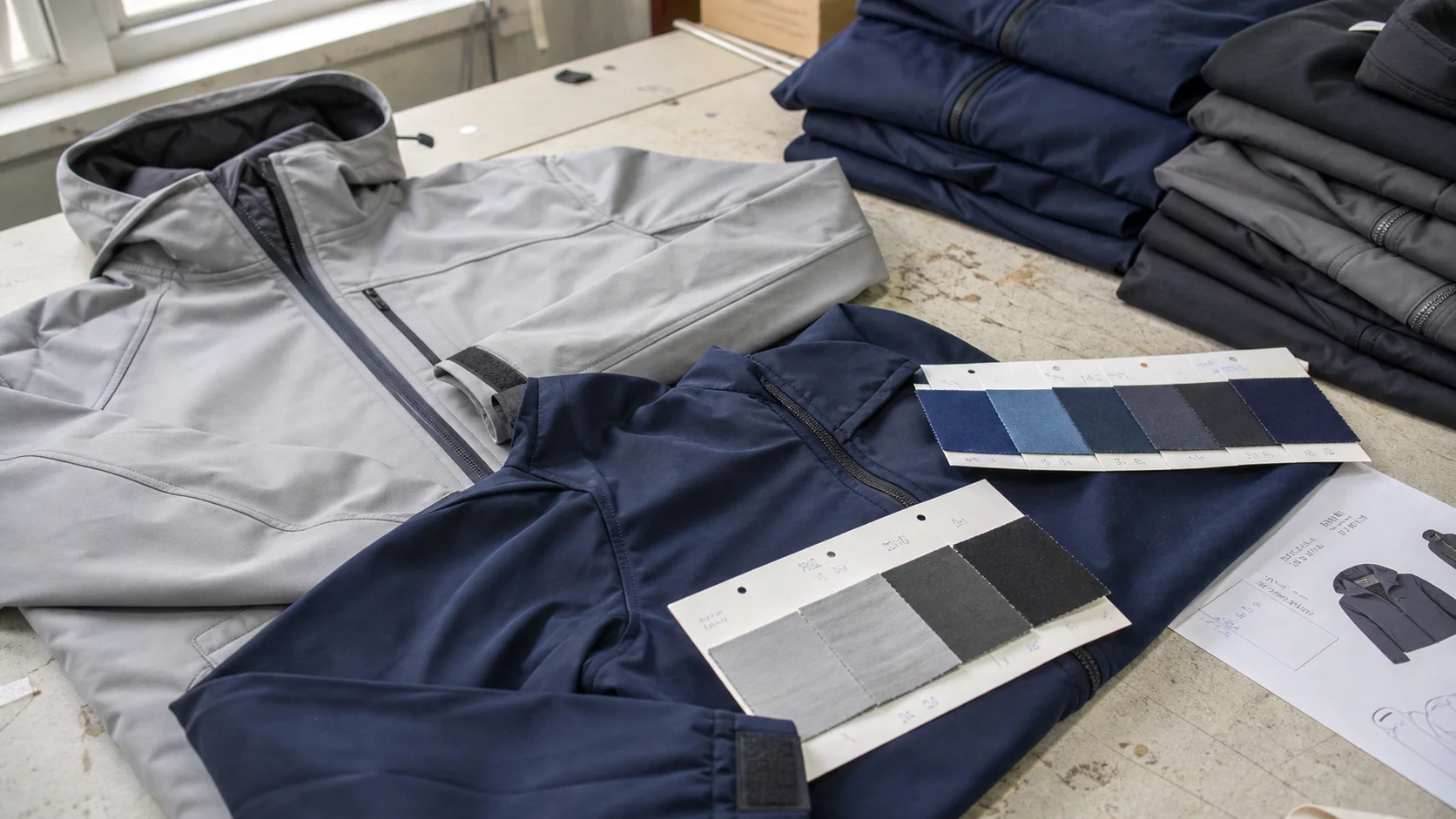
A quality inspection outline for restaurant groups sourcing branded softshell jackets, focused on factory colorfastness audits, wash durability, crocking,...
Softshell Jacket Colorfastness Audit for Restaurants - Fabrikn production reference
Restaurant groups buy softshell jackets for a different purpose than outdoor retail brands. The garment still needs to look sharp, resist weather, and hold up to repeated use, but the biggest risk is brand inconsistency across locations. A black softshell that turns charcoal after several washes, a red logo panel that bleeds into white embroidery, or a navy jacket that crock-marks a light shirt can create complaints quickly.
A softshell jacket factory colorfastness audit for restaurant groups is a targeted quality check focused on how well the jacket’s fabric, trims, printing, embroidery, and color-blocking perform before bulk shipment. It is not just a lab report. A useful audit connects lab testing, production inspection, shade control, wash behavior, and real restaurant working conditions.
For multi-unit restaurant buyers, franchise groups, hospitality procurement teams, and uniform distributors, colorfastness deserves more attention than it often receives. The cost of replacement jackets, inconsistent brand presentation, delayed rollouts, and staff dissatisfaction can be higher than the original inspection cost.
Softshell jackets are often used by restaurant managers, delivery teams, drive-thru staff, catering crews, outdoor hosts, and event workers. They may be worn over branded polos, aprons, chef coats, or light-colored shirts. That creates a practical problem: if the jacket fabric is not colorfast, it can stain other garments or lose its own brand color quickly.
Restaurant uniforms also sit in a more demanding environment than many office apparel programs. Staff move between hot kitchens, cold storage, rain, sunlight, grease, cleaning chemicals, food spills, and repeated laundering. A jacket that passes a basic visual check at the factory may still perform poorly after three weeks in a restaurant setting.
Colorfastness issues usually show up in one of five ways:
For a restaurant group, these problems are not merely technical defects. They affect brand presentation. A jacket that looks premium in the launch photo but uneven in the dining room weakens the uniform standard. When dozens or hundreds of locations are involved, inconsistent shade control becomes visible.
A practical colorfastness audit asks one simple question: will this jacket still look like the approved brand garment after real restaurant use, laundering, and reordering?
A softshell jacket factory colorfastness audit should combine document review, material verification, in-line or final inspection, and targeted testing. It is not enough to check that the jacket is the correct color on the inspection day. The audit must confirm that the supplier has controlled fabric dyeing, lamination, finishing, trims, decoration, packaging, and shade segregation.
The audit usually covers these areas:
A good audit also checks whether factory staff understand the risks. If dark body panels, white embroidery, reflective tape, and contrast piping are all stored together with no shade or contamination control, the risk is higher. The same applies when the factory relies only on mill statements without checking production lots.
Restaurant buyers should treat colorfastness as part of the full quality plan, not as an optional lab add-on. For broader quality and inspection support, sourcing teams often review structured programs such as Fabrikn services to decide where factory checks, product inspections, and supplier coordination fit into the buying process.
Colorfastness requirements should match the way the jacket will actually be used. A front-of-house manager jacket has a different risk profile than a delivery rider jacket. A catering crew jacket used outdoors during events may need better light fastness and rain resistance than a back-office jacket.
Restaurants often wash uniforms more frequently than corporate apparel users. Grease, odor, and food contact can drive weekly or even more frequent laundering. Repeated washing exposes weak dye fixation, poor print adhesion, unstable lamination, and trim bleeding.
Dark softshell jackets are commonly worn over white or light-colored shirts. This increases the importance of colorfastness to rubbing, also called crocking. Both dry and wet rubbing matter. A damp sleeve or collar area can transfer dye more easily than a dry surface.
Outdoor staff may use jackets in rain, humidity, and sunlight. Water can trigger dye bleeding or staining from trims. Sunlight may cause fading, especially in bright reds, certain blues, and fluorescent colors. Delivery use also increases abrasion from bags, straps, vehicle seats, and repeated movement.
Restaurant environments include sanitizers, degreasers, bleach-based products, and alcohol-based solutions. A normal colorfastness audit may not cover every chemical exposure, but buyers should flag this risk if staff handle cleaning products while wearing the jacket. Chemical splash resistance is a separate requirement and should be specified if needed.
Restaurant groups may distribute jackets to warehouses, franchise locations, regional managers, or new store opening kits. Poor packaging can cause color transfer under pressure, humidity, or heat. Dark garments packed against light logos or trims without tissue or separation can create preventable staining.
Testing standards vary by destination market, buyer requirement, and product use. The audit should identify the relevant standards before production, not after a failure. Common standards include ISO, AATCC, GB, and other regional methods. Buyers do not need to memorize every method, but they should know which performance areas must be covered.
Test Area What It Checks Restaurant Uniform Relevance Typical Concern Level Colorfastness to Washing Color change and staining after laundering Critical for jackets washed frequently by staff or laundry services High Colorfastness to Rubbing/Crocking Dye transfer under dry and wet rubbing Important when worn over white shirts or in damp conditions High Colorfastness to Water Bleeding or staining when wet Relevant for rain, spills, wet sleeves, and storage humidity Medium to High Colorfastness to Perspiration Color change and staining from acidic or alkaline sweat Useful for collar, underarm, cuff, and delivery use areas Medium Colorfastness to Light Fading under light exposure Important for outdoor seating, catering, and delivery crews Medium to High Decoration Durability Logo fading, cracking, peeling, or thread bleeding Critical for brand identity and uniform acceptance HighThis is the first test most restaurant buyers should prioritize. Softshell jackets may not be washed as aggressively as aprons, but they still need stable performance after repeated home laundering or commercial cleaning. Test conditions should match the care label. If the label says machine wash cold, tumble dry low, then testing should not rely only on gentle hand-wash assumptions.
For restaurant groups, a cautious requirement is to review color change and staining against multi-fiber fabric. Dark colors, contrast panels, and branded trims deserve special attention. A passing grade may vary by buyer standard, but weak staining results on white or nylon adjacent fabric should be treated seriously.
Rubbing is one of the most common practical failure points. A black or navy softshell can look excellent on the hanger and still transfer dye onto a white polo during wear. Wet rubbing is usually harder to pass than dry rubbing. Brushed, peached, or heavily dyed surfaces may have higher risk.
Restaurant buyers should ask for both dry and wet rubbing results on the outer shell and, where relevant, the inner fleece surface. If the jacket has dark fleece lining, that inner surface can stain shirts. This is easy to miss when inspection focuses only on the outside appearance.
Softshell fabric is often promoted as water-resistant, but water resistance does not automatically mean dye stability. Rain can pull loose dye from fabric, elastic binding, zipper tape, or contrast trim. If staff work outdoors, the audit should include water-related staining checks.
Perspiration testing matters around the collar, underarms, cuffs, and inside neck tape. Restaurant workers may wear jackets during active shifts, deliveries, or loading tasks. Dye migration caused by sweat can stain base layers and create visible discoloration in high-contact zones.
Outdoor-facing roles should consider light fastness. This is especially relevant for restaurants with patios, food trucks, catering events, drive-thru lanes, or delivery teams. Deep blacks and navies can fade unevenly, while some reds, oranges, and bright brand colors may shift faster than expected.
Colorfastness starts with the specification sheet. If the tech pack only says “black softshell jacket,” the factory has too much room to choose materials that look acceptable at approval but fail later. Buyers should define the fabric, color reference, finish, decoration method, and testing requirements in writing.
Typical restaurant softshell jackets use polyester or polyester-spandex face fabric bonded to fleece or microfleece backing. Some versions include a TPU or PU membrane for wind resistance and water resistance. Common weights may range from about 250 gsm to 350 gsm, depending on warmth, stretch, and price target.
Key fabric details to specify include:
For restaurant brands, “close enough” is a poor color strategy. Black, charcoal, navy, burgundy, forest green, and red can vary widely between mills and dye lots. A colorfastness audit should confirm that the bulk fabric matches the approved lab dip or production standard within the buyer’s tolerance.
Buyers should keep a physical approved standard. Digital color references are useful for communication, but screen color is not enough for production approval. If the uniform program includes reorders, the approved standard should be stored and referenced again for every new production lot.
Trim bleeding is a frequent hidden risk. Zipper tape, elastic binding, drawcords, toggles, hook-and-loop, seam tape, and woven labels may come from different suppliers than the main fabric. A jacket can pass shell fabric testing and still fail because the zipper tape stains the placket after washing.
Restaurant buyers should request trim colorfastness checks for high-risk combinations:
Branding must be tested as part of the finished garment, not only as a separate artwork approval. Embroidery threads, backing, heat transfers, silicone prints, screen prints, woven patches, and badges behave differently. A restaurant group may prefer embroidery for durability, but embroidery can pucker bonded fabric or collect moisture if not handled properly. Heat transfers can look clean, but low-quality transfers may crack, peel, or lose color after washing.
For logo areas, the audit should check:
Colorfastness problems are much cheaper to correct before cutting bulk fabric. A disciplined sample process helps restaurant buyers avoid approving a jacket based only on fit and appearance.
The supplier should submit lab dips or fabric swatches for each main and contrast color. These should be reviewed under controlled lighting, ideally against a physical brand standard. Buyers should not approve bulk dyeing until the target shade is accepted.
Before garment samples are approved, review the mill’s fabric test report. The report should match the actual fabric composition, color, finish, and lot where possible. Generic reports are less useful. If the order volume is meaningful, third-party testing on submitted fabric is more reliable.
The proto sample checks design, fit, construction, pocket layout, collar shape, sleeve length, and branding position. It may not use final bulk fabric. If it does not use final fabric, buyers should avoid treating its colorfastness as proof of bulk performance.
The pre-production sample should use approved bulk fabric, trims, decoration, and labels wherever possible. This is the critical sample for color and performance review. A restaurant group should wash and rub this sample before bulk approval, especially for dark colors.
Size sets confirm grading and fit across sizes. Colorfastness is not usually checked on every size, but shade consistency should be checked if different sizes were cut from different fabric rolls.
Bulk production should begin only after written approval of color, fabric, trims, logo, care label, and testing requirements. The approval record should include photos, test reports, physical swatches, and clear comments on accepted deviations if any.
Do not approve bulk production based on a clean-looking jacket alone. For restaurant uniform programs, the approved sample should be washed, rubbed, and compared again before production release.
A factory colorfastness audit should be structured enough to catch both material and process risks. The checklist below can be adapted for pre-production, during-production, or final inspection stages.
Audit Area What to Check Buyer Risk if Missed Approved Standards Physical color swatches, lab dips, artwork, trim cards Bulk goods may match factory opinion rather than brand requirement Fabric Test Reports Washing, rubbing, water, perspiration, light if needed Weak dye stability discovered after shipment Roll Shade Control Roll numbering, shade bands, fabric inspection records Panels from different shades mixed in one garment Cutting Process Bundle separation, shade grouping, marker control Left and right sleeves or body panels may look mismatched Trim Storage Color segregation, clean storage, supplier labels Wrong trim shade or bleeding trim used in production Decoration Logo color, placement, adhesion, embroidery thread quality Brand mark fails before garment body does Finished Garment Inspection Shade variation, staining, rubbing risk, packing stains Visible defects reach stores or staff Packing Polybag quality, folding method, color separation, humidity risk Color transfer during storage or ocean transitThe audit should start with paperwork, but it should not stop there. Check purchase order requirements, tech pack, approved samples, test reports, color standards, care labels, and supplier declarations. Make sure the test reports apply to the same fabric and color being produced.
On the production floor, the inspector should verify whether fabric rolls are identified and segregated by shade. Softshell fabric can show directional nap or surface tone variation. If panels are cut without controlling direction and shade, the finished jacket may look patchy under store lighting.
Finished jackets should be reviewed under consistent lighting. Inspect body panels, sleeves, collar, cuffs, pocket welts, zipper tape, inside fleece, binding, logo areas, and labels. Pay special attention to dark-to-light contact points and folded areas where color may transfer during packing.
Factory inspections are not a substitute for lab testing, but simple screening can still catch obvious risks. A white cloth rub check on dark fabric, a damp tissue contact check on trims, and comparison of multiple garments from different cartons can reveal problems worth escalating. These quick checks should be documented as screening only, not as formal test certification.
Restaurant groups often want custom colors, branded trims, and low opening-order quantities. That combination creates sourcing pressure. The lower the order quantity, the harder it may be to secure custom-dyed fabric, dedicated trims, and extensive testing without increasing unit cost.
MOQ varies by supplier, fabric availability, color, decoration, and country of production. As a cautious market guide, buyers may see the following ranges:
These are not fixed rules. Some suppliers accept lower MOQs with surcharges, stock fabric substitutions, or limited color options. Restaurant buyers should ask what is truly custom and what is being pulled from stock. Stock fabric may reduce lead time but can make reorder shade matching less predictable.
Typical lead times depend on fabric sourcing, testing, sample approval, decoration complexity, factory capacity, and shipping method. A straightforward stock-fabric order with embroidery may move faster than a custom-dyed softshell with contrast panels and lab testing.
Common planning ranges may look like this:
Buyers should avoid building the calendar around the best-case production time only. Colorfastness failures can require re-dyeing, trim replacement, revised decoration, or new sample approval. That delay is painful if jackets are needed for a new store launch or seasonal rollout.
Colorfastness control costs money, but the cost is usually lower than replacing failed uniforms after distribution. Restaurant groups should decide where to spend based on risk.
A cheaper jacket is not always a worse purchase, but a cheap custom color with no testing is a risky purchase. The better buying decision is to align the quality budget with the visibility of the garment and the cost of failure.
Softshell jacket inspections can miss colorfastness problems when the checklist is too general. Standard AQL inspection is useful for workmanship defects, measurements, labeling, and packaging, but colorfastness requires more focused attention.
Restaurant brand colors often have tight visual expectations. If the approved standard is unclear, the factory may approve bulk fabric internally. Once garments are cut and decorated, shade correction becomes difficult. The audit should compare bulk goods to the approved physical standard, not just the purchase order color name.
Softshell fabric may vary between dye lots or even between rolls in the same lot. The difference can be subtle on rolls but obvious after panels are sewn together. Inspectors should check whether the factory groups rolls by shade and avoids mixing shade bands within one garment.
Many softshell jackets have brushed fleece inside. If the inside is black, navy, or red, it may transfer dye onto light polos. Buyers often focus on the outer shell and forget the inner surface. Wet rubbing and perspiration risks are relevant here.
A jacket body may pass washing, but the logo may fail. Heat transfer edges can lift. Prints can crack over stretch zones. Embroidery thread can bleed. Patch backing can discolor. Brand marks should be included in washing and rubbing checks because the logo is the most visible part of the restaurant uniform.
Trim suppliers may not follow the same colorfastness standard as the fabric mill. Zipper tape and elastic binding are common trouble spots. A wet jacket packed tightly can encourage dye transfer from trim to nearby panels.
Color transfer can happen after production. Tight folding, humid cartons, long sea freight, and dark garments pressed against light decoration areas increase risk. White tissue, proper garment folding, dry cartons, and shade separation can reduce the problem.
Restaurant groups often reorder after opening new locations or replacing staff garments. If the supplier does not keep a clear color standard and production record, the second batch may not match the first. For franchise systems, this can create uneven appearance across markets.
When a colorfastness issue appears, buyers should separate cosmetic variation from functional failure. A minor shade difference may be negotiable if it is within tolerance and not visible in normal use. Dye transfer, bleeding, or logo degradation is more serious.
Corrective actions may include:
Not every failure can be fixed economically. If fabric has already been cut and sewn, re-dyeing may not be practical for softshell garments because lamination, trims, and decoration can be damaged. The best correction is early prevention through fabric testing and pre-production approval.
For orders already in production, a during-production inspection can help contain the issue before all units are completed. For finished goods, final inspection may identify the problem but not always solve the delivery timeline. Buyers that need help assessing next steps can discuss options through Fabrikn contact channels before committing to shipment decisions.
A good sourcing decision balances brand standard, budget, timing, and risk. For restaurant groups, the right softshell jacket is not necessarily the most technical outdoor garment. It is the garment that stays presentable, fits the role, can be reordered consistently, and does not create avoidable complaints.
Stock colors make sense when timing is tight, MOQ is low, or the brand can accept standard black, navy, grey, or red. The tradeoff is less control over exact brand shade and reorder consistency. Stock fabric can still be tested, but buyers should confirm whether future batches will use the same mill and quality.
Custom dyeing is better for restaurant groups with strict brand colors or large rollouts. It allows stronger shade control but raises MOQ, lead time, and testing responsibility. A custom-dyed jacket without lab dips, bulk shade approval, and colorfastness testing is not much safer than stock fabric.
Complex color-blocking looks distinctive, but it increases bleeding and shade-matching risks. Dark panels next to white panels are especially risky. If the order quantity is modest or the deadline is tight, a simpler design with logo decoration may be a better purchasing choice.
Testing should be upgraded when the jacket is dark, worn over light garments, used outdoors, washed frequently, or distributed across many locations. High-visibility restaurant roles justify more scrutiny. A single-location promotional jacket may not need the same test package as a national manager uniform program.
Rejecting shipment is a commercial decision, but dye transfer onto white cloth, visible bleeding between panels, severe shade mismatch, or failing logo adhesion should not be ignored. Accepting goods with known colorfastness failure often shifts the cost to store operators and staff. If the garment will be seen by customers, the tolerance should be tighter.
Restaurant procurement teams that want to understand the sourcing partner behind quality controls can review Fabrikn about us for company background and service direction.
For most restaurant groups, the practical audit plan should be based on order size and garment risk. The following framework can help buyers choose a sensible level of control without overcomplicating every purchase.
Order Type Suggested Controls Purchasing Judgment Small stock jacket order with logo Approved sample, logo wash check, final inspection, basic rubbing review Good for low-risk local use if brand shade is flexible Multi-location manager jacket Lab dip approval, fabric test review, PP sample wash test, final inspection Worth stronger shade and logo controls due to customer visibility Delivery or outdoor staff jacket Washing, rubbing, water, perspiration, light fastness if relevant, packaging check Higher wear conditions justify more testing Custom color-blocked jacket All color panels tested, trim bleeding check, shade band control, during-production inspection Higher failure risk; do not skip pre-production testing Large franchise rollout Full test package, approved production standard, DUPRO, final inspection, reorder shade record Best suited for formal quality plan and supplier accountabilityThis plan can be adjusted by market, season, and budget. The key point is to test the materials that create the biggest risk. A black shell, white logo, red trim, and fleece lining should not all be treated as one single colorfastness question. Each component can fail differently.
Verbal expectations are weak protection. The purchase order and tech pack should state the colorfastness requirements clearly. This does not need to be complicated, but it should be specific enough that the supplier understands what must be proven before shipment.
A practical purchase order note may include:
Buyers should also confirm the care label before testing. If the jacket is labeled “dry clean only,” it may reduce washing risk but create poor practicality for restaurant staff. If the real use will be home laundering, the test plan should reflect home laundering. Care labels should support real use, not hide weak performance.
A softshell jacket factory colorfastness audit for restaurant groups is a practical safeguard against brand damage, staff complaints, and expensive replacement programs. The main risks are predictable: weak washing fastness, dye transfer from dark surfaces, trim bleeding, logo failure, shade variation, and reorder mismatch.
The best results come from early control. Approve lab dips carefully. Test the actual fabric and trims. Wash and rub the pre-production sample. Check roll shade management during production. Inspect finished garments for staining, shade variation, and decoration durability. Keep physical standards for future reorders.
Restaurant buyers do not need the most complex technical outerwear specification for every program. They do need a jacket that holds its color, protects the brand image, and performs under real restaurant working conditions. That is where a focused colorfastness audit earns its place in the quality plan.
Get a free quote from Fabrikn — your trusted B2B clothing manufacturer with 10+ years of experience. MOQ as low as 200 pieces.
Get a Free Quote →It is a factory quality check focused on whether the jacket’s fabric, trims, lining, and branding hold their color during washing, rubbing, water exposure, perspiration, storage, and normal use. For restaurant groups, it helps prevent fading, dye transfer, panel bleeding, and inconsistent brand appearance.
Restaurant staff often wear jackets over light shirts and wash them frequently. They may also work around rain, grease, heat, cleaning products, and sunlight. Poor colorfastness can stain other garments, make uniforms look old quickly, and create inconsistent branding across locations.
Most programs should consider colorfastness to washing, dry and wet rubbing, water, and perspiration. Outdoor or delivery programs may also need light fastness testing. Decoration durability should be checked through washing and rubbing because the logo is a major brand element.
Stock fabric orders with custom logos may start around 100 to 300 pieces, depending on supplier policy. Custom-dyed softshell fabric often requires about 500 to 1,000 pieces per color, sometimes more. Custom trims or complex color-blocking can raise the MOQ further.
A simple stock-fabric jacket order may be faster, while custom-dyed softshells need more time. Lab dips may take 5 to 14 days, samples 7 to 21 days, fabric dyeing 15 to 35 days, and bulk production 25 to 45 days after approvals. Testing, inspection, and corrections can add time.
No. Factory inspection can identify visible shade variation, staining, trim issues, and packaging risks, but formal colorfastness results require proper testing. The strongest approach combines lab testing with production inspection and sample approval.
Dye transfer from dark fabric or fleece lining onto light shirts is a common practical issue. Trim bleeding and logo deterioration after washing are also frequent risks, especially when dark zippers, bindings, or heat transfers are used without proper testing.
Stock colors are useful for lower MOQ, shorter lead time, and simpler programs. Custom colors are better when brand accuracy matters across many locations. The tradeoff is that custom colors need stronger lab dip approval, testing, and shade control.
They should identify whether the failure comes from fabric, trim, lining, or decoration. Possible actions include replacing trims, changing decoration, after-treating fabric, recutting affected panels, or rejecting the lot. If the issue is serious dye transfer or bleeding, shipment should not proceed without corrective action and retesting.
They should keep physical approved color standards, record fabric mill and lot information, require lab dip approval for each new run, and compare reorder production against the original standard. Reorder shade control should be part of the purchase order, not an afterthought.