
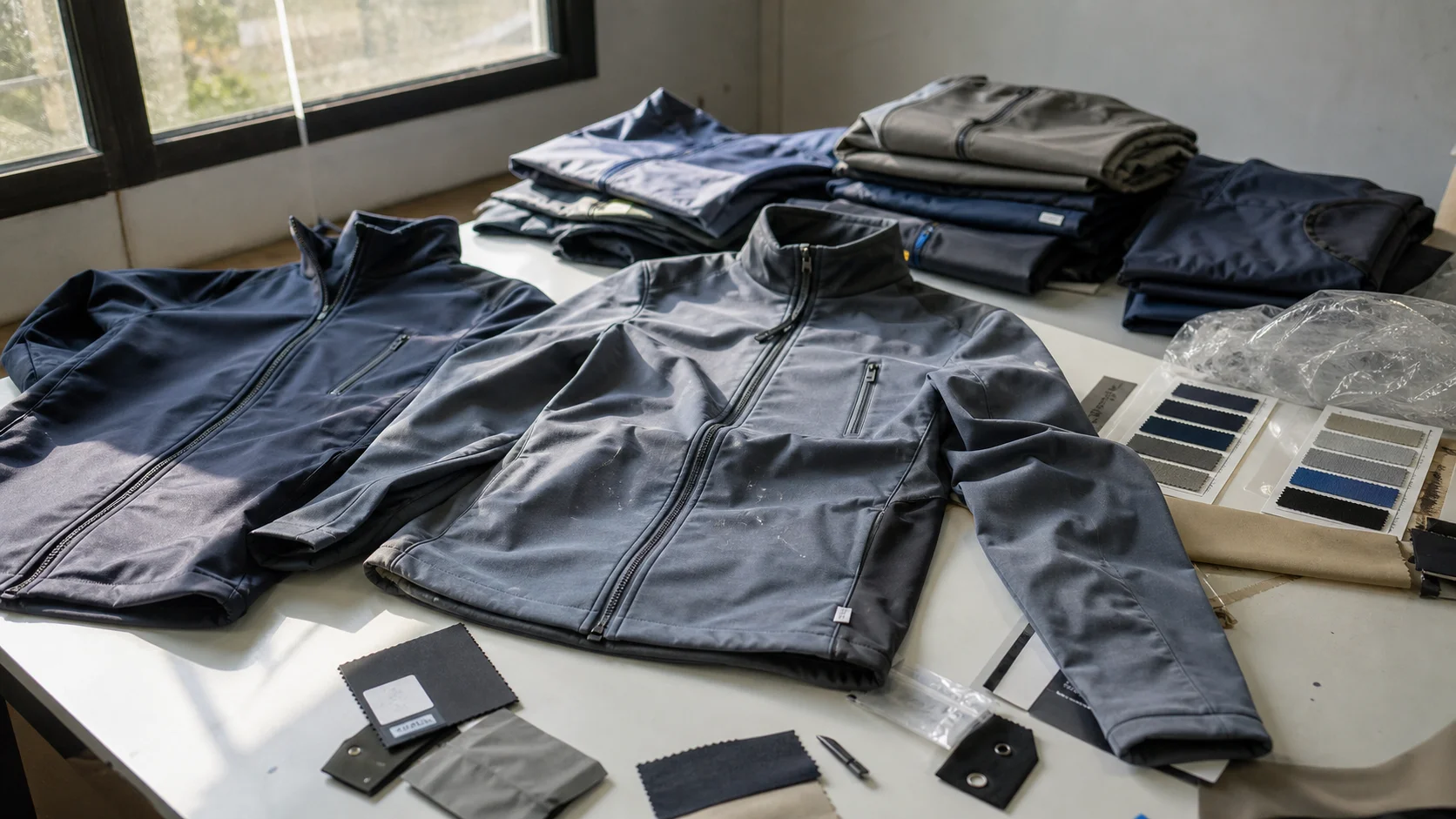
A practical guide for cleaning companies to inspect, sort, document, and resolve softshell jacket order defects before uniforms reach crews in the field.
Softshell Jacket Defect Sorting for Crew Orders - Outerwear & Jackets manufacturing guide
Category: Outerwear & Jackets
Softshell jacket defect sorting for crew orders is not just a quality-control exercise. It is a purchasing decision that affects worker comfort, brand consistency, replacement cost, and the speed at which a large apparel order can be issued to cleaning teams. For cleaning crews, jackets are exposed to daily abrasion, repeated laundering, chemical contact, and cold-to-wet working conditions. That means defect sorting has to look beyond cosmetic issues and focus on performance, durability, and repeatability across the full order.
This guide covers how to sort softshell jacket defects before distribution, what matters most for crew use, where sorting often fails, and how buyers can structure inspections, sampling, and final acceptance rules without overbuying or accepting avoidable risk. It is written for sourcing teams, uniform buyers, and operations managers who need usable jackets delivered on time and in consistent condition.
Defect sorting is the process of reviewing each jacket against a defined acceptance standard and separating units into categories such as pass, rework, repairable, or reject. In crew orders, the goal is not perfection in a showroom sense. The goal is field-usable outerwear that meets the agreed standard for appearance, fit, function, and wash durability.
For softshell jackets, sorting usually covers three layers of risk. First is visual quality, including fabric shade consistency, stitching, logo placement, and panel alignment. Second is functional quality, including zippers, seam integrity, pocket construction, cuff adjusters, and water resistance. Third is order consistency, meaning the jackets in a batch match the approved sample, size spec, and color standard closely enough that the team receives a coherent uniform set.
A good sorting program prevents two common failures. One is distributing obvious defects because no one checked the cartons closely enough. The other is rejecting too much product because the buyer never defined the tolerance band. Both mistakes cost money. The first creates field complaints and replacements. The second creates unnecessary chargebacks and delay.
Cleaning crews place different demands on a softshell jacket than office, retail, or promotional users. Their jackets often see repeated bending, kneeling, carrying tools, contact with detergents, and exposure to damp environments. Small manufacturing issues can become operational issues quickly.
A loose seam at the shoulder may not matter on day one, but it can fail after a few wash cycles. A zipper with rough tape can catch during cold-weather use. A cuff that was stitched slightly off can irritate a worker during long shifts. A slight shade difference may not concern a casual customer, yet it becomes a uniform problem when a crew is split across multiple sites and managers need the group to look consistent.
Sorting standards for cleaning crews should also account for laundering. If the jacket is expected to survive industrial or commercial laundering, the buyer should treat print adhesion, reflective trim, thread strength, and bonded layer stability as functional criteria. A jacket that looks acceptable on a hanger can still fail after the first wash cycle if the material pairing is weak.
For crew orders, the cheapest jacket is rarely the lowest-cost outcome. A tighter sorting standard usually saves money when replacement, downtime, and reissue costs are included.
Softshell jackets can fail in several ways, and the defect list should be written around both manufacturing realities and worker use. The most useful sorting systems group defects by severity rather than by factory department.
Defect Type Examples Typical Risk Level Sorting Action Critical Broken zipper, open seam, missing reflective element where required, severe size mismatch, contaminated fabric High Reject Major Misaligned logo, strong shade variation, fabric snag, pocket malfunction, failed water-repellent performance High Reject or rework, depending on use case Minor Small loose thread, slight topstitch irregularity, minor label skew, light packaging damage Low to medium Accept only if within approved toleranceFabric issues are often the hardest to fix and the easiest to overlook during rushed inspections. Watch for shade banding, surface pilling before use, coating inconsistency, delamination, and unexpected stretch variation across panels. In a bonded softshell, poor lamination can show up as bubbles, edge lift, or stiffness differences between units. Those signs should be treated seriously because they often indicate weak process control.
Thread breakage, skipped stitches, uneven seam allowance, puckering, and exposed raw edges are common sorting points. Crew jackets should be checked under movement, not only on a flat table. Lift the sleeves, flex the shoulders, zip and unzip the front, and inspect the underarm and side seams. A jacket that passes visual review may still fail functionally if the seam tension is too tight or too loose.
Zippers are a frequent failure point. Sorting should check smoothness, alignment, insertion, stopper integrity, pull tab attachment, and whether the zipper tape sits flat. On crew jackets, pocket zipper quality matters nearly as much as front closure performance because workers use pockets constantly. Cords, toggles, snaps, Velcro, reflective tapes, and binding should be checked for secure attachment and consistent finish.
If the jackets carry a logo, that decoration becomes part of the acceptance standard. Typical issues include off-center placement, poor registration on embroidery, heat transfer lifting at the edges, color mismatch with the approved artwork, and distorted sizing after application. Small branding errors are often visible from a distance, which makes them more damaging than they seem on a worktable.
Size defects are especially expensive in crew orders because they create swap requests and partial reissues. Buyers should not assume that a labeled size means usable fit. Garment measurements must be checked against the approved size chart for chest, body length, sleeve length, and hem sweep. For uniforms, consistency between sizes matters as much as the individual size itself.
Inspection criteria should be practical and measurable. A softshell jacket defect sorting guide for cleaning crews should include both appearance checks and use-based checks. The following items usually carry the most value.
For larger orders, acceptance should be based on a documented inspection plan. Many buyers use an AQL-based approach for carton sampling, then add 100 percent visual sorting of specific defect types before issue. That makes sense when the order is time-sensitive and the jackets will be distributed to multiple crew teams. AQL alone is not enough if the consequences of a bad unit are operationally costly.
Inspection should also distinguish between warehouse damage and factory defects. Scuffed trim, crushed boxes, and water damage in transit may not belong to the production supplier, but the buyer still needs a handling procedure. The final sorting record should show which issues were found at production, which were found at incoming inspection, and which were found during packout.
Sorting works best when it is standardized before bulk production starts. The buyer should approve a pre-production sample, confirm the size set, and define the defect threshold in writing. Once production begins, the sorting process can follow a structured sequence.
Start with the sealed sample or reference garment that defines acceptable quality. If there is a lab dip, trim card, logo strike-off, or prototype sample, those should be part of the same control set. The inspection team needs a single point of reference. Mixed references create mixed decisions.
Sort incoming cartons by size run and production lot. This helps identify whether a defect is isolated or systemic. If one size is drifting in sleeve length, the issue may be cutting or grading. If one carton contains multiple zipper failures, the issue may be a batch of faulty trims.
Critical defects should be removed before any minor sorting takes place. Broken closures, open seams, contamination, and major shade mismatch belong in this step. If a jacket is unsafe, nonfunctional, or clearly outside the approved standard, no amount of cosmetic correction should rescue it for issue to a crew.
Use a garment measurement chart and measure enough units to confirm consistency. Focus on chest width, back length, sleeve length, and hem opening. For crew orders, a jacket that is technically within tolerance but feels too tight during movement may still create complaints. Functional fit matters more than theoretical fit.
Zip the jacket while wearing it or while simulating movement on a hanger. Raise the arms, bend the elbows, and check whether the hem rises too much or the shoulder pulls. Cleaning crews need jackets that can move with the body. A garment that binds under normal motion is not a field-ready garment.
After inspection, classify each unit as pass, repairable, or reject. Repairable items should have a clear rework route, such as loose thread trimming, minor label correction, or packaging replacement. Anything with structural weakness, clear moisture barrier failure, or major branding issues should be rejected rather than patched.
Sorting is easier when the spec sheet is disciplined. Many defect disputes start because the buyer under-specified the jacket or treated development details as optional. For softshell jackets intended for cleaning crews, the spec should cover the fabric system, trim stack, and construction limits.
Fabric choice is where many purchasing tradeoffs show up. A heavier shell may hold up better against abrasion, but it can feel stiff and reduce comfort in active work. A softer bonded fabric may feel better on first wear, but if the face fabric is too light, the jacket can pill or snag faster. Buyers should decide whether the crew needs higher durability, lighter weight, or easier laundering. The best answer depends on site conditions, not on catalog language.
Trim selection matters just as much. Low-grade zippers save pennies and create service calls. Thin reflective tape can crack or peel. Weak hook-and-loop closures lose grip after repeated use. For crew orders, trim durability is often a better investment than decorative detail.
Softshell jacket orders usually do not begin at true retail-scale quantities, but they also are rarely trivial. Typical MOQ ranges depend on fabric availability, color commitment, decoration method, and whether the supplier is running a stock pattern or a custom development. For many programs, a practical MOQ might start around 300 to 500 pieces per color if the fabric is already sourced, and rise to 800 to 1,500 pieces or more for custom materials, custom trims, or special branding. Buyers should verify the actual threshold with the supplier before promising delivery dates internally.
Sample approval affects lead time more than many teams expect. A standard sequence often includes proto sample, fit sample, size set sample, PPS or pre-production sample, and TOP or top-of-production reference if the order is large. Each round adds time if comments are not consolidated. Slow sample approval usually creates more risk than a slightly higher unit price.
Lead time also depends on fabric development, trim sourcing, testing, and seasonality. If a supplier must secure bonded fabric, waterproof zippers, or custom reflective details, the critical path can extend quickly. Buyers should allow time for color approval, measurement corrections, and reinspection. A simple rule applies: the more customized the jacket, the less forgiving the schedule.
For procurement teams needing supplier support, it is often useful to start with a focused brief and request process guidance through Fabrikn services. If the order involves a new uniform program or a revision to an existing jacket line, the supplier should be asked to confirm fabric options, production constraints, and defect tolerance before bulk approval. When the specification is still being shaped, the fastest route is often direct coordination through Fabrikn contact.
Even a clean production run can be damaged by poor packout. Softshell jackets should be folded consistently, paired with size stickers or barcode labels if needed, and packed in a way that prevents moisture and crushing. For crew distribution, consistency matters because mismatched packing creates confusion at issue points and slows deployment.
Packout should also reflect defect sorting decisions. A repaired item should never be mixed into a clean carton without clear marking. Returned units should be tracked separately so that the buyer can identify whether the issue was production-related, handling-related, or warehouse-related. That distinction matters when evaluating supplier performance.
For multi-site cleaning operations, carton-level labeling should identify size, color, and quantity clearly. If the order includes different role groups, such as field cleaners, supervisors, or night-shift workers, the distribution plan should avoid mixed carton contents. Clear packing structure reduces errors and prevents last-minute re-sorting at the delivery site.
Defect sorting is not free. Each extra inspection step adds labor, and each rework decision adds handling time. The decision is not whether to spend money on quality control. The real decision is where to spend it. On a crew jacket program, the most economical choice is usually to spend more on upfront sample control, fabric verification, and trim standards, then reduce downstream sorting pain.
There is also a tradeoff between perfection and velocity. A buyer who rejects every slight cosmetic irregularity may miss deadlines and increase production cost. A buyer who accepts too much variation will spend more on replacements and field complaints. The right balance depends on the jacket’s role. A cleaning crew jacket used in public-facing locations should have tighter visual standards than a jacket used only in back-of-house work, but functional failures should never be tolerated in either case.
Another tradeoff is between uniformity and availability. If a supplier cannot source a specific trim or fabric consistently, locking the program to that component may create shortages. In those cases, buyers should define acceptable alternates in advance. That is better than discovering during production that a key zipper or binding tape is unavailable and the factory has substituted without approval.
A defect sorting guide only works if the supplier understands it before production. The buyer should request a written response to the critical points: fabric standard, trim standard, measurement tolerances, branding placement, inspection method, and packaging rules. If any of those are vague, the dispute will usually surface after goods are finished, when correction is slower and more expensive.
Escalation should be tied to the severity of the issue. A single loose thread is not the same as a zipper batch failure. A few slight shade variations are not the same as a mixed-lot fabric problem. The supplier should know which problems trigger rework, which trigger sorting credit, and which trigger full rejection. Clear escalation rules reduce debate later.
When a program requires ongoing support, it helps to choose a supplier that can discuss fit, sourcing, and quality control in the same conversation. Background on the company and operating approach is available at Fabrikn about us. That kind of reference is useful when a buyer needs to understand whether the supplier is set up for repeat uniform orders or only one-off garment runs.
For cleaning crew softshell jacket orders, the best acceptance approach is usually a hybrid model. Use sample-based approval to lock the standard, incoming inspection to catch lot problems, and final sorting to remove obvious field risks. Treat critical defects as automatic rejects. Treat major defects as rejects unless rework is proven to restore full use. Treat minor defects only within pre-agreed tolerance and only if they do not affect durability, branding, or crew presentation.
The most useful question is not whether a jacket looks acceptable in isolation. The better question is whether it will still perform and present well after repeated use by a cleaning crew. That standard is stricter than promotional apparel and less rigid than fashion outerwear. It is the correct middle ground for uniform buying.
Get a free quote from Fabrikn — your trusted B2B clothing manufacturer with 10+ years of experience. MOQ as low as 200 pieces.
Get a Free Quote →Zipper problems, seam irregularity, and shade variation are common. In practice, zipper issues tend to cause the fastest operational complaints because they affect daily use immediately.
Not always. Minor loose threads can be trimmed during sorting if the seam itself is secure and the garment otherwise matches the approved standard. If loose threads point to weak seam construction, the unit should be rejected or reworked.
Many programs start around 300 to 500 pieces per color for stock-based orders, with higher minimums for custom fabrics, special trims, or complex branding. Actual MOQ depends on the supplier’s material setup and production method.
A practical program may include proto sample, fit sample, size set sample, and pre-production sample. Larger or more customized orders can require more than one correction round if measurements, branding, or fabric performance need adjustment.
Both matter, but the priority depends on the job environment. If crews work outdoors in wet conditions, water resistance takes priority. If they are active for long periods and generate heat, breathability becomes more important. The right balance should be specified before production.
Yes for critical and major defects. Minor cosmetic issues can be accepted only if they fall within the agreed tolerance and do not affect wear, branding, or laundering performance. If a defect may create a replacement claim later, it is usually cheaper to remove it before issue.
For buyers building a new uniform program or tightening quality control on an existing one, the most practical next step is to align the spec sheet, sample approval, and inspection criteria before bulk production starts. That is where most defect sorting problems are prevented.