
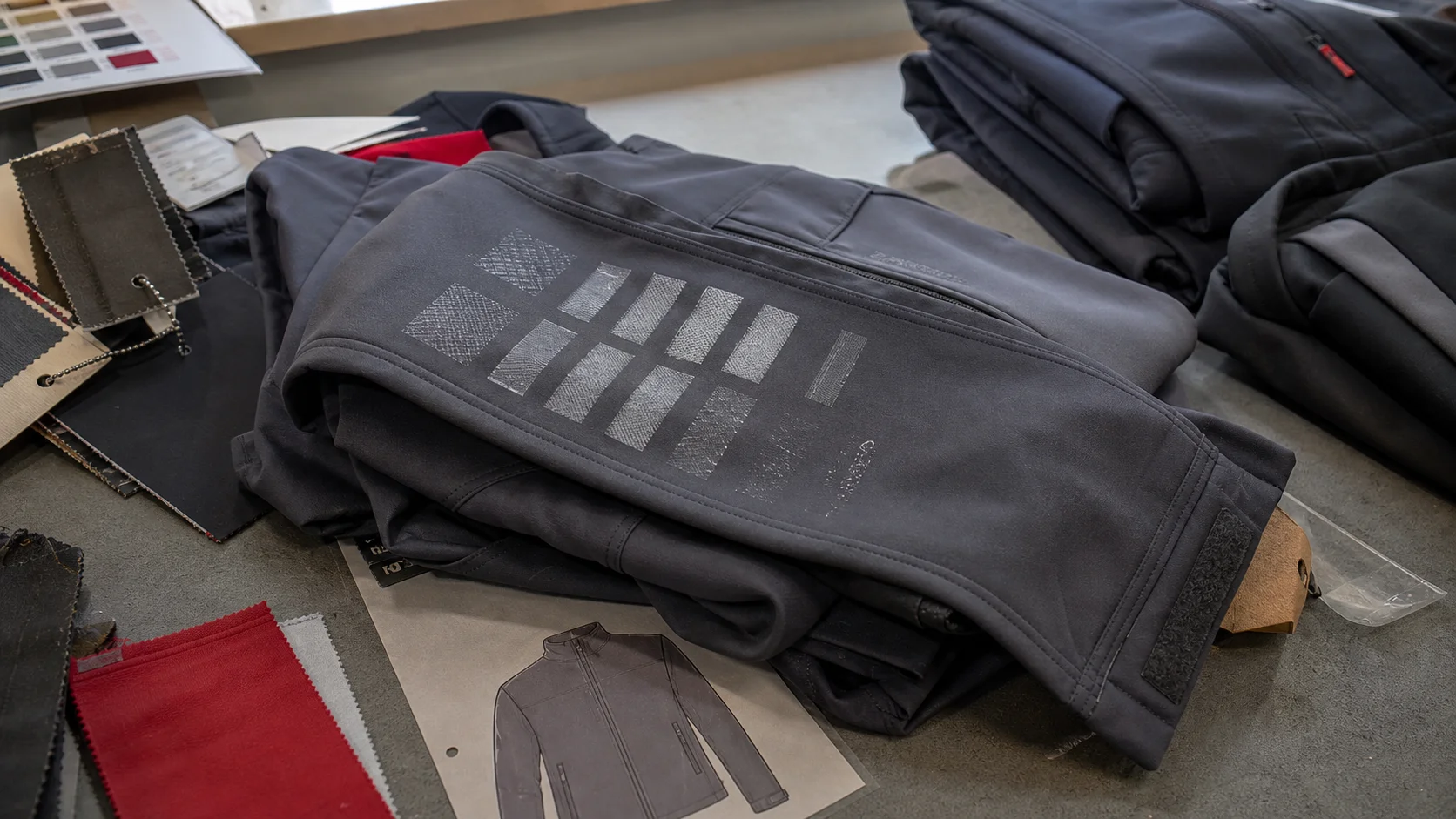
A focused inspection outline for fitness club buyers evaluating printed softshell jackets, covering decoration methods, abrasion checks, wash testing,...
Fitness club buyers usually want softshell jackets that look sharp at launch, stay readable after regular washing, and still feel premium at the end of a membership cycle. That is a narrow target. The jacket has to carry branding without cracking, peeling, or turning glossy in the wrong places. It also has to fit the realities of supplier production, where fabric choice, print method, curing control, and garment construction all affect durability. This review focuses on what a buying team should check when evaluating a softshell jacket supplier for print durability, with the practical concerns that matter in bulk orders, staff uniforms, retail resale, and member merchandise.
For sourcing support, see Fabrikn services, or reach out through contact us if you need a print-and-garment review workflow. Background on the company and production approach is also available on about us.
Softshell Jacket Print Durability Review for Buyers - Fabrikn production reference
A fitness club jacket is not a seasonal fashion piece. It gets used at reception desks, on the gym floor, during outdoor classes, for coach uniforms, and sometimes for retail sales to members. That means branding is exposed to repeated wear, laundering, abrasion from bags and seats, and stretch movement at shoulders and elbows. If the print fails early, the garment looks tired before the fabric does. That is a waste of both garment value and brand presentation.
For buyers, print durability is not only an aesthetic question. It affects replacement cost, staff consistency, member perception, and the resale value of branded apparel. Clubs that order in volume usually want a logo system that survives 20 to 40 home wash cycles without visible breakdown. The exact expectation should be written into the purchase specification because suppliers often interpret “durable” differently. A supplier may mean the print still exists. A buyer usually means the print still looks acceptable under normal use.
The most important point is simple: softshell fabric is less forgiving than flat cotton jersey. A print method that works well on tees may perform poorly on a bonded or brushed softshell surface. Buyers should review the jacket as a complete system, not as a logo applied in isolation.
Softshell jackets are usually built from layered synthetic fabrics, often polyester or polyester-spandex blends with a water-resistant face and a fleece or microfleece back. That construction creates several print challenges. The face fabric may have a DWR finish that reduces ink adhesion. The surface can be smooth enough to show defects, yet textured enough to limit crisp edge definition. Stretch can also stress the printed area, especially on sleeves, chest logos, and side panels where movement is constant.
Heat is another concern. Some softshell fabrics can tolerate only limited curing temperatures before the face sheen changes or the fabric laminate starts to distort. That matters for screen printing and transfer processes that depend on heat or pressure. A supplier should be able to explain the temperature range the jacket fabric can handle without damage. If the answer is vague, that is a risk signal.
Placement matters as well. A large chest print on a flat front panel is easier to control than a logo placed over a seam, zipper placket, pocket edge, or stretch panel. Fitness club buyers often want the logo highly visible, but the best position is not always the most prominent one. The cleanest application area is usually a stable panel with minimal curvature and no seam interruption.
Practical rule: the more a softshell panel moves, bends, or rubs, the more likely the print will fail early unless the method is chosen carefully.
Not every decoration method belongs on a softshell jacket. The right choice depends on quantity, logo complexity, expected wash frequency, and the visual finish the club wants. Buyers should not accept a supplier’s preferred method without asking why it fits the garment.
Screen printing can work on softshell jackets when the ink system is matched to the fabric and the print area is stable. It is usually cost-effective for larger orders and simple logos. Durability can be strong if the ink bond is correct and curing is controlled. The weakness is flexibility. Thick ink deposits can crack if the jacket stretches often, and poor surface preparation can lead to early peeling.
For fitness club orders, screen printing is most defensible when the logo is small to medium size, the artwork is simple, and the supplier has proven experience on coated synthetic outerwear. Buyers should ask whether the ink is intended for polyester technical fabric and whether adhesion testing has been done on the actual jacket fabric, not just a lookalike swatch.
Heat transfer methods, including certain DTF applications, are attractive because they can reproduce detailed logos and gradients. The drawback is long-term edge durability. On softshell, transfers may lift at corners, especially after repeated flexing, tumble drying, or abrasion from backpack straps. A premium transfer system can perform well, but only if the adhesive and pressing parameters are tuned to the fabric.
Buyers should request a wash and abrasion trial on the actual jacket construction. The sample should be evaluated after laundering and after flex testing at the logo location. A glossy finish, slight edge lift, or local stiffness can be acceptable for some retail applications. Staff uniform buyers usually need a lower tolerance threshold because the jacket is worn more often.
Embroidery is often more durable than print, but it is not always the best answer for softshell. Dense stitching can puncture the face fabric too much, alter drape, or create a stiff patch that feels out of place on a technical jacket. Small chest logos and text are common embroidery candidates, yet large designs can distort the garment. Buyers should think of embroidery as a durability benchmark, not a default solution.
If the logo is fine-detail, uses gradients, or must remain very lightweight, print may still be the better choice. The sourcing decision should balance appearance, cost, and performance rather than assuming embroidery always wins.
Method Durability on Softshell Best Use Main Risk Screen printing Good when matched to fabric Simple logos, higher quantities Cracking if ink is too rigid Heat transfer / DTF Moderate to good with correct setup Detailed logos, smaller runs Edge lift after washing and flexing Embroidery Very good for small marks Chest logos, name marks Fabric puncture and stiffnessA supplier’s durability claim is only useful if it can be traced to process control. A buyer should ask what exact tests were performed and on what fabric build. If the supplier says the print is “wash-resistant,” that does not tell you much. Ask for details: wash temperature, detergent type, number of cycles, drying method, and whether the test was conducted before or after garment assembly.
Strong suppliers can explain the connection between face fabric, coating, print chemistry, and curing method. Weak suppliers talk only about the logo file. On a softshell jacket, the logo file matters less than the garment substrate. If the fabric has a water-repellent finish, the ink needs to bond through that layer or the process needs to compensate for it. If the fabric contains elastane, the decoration must tolerate stretch without visible damage.
It is also worth checking the supplier’s color management. Dark jackets can hide slight print inconsistency, but they also make weak contrast more obvious under low light. White and light-colored prints may look clean at first and then show staining or gloss change more quickly. A quality review should look at the jacket under neutral light, side light, and after flexing the print zone.
Sample approval is where many buyers lose control. A good-looking sample can still fail in bulk if the supplier changes ink, film, press settings, or subcontractor handling. The approval process should be built to catch those risks before the order enters mass production.
A practical approval sequence for fitness club buyers starts with a digital artwork confirmation, then a blank garment confirmation, then a decorated pre-production sample. The decorated sample should be reviewed for placement, edge sharpness, hand feel, and visual match to brand standards. After that, the sample should be washed and inspected again. If the print changes materially after one or two washes, the process is not ready for production.
For larger orders, ask for a size-run sample if the logo placement differs by size or if the print location shifts due to grading. A logo that looks centered on medium size may drift awkwardly on extra-small or 3XL jackets. That is a common issue in uniform programs.
The safest approval record includes a signed sample reference, print size in millimeters, Pantone or color reference where relevant, and a short note on acceptable variation. Without that, disputes become subjective after shipment.
MOQ for branded softshell jackets varies by factory capability, print method, and fabric availability. For many suppliers, a practical MOQ might range from 100 to 300 pieces per color and logo setup for straightforward decoration. Some suppliers can go lower for sampling or premium pricing, while larger factories may want 500 pieces or more to justify setup efficiency. Buyers should treat low MOQ offers carefully if they come with uncertain print control or weak QC discipline.
Lead time depends on more than decoration. Fabric knitting or sourcing, laminate availability, waterproof zip procurement, lining supply, print setup, sample approval, and final inspection all affect delivery. A jacket with custom trims, branded zipper pulls, or special reflective elements can add several weeks. If the club is planning a seasonal launch, the order should be frozen early enough to absorb sample revisions.
Printing itself can become the bottleneck when colors require multiple passes or when the supplier needs to test adhesion on revised fabric lots. If the club wants repeated reorders, the supplier should retain the approved material spec and print recipe. Without that discipline, the second batch can drift from the first.
Softshell jacket print inspection needs to cover the decoration and the garment together. A print can look acceptable on a hanger and fail when the jacket is worn. Buyers should define what defects are unacceptable before production starts.
Common print-related risks include incomplete ink coverage, edge feathering, weak adhesion at corners, gloss mismatch, cracked ink after stretch, and offset misalignment across size runs. On dark jackets, ghosting around the logo can happen if the transfer film or ink is not fully set. On light jackets, contamination from handling or packing may show up immediately.
Garment-related issues can also affect print durability. If the jacket panels are inconsistent in thickness, the press pressure may vary across the print area. If seam bulk sits under the logo, the print can bridge unevenly and fail faster. If the face fabric has surface contamination from finishing oil or dust, adhesion may be compromised from the start.
Inspection should include random pull testing on print edges, measurement of logo placement, and review of wash performance on a retained sample. For club buyers, a small failure rate can become a large brand problem if the jackets are used by frontline staff. A uniform program rewards consistency, not just average quality.
If the supplier cannot explain how print adhesion is verified on the actual jacket fabric, the order is not fully controlled.
Buying teams do better when the spec sheet is precise. A workable spec for a softshell jacket should define the base fabric composition, face finish, backing type, print location, maximum print dimensions, acceptable color tolerance, and wash expectation. It should also define whether the jacket is for staff use, member retail, or promotional distribution, because the durability bar is not the same for all three.
A common softshell construction for club orders might use a polyester or polyester-spandex face with a brushed fleece back, though the exact hand feel and water resistance vary by supplier. Trim details should be chosen for service life as well as appearance. Zippers, binding, pocket construction, and cuff finishing all influence how the jacket ages. A cheap trim package can make a good print look worse by association.
For print specs, many buyers prefer a logo that stays within a controlled size range and avoids the highest-flex zones. Small left-chest marks and upper-back branding are usually safer than large wraparound decoration. If the design needs multiple colors, ask whether the supplier can keep registration tight across the full run. Complex artwork increases the chance of failure and inspection disputes.
Fitness club buyers should spend money where it protects brand visibility and wear life. That usually means better print chemistry, stronger process control, and a pre-production sample approval workflow that is strict enough to catch variation. It may also mean accepting a slightly higher unit price for a print method that survives use rather than choosing the cheapest decoration option.
There are places to save. If the logo is simple, a smaller print may be enough. If the jacket is for occasional event staff rather than permanent uniforms, the durability threshold can be lower. If the club uses the jacket as a seasonal giveaway, design complexity should be reduced so the production process stays stable. Savings should come from design simplification, not from weak quality control.
The most common mistake is specifying a visually impressive print without considering the garment’s actual use case. A club that wants a premium look on a technical jacket should accept the reality that technical fabrics need careful decoration. A low-cost supplier may still deliver acceptable results for a short campaign, but repeated wear exposes weak process control quickly.
In sourcing terms, the best supplier is not the one that says yes to every decoration request. It is the one that explains the tradeoffs clearly and can support the chosen method with consistent samples, realistic lead times, and inspection-ready production records.
Get a free quote from Fabrikn — your trusted B2B clothing manufacturer with 10+ years of experience. MOQ as low as 200 pieces.
Get a Free Quote →There is no single winner for every order. Screen printing can be durable on stable panels with the right ink system, while embroidery can outperform print for small logos. Heat transfers and DTF can work well when the adhesive, press settings, and fabric are properly matched. The right method depends on jacket construction, logo size, and washing frequency.
For staff uniforms, many buyers want the logo to remain acceptable through roughly 20 to 40 home wash cycles. That is not a universal standard, but it is a practical planning range. If the jacket will be washed more often or used in heavier conditions, the durability requirement should be tightened.
A common MOQ range is 100 to 300 pieces per color and logo setup, though some factories can go lower and some will require more. The exact MOQ depends on fabric sourcing, decoration method, and trim complexity. Very low MOQ pricing often carries tradeoffs in cost or process control.
Yes. Testing only on a similar fabric is not enough when the jacket has a water-resistant finish, a brushed back, or stretch content. The actual garment construction is what determines adhesion and durability. A pre-production sample on the real jacket is the minimum sensible check.
Reject visible cracking after flexing, edge lift, misaligned logos, poor registration, uneven color, print gloss mismatch that changes the brand look, and any sign that the print will catch or peel after laundering. If the print sits over a seam or zipper and shows distortion, that should be treated as a process problem, not a cosmetic one.
No. Embroidery is durable, but it can make a softshell jacket feel stiff and may not suit detailed artwork or large branding. Print can be the better choice when the design needs lightness, flexibility, or fine detail. The decision should follow the garment and brand use case, not habit.
For buyers comparing suppliers or reviewing a new decoration plan, the best next step is to request a decorated sample, a short wash test report, and a written production spec. If you need a supplier review or a controlled sourcing discussion, start with services or use contact us to outline the jacket type, logo format, and target quantity.