
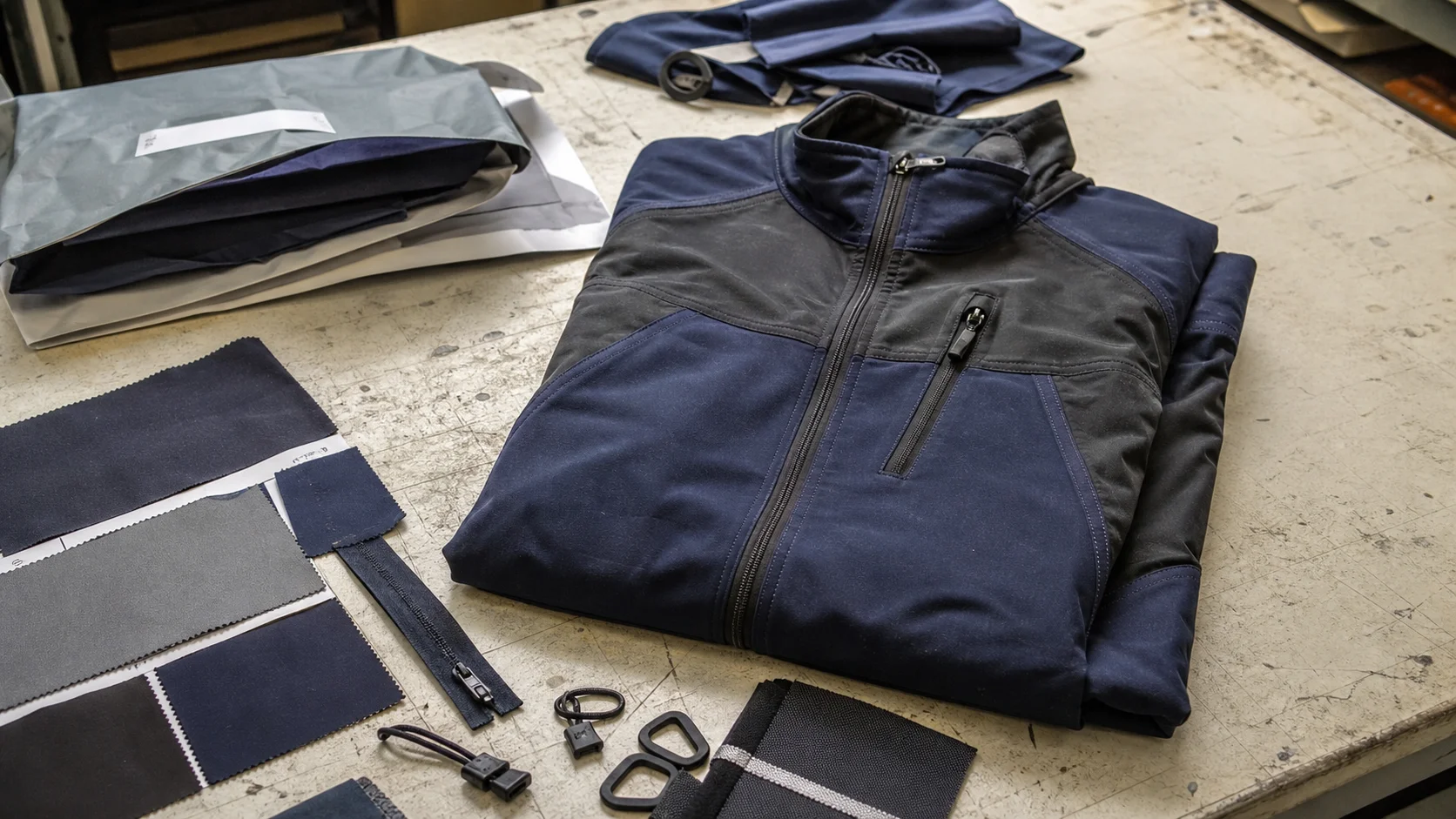
A production-focused outline for specifying, inspecting, and approving softshell jackets built for cleaning crews, covering fabric performance, decoration...
Softshell Jacket Control Brief for Cleaning Crews - Outerwear & Jackets manufacturing guide
A softshell jacket for cleaning crews is not a fashion outerwear item with a logo added at the end. It is a daily-use work garment that has to handle repeated movement, damp conditions, indoor-outdoor temperature changes, and regular laundering. The production control brief should treat it as operational uniform apparel first and branded outerwear second.
Cleaning teams often move between lobbies, loading areas, corridors, parking zones, restrooms, kitchens, service elevators, and exterior walkways. The jacket must be comfortable enough for long shifts, tidy enough for client-facing sites, and durable enough to survive abrasion from carts, buckets, keys, tools, and cleaning chemical contact. A weak specification creates avoidable returns: peeling prints, broken zippers, sleeve restriction, delamination, seam slippage, color mismatch, and inconsistent sizing across reorders.
This control brief is written for buyers, uniform distributors, facility service groups, and sourcing teams preparing a softshell jacket production order for cleaning crews. It focuses on the areas that normally decide whether the garment performs well in the field: fabric selection, pattern engineering, trim quality, sample approval, MOQ planning, lead-time management, inspection, and packing.
For buyers building a larger uniform program, softshell jackets should be specified alongside polo shirts, work trousers, vests, aprons, and rainwear. A single outerwear decision affects staff appearance, replacement cost, laundering instructions, and reorder consistency. If the project requires manufacturer coordination across several product types, review the production support options at Fabrikn services before locking the garment brief.
The correct softshell jacket starts with the cleaning crew’s work environment. A jacket used by overnight janitorial teams in office buildings does not need the same protection as one used by airport, hotel, campus, hospital, or outdoor facility crews. The buyer should define the job setting before choosing fabric weight, membrane, trims, and reflective details.
The strongest buying decision is not always the heaviest or most technical jacket. For indoor cleaning crews, a bulky laminated softshell can feel too warm and reduce compliance. For outdoor crews, a thin unlaminated stretch woven may look good in the sample room but fail in wind and drizzle. The brief should match the garment to the actual shift conditions.
Practical sourcing rule: specify the softshell around the worker’s task, not around a catalog description. Cleaning crews need a jacket that moves, washes, and stays presentable more than they need unnecessary outdoor sports features.
Fabric is the largest cost driver and the main reason softshell jackets succeed or fail. The brief should state the face fabric, backing, stretch, water resistance target, color, and testing expectations. Vague wording such as “good quality softshell” is not enough for production control.
A practical specification for cleaning crew softshell jackets often uses polyester or polyester-spandex face fabric with a fleece or microfleece backing. Typical weights range from 250 gsm to 340 gsm. Lightweight versions may sit around 220 gsm to 260 gsm, while colder-use jackets may move toward 320 gsm to 380 gsm. Weight alone does not prove performance. A 300 gsm fabric with poor bonding can fail faster than a 260 gsm fabric with stable lamination and better recovery.
Chemical exposure is a practical concern. Cleaning crews may come into contact with diluted disinfectants, detergents, bleach traces, degreasers, and floor-care products. No standard softshell should be sold as chemical protective clothing unless it is properly engineered and certified for that purpose. The realistic control point is to require acceptable colorfastness, avoid unstable prints, and provide clear wash and care instructions.
Uniform buyers often underestimate shade control. A softshell jacket ordered today must look consistent with a reorder six months later. The brief should require lab dips for approval before bulk dyeing or stock fabric confirmation before cutting. For stock fabric programs, ask whether the supplier can reserve fabric or maintain shade continuity for replenishment orders.
Cleaning crews frequently wear jackets in visible client environments. A slight shade mismatch may be acceptable for a single order, but it becomes obvious when old and new garments are worn together. Navy and charcoal can vary significantly between fabric lots. Black hides more variation but can show lint, dust, detergent marks, and fading if the dyeing or finishing is weak.
Construction should prioritize durability, comfort, and clean finishing. Cleaning crew jackets are often worn during physical tasks, not only while commuting. Weak seams, tight armholes, and poor pocket placement are common production risks.
For cleaning crews, the jacket should not be overbuilt with heavy tactical details unless the work environment demands it. Extra panels, thick reinforcements, multiple zipped pockets, and complex trims increase price and production risk. A clean softshell with reliable zipper, two secure hand pockets, optional chest pocket, and neat branding is usually easier to control at scale.
Many buyers ask for waterproof jackets when they actually need water-resistant workwear. Fully seam-sealed softshell construction costs more, requires different production equipment, and can create stiffness. For cleaning crews exposed to light rain between buildings, water-repellent fabric and good zipper protection may be enough. If teams work outdoors for extended periods, a rain jacket or hardshell may be more appropriate than trying to force softshell into a waterproof role.
The production brief should clearly state whether seam sealing is excluded, partially required, or fully required. Partial seam sealing can create confusion in inspection unless zones are mapped. Fully taped seams must be checked for tape adhesion, neatness, and coverage, especially around curved seams and pocket openings.
Fit is a major source of complaints in uniform outerwear. Cleaning crew staff may need to layer the jacket over polo shirts, sweatshirts, or light fleece. The pattern should allow working movement without looking oversized.
Unisex sizing can simplify ordering and reduce MOQ complexity, but it may create fit compromises. Women’s sizing improves wearability for many teams, yet it requires separate grading, separate samples, and sometimes separate minimums. For large programs, separate fits are worth considering. For small runs, a well-graded unisex fit with clear size chart may be more practical.
The production brief should require a size set sample before bulk cutting, especially for custom patterns or first-time orders. A common approval route is to fit medium or large first, then review the full size set after pattern corrections. Do not approve bulk production from a single attractive salesman sample if the size grading has not been checked.
Critical measurements include chest, sweep, across shoulder, sleeve length, center back length, armhole, bicep, cuff opening, and pocket placement. Tolerances should be realistic. A typical outerwear tolerance may be ±1 cm for small measurements and ±1.5 cm to ±2 cm for larger body measurements, depending on the point of measure and fabric stretch. Overly tight tolerances may cause unnecessary inspection failures, while loose tolerances create poor size consistency.
Trims look minor on a costing sheet, but they often create the most visible defects. Cleaning crew jackets need reliable zippers, durable pullers, stable pocket bags, and branding that can withstand laundering.
The front zipper should be specified by type, size, color, and performance level. Common options include nylon coil zippers for flexibility or molded plastic zippers for a more robust appearance. Metal zippers are usually less suitable for cleaning crew softshells because they add weight, can feel cold, and may corrode or become uncomfortable in wet conditions.
For standard uniform softshells, a nylon coil zipper in size 5 is common for the center front. Pocket zippers may be size 3 or size 5 depending on pocket design. Low-cost zippers can save money at order placement and create replacement cost later. Zipper smoothness, puller strength, top-stop security, and color matching should be checked during sampling and final inspection.
Most cleaning crew softshell jackets need two hand pockets, preferably zipped to prevent items falling out while bending or moving. A chest pocket can be useful for ID cards or small notes, but it adds cost and can interfere with logo placement. Internal pockets are useful for supervisors but may be unnecessary for all staff.
Pocket bags should be strong enough for keys and small tools. Thin pocketing can tear quickly. If the jacket is intended for teams carrying access cards, radios, or small devices, the pocket size and entry angle should be tested before approval.
Branding should be selected based on durability and fabric compatibility. Embroidery is common and professional, but it can reduce water resistance at the stitched area and may pucker if backing is wrong. Heat transfer gives a clean finish, especially for detailed logos, but must be tested for wash durability and adhesion on softshell surfaces. Woven patches can be durable and consistent, though they add a more structured look.
Branding Method Best Use Control Risk Embroidery Simple logos, premium uniform appearance Puckering, thread abrasion, needle holes, backing discomfort Heat transfer Detailed logos, small text, clean modern look Peeling, cracking, poor adhesion after washing Woven patch Consistent logo reproduction, easy visual control Edge lifting, stiffness, incorrect placement Reflective print Low-light identification and safety details Reduced reflectivity after washing, cracking on stretch zonesLogo placement should be mapped in the tech pack with measurements from fixed points, not described casually. “Left chest logo” is not enough. State distance from center front, distance from shoulder seam or high point shoulder, logo size, color, artwork file format, and acceptable tolerance. For cleaning crews, avoid large prints across high-stretch zones unless tested.
A disciplined sample process reduces the risk of bulk production disputes. The exact sample names vary by supplier, but the approval logic should remain consistent.
The pre-production sample is the most important control sample. It should be sealed before bulk production starts. If the buyer approves only a development sample in substitute fabric, the production team still needs a final approved reference using correct fabric, trims, colors, logo, labels, and workmanship.
Buyers should keep written comments after every sample review. Use clear approval language: approved, approved with comments, revise and resubmit, or rejected. Ambiguous comments such as “make better” or “improve quality” do not protect either party. Specific comments reduce delay and make inspection easier.
If your team is preparing a new uniform jacket project and needs to align specifications before inquiry, use the contact route at Fabrikn contact us to share the product brief, target quantity, size range, and branding needs.
Minimum order quantity depends on fabric source, color, trims, branding method, and whether the pattern is custom or based on an existing block. Softshell fabric can carry higher MOQ than basic knitwear because bonding, lamination, dyeing, and finishing require more setup.
These ranges are general planning figures, not fixed promises. Actual MOQ changes with supplier capacity, seasonal demand, fabric availability, color count, size spread, packaging requirements, and testing needs. A small order with five colors and extended sizing may be harder to place than a larger single-color order.
Softshell jacket lead time is often affected more by fabric than sewing. If approved fabric is in stock, production may move faster. If fabric must be dyed, bonded, laminated, tested, and shipped to the sewing line, the schedule expands.
A realistic custom softshell project may require 8 to 14 weeks after sample approval, and longer during peak outerwear seasons. Stock fabric programs can be shorter, but only when all trims, labels, and logo components are ready. Buyers should not treat the quoted sewing time as the full project lead time.
Late artwork approval, changing logo size, switching zipper color, or adding reflective tape after sampling can reset the timeline. The brief should lock all visible details before pre-production approval. If the buyer needs a fixed launch date, leave schedule buffer for one round of sample corrections and one round of fabric or branding adjustment.
Softshell jacket inspection should cover measurements, fabric condition, workmanship, trims, branding, packing, and shade consistency. Cleaning crew jackets are workwear, so inspection should focus on real-use durability as much as appearance.
Inspection should not rely only on top-of-carton visual checks. Pull random pieces by size and color. Open zippers fully, test pocket function, examine stress points, and compare measurements against the approved spec. For branded jackets, confirm logo location across several sizes because grading can make placement look inconsistent if not adjusted correctly.
Testing should match the risk level and market requirements. Typical tests may include fabric weight, composition, colorfastness to washing, colorfastness to rubbing, dimensional stability, pilling resistance, seam strength, zipper performance, and water repellency. If reflective material is used, reflectivity and wash durability may be relevant.
Not every order needs a full technical testing package, especially small local uniform runs. Still, basic wash testing is worth considering. A jacket that looks acceptable before washing can reveal shrinkage, transfer failure, dye bleeding, or backing pilling after a few cycles. Cleaning crew uniforms are washed often, and poor wash stability becomes a real cost.
Inspection judgment: do not approve a softshell jacket only because the front view looks clean. Open it, stretch it, zip it, measure it, wash-test the branding, and check whether it can survive the worker’s shift.
Packing decisions affect distribution efficiency. Cleaning crew uniform orders are often delivered by site, department, employee size, or replenishment batch. Poor carton organization can create extra warehouse handling and delay rollout.
Individual polybags can protect garments during transit, but some buyers want reduced plastic. If polybags are used, size and safety warning requirements should be confirmed. If bulk packing is chosen, protect against moisture, crushing, and shade mixing. The brief should define folding method, bagging method, carton assortment, and any site-specific packing list.
For cleaning companies with multiple client sites, carton sorting by location can save substantial time. This requires accurate size allocation before packing starts. Late changes to distribution lists often cause errors, so the packing plan should be finalized before bulk goods are ready.
A good softshell jacket production brief does not chase every feature. It chooses the right features for the cleaning crew’s work conditions and budget. The main tradeoff is between durability, comfort, weather resistance, branding quality, MOQ, and delivery speed.
The best version for many cleaning crews is a midweight polyester stretch softshell, around 280 gsm to 330 gsm, with a smooth outer face, light fleece backing, full front zipper, two zipped hand pockets, controlled logo branding, and practical sleeve and hem finishing. For outdoor or low-light sites, add reflective details only where needed and test them properly. For warmer indoor teams, reduce weight and bulk rather than forcing staff into a jacket they will not wear.
Buyers should also plan replenishment. Cleaning crew uniforms suffer loss, damage, staff turnover, and size changes. If the first order uses custom-dyed fabric, ask how reorders will be handled. If fast replenishment matters, stock fabric may be the better commercial choice even if the color options are limited.
Supplier capability matters, but the buyer’s brief matters just as much. A clear brief makes costing more accurate, sampling faster, and inspection more objective. If you want to understand how a manufacturing partner frames sourcing, production, and quality support, review the company background at Fabrikn about us.
The following template can be adapted for a cleaning crew softshell jacket inquiry or purchase order. It is not a substitute for a full technical pack, but it gives the sourcing team a practical structure.
Control Area Specification to Confirm Approval Evidence End Use Cleaning crew workwear for indoor-outdoor facility service Buyer brief and wearer use notes Fabric Polyester or polyester-spandex bonded softshell, target gsm, stretch direction, color Fabric swatch, lab dip, test report if required Weather Function Wind resistance and light water repellency, not certified rainwear unless specified Fabric test or supplier declaration Fit Unisex or gender-specific fit, layering allowance, size range Fit sample and size set Trims Center front zipper, pocket zippers, pullers, labels, elastic or cuff finish Trim card and pre-production sample Branding Logo method, artwork, size, position, color, wash durability requirement Branding strike-off or logo sample Workmanship Seam type, reinforcement, bartacks, pocket construction, clean finishing Approved pre-production sample Inspection AQL level, measurement tolerance, defect classification, carton sampling Final inspection report Packing Individual or bulk pack, size stickers, carton assortment, site allocation Packing list and carton marksA buyer who provides these details early will usually receive more reliable pricing than a buyer who sends only a photo. Photos help communicate style direction, but they do not define fabric, fit, trim quality, testing, or packing. The clearer the brief, the easier it is to compare supplier quotations on a like-for-like basis.
A softshell jacket for cleaning crews should be specified as washable, mobile, durable uniform outerwear. The control brief should avoid vague claims and focus on measurable details: fabric weight, construction, fit, trims, branding, MOQ, lead time, inspection standards, and packing method.
The safest purchasing approach is to approve the product in stages: fabric and color first, fit and construction second, branding third, pre-production sample last. Bulk production should start only after the supplier has a complete approved reference. Rushing this step may save a week at the start and cost much more during delivery, replacement, or rollout.
For most programs, choose a practical midweight softshell, keep the styling clean, specify reliable trims, test the logo, and control shade. That combination gives cleaning crews a jacket they are more likely to wear and gives buyers a better chance of consistent reorders.
Get a free quote from Fabrikn — your trusted B2B clothing manufacturer with 10+ years of experience. MOQ as low as 200 pieces.
Get a Free Quote →A practical range is usually 280 gsm to 330 gsm for general indoor-outdoor cleaning crew use. Lighter jackets around 220 gsm to 260 gsm may suit warmer indoor sites, while heavier options above 330 gsm can work for cooler environments. The best choice depends on climate, shift conditions, layering, and laundering needs.
Most softshell jackets are water-resistant, not fully waterproof. They can handle light rain or brief exposure if the fabric has a water-repellent finish. For prolonged rain, a seam-sealed rain jacket is usually a better choice.
Typical MOQ may range from 100 to 300 pieces for stock fabric and standard colors. Custom colors often require 300 to 800 pieces, while custom laminated fabrics may require 500 to 1,500 pieces. Exact MOQ depends on fabric, color, trims, branding, and supplier setup.
A custom softshell jacket order often takes 8 to 14 weeks after sample approval, depending on fabric production, trims, branding, factory capacity, and inspection. Stock fabric orders can be faster, but only when all materials and artwork are ready.
Embroidery gives a professional and durable look for simple logos, but it can pucker or create needle holes. Heat transfer is better for detailed artwork and small text, but it must be tested for adhesion and wash durability. The right choice depends on the logo, fabric surface, wash requirements, and budget.
Reflective details are useful for crews working near parking areas, loading docks, campuses, roads, or low-light exterior routes. They may be unnecessary for teams working mainly indoors. If reflective material is used, check placement, wash durability, and whether any safety standard is required.
Common problems include fabric delamination, pilling, zipper failure, shade variation, poor logo placement, transfer peeling, seam defects, measurement inconsistency, and weak pocket construction. These risks should be controlled through sampling, testing, and final inspection.
A unisex fit can work for smaller or simpler programs, especially when MOQ is limited. Separate men’s and women’s fits usually improve comfort and appearance but add sampling, grading, and inventory complexity. Buyers should decide based on team size, size spread, budget, and expected reorder needs.
Approve the fabric, color, trims, fit, size chart, branding, labels, packing method, and pre-production sample. Bulk production should not start from a rough development sample unless the buyer accepts the higher risk of mismatch or rework.
Packing should match the distribution plan. Options include individual polybags with size stickers, bulk packing by size, or carton sorting by worksite. Multi-location programs should confirm size allocation and carton labels before packing begins.