
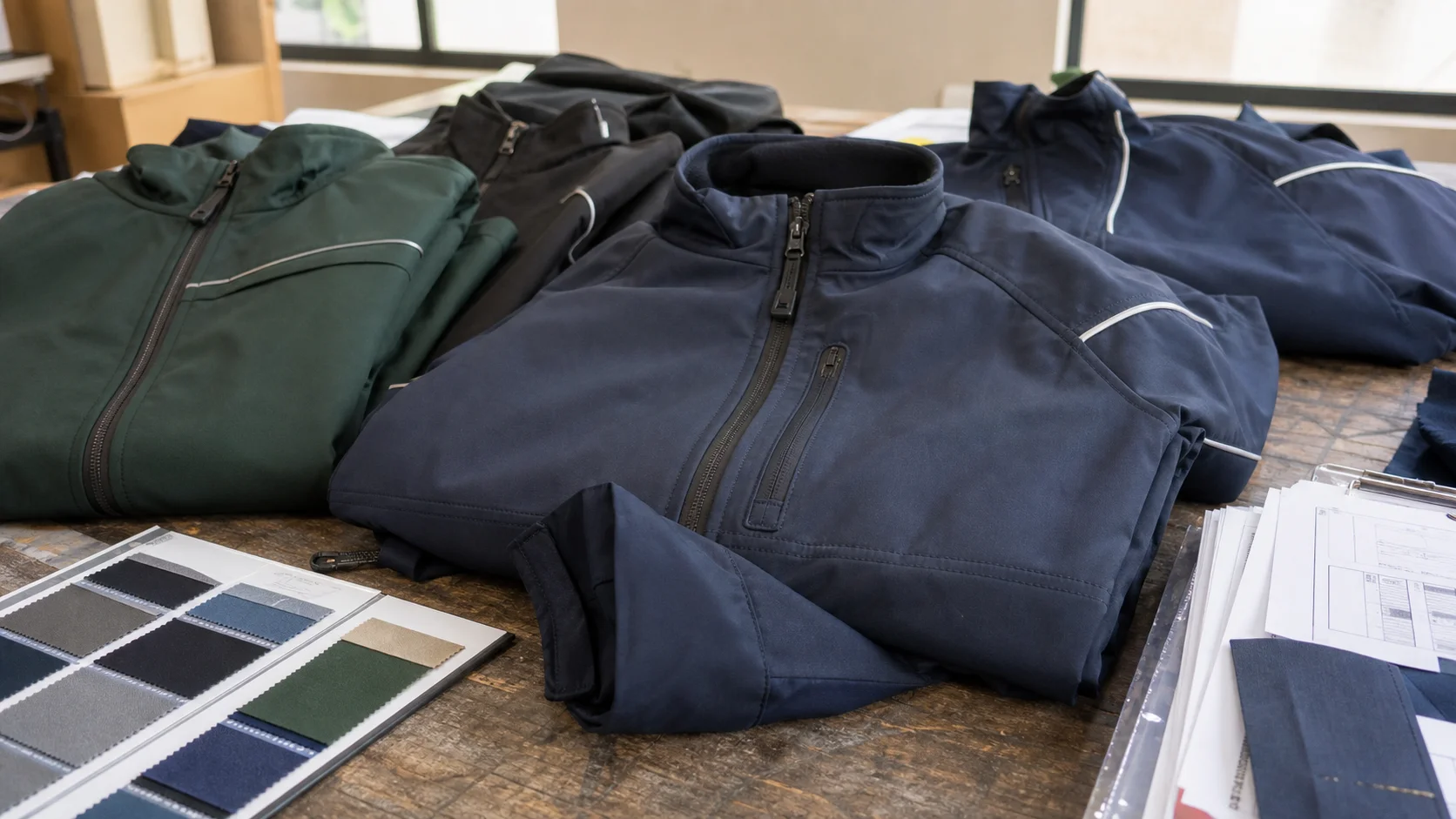
A product-specific SEO outline for outdoor school buyers reviewing softshell jacket reorder risks, from fabric continuity and decoration placement to...
Softshell Jacket Reorder Risk Review for Schools - Outerwear & Jackets manufacturing guide
Softshell jackets look simple on a school order sheet: one outerwear style, school colours, logo placement, size curve, delivery date. In practice, reordering them carries more risk than many outdoor school buyers expect. A softshell jacket is not a basic T-shirt. It combines laminated fabric, stretch recovery, weather resistance, zippers, pocket construction, cuffs, hem finishing, embroidery or heat transfer, and often a broad youth-to-adult size run.
For schools, the risk is not only product failure. The bigger commercial issue is inconsistency. A reorder that arrives in a slightly different navy, with a new zipper pull, tighter sleeves, weaker water resistance, or a logo positioned lower than the previous batch can create complaints from parents, staff, and uniform committees. Schools usually buy outerwear for multi-year continuity. Reorder control matters because the jacket must look like part of the same uniform programme, even when production happens months or years apart.
This outdoor school buyers softshell jacket reorder risk review focuses on what procurement teams, uniform distributors, schoolwear brands, and sourcing managers should check before repeating an order. The aim is practical: reduce surprises, protect delivery dates, and make sure the reorder matches the approved standard closely enough for school use.
Purchasing judgment: treat every school softshell reorder as a controlled repeat order, not an automatic copy. The supplier may still have the tech pack, but fabric mills, trim suppliers, dye lots, machines, operators, and packaging requirements can all change between runs.
Outdoor school buyers are not all buying for the same use case. Some need jackets for daily uniform wear. Others source for residential trips, forest school programmes, sports teams, staff outerwear, or branded merchandise. The reorder risk changes depending on the jacket’s role.
A daily uniform softshell needs colour stability, easy care, durability, and a size range that covers multiple age groups. A trip jacket may need stronger water resistance, better breathability, and higher visibility details. Staff jackets often require a more adult fit, quieter branding, and longer wear life. If one style is being used across all these needs, the specification must be robust enough to handle the highest-risk use case.
School buyers usually care about five commercial outcomes:
For manufacturing support, buyers often need a supplier that can handle repeat specifications, sample approvals, fabric matching, and reorder documentation. Businesses comparing sourcing routes can review broader production support through Fabrikn’s services.
The largest reorder risks for school softshell jackets usually fall into six areas: fabric continuity, colour matching, fit repeatability, trim availability, decoration consistency, and delivery planning. None of these risks is unusual. The mistake is assuming they will manage themselves because the first order went well.
Risk Area Common Reorder Problem Buyer Checkpoint Purchasing Judgment Fabric Different hand feel, stretch, weight, or lamination quality Request fabric lot reference, GSM, construction, and performance test data Do not approve by colour alone Colour Navy, black, bottle green, or burgundy shifts between batches Compare lab dip or bulk cutting against retained approved sample School colours need tighter control than casual outerwear Fit Sleeves, body length, or shoulder width change after pattern adjustment Review size specs and tolerance table before production Growth allowance matters for children’s outerwear Trims Zipper, puller, cord, label, or binding replaced without approval Approve trim card for each reorder Substitution must be documented, not casual Branding Logo colour, size, placement, or embroidery density varies Use a branding placement sheet and decoration strike-off Parents notice logo inconsistency quickly Lead Time Fabric or zipper delay pushes delivery past term start Confirm material booking dates and production slot Calendar risk is as important as unit priceSoftshell fabric is the core risk in a reorder. A typical school softshell uses a bonded or laminated construction: woven or knitted outer face, membrane or TPU layer, and fleece or brushed inner backing. Common weights sit around 280–350 GSM, though lighter 240–270 GSM fabrics may be used for budget schoolwear and heavier 360–400 GSM fabrics for colder outdoor programmes.
Buyers should confirm the fabric construction, not just the marketing description. “Three-layer softshell” can mean different things depending on the supplier. A good reorder specification should include face fabric composition, backing composition, total GSM, stretch direction, water resistance target, breathability target where relevant, and finish requirements.
For school buyers, the best value is rarely the highest technical specification. A very high-performance softshell may exceed the budget and still fail if sizing or delivery is poor. A low-cost softshell may look acceptable at sample stage but pill, delaminate, or lose shape after repeated use. The safer middle ground is a well-documented fabric with stable colour, acceptable weather resistance, and proven wash performance.
Reorders should not proceed without checking whether the original fabric is still available. Mills can discontinue a base fabric, change backing fleece, adjust dye processes, or replace a membrane. If the supplier proposes an “equivalent” fabric, ask for a side-by-side comparison against the approved bulk sample. The comparison should cover GSM, colour, stretch, hand feel, backing shade, water repellency, and shrinkage.
Purchasing judgment: if the jacket is part of a strict school uniform range, fabric continuity is worth paying for. If the jacket is for a one-off outdoor trip, a controlled equivalent may be acceptable, provided branding and sizing remain stable.
Fit is a major reorder risk because school size ranges are broad. A single programme may require youth sizes, teen sizes, and adult staff sizes. Children also wear softshell jackets over shirts, polo tops, jumpers, blazers, sports layers, or hoodies, depending on school policy. A jacket that fits well in a showroom can become a complaint generator when layered over winter uniform.
Buyers should avoid vague fit terms such as “standard school fit” unless the supplier has a proven size chart. A reorder file should include finished garment measurements for chest, hem, shoulder, sleeve length, back length, cuff opening, and armhole. Tolerances should be realistic. For school outerwear, a common tolerance may be around ±1cm for smaller measurements and ±1.5cm to ±2cm for larger body measurements, depending on the point of measure and size.
Reorders often fail commercially when the size curve is copied without reviewing actual sales. If the first order sold out of ages 9–10 and adult small but left excess in age 5–6, the next order should be adjusted. Schools with new intake patterns, sports cohorts, or staff purchasing programmes may need a different ratio.
A typical school softshell order may include a spread such as:
The key is to compare reorder demand against returns data, not only sales volume. A size that sells quickly but generates many exchanges may be misgraded. Repeated complaints about tight sleeves, short body length, or restrictive shoulder movement should trigger a fit review before another bulk run.
A school softshell jacket should allow movement. Ask the supplier to check arm lift, backpack wear, seated comfort, and sleeve length with layering. For younger students, zipper operation matters too. A heavy or snagging zipper can create daily frustration. For outdoor learning, cuffs and hems should limit cold air entry without being difficult for children to manage.
Fit consistency can be more valuable than a small cost saving. If changing factory or pattern room saves a few percent but increases exchange rates, the saving may disappear quickly through returns, parent complaints, and emergency replenishment.
School softshell jackets are highly visible. Branding consistency is a repeat-order priority, not a finishing detail. Embroidery, heat transfer, woven badges, rubber patches, and reflective prints each bring different reorder risks.
Embroidery is durable and familiar for schoolwear, but it can affect fabric performance if placed on a laminated panel without backing control. Dense embroidery may pucker on stretch softshell, especially around chest logos. Heat transfers can look clean and lightweight, but they must be tested for wash durability, stretch cracking, edge lifting, and colour migration. Woven badges add a traditional look, though they can increase labour and create edge curling if not attached properly.
Trim consistency deserves the same discipline. Zippers, zip pullers, binding, drawcords, elastic, Velcro, labels, hangtags, and polybags can all change during a reorder. A zipper substitution may seem minor until the new puller looks cheaper or fails during winter wear. Binding shade can also create a visible mismatch against the shell fabric.
For children’s garments, avoid trims that create avoidable safety or durability issues. Long cords, weak snap components, sharp pullers, and loosely attached badges need careful review. If reflective details are used, specify whether they are decorative visibility elements or intended to meet a particular performance standard. Do not imply compliance unless the product has been tested to the relevant standard.
Buyers who need help aligning decoration, trims, and production documentation can use the enquiry route at Fabrikn’s contact page to discuss the order structure and risk points.
Minimum order quantity is one of the most common pressure points in school softshell jacket reorders. Schools often want small top-up quantities, while factories and fabric mills prefer efficient production runs. The gap between those two needs drives many reorder compromises.
Typical MOQ ranges vary by supplier, fabric availability, decoration method, and colour. For a stock-supported or near-stock softshell style, MOQs may be around 50–150 pieces per colour with decoration. For custom fabric colours, custom trims, or fully bespoke patterns, a practical MOQ may sit around 300–800 pieces per colour. If fabric must be dyed or laminated specifically for the order, the fabric mill MOQ can push the garment MOQ higher, sometimes beyond 1,000 pieces depending on the fabric and colour.
Order Type Typical MOQ Range Best Use Case Main Tradeoff Decorated stock softshell 50–150 pieces Small school top-ups and staff jackets Less control over fabric, fit, and trim continuity Private-label existing pattern 150–500 pieces Schoolwear distributors and repeat uniform programmes Moderate flexibility, but still dependent on base fabric availability Custom colour or custom trim 300–800 pieces Schools with strict brand colour requirements Higher commitment and longer lead time Fully bespoke softshell 500–1,000+ pieces Multi-school groups, outdoor education providers, branded ranges Best control, highest planning burdenReorder economics should be reviewed beyond unit price. A cheaper reorder can become expensive if it causes colour mismatch, late delivery, returns, or forced air freight. Buyers should compare landed cost, decoration cost, inspection cost, duty where applicable, freight mode, storage, and expected leftover inventory.
Small reorders can be sensible when demand is uncertain. Larger reorders make sense when the style is stable, the size curve is proven, and the school has a multi-year requirement. The risk is tying cash into slow sizes or obsolete branding if the school changes its crest, uniform policy, or colour scheme.
Purchasing judgment: do not chase the lowest MOQ if it forces an uncontrolled fabric substitute. For uniform continuity, a slightly larger planned reorder can be safer than repeated small emergency runs.
A reorder still needs sampling discipline. The sample process can be shorter than a new development project, but it should not be skipped. The goal is to confirm that the supplier can repeat the approved garment using current materials and current production conditions.
The pre-production sample is especially important if any material has changed. A sample made from leftover fabric may not represent the new bulk run. Buyers should ask whether the sample uses actual bulk fabric, substitute sample fabric, or previous-season fabric. That difference should be recorded.
For decoration, a digital mock-up is not enough. It can confirm approximate position, but it cannot show embroidery puckering, transfer sheen, fabric reaction, backing visibility, or stitch tension. A physical strike-off or decorated panel is a better control point.
A full size set may not be necessary for every reorder, especially if the same factory, same pattern, and same fabric are used. A size set is worth requesting when changing supplier, changing fabric stretch, extending the size range, responding to fit complaints, or adding adult sizes. At minimum, review one small youth size, one middle youth size, and one adult or largest key size if the size run is broad.
Approval records should be simple but complete. Keep dated photos, signed sample tags, measurement reports, fabric references, logo approvals, and buyer comments. If there is a dispute later, “same as last time” is not a strong production instruction. A documented approval file is much safer.
Lead time for school softshell jackets depends on fabric status, trim availability, decoration capacity, factory production slots, inspection timing, and freight mode. The visible sewing time is only one part of the schedule.
Typical lead-time ranges can look like this:
These ranges are not guarantees. Peak schoolwear seasons, public holidays, fabric mill queues, port congestion, and decoration bottlenecks can extend timelines. Buyers should build the schedule backward from the required in-school date, not from the desired purchase order date.
Late softshell deliveries are particularly damaging because jackets are seasonal. A delay from September to November may still have value, but a delay from February to April can leave the buyer with stock that misses the weather window. If the jacket is needed for a specific trip, late delivery can make the order commercially useless.
Air freight can rescue a deadline, but it can also erase margin. It should be treated as an exception, not a planning method. For repeat school programmes, the stronger approach is earlier demand forecasting, confirmed size curves, and a reorder calendar agreed before peak season.
Inspection is where many reorder assumptions get tested. A reorder can pass visually in carton but still fail in measurements, shade consistency, zipper function, seam quality, or decoration placement. Softshell jackets have more inspection points than many school basics because the fabric and trims are functional.
Shade variation is one of the most important risks for school softshell jackets. Dark colours can vary by dye lot, and softshell fabric may show shade differences between face and backing. If panels are cut from mixed lots without control, the jacket can show visible mismatch. Buyers should request lot control and shade band approval for strict uniform colours.
Measurement inspection should not only check one size. Reorder problems often appear in grading. The base size may be correct while the smallest or largest sizes drift outside tolerance. For schoolwear, this creates returns and weakens parent confidence in the size guide.
Water resistance and wash performance are harder to check during a basic final inspection. If these performance claims matter, testing should be arranged before shipment or at least at approved fabric stage. Simple spray checks can indicate surface repellency but do not replace formal testing where a claim is being made.
School orders often require clean size segregation. A carton with mixed sizes, wrong labels, or inaccurate packing lists can cause serious distribution problems. This is especially true for schools using online pre-orders, class-based issue, or parent collection days. Packaging should be confirmed before bulk packing starts.
For outerwear, avoid compressing jackets so tightly that they arrive creased or distorted. Softshell fabric can recover, but heavy compression may affect presentation. If the jacket is going straight to a uniform shop or school event, presentation matters.
A strong reorder process does not need to be bureaucratic. It needs clear control points and disciplined documentation. The following measures reduce most preventable reorder risks.
The reorder file should include the approved tech pack, measurement chart, grading rules, fabric specification, trim card, branding sheet, wash-care label content, packaging instructions, previous inspection report, previous shipment sample, and order history by size. Keep this file updated after each production run.
Photos are useful, but they are not enough. Written specifications protect both buyer and supplier. If a zipper puller, logo thread, or backing fleece changes, the change should be approved and recorded. This avoids later arguments about whether a substitution was acceptable.
Retain a sample from the approved bulk shipment, not only the sales sample. Sales samples may be cleaner or made from different material. A bulk sample shows the actual production standard. For the next reorder, compare fabric, shade, trims, fit, and decoration against that retained sample.
Many school buyers wait until stock is low before reordering. That creates rushed approvals, limited fabric options, and expensive freight choices. A safer approach is to review sales and stock shortly after the main buying season, then place planned replenishment before the factory and decoration capacity becomes tight.
Not every detail deserves the same level of control. School crest colour, outer shell colour, fit, and main zipper quality may be must-match items. Inner label layout, hangtag format, or polybag wording may allow some flexibility if approved. Separating critical and flexible details helps sourcing teams make practical decisions without losing control of the product.
Softshell jacket reorders are easier when the supplier can manage fabric booking, decoration, QC, and repeat documentation. Buyers should check whether the supplier understands schoolwear continuity rather than treating each run as a one-off promotional order. Background on a sourcing partner’s approach and positioning can often be reviewed through pages such as Fabrikn’s about page.
Softshell jackets are a strong product for schools when the specification is controlled. They offer a smart uniform look, useful weather resistance, and enough comfort for daily outdoor movement. Reorders become risky when buyers rely on memory, old emails, or broad instructions such as “repeat last order”.
The better route is to treat the reorder as a managed production event. Confirm the fabric, lock the colour, review the size curve, approve current trims, check branding, and protect the calendar. The process may add a few steps, but it reduces the more expensive problems: mismatched school colours, parent complaints, late delivery, and unsellable stock.
For outdoor school buyers, the right purchasing judgment is clear. If continuity matters, invest time in the reorder file before the purchase order is placed. If speed and low MOQ matter more, accept that some specifications may be less controlled. The key is making that tradeoff deliberately, not discovering it after cartons arrive.
Get a free quote from Fabrikn — your trusted B2B clothing manufacturer with 10+ years of experience. MOQ as low as 200 pieces.
Get a Free Quote →The biggest risk is usually inconsistency between the new batch and the previous approved batch. Fabric shade, hand feel, fit, zipper quality, and logo placement can all shift if they are not checked before production. For school uniform programmes, colour and fit consistency are often the most sensitive issues.
Typical MOQs vary by order type. Decorated stock jackets may start around 50–150 pieces. Private-label repeat orders often sit around 150–500 pieces. Custom colours, custom trims, or fully bespoke softshell jackets may require 300–1,000+ pieces, especially if fabric must be dyed or laminated for the order.
Yes, at least a pre-production sample or confirmed current production sample should be reviewed. If the same fabric, pattern, trims, and factory are used, the process can be faster. If any material, decoration, or supplier has changed, physical approval is important before bulk production.
A decorated stock jacket may take around 2–5 weeks. A repeat private-label production order with available fabric may take around 6–10 weeks after approvals. Custom dyed fabric or custom trim can push lead time to around 10–16 weeks or more. Timing depends on approvals, fabric availability, factory capacity, decoration workload, inspection, and freight.
Many school softshell jackets use fabric around 280–350 GSM. Lighter fabrics may reduce cost and bulk, while heavier fabrics may feel warmer and more substantial. Buyers should compare GSM with construction, stretch, backing, and water resistance rather than judging weight alone.
Embroidery is durable and widely used in schoolwear, but dense embroidery can pucker on stretch softshell. Heat transfer can look clean and modern, but it needs testing for wash durability, cracking, and edge lifting. The better choice depends on the logo, fabric, budget, and expected wear.
Keep a retained bulk sample, approve lab dips or shade bands, confirm fabric lot control, and compare new production against the previous approved shipment. For strict school colours such as navy, green, burgundy, or red, buyers should not rely only on digital images.
Important inspection points include shade consistency, measurements, seam quality, zipper function, pocket construction, logo placement, decoration quality, label accuracy, carton packing, and quantity reconciliation. If water resistance is part of the selling claim, fabric testing should be arranged separately from basic visual inspection.
The safest time is after reviewing seasonal sales and returns, but before peak schoolwear production periods. Buyers should work backward from the required delivery date and allow time for fabric booking, sample approval, decoration, inspection, freight, and school distribution.
An equivalent fabric can be acceptable for non-strict programmes, but it should be approved carefully. Buyers should compare GSM, colour, stretch, backing, water repellency, shrinkage, and hand feel against the retained bulk sample. For strict uniform continuity, original fabric or a very close approved match is safer.